Nonfiction Graphic Novels

For several months this summer, my local library ran a reading rewards program for both children and adults, and I should definitely be too old for this, but I was thrilled to be able to read a book and get a little treat for filling out a quick review. After the first few times, I tried to maximize my treats by checking out a bunch of graphic novels, and then didn’t get to them until after the program ended. Even though I didn’t get a chocolate for either of these, I still recommend them quite a bit (and also strongly recommend public libraries)!

The Magical Life of Long Tack Sam

By Ann Marie Fleming

This book, called an “illustrated memoir” caught my eye because it is a really interesting mix of comics panels, photographs, and printed copy, all from the author’s research into her great grandfather. Long Tack Sam was the most famous Chinese acrobat and magician in the US vaudeville circuit in the early 1900s, but he’s basically unheard of today. Fleming pieces together what she can from archival records around the world, and the story she puts together is fascinating.

What is almost as interesting, though, is what she isn’t able to find: Long Tack Sam had told at least three distinct “origin” stories of his upbringing and introduction to acrobatics, all of them about equally likely or unlikely, and with no evidence anymore to substantiate any of them.

In addition to being the story of her great grandfather, it is also the story of Fleming’s search for her ancestry, and also a look at what is preserved and what is lost in history and documents. I occasionally wished the book had explored that last more deeply, but Fleming is already packing a lot into a relatively short book.

The Great American Dust Bowl

By Don Brown
My brother was telling me about the Saharan dust hitting Texas over the summer, and I asked whether that had contributed to the 1930s Dust Bowl. Upon being assured it wasn’t, I realized that I was woefully ignorant of any real knowledge about it and jumped on this very short graphic novel when I saw it at the library. Only 77 pages, and many of them sprawling full-page illustrations, this book is still chock full of facts that seemed to me to give a concise but comprehensive overview of the causes and effects.

The illustrations really captured the horror and scope of it better than the verbal descriptions or numbers. Whole pages of deep brown watercolor splashes enveloping tiny cars in the bottom corner, tall vertical panels with the dust hovering high above the minuscule Washington monument, and 14 panels of storm after storm really give you a sense of how badly the farmers of the plains were pummeled.

Don Brown stays very factual and almost entirely limited to the historical events of the 30s, but still ends the comic ambivalently, that such crises (or worse) could definitely be on the horizon today.
The 1619 Project: Born on the Water, by Hannah-Jones, Watson, and Smith

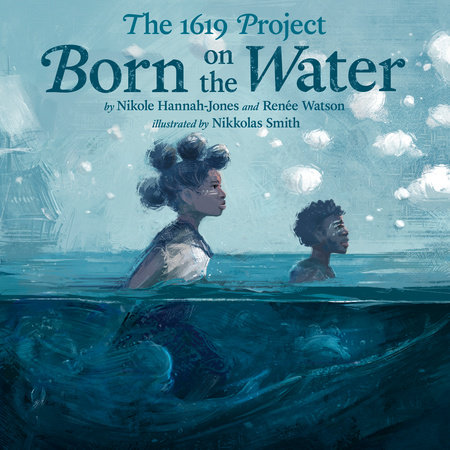
The 1619 Project: Born on the Water
written by Nikole Hannah-Jones and Renée Watson
illustrated by Nikkolas Smith
2021

This is a children’s picture book that was part of The 1619 Project and it is beautifully written, gorgeously illustrated, and addresses a difficult but vitally important topic in an age-appropriate manner.

The framing story starts with a young child being given a class assignment to write out their family tree. However, while their white peers are able to go back many generations and list which countries their families came from, this black student can only list three generations and feels ashamed. The main focus of the book is the history of that student’s family that starts with joy and culture and rich history in Africa, goes through great suffering and hardship with kidnapping and enslavement in America, but still perseveres, fights, and survives to live on in the student today. It gives a message that survival in the face of trauma is to be celebrated. Black Americans have a great deal to be proud of in their African roots and their American survival and their achievements – past, present, and future.

I’m particularly impressed with the way this book shows centuries of American slavery as the middle part of the history of the student’s ancestors. Slavery was long and harsh and transformational, but it was not the start of their history and it was not the end of it.

This is clearly intended for a young audience, but I highly recommend it for adults as well, not just for the pure artistry of the writing and illustrations, but also for the soft discussion of a difficult topic.

Who Is Ana Mendieta? by Redfern & Caron

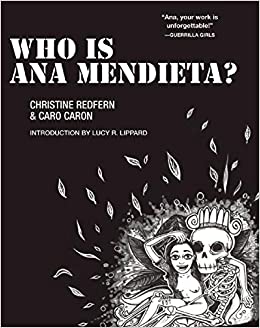
Who Is Ana Mendieta?
by Christine Redfern & Caro Caron
introduction by Lucy R. Lippard
2011

This is a relatively short but extremely full and dense graphic novel. It’s a biography of an artist, but also a window into an artistic movement, and also a true crime tragedy, and also a demonstration of how systemic prejudice works to keep a whole demographic down. The particular art styles of both the book and the art movement that it describes are not ones that I particularly enjoy (a lot of shock value and intentionally disturbing imagery), and yet, I still highly recommend the book. It was a reminder to me of what second-wave feminism was trying to accomplish and the context it was working in.

Ana Mendieta was born in 1948 in Havana, Cuba, moved to the US in 1961, and died violently in 1985 (her husband was indicted for murder three times by a jury, and acquitted three times by a judge who then sealed the records.) During her life, Mendieta was a rising star in the art world and making waves. But the book also points out that she, like so many women before her, had to be their own firsts, breaking the glass ceiling, not because there hadn’t been women before her, but because the existence of those women was and is so regularly denied. This book itself is an effort to not have Ana Mendieta suffer the same fate, not just of death but of being quietly brushed aside, leaving art history to continue as a history of male artists.

So all of this to say: this book is educational, distasteful, enraging, and important.

illustrated travelogues

These books make me yearn for the open road. I don’t really enjoy hiking and I haven’t traveled much in a while even before the whole world went into various levels of quarantine but having read/looked through these two beautiful books about traveling the countryside by bicycle and by foot, I yearn. The complete impossibility of doing this myself makes the yearning all the stronger, since it doesn’t have to confront the fact that I like my creature comforts a bit too much for camping.

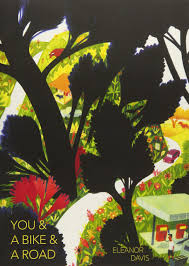
You & A Bike & A Road
by Eleanor Davis
2017

I received this book as a Christmas present in 2020 and read it within days. It’s basically a copy of the author’s sketch-pad/diary that she kept while making a cross-country bicycle trip from Tuscan, Arizona where her parents live to her home with her husband in Athens, Georgia. The pages are little illustrations of her experiences with short descriptions to show her thoughts. She’s struggling with depression and this is a way for her to get out of her head and try something new and difficult. While the main plot, such as it is, is her personal journey – both physical and emotional – it’s also dotted with stories of the people she comes across at the various resting points. As much as the journey works for Davis, it works for the reader too, to vicariously experience the weirdness, exhaustion, and exhilaration of making this attempt, and get out of my own head too.

The Fifty-Three Stages of the Tokaido
by Hiroshige
1833-1834
published by Heibonsha Ltd, 1960

I received this book for Christmas in 2019, and worked though it in its and starts over the course of a year. The 55 illustrations in this series, showing images from Edo to Kyoto with the 53 stages of the Tokaido in between, are enchanting and lure me into thinking it’s a journey I would like to take. The Tokaido is a 320-mile-long road in Japan that the governments have maintained for centuries, connecting two of the country’s major cities. This set of woodblock prints by Hiroshige romanticizes each stage of the trip – the gorgeous vistas, the exciting markets, the specialized restaurants, and even the uncertain weather – and establishes his reputation as an artist at the same time. The scenes are both gorgeous and fascinating and the way they show calm water and raging storms and mountains both near and far just makes something in my mind un-tense for a little bit.

This specific publication of the illustrations also comes with short descriptions of each which were both helpfully informative and occasionally unintentionally funny. These captions vary between describing the locations (how the stages worked and which services and resources were there), describing the subject matter (what type of people were being shown and what interactions were taking place), and describing the artwork itself (letting me know which ones I should appreciate more than others, in case I wasn’t appreciating them correctly). What I considered particularly funny was the contrast between the detailed discussion regarding exactly when a particular image was set based on the presence of famous travelers versus how casually the descriptions discuss the artistic license used with both the events being shown and even the physical geography of other images that rearranged, removed, or created whole mountains for the aesthetic. But regardless of how much or little accuracy they may have, they are all lovely and intriguing.

In a time when it’s been nearly a full year of staying in my house with a single exciting trip to a grocery store every other week, these books were a chance to imagine a freedom of movement that comes with its own pros and cons, but feels so refreshing just to think about.

Reading Through the Pandemic

So, it’s been a while. 2020, huh? I may have aged 20 years since February. Everyone hanging in there?

While I have definitely spent my share of this pandemic doom-scrolling, playing a truly astounding amount of Thirteen, and watching every episode of the Great British Baking Show again, I have actually read a fair amount. My book list from the last five months is an odd mix of romance, non-fiction, and literary best sellers as I keep trying different kind of books, looking for the perfect thing to help me either forget the world or understand what is going on around me. I don’t know that I have yet to find a book that genuinely helped on either front, but I did read some smart, touching, fun things that kept me off Twitter. It’s all I’ve got today, but I’m going to offer it to you: some books that might take you away from the current hellscape for a few minutes.

Disappearing Earth by Julia Phillips
A while back I read Reservoir 13, a novel about how the disappearance of a young girl affects the residents of a small town. It got rave reviews, but I found it deeply unsatisfying. This book is everything I had hoped Reservoir 13 would be. I also really enjoyed a peek inside life in a far-flung Russian province, including in its indigenous communities.

The Starless Sea by Erin Morgenstern
People absolutely adore Morgenstern’s first book, The Night Circus, but I thought it was just pleasant enough and Anna was even less impressed. But it’s a pandemic, I’ve got nothing but time, so I thought I as might as well tackle her second one. It’s another long, sprawling magical realism story with lots of characters and multiple time frames, but I was much more caught up in the characters and the magical world she created this time around.

The Checklist Manifesto by Atul Gawande
I made so much fun of Anna for reading this at the beach a few years ago, but she was totally right! This is a smart, readable book that provides a sense of hope that there are concrete things we can do to improve the world.

Open Book by Jessica Simpson
I know! The Jessica Simpson book! It is actually very good!

The Widows of Malabar Hill by Sujata Massey
Massey wrote a series of mystery novels about a Japanese-American woman solving crimes in modern-day Tokyo, which I liked a lot, but this book kicked of an even more interesting new series about a female lawyer working in 1920s Bombay. The story was interesting, but I was most impressed with the level of research that Massey must have done, which allowed her to create this world that felt so real, even while being so far from anything I’m familiar with.

Because Internet by Gretchen McCulloch
Have you been wanting to read a linguist discuss how people on the Internet communicate? You want to, whether you know it or not. This can get a little dense at times, but McCulloch is funny and the phenomena she describes will be familiar to anyone who has spent significant time on line over the last 25 years. Having an expert take a specific Internet language thing (a meme, an acronym, ellipses) and then explain exactly what purpose it serves actually gave me a lot of respect for how we create the forms of communications we need in real time every day.

The Alice Network by Kate Quinn
This last one isn’t cheerful, I’ll warn you, but it was compelling. I think I found this book in a round-up of WWII stories, but it actually has an interesting twist. The story follows two timelines–a female spy in France during the first World War, and then a young American girl in Europe in the years immediately following the end of the second war. Anyone who reads a lot of historical fiction ends up reading a lot of WWII stories, and that’s all fine, but they often focus exclusively on the war years and little before or after. I liked how Quinn’s story showed how close and connected the wars, and individuals’ experiences of them, were and how Europe had begun to rebuild in the late 1940s.

Agrippina: The Most Extraordinary Woman of the Roman World

Over the past few weeks, as I have been telling people how much I liked this historical biography of a Roman empress, I have gotten some very skeptical responses. And I get it–it doesn’t sound like the kind of book you might pick up for a casual read on a Saturday afternoon. But I promise, Agrippina: The Most Extraordinary Woman of the Roman World by Emma Southon is fascinating and compelling and funny and sad. Even though I knew Agrippina was not going to get a happy ending, I was still reading along as fast as I could, desperate to know what happened to this incredible woman who lived 2000 years ago.

The basic facts: Agrippina was the great-granddaughter of the emperor Augustus, and spent decades at the center of the imperial family and of Roman politics–she was Caligula’s sister, Claudius’s wife, and Nero’s mother. Her life was shot through with tragedy (imperial family disputes had a tendency to get bloody) but also with glory and ambition. Historical information about her is limited, since Roman writers only occasionally even bothered to mention women, so a lot of the book is Southon explaining what sources do mention Agrippina, and what we can assume in places where the historical record is silent. Southon (who is also lots of fun on Twitter @nuclearteeth) also does a really excellent job of both making sure that we remember that Agrippina was a real person with fears and loves and emotions, while also making it clear that Agripppina lived in an entirely different culture and time. For example, when discussing Agrippina’s first marriage, Southon talks about how disturbing she finds it that the 13-year-old bride was married to a man more than twice her age, but also makes the point that we really have no way of knowing how a Roman princess would have thought about this.

Southon is also really funny, and that’s what really makes this book stand apart. Yes, it’s a very detailed, academic history book that is rigorous in the treatment of its primary sources. But it’s also like hearing a snarky friend gossip about people you know. She calls Caligula “subtle as a brick,” says that Agrippina’s first husband was “a dick,” and is entertainingly exasperated with the Roman habit of giving everyone some variation of the same four names. It makes the book so readable, and helps bring the historical figures to life.

One final note: in the UK, where this was initially published, the title was Agrippina: Empress, Exile, Hustler, Whore which is way more fun! I guess us Americans can’t handle that level of excitement in our history.

Kinsey’s Three Word Review: Tragic, yet funny.

You might also like:  For some more educational history enhanced by dry humor, check out A Short History of Nearly Everything by Bill Bryson, or any of Sarah Vowell’s historical books–I particularly like Assassination Vacation and Unfamiliar Fishes.

Graphic novels on systematic oppression

I was in a mood the last time I was at the library and these are the three other graphic novels I got along with Freedom Hospital, and all of them are about dealing with systematic oppression. Not necessarily successfully, but trying to. They are none of them cheery.

RunforitRun For It: Stories of slaves who fought for their freedom
by Marcelo D’Salete
2017

There’s four chapters, telling four somewhat interlinked stories of black resistance to slavery in Brazil. And it’s just heart-breaking. Individuals could and did fight for their freedom, but unlike a game of tag, there was no home base, no safety or home free. There was just constant risk of staying, even greater risk of trying to leave, and no alternatives.

And trying to organize for a rebellion against the structure itself was just more courting death.

It also really shows how slavery-based societies actively promote viciousness and suppress empathy, among everyone involved, slave owner and slave alike. And possibly the greatest rebellion that the slaves managed to (sometimes) win, was to maintain a sense of worth to their own lives and the lives of their loved ones.

girlcalledechoA Girl Called Echo, Vol. 1: Pemmican Wars
by Katherena Vermette, Scott B. Henderson, and Donovan Yaciuk
2017

This a beautifully done YA comic about Echo, who has been placed in a new school and a new foster care house. In school, she’s learning the history of the Métis, the local indigenous tribe, from which she is descended but not raised with. She’s in a position where she doesn’t fit in with the people around her or even with the people who should have been her people, but about whom she doesn’t know anything.

But in an odd experience that comes with no explanation (in this volume, at least) she is transported back in time, for short periods, to the era that her modern history class is talking about. And that’s where she makes what looks like her first a friend, Marie, a young Métis girl. But Marie is experiencing the time that Echo is learning about in school: the series of conflicts between Métis and colonists that largely destroyed the Métis way of life.

veraxVERAX: The True History of Whistleblowers, Drone Warfare, and Mass Surveillance
by Pratap Chatterjee and Khalil
2017

Pratap Chatterjee is a journalist and the graphic novel follows his years-long investigation into governmental mass surveillance and drone warfare. So the slow start and surprisingly long time it takes to get anywhere might be a realistic portrayal of the frustration of the investigation but it makes for a book that spends the first half alternating between victims speaking about their loved ones being killed in drone attacks and Chatterjee speaking about his editor not properly appreciating his nose for a story. Chatterjee does not look good in the comparison.

That said, about two thirds of the way through, it starts to pick up with Edward Snowden’s whistleblowing. At that point the story shifts from following an investigation to explaining the implications of the information found, and that was much more interesting.

VERAX brought up two things that I hadn’t given much thought to before:

First:

That unmanned drones are not actually unmanned: they have a crew of 180 people stationed around the world, keeping them in the air, flying them, analyzing the data, examining the video feed, and making the calls to fire. It means that Air Force enlisted kids right out of high school and sat them down in front of screens with crappy surveillance video (this is not the high def videos shown in the movies) and has them watch the grainy videos of people dismembered and dying from the missiles they helped launch. Rates of PTSD among drone pilots who never leave their offices is amazingly high.

My dad used to say, “be careful what you put into your head, because you can’t always get it out again.” Some knowledge is important to have, and certainly worth the pain of being a third party witness. But sometimes it is just too much: I can’t imagine spending years watching those videos live.

Second:

While mass surveillance is an invasion of privacy and terrifying in how pervasive it is, it is almost equally terrifying how rife with errors it is. It’s bad data and the government is making life-or-death decisions based on this data. That’s why there are so many civilian casualties by a method that is supposed to be created specifically to avoid them. Because how often have you called a wrong number or gotten a call from someone trying to reach someone else? Maybe it’s an old phone number of maybe a 5 got misread as a 6, or a 1 as a 7.

It’s full of bad data, such that a good third of the drone strikes were made on the wrong targets. And the institutions making use of the data tend heavily towards confirmation bias. Ie, if they’re looking for a weapon and they see someone in a person’s hands, that’s evidence that they have a weapon. As opposed to looking at someone carrying something and considering how many other things they could be carrying: a glass of water, a baby, a bag of skittles. No matter how smart you are, no matter how dedicated, you cannot make good decisions based on bad data.

But overall, as a book, it was a slow start that finished with a lot of ideas and was very thought provoking.

I recommend all three books, but they are draining as they show how hard and yet necessary it is to maintain hope.

What She Ate

Current events at the moment seem specifically designed to fill me with rage, so at this point I am generally looking for escape in the books I read. I thought that What She Ate by Laura Shapiro–described as a look inside the lives of six famous women by examining the food they ate–would be a fun discussion of snacks and baking. In fact, what Shapiro actually did was highlight how the patriarchy has devalued the experience of women throughout history. So reading this did not help with my rage! But it was a completely absorbing, fascinating book.

Shapiro writes a chapter each on six famous women, using their own writings and primary historical sources to tell both their individual story and highlight some element of the time they lived in:

  • Dorothy Wordsworth, the sister of poet William, kept house for her brother in the Lake District until he married and struggled to find her place in 17th century English society as an unmarried woman.
  • Rosa Lewis, a famous caterer in Edwardian England used food to, if not defeat the English class system, then at least to make herself a good life within it.
  • Eleanor Roosevelt apparently pretty actively supported terrible food in the White House for a variety of reasons, but at least part of it being because she had (and wanted everyone to know she had) bigger things to worry about.
  • Eva Braun’s insane relationship to food and illustrated a tiny corner of the Nazis’ insanity and hypocrisy.
  • Barbara Pym was a brilliant author whose stories of domestic life offered a window into the world of middle-class post-war England.
  • Helen Gurley Brown, the famously skinny editor of Cosmopolitan who was trying to navigate the ever-changing role of women in the workplace and mostly just seems to have ended up torturing and denying herself at every turn.

Each woman’s story was interesting, but Shapiro also uses the book to make a larger point about how what is considered “important history” has long been determined by men. Food is enormously important to everyone–we all think about food all day!–but because food was traditionally women’s business, history rarely takes it into account. Literature, as well. Shapiro describes how the journal that Dorothy Wordsworth kept in the Lake District has long been considered only in terms of the insight it could offer into her brother’s poetry, but is actually a significant historical and literary document in and of itself. Apparently the fact the she talks about what she plans to make for dinner somehow negates it’s worth. This book is a huge step towards insisting that food be seen as an important element of history itself, as well as a tool for examining larger cultural forces.

I should also say that although each of these stories was engaging to read, most of them were not particularly happy. Perhaps that is just the fate of being a smart woman in most any period in recent history, but quite a number of these stories ended sadly. The only two women that I might consider swapping places with would have been Rosa Lewis and Barbara Pym–maybe because they were women least interested in fitting themselves into traditional roles and most willing to follow their own paths, regardless what anyone thought.

Kinsey’s Three-ish Word Review:  Sneakily-radical history via food

You might also like:  Each of the stories here made me want to track down more info on the person profiled (except for Helen Gurley Brown, she seems awful) and Barbara Pym is a goddamn genius so I obviously recommend that everyone go read her work. But if you’d just like to read something about fun that revolves around food, the novel Kitchens of the Great Midwest is lovely. And while I know it isn’t universally beloved, I really adore Julie and Julia by Julie Powell and I think she does a good job of discussing how Julia Child thought about food and how it impacted her life.


Dear Mrs. Bird

51-Gwr6g5jL._SX329_BO1,204,203,200_

I am an absolute sucker for books about the Blitz. Something about the combination of London, historical fiction, the drama of WWII–I will read just about anything the features the word “Blitz” in the blurb. And I’m clearly not the only person who feels this way, since these books continue to get published. The new Dear Mrs. Bird by A.J. Pearce fits nicely into my favorite sub-category of this genre–women in the Blitz–while adding some layers I haven’t often seen.

Emmie is a young woman living in London in the early days of WWII. She works part-time as a fire dispatcher, but dreams of being a reporter and is thrilled to get a job at a magazine, sure she is on her way to be an intrepid war correspondent. However, it turns out that she is mostly doing typing at an old-fashioned ladies’ magazine whose editor won’t answer any sort of reader questions that deal with any “Unpleasantness.” Of course, there’s a war on and life is complicated, so Emmie ends up reading lots of letters from readers with serious problems, and can’t bear to think that they won’t get any response. She she starts responding and well, hijinks ensue.

Now, the basic plot here requires that Emmie spends a lot of time worried about being caught and worrying about what will happen when she does, and that is one of my least favorite things to read–I find that completely agonizing and by the end of the book was almost skimming scenes in her office for fear of what was going to happen. What saved the book for me were Emmie’s experiences outside work, where she and her best friend attempt to live their 20-something lives in the middle of a war. More than most Blitz books I’ve read, Dear Mrs. Bird gets across the feeling that yes, terrible things were happening, but that for those people living in the middle of the bombing, it became normalized. Emmie and her friends have to view the nightly bombings and tragedies as just another irritation to deal with, like bad traffic, in order to live their lives. And when you’re twenty-two, something like getting dumped is likely to feel like a much bigger deal than the war. And yet, at the same time, the book takes on the issue of how the internal and external pressure to keep the famous British “stiff upper lip” was hard on people, and how sometimes even the most patriotic Londoner needed to acknowledge the toll the constant bombing took on them.

There’s also just a bit of romance, although I couldn’t help but feel that Emmie might have landed in the wrong place there–I’m holding out hope that there might be a sequel featuring my favorite character, Emmie’s long-suffering boss at the magazine. He’s in his forties and spends most of the book rolling his eyes at Emmie’s adventures and the rest of the world, and I found him completely charming. And I’m sure that has nothing to do with the fact that this is the role I would most likely be playing in this story.

Kinsey’s Three-ish Word Review:  The Guernsey Literary and Potato Peel Pie Society meets Bridget Jones.

You might also like:  Well, obviously, The Guernsey Literary and Potato Peel Pie Society and the Bridget Jones books. But also a book I rave about a lot called The Lost Art of Keeping Secrets or another adorable one called Miss Buncle’s Book. And if you’re looking for a little period escapism with a lot of charming young British ladies falling in love, Mary Stewart basically perfected post-war romantic suspense and I read through all her work as a teenager–my favorites of hers were always Touch Not the Cat and Nine Coaches Waiting.

And if, like me, you’d just like to read some more books about the Blitz, Connie Willis’s Blackout and All Clear are epics that also involve time travel. I also love Life After Life by Kate Atkinson, The Night Watch by Sarah Waters, and The Distant Hours by Kate Morton. And in other media, check out “The Stolen Child” and “The Doctor Dances” episodes of Doctor Who and the movie Hope and Glory.

The Essex Serpent

61U76uN5PHLI was in London earlier this summer and the book of the moment, the book piled up in store displays and advertised in posters around town, was The Essex Serpent by Sarah Perry. I was worried that this would be another of those Kinsey Tells You About an Already Wildly Popular thing entries, but I haven’t heard much about The Essex Serpent here in the U.S., which is a shame, because it’s really quite a good book.

I suppose you could call this a neo-Victorian novel–it’s set in England in late 1800s, and focuses on a woman named Cora. Her husband has just died–not a terribly sad occasion for her–and being a widow has allowed her the freedom to start walking the marshes and looking fossils and getting muddy and generally ignoring nice society. In the course of all this she meets the vicar of a small town on the English coast and they strike up a friendship, which is at least partly based on Cora’s interest in rumors of a sea monster (the Essex Serpent) that has been plaguing the town. What will this relationship bring? Will they ever find the serpent?

This description makes it sound like plot-driven, exciting tale! But it’s not, really–it’s not a romance, and it’s not a supernatural mystery/adventure. The basic plot description doesn’t account for how the story’s point of view moves from character to character, not only Cora and the vicar, but also their children, the vicar’s wife, and a doctor friend of Cora’s, among others. The book is really a character study, illuminating the inner lives of a variety of people that, for various reasons (gender, class, intelligence), are marginalized or limited within society.  Plus, the tiny villages and marshes of English seaside basically serve as one of the characters, giving the whole book a sort of damp, salty feeling to it. All this makes it seem odd, honestly that this is such a book of the moment in England–it’s about as far from The Girl on the Train as you could get, but it’s a lovely book and I’m glad it’s gotten so much attention. The cover is also just gorgeous.

Kinsey’s Three Word Review: Atmospheric Victorian tale

You might also like: The Historian or The Thirteenth Tale; or Kate Morton’s books, including The House at Riverton; or Sarah Waters’s books, especially Fingersmith.