Crooked Letter, Crooked Letter

By Tom Franklin

So, it has been a bit of a rough couple of weeks—holidays are looming and my company has some restructuring coming up—but I will say that Crooked Letter, Crooked Letter is a good book to help you get some perspective on life.

I am stressed about getting all my work and Christmas shopping down, but I am not a poor black boy or a painfully shy white nerd trying to get by as an outsider in the deep South…Oh, wait. I was a painfully shy white nerd in Texas only about 10 years after this book takes place. (Although Austin, though less liberal then than it is now, was still a damn sight more liberal than rural Mississippi, and the mid-90s were just  generally more liberal than the mid-80s, so it’s a bit of a cheap comparison.)

Still, there were several details that did actually remind me of my own adolescence. Very minor spoilers follow:

Continue reading

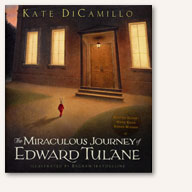
The Miraculous Journey of Edward Tulane

By Kate DiCamillo

Oh, Lord, this book! I knew I shouldn’t read it. When Kinsey mentioned it previously, comparing it to The Velveteen Rabbit, I even commented that considering how affected I was by The Velveteen Rabbit, I was going to steer clear of Edward Tulane.

Then, I was browsing in a used bookstore, saw a copy, and figured I’d just read the first few pages to see what all of the fuss was about. 20 minutes later, I was almost halfway through (it is a young readers book with large, well-spaced type) and realized that I had better put it down if I wanted to avoid embarrassing myself by crying in the middle of the bookstore.

The next day I checked it out from the library, waited until I had an evening to myself, and sobbed my way through the second half. And I mean really sobbed, not just tearing up or anything. Now, honestly, I think it is probably more hard-hitting for adults than children, since most children won’t completely resonate with the theme of losing people you love and learning to love again.

But if I were a parent, I don’t know that I could get through reading it to my child without completely embarrassing myself all over again. So, there’s that. Read it, but carve out a time and place to curl up by yourself and think about life and love afterwards (and get some eye drops in order to disguise red, puffy eyes).

[When googling for a photo of the cover, I ran across this review, which I think has a very good analysis, but with spoilers.]

—Anna

Christmas Reads

Now that Thanksgiving is over I can officially start one of my annual holiday traditions: the rereading of the Christmas books. I don’t tend to decorate much, but there’s a certain set of books that makes it feel like Christmas to me.

Miracle and Other Christmas Stories by Connie Willis
I am alternatively thrilled and aggravated by Connie Willis. To Say Nothing of the Dog is one of my favorite books, but Blackout and All Clear were interminable (this does not mean that I didn’t cry at the end, because I totally did). But I adore this book of Christmas short stories and read it every year. Each story has at least a hint of science fiction about them, but the stories span the range of emotions. There’s a romantic comedy that involves aliens invading at Christmas and a haunting thriller about three modern-day wise men driving across the U.S. in a blizzard. In my favorite story, Mary and Jesus accidentally stumble through time into a modern day church during Christmas preparations, and a busy mom has to help them get back to Bethlehem. Plus, the forward to the book includes Willis’s own list of favorite holiday books and movies.

The Lost Art of Keeping Secrets by Eva Rice
This one is not overly Christmas-y–although it does feature a Christmas scene–but  for some reason it puts me in a cozy, holiday state of mind. Perhaps because the story about British teenagers in the 1950s is so pretty and candy-colored that it feels like a fairy tale. I’ve read about a trillion books set in WWII England, but hardly any about the generation that came of age immediately after the war, so this offers a slightly different perspective.

Olive, the Other Reindeer
Yes, it’s a kids’ book, but it’s got a small dog! Named Olive! It’s just charming.

Comfort and Joy by India Knight
This just came out last year, but it immediately earned a permanent place on my list of holiday books. There’s not a lot of plot here, it’s just the story of a modern-day, many-branched English family trying to sort out how to celebrate Christmas. I adore India’s blog and love following her on Twitter because her writing makes you feel like you’ve just sat down with her to have a cup of tea and tell scandalous stories about all your mutual friends. This book feels exactly the same way and is full of all sorts of wonderful family and holiday details. I had to order mine from Amazon.co.uk last year, but now you can can get a nice, affordable American version.

Also, I think all of us would happier people if we all rewatched While You Were Sleeping during this time of year.

The Shining (Part III)

Cover Image: The ShiningAlright, I know this is shamefully late, but here is the rest of the book in one long dump. I’m just so, so grateful to be done and moving on to other books!

Maybe I haven’t been giving Stephen King enough credit; perhaps he has been realistically recreating for the reader the sensation of being stuck in a miserable hotel for months on end with horrible people.

Anyway, here’s the final installment of my journal through The Shining (with spoilers, of course):

Continue reading

The Shining (Part II)

Cover Image: The ShiningI’m halfway through the book now, and this is the point where I’ve started fantasizing about the light, funny book that I’ll read next, with characters I actually like and am interested in. I’m even starting to wish I’d chosen a different Stephen King book, though still not The Stand. Here’s my the blow-by-blow account of the second quarter of the book, with spoilers:

Continue reading

The Leftovers

In my last post I talked a bit about how hard it can be to find books that have elements of fantasy of science fiction, but are not cheesy genre fiction. By all accounts, Tom Perrotta’s The Leftovers should be exactly my kind of book. Perrotta is a well-respected literary author probably most famous for Little Children, which was made into a move with Kate Winslet and Patrick Wilson. (Topic for another day: while I liked Little Children, as far as I can tell, the only reason it wasn’t classified as chick lit is that it was written by a man. Had the author been named Tara Perrotta, I bet you money that thing would have had a pink cover. Possibly featuring shoes.) In The Leftovers, Perrotta is still focused on normal, middle American families, but he’s put a slightly supernatural spin on this time. Several years before the events of the book take place, a significant number of the earth’s population disappeared—vanished in an instant. While many people assume this was the Rapture, plenty of non-Christians disappeared as well, and nothing has happened since that day to provide any additional information.

It’s an intriguing concept and I was interested in reading a book that deals with a Rapture-like event without being overbearingly religious (in other words, not the Left Behind books). And the book does an excellent job of portraying what might really happen in this situation. Some people assume the world is ending and turn to religious cults, some lose their faith entirely, and some do their best to move forward and not think about it too much. (I would definitely be in that last category.)

But the thing is, this book really isn’t about the disappearance. It’s about normal, middle-class American families in a small town: people get together, people break up, a teenager makes a friend who might not be a good influence. Okay, there is a very creepy Doomsday cult involved, but even that comes off less as science fiction and more like a plot line about someone joining a strict new church. And the characters, even the ones in the cult, don’t even discuss the disappearance much at all. The Rapture wasn’t even necessary—using another significant disaster or trauma wouldn’t have caused that many changes in the book.

Perrotta is known for his detailed descriptions of emotional turmoil under the surface of normal life, and the book definitely does that well. I would have no issues recommending the book to someone like my sister, who hates science fiction books and doesn’t read them at all. But for me, there was a lot less supernatural excitement than I was expecting or hoping for. On the continuum of realistic to fantastical, The Leftovers falls too much on the everyday-life side of things for me.

The Shining (Part I)

Cover Image: The ShiningOoh, you guys are in for a treat (you are not in for a treat). This is perhaps the longest book review in the history of books! It is not as long as The Shining itself, only because that book is very, very long (it’s not actually hugely long, but it sure does read like it is).

I’ve always thought that I just don’t like Stephen King’s books, but to date, I’ve managed to only read his two most commonly disliked books, Dolores Claiborne and Thinner (actually I only read the first third or so of Thinner). Fans assure me that I need to retry King with one of his more famous works. In fact, several people have recommended The Stand, since it takes place in Boulder, but I’m not reading a 1000+ page Stephen King book.

This year for Tom’s* birthday I made us reservations for a night at The Stanley Hotel, where King was staying when he was inspired to write The Shining. (They also play the Jack Nicholson version on loop on one of the tv channels, leading me to rewatch it and scare the bejeesus out of myself on what was supposed to be a romantic weekend.) Watching Shelley Duvall sob and shriek her way through the movie, I was curious as to whether the novel has more nuanced characters, and decided to give it a shot.

Since The Shining is definitely going to take me more than a week to read, I thought I’d give semi-live-blogging a shot. This is a journal of sorts of my progress (absolutely with spoilers):

*I related a story to Tom in which I referred to him as “the dude I live with,” to which he took some exception. However, Tom is the dude I live with.

Continue reading

A Discovery of Witches

This is not exactly my proudest admission, but the number one place I get my book recommendations is the Entertainment Weekly Books section. It may not be the New York Review of Books, but EW’s book section tends to include a good mix of literary fiction, genre fiction, and nonfiction, and the reviews generally manage to assess the book without giving away the whole plot. They also tend to be pretty stringent with their grading–they have no issues giving C or D grades to big names or wildly-praised books such as Run by Ann Patchett  or Mr. Peanut by Adam Ross. Which is why I was excited to read their review of A Discovery of Witches by Deborah Harkness. EW gave it a B+ and the review made is sound like a solid, well-written book with believable characters that just happened to feature witches and vampires–in other words, exactly the sort of urban fanstay based in the modern-day world that I love.  I knew going in that it wasn’t Faulkner, but I had high hopes that I might have found another genre book that incorporates the supernatural while not being trashy or badly written. Which is why I was a little dismayed to realize that it was basically Twilight for grown-ups.

Without giving too much away, the basic plot is that witches, vampires, and daemons are all real, but they live fairly normal lives alongside oblivious humans. (Side note: is it just me, or did the His Dark Materials series pretty much take over that spelling of daemon?) Diana is witch, part of powerful and famous witch family, who is trying to distance herself from her powers by living a quiet life as a graduate student at Oxford. Then she accidentally does something that attracts the attention of the supernatural community, she meets a dangerous yet irresistible vampire named Matthew, and her whole life starts racing away into adventure, danger, romance, etc.

Here are my three main issues with this book:

1) The lead character falls totally, immediately, and completely in love with a vampire, despite his vampiric nature, in exactly the same way Bella does in Twilight. In an adolescent this is annoying, but somewhat understandable and forgivable. In a grown-ass woman, it just seems like bad decision making.

2) The book is 592 pages long and it ends on a cliff hanger. After I read the book I learned that it’s the first in a planned trilogy. Look, I love a good book series, but I also pretty firmly believe that individual books should stand alone. Sure, plot threads may carry from one book to another, but it makes me grumpy when a book just stops in the middle of things. I like to think of a book as an entity both physically and in terms of the story telling. If the author can’t figure out how to make a single book at least somewhat satisfying and functional in and of itself, I start losing trust in them. (See also: Blackout and All Clear by Connie Willis.)

3) The witches and vampires and daemons in Oxford all go to a special hot yoga class together. HOT YOGA.

Don’t get me wrong, I read it and enjoyed most of it and it was definitely better written than Twilight.  I suspect I’ll read the next one, if only to figure out what happens next since there was certainly no closure in this book. And there were some lovely parts–Diana’s family has a haunted house that is both creepy and considerate (creating new rooms when company is coming), and the descriptions of Oxford make me want to book a trip there–but I just feel like I need to warn other people who might be looking for more literary fantasy. Twilight for grown-ups.

But I hear good things about the new Colson Whitehead zombie book Zone One. His book The Intuitionist managed to be beautiful and heart-breaking and thrilling while describing an alternate reality in which elevators are glorified, so right now he’s got my trust. (Yes, elevators. And it’s about racism. It’s great.)

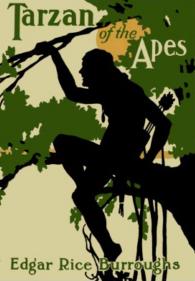
Tarzan of the Apes

Tarzan of the Apes cover imageTarzan of the Apes
written by Edgar Rice Burroughs
(1912)

Reading Tarzan of the Apes proved to be an experience.

I don’t know when I first heard the story of Tarzan. I assume that I acquired it from the aether of having grown up in a well-read household. It is a fun archetype: A child, orphaned and abandoned far from humanity, is raised in the wild by animals and grows up strong and clever.

The Jungle Book by Rudyard Kipling, written in 1894, has the same basic premise. There are a number of more recent books with the same premise, although they tend to add telepathic communication to the mix. I’d watched movies and cartoons of these classic stories, and read reworkings of the archetype many times before I ever got around to reading Tarzan of the Apes, as written by Edgar Rice Burroughs in 1912.

I don’t consider myself an easily offended reader, and I wasn’t even offended, precisely, by reading this book. Astounded, maybe. Appalled. Intrigued in the way of watching a train wreck. It is, I think, the single most prejudiced book I have ever read. If there’s a prejudice you can think of, it’s in there.

Sexism: check!
Racism: check!
Nationalism: check!
Classism: check!

Continue reading

Our Tragic Universe

Scarlett Thomas wrote PopCo, a fascinating book that I loved and have given to loads of people as a gift. It is full of intricate dialogue and detail, but a mystery at the heart of the story constantly drives the plot forward. However, her follow-up book, The End of Mr. Y, felt like chore to read. It consisted of page after page of characters talking about possibilities and consciousness and reality.  I kept losing interest and skimming over huge sections of philosophical musings in an effort to figure out when something would actually happen. So I was dubious when a friend loaned me Thomas’s latest, Our Tragic Universe to read while at the beach this summer. I can handle some musings on the nature of the universe when it’s cold and gray outside, but not when I’m relaxing in a beach chair. But I really enjoyed Our Tragic Universe, not because Thomas returned to a more plot-driven format, but because she fully committed to “the storyless story.”

The plot of the book, such as it is, centers on a young woman living with her (completely useless and aggravating) boyfriend in a small town on the English coast. She spends her time writing genre books, avoiding working on the serious novel she wants to write, and thinking about various New Age-y, self help-y concepts. Things meander along for a while, with various characters having conversations and eating meals and occasionally making decisions about where to live or what job to take or whether to have lunch with someone or not.

There’s no grand dramatic arc. There’s no great rise and fall of action. I was at least 200 pages in before I realized that the tragedy or accident or other major incident I was bracing myself for was never coming. Reading the book was remarkably like listening in on the day-to-day activities of some very smart, thoughtful people who occasionally make some dumb decisions.  And while this is not typically the kind of thing I would enjoy—in general, I say that if you can make things up you should go ahead and make up some excitement and some closure—Thomas writes about her characters with such detail and such care that I was completely drawn in. Our Tragic Universe treats the minutia of its characters’ lives with the same respect that we treat the details of our own lives.