A Discovery of Witches

This is not exactly my proudest admission, but the number one place I get my book recommendations is the Entertainment Weekly Books section. It may not be the New York Review of Books, but EW’s book section tends to include a good mix of literary fiction, genre fiction, and nonfiction, and the reviews generally manage to assess the book without giving away the whole plot. They also tend to be pretty stringent with their grading–they have no issues giving C or D grades to big names or wildly-praised books such as Run by Ann Patchett  or Mr. Peanut by Adam Ross. Which is why I was excited to read their review of A Discovery of Witches by Deborah Harkness. EW gave it a B+ and the review made is sound like a solid, well-written book with believable characters that just happened to feature witches and vampires–in other words, exactly the sort of urban fanstay based in the modern-day world that I love.  I knew going in that it wasn’t Faulkner, but I had high hopes that I might have found another genre book that incorporates the supernatural while not being trashy or badly written. Which is why I was a little dismayed to realize that it was basically Twilight for grown-ups.

Without giving too much away, the basic plot is that witches, vampires, and daemons are all real, but they live fairly normal lives alongside oblivious humans. (Side note: is it just me, or did the His Dark Materials series pretty much take over that spelling of daemon?) Diana is witch, part of powerful and famous witch family, who is trying to distance herself from her powers by living a quiet life as a graduate student at Oxford. Then she accidentally does something that attracts the attention of the supernatural community, she meets a dangerous yet irresistible vampire named Matthew, and her whole life starts racing away into adventure, danger, romance, etc.

Here are my three main issues with this book:

1) The lead character falls totally, immediately, and completely in love with a vampire, despite his vampiric nature, in exactly the same way Bella does in Twilight. In an adolescent this is annoying, but somewhat understandable and forgivable. In a grown-ass woman, it just seems like bad decision making.

2) The book is 592 pages long and it ends on a cliff hanger. After I read the book I learned that it’s the first in a planned trilogy. Look, I love a good book series, but I also pretty firmly believe that individual books should stand alone. Sure, plot threads may carry from one book to another, but it makes me grumpy when a book just stops in the middle of things. I like to think of a book as an entity both physically and in terms of the story telling. If the author can’t figure out how to make a single book at least somewhat satisfying and functional in and of itself, I start losing trust in them. (See also: Blackout and All Clear by Connie Willis.)

3) The witches and vampires and daemons in Oxford all go to a special hot yoga class together. HOT YOGA.

Don’t get me wrong, I read it and enjoyed most of it and it was definitely better written than Twilight.  I suspect I’ll read the next one, if only to figure out what happens next since there was certainly no closure in this book. And there were some lovely parts–Diana’s family has a haunted house that is both creepy and considerate (creating new rooms when company is coming), and the descriptions of Oxford make me want to book a trip there–but I just feel like I need to warn other people who might be looking for more literary fantasy. Twilight for grown-ups.

But I hear good things about the new Colson Whitehead zombie book Zone One. His book The Intuitionist managed to be beautiful and heart-breaking and thrilling while describing an alternate reality in which elevators are glorified, so right now he’s got my trust. (Yes, elevators. And it’s about racism. It’s great.)
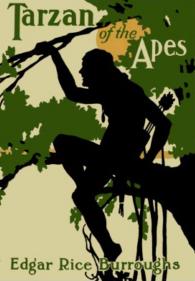
Tarzan of the Apes

Tarzan of the Apes cover imageTarzan of the Apes
written by Edgar Rice Burroughs
(1912)

Reading Tarzan of the Apes proved to be an experience.

I don’t know when I first heard the story of Tarzan. I assume that I acquired it from the aether of having grown up in a well-read household. It is a fun archetype: A child, orphaned and abandoned far from humanity, is raised in the wild by animals and grows up strong and clever.

The Jungle Book by Rudyard Kipling, written in 1894, has the same basic premise. There are a number of more recent books with the same premise, although they tend to add telepathic communication to the mix. I’d watched movies and cartoons of these classic stories, and read reworkings of the archetype many times before I ever got around to reading Tarzan of the Apes, as written by Edgar Rice Burroughs in 1912.

I don’t consider myself an easily offended reader, and I wasn’t even offended, precisely, by reading this book. Astounded, maybe. Appalled. Intrigued in the way of watching a train wreck. It is, I think, the single most prejudiced book I have ever read. If there’s a prejudice you can think of, it’s in there.

Sexism: check!
Racism: check!
Nationalism: check!
Classism: check!

Continue reading

Our Tragic Universe

Scarlett Thomas wrote PopCo, a fascinating book that I loved and have given to loads of people as a gift. It is full of intricate dialogue and detail, but a mystery at the heart of the story constantly drives the plot forward. However, her follow-up book, The End of Mr. Y, felt like chore to read. It consisted of page after page of characters talking about possibilities and consciousness and reality.  I kept losing interest and skimming over huge sections of philosophical musings in an effort to figure out when something would actually happen. So I was dubious when a friend loaned me Thomas’s latest, Our Tragic Universe to read while at the beach this summer. I can handle some musings on the nature of the universe when it’s cold and gray outside, but not when I’m relaxing in a beach chair. But I really enjoyed Our Tragic Universe, not because Thomas returned to a more plot-driven format, but because she fully committed to “the storyless story.”

The plot of the book, such as it is, centers on a young woman living with her (completely useless and aggravating) boyfriend in a small town on the English coast. She spends her time writing genre books, avoiding working on the serious novel she wants to write, and thinking about various New Age-y, self help-y concepts. Things meander along for a while, with various characters having conversations and eating meals and occasionally making decisions about where to live or what job to take or whether to have lunch with someone or not.

There’s no grand dramatic arc. There’s no great rise and fall of action. I was at least 200 pages in before I realized that the tragedy or accident or other major incident I was bracing myself for was never coming. Reading the book was remarkably like listening in on the day-to-day activities of some very smart, thoughtful people who occasionally make some dumb decisions.  And while this is not typically the kind of thing I would enjoy—in general, I say that if you can make things up you should go ahead and make up some excitement and some closure—Thomas writes about her characters with such detail and such care that I was completely drawn in. Our Tragic Universe treats the minutia of its characters’ lives with the same respect that we treat the details of our own lives.

The Anastasia series by Lois Lowry

When Anna suggested that we each write something for Banned Books Week, she sent me to the ALA site that lists the most-frequently challenged books. Those lists are topped by the expected things (Harry Potter, Judy Blume, etc.) but number 75 on the Top 100 Banned/Challenged Books 2000-2009 shocked me: the Anastasia series by Lois Lowry. I LOVE Anastasia Krupnik! I wanted to BE Anastasia Krumpnik! How could anyone object to Anastasia! I could not remember a single thing about any Anastasia book that I could imagine anyone objecting to. But it had been quite a while since I had read them so, while I didn’t have time to reread all six of the Anastasia books that I own, I did pull them all out and glance through them. (This was harder than it should have been, since a couple of years ago I followed an Internet trend and arranged all the books in my bookcase by color. People always ask me if it makes it hard to find my books and I always say no, but this is a lie. It does. Did you know that each of the Anastasia books is a different color? Assembling them all took a while. Take my advice and don’t arrange your books by color, no matter how cool it looks.)

As a quick overview, the Anastasia series consists of nine books that follow the adventures of a girl named Anastasia Krupnik, who lives in Boston with her parents and her little brother Sam. And when I say “adventures,” I mean things like having to do a science fair project and having her best friend go away to summer camp. These are low-drama books. However, looking through them, I was reminded of what I loved so much as a child about the books: Anastasia was smart. She wasn’t always right, but she was always thinking and planning and having ideas, and her (slightly neurotic) inner life seemed to more closely resemble my own than that of most kids’ book characters. Looking through them now as an adult, I can also see more clearly that while Anastasia is smart, she is still a kid and is still making some of the crazy of leaps of logic and wild decisions that kids make. In my favorite of the books, Anastasia On Her Own, thirteen-year-old Anastasia is in charge of the house while her mother is away on business and decides (for a variety of reasons) to cook a dinner that includes Ragout de Veau aux Champignons (I like to imagine this was a Julia Child recipe). Anastasia uses some fairly creative problem-solving and does manage to successfully cook the dish, but the dinner itself turns into a disaster. The whole situation ends up being absurd, in the way that a thirteen-year-old’s decisions are absurd. And yet, I can also see myself ending up in the same situation at that age.

According to Wikipedia, these books have been challenged because of “references to beer, Playboy Magazine, and a casual reference to a character wanting to kill herself.” This makes me wonder if the people who are apparently out there complaining about these books today have read ANY of the dark young adult fiction that has come out in the last ten years. Which is not to say that I think that books that actually show children DRINKING beer, rather than just referencing it, should be banned. (I think it’s safe to say that I am against book banning in general.)  I actually think that the fact that books as innocent as these end up on the list makes it easy to dismiss people who try to get books pulled. They come off seeming like crackpots for complaining about nothing and I don’t even bother taking them seriously. But, we should take them seriously, because sometimes they succeed. And it make me sad to think that some smart, neurotic girl out there might not get to read an Anastasia Krupnik book because one of the characters has the nerve to discuss a Playboy magazine.

So, in conclusion, banning books is bad and Anastasia Krupnik is awesome, and it is ridiculous to me that the two even have to be in the same sentence. Also, Wikipedia tells me that an Anastasia book came out in 1995. Considering that I was 20 in 1995, I’m fairly sure that I haven’t read that one yet, and will need to make a trip to my library soon. Yay for more Anastasia!

Lord of the Flies

Banned Books Week (Sept. 24-Oct. 1, 2011)In high school, I had an excellent English teacher, Mrs. Fort. She was tough with students and passionate about her job. Every year she had to do battle with the conservative Texas school board. Because of her, I was able to read and discuss Mark Twain’s Huckleberry Finn and Ralph Ellison’s Invisible Man in a classroom setting. However, she wasn’t able to win every fight.

On graduation day, the Valedictorian gave a speech criticizing censorship in our schools, and mentioned both William Golding’s The Lord of the Flies and Ray Bradbury’s The Martian Chronicles as books that got cut from our reading lists. Before I fell asleep (I was the second person across the stage in a graduating class of 400), I determined that I would go back and read both of those books.

Continue reading

My Year of Meats

Photo of Book Cover: My Year of MeatsThis is a cautionary tale about my book-recommending abilities:

My friend Kinsey has a superpower: she can recommend a book to anyone, even books she hasn’t read to people she hasn’t met. It doesn’t matter, they will love whatever book she recommended. I’ve always been, not jealous exactly, more wistful, wishing that I had the same talent. Unfortunately, instead, I’m Kinsey’s kryptonite.

The first time my antipower reared its ugly head, I was trying to find a Christmas present for Kinsey and while shopping, ran into another friend. He recommended My Year of Meats by Ruth L. Ozeki, describing it as a funny culture-clash story about an Asian American woman working as a translator in the meat industry. That sounds interesting and sophisticated, I thought to myself, so I bought it and gave it to Kinsey for Christmas.

SPOILERS

Continue reading