A Reliable Wife

By Robert Goolrick

Book Cover: A Reliable WifeA Reliable Wife is apparently a quintessential workplace “water cooler” book. It was among the books literally stacked on top of the water cooler at my old job, and is one of the books in my new job’s kitchen (though on a table diagonal from the actual water cooler). I had admired the cover (I like the maroon and gray color scheme) and read the back blurb* several times while filling my water bottle, but had been reluctant to read it. It sounded like it could go two different ways, either a high-brow character portrait or a low-brow romance, and I like to at least claim that I don’t enjoy either, though I’ve been known to indulge in both.

I had asked a coworker whether this was an inspirational, love-conquers-all kind of story, and she said no, but I wasn’t entirely sure I believed her. Then, my previous book, the fifth in the Lady Julia Gray series, made me so irritated with romantic leads that I decided I wanted a book with at least the possibility of two people in a relationship scheming against each other until one kills the other (I wasn’t even that particular about who killed who, though I’m usually pretty biased toward the wife).

Anyway, without spoilers, it is not really a love-conquers-all story, though it could perhaps stretch to be interpreted that way. It is a bit of both high-brow and low-brow, and I really enjoyed it! There is lots of character portraiture of the two main protagonists, background to demonstrate how they each got to be at this current point in their lives, interspersed with some fairly unexpected intrigue and deceit. It was not exactly the book I was looking for when I started to read it, but I was quickly engaged and then satisfied with it in the end.

In addition, this book is all about sex. The characters all have sex, talk about sex, imagine having sex, imagine other people having sex, etc. Sex drives most of the characters and their motives most of the time. I’m always kind of on the fence about reading about sex; it often makes me feel uncomfortably voyeuristic. At the same time, it is a fragile story of two very damaged people coming together and trying to do right by each other and themselves, which resonated a bit more for me than all the sex.

P.S. – This book is also ALL about the small tragedies of everyday life, so clearly not for you, Kinsey.

*Here’s the back blurb: “He placed a notice in a Chicago paper, an advertisement for a ‘reliable wife.’ She responded, saying that she was ‘a simple, honest woman.’ She was, of course, anything but honest, and the only simple thing about her was her single-minded determination to marry this man and then kill him slowly and carefully, leaving herself a wealthy widow. What Catherine Land did not realize was that the enigmatic and lonely Ralph Truitt had a plan of his own.”

—Anna

That’s not funny

I hate writing negative reviews of books. There are so many awesome books out there that I would far rather spend my time and words directing people to things I think they would love. Plus, a lot of times the books that I don’t like aren’t bad, exactly, they just didn’t work for me. So rather than a negative review, let’s consider this more of a question about why I am sometimes so out of sync with what other people think.

I recently finished The Imperfectionists by Tom Rachman, which is essentially a series of interlocking short stories about the staff members of an international newspaper based in Rome. The paper is in the process of going out of business, and the book tracks both how the paper came to be and how the staff members are dealing with its slow decline. The book got wonderful reviews, many of which mentioned its humor. The New York Times Books Review called it “alternately hilarious and heart-wrenching.” Janet Maslin in the New York Times said it was “smartly satirical yet brimming with affection.” When you look at the reviews on the Amazon page, you get a lot of big-name publications using words like “funny” and “charming,” saying that you’ll laugh and cry, etc. I thought it was horrible. Not badly written, I actually think it was very well-written. But I found it heart-breaking and full of awful people,  plus some good people that awful things happen to. I only kept reading because I assumed that somehow things were going to get better and the book would resolve in a satisfying way. Instead, the things that happened to these characters got worse and worse until the very end when I had to remind myself very sternly that these were all imaginary people and there was no reason to let the horrible things that happened to them ruin my day. I wish I could pull an Eternal Sunshine of the Spotless Mind and remove the memory of this book from my brain, I found it that upsetting. Again, I’m not saying this was a bad book–it clearly had a huge impact on me. But not every book is for every person and I long ago decided that books about the small tragedies of everyday life are just Not For Me. What is baffling me here is the number of people who seem to consider this book funny. There was nothing in this book that I thought was funny. There were things that the characters seemed to think were funny, but my reaction to that was that those characters were horrible people for laughing at the pain of others.

I had a similar experience with The Lonely Polygamist by Brady Udall. Reviews for this called it “uproarious,” “entertaining,” and “funny.” But I should have paid way more attention to the words like “bittersweet,” because then maybe I would have realized that the book would just make me feel bitter, minus the sweet. The title here is pretty self-explanatory, but this is a novel about a guy with multiple wives who is struggling to keep all of them happy and support his family. Again, I found nothing funny here. The only things that I can imagine someone else might find funny just made me cringe because they seemed to be drawing humor from the fact that the characters were not happy or successful and would never be happy or successful. I went in expecting something at least somewhat witty or entertaining and ended up despairing about how we all just die alone and there’s no point in even trying to talk to any one else since it will all only go terribly wrong.

I don’t expect every book out there to make me laugh–I do recognize that the point of some books it to tell a sad story or to point out more poignant aspects of life. And I am fine with a sad book. One of the best things I have read in recent years was The Book Thief by Marcus Zusak and that made me sob and sob on the train like a crazy person. What I find odd is when I read these reviews that say that I will laugh and cry, and I can’t even see why anyone would ever laugh. When sources I trust repeatedly refer to the humor in a book, I don’t expect that book to leave me feeling horrible about myself, and the people in the book, and humanity in general, which is how I felt after both of these. Considering how far off my reactions to these books seem to be from the norm, I can only assume that I have some sort of enormous comedic blind spot.

Have you read either of these books? Did you like them? And more importantly, did you think they were funny?

Temeraire by Naomi Novik

His Majesty’s Dragon
Naomi Novik
2006

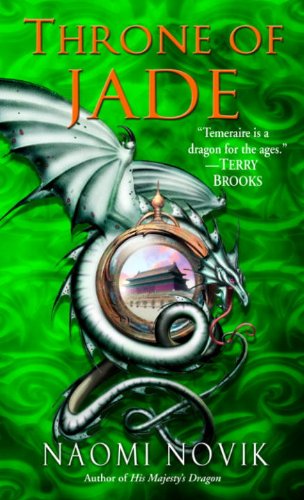
Throne of Jade
Naomi Novik
2006

In honor of Crucible of Gold being released this last Tuesday, I have to go back and review His Majesty’s Dragon and Throne of Jade, the first two book in the Temeraire series.

The books are:
His Majesty’s Dragon
Throne of Jade
Black Powder War
Empire of Ivory
Victory of Eagles
Tongues of Serpents
Crucible of Gold

I have to admit that I’ve actually only read the first two books. However! The reason for that is that I am clearly insane. Despite how I don’t do this for any other series in the world, I can never seem to start the third book without wanting to go back and re-read the series from the beginning. There are so many good scenes and characters and dialog that I can’t resist it. So I go back and read the first two books, at which point I discover that these are really wonderfully dense books in which the plot and action just keeps coming, and so I can’t really read more than two in a row without beginning to feel a bit glutted. But glutted with awesome!

Eventually I’ll have simply memorized the first two, and then I’ll be able to move on to the third and fourth book, I suppose, and I’m very excited about that prospect. But in the mean time, I have to go back and re-read the scene in which Temeraire hatches, and their first air battle, and when Laurence confronts Rankin, and has dinner with Roland, and… and… and…!

Anyway, plot: This is historical fiction based around the Napoleonic War… with dragons. As it turns out, I like historical fiction a lot more when there are dragons inserted. Especially these dragons.

The main character is Captain Will Laurence, formerly of the British Navy. A variety of circumstance, however, lead him to harnessing a young dragon, Temeraire, at which point, he was, perforce, part of the British Aerial Corp. While the war is, of course, a large driving force for the plot, a larger part circles around the differences between the very formal British society that Laurence is accustomed to, the more casual environment of the Aerial Corp, which bridges that of British society and that of the dragons, and the dragon perspective. While Will Laurence and many of the other characters are definitely characters of their time period, the dragons often act as an outside perspective on events and social mores. Dragons, for instance, have their own perspective on sexism and slavery and right and wrong, which isn’t really anachronistic because, well, they’re dragons.

His Majesty’s Dragon and Throne of Jade both really come together because Temeraire is an absolute delight, Laurence is wonderful in his awkward formality and concepts of honor, and they are absolutely devoted to each other, which just makes their differences with and regarding the world around them all the more apparent.

It’s a story about the love of a man for his dragon, and a dragon for his man. Anyway, these are wonderful books and I definitely recommend them.

Please don’t talk to me, middle seat person. I’m reading.

I spent the last two weeks traveling on business, which meant that I was too exhausted at the end of the day to put two words together for a post, but I got LOTS of reading done in airports, on airplanes, and in hotel rooms and lobbies. While I will spare you descriptions of the many in-flight magazines and celebrity tabloids I read during the enforced no-electronics portions of my flights, here are quick summaries of the books that kept me sane as I criss-crossed the country:

The Marriage Plot by Jeffery Eugenides
This was fine, I guess? I was interested in all the characters and I wanted to find out what happened, so it was compelling reading. On the other hand, it was really long and nothing much actually happened and there was almost no resolution of any sort and just because I was interested in the characters didn’t mean I liked them. In fact, pretty much everyone in the book was extremely unpleasant or shallow, so it was a bit like watching a very long, slow train wreck as these characters messed up their lives over and over. I had initially written here that I wanted to warn people about an unflattering portrayal of a character with a mental illness, but all of the characters were portrayed in unflattering ways so the manic depressive actually came out pretty well, comparatively speaking. I loved The Virgin Suicides, so Eugenides has credit in the bank with me, but while The Virgin Suicides felt airy and impressionistic, this dense, heavy, weighty novel feels like it was written by someone else entirely. English majors might like it though, since it seems to feature a lot of inside jokes about literary criticism.

Let the Great World Spin by Colum McCann

Remember how back in the 1970s a French guy strung a tightrope between the two World Trade Center towers and walked back and forth between the buildings, a hundred floors up with no safety net? This novel describes what was happening in the lives of a number of New York residents on that day, and how they were all connected to the wire walker and to each other. Although it does feature the walker (in real life, his name was Philippe Petit and you can watch an amazing documentary about his walk called Man on Wire), the story isn’t really about him at all. It’s really about New York, and America, in the 1970s–Vietnam, crime in the cities, race, immigration, and how all these things play out in the life a few individuals. As a general rule, I don’t like books that follow multiple characters connected only by the thinnest of threads. However, in this book each character is beautiful and heart-breaking and I found that they all looped together in really satisfying ways. Sad, but lovely.

The Thrift Book by India Knight
I think I’ve explained here before that I want India Knight to be my best friend, so I adored this book, even though it is basically just a list of fairly obvious ways to save money. You know, cook at home, make Christmas presents, grow your own herbs, don’t be fooled by fancy skin creams. Knight puts a fun spin on it by focusing not on getting out of debt or being as cheap as possible, but by talking about all the ways her strategies make you feel (to sound English about it) posher and more glamorous by not trying to hard or getting caught up spending on foolish thing. Plus, she’s funny. At one point she refers to playing Scrabble online as her “ongoing Alzheimer’s prevention project,” which is exactly how I think of Words with Friends. However, if you are not trying to befriend or become India Knight, it’s probably not necessary to read this.

Ready Player One by Ernest Cline

Really fun, and absolutely perfect airplane reading. A sci-fi story that manages to be both a puzzle/treasure hunt and a celebration of 80s pop culture. I think is truly aimed at folks a few years older than I am who spent much more time in video arcades, but I loved it and was so absorbed I was able to read it in even the loudest terminals and restaurants.

Fate’s Edge by Ilona Andrews

Fate’s Edge
Ilona Andrews
2011

As my last hurrah before starting a new semester, I read Fate’s Edge. Of the authors who are currently producing new books, Ilona Andrews is my favorite. However, she has two series and I prefer the other one.

The Edge series has a wonderful premise:  There are two worlds, the Broken (our non-magical world) and the Weird (the magical realm), with the Edge as a thin stretch of land that divides the two realms. The Edge is essentially the gateway between both realms and is largely invisible to both as well. Plus, it’s the poor backwoods residents of either land who actually live there.

In this series, they’re our heroes.

This is an awesome premise!

I like it a lot.

A lot of the plot comes in from the fact that various lands in The Weird have rather tense relationships. It’s kind of Cold War-ish, with spies fighting spies and neither side wanting to really declare outright war unless they have a better chance of winning.

So there’s spies and magic and a long stretch of land that is best known for it’s violently clannish population and smuggling operations.

There is oodles of fun to be had there.

The weakness of the series is in the characters, who come across as fairly cookie-cutter standard romance-novel love-interests. However, each book in this series is slightly better than the one preceding it, and Fate’s Edge is the third book in the series, so it’s characters are the best yet.

One reason for the increasing complexity of the characters is that so far the pattern is that the next male protagonist is introduced as a side character in the preceding book. As a side character can’t be allowed to upstage the main hero of a book, the side characters are given flaws that make them lesser than the hero but also a lot more interesting and realistic. If Audrey and Kaldar, the pairing in this book, had been the main pair in the first book, I would have been a lot happier.

However, since a lot of the characters are introduced in the preceding books, I’m not really sure how well this book can stand on its own. To get a full sense of the world building, you definitely need to read the first two books.

So over all, it’s a good, fun read, and I do recommend it, but you have to choose between reading the first two first two books with their character issues or missing out on some of the awesome world-building.

Touch of Power by Maria V. Snyder

Touch of Power
Maria Snyder
2011

I read the first few (short) chapters on Amazon, got hooked, checked the book out from the library and read it in an evening. It was a fun light read that was pretty much just what I needed to relax with. It’s one of those books that balances between being a fantasy-adventure novel with a strong romance plot line and being a romance novel with a strong fantasy-adventure plotline.

I believe this is the second fantasy universe for this author, and while the universes have distinct rules of magic and society, the character dynamics in Touch of Power were really similar to those in Poison Study (the first book in the other universe). If you like the one, you’ll probably like the other, (I certainly did) but go in expecting the same type of thing rather than anything spectacularly new or inventive.

The plot is a really common one for romance novels: There are two secretly awesome people – sometimes their awesome is secret from the world, other times their awesome is just secret from each other – who each feel that the other person has wronged them in some way. They then proceed to act either aggressively or passive aggressively at each other in response and things escalate until a final showdown reveals that they have both misunderstood the situation and wronged the other, not in the original perceived acts but in their responses. This can be written at various levels of quality, but when done well it’s a wonderfully self-indulgent bit of character drama. When done poorly, it convinces me that both characters are judgmental idiots. Snyder does one of the better jobs of writing this plot line (although no where near as good as Jane Austin’s Pride and Prejudice) and manages to largely avoid the pitfall of idiocy.

In this book, Healers with magical healing abilities have been blamed for the great plague that swept the land and thus they are generally killed on sight. Our heroine is a Healer and our hero is a guy who badly needs someone healed and will do whatever it takes to help his friend. Under the circumstances, you can see why they start off with the wrong impression of each other. It was a great deal of fun seeing the characters struggle to work together and waiting to see when the big reveal would happen.

I’ll discuss that  a little more under the spoiler cut, but in general, this is a fun book. I enjoyed it and I recommend it the same way I would recommend a summer blockbuster or a soap opera. It’s not high literature, but I’m rarely in the mood for high literature. It’s fun and relaxing and should be enjoyed as such.

Continue reading

The Great Night, by Chris Adrian

Chris Adrian’s The Great Night has been getting fabulous reviews everywhere, including on NPR’s Pop Culture Happy Hour, my favorite podcast ever and the thing that makes my commute bearable. The book is billed as a retelling of A Midsummer Night’s Dream set in modern-day San Francisco. I liked the book and would recommend it, but I think anyone interested in reading it should keep two things in mind:

1) It’s more “inspired by” than a retelling. This is not Clueless, where you can find an exact parallel to almost every character and plot point. Yes, there are fairies and it is Midsummer Eve, but from there the plot’s relation to Shakespeare’s play gets hazier. In this version, Titania and Oberon rule the fairy world under a San Francisco park, but their marriage is breaking under the weight of their grief over the death of a human changeling boy they had adopted. Puck is not, well, puck-ish but is (to quote NPR’s PCHH) a Big Bad who is freed from service to the King and Queen and is now out for revenge. Humans are involved, but it’s not two pairs of lovers, it’s three single city residents all on their way to the same party, who get trapped in the park when Puck is freed. And remember the “rude mechanicals,” like Bottom with the donkey’s head? In this story those are the homeless people also trapped in the park during Puck’s rampage.

2) The tone is . . . dark. I know that the play deals with themes that are not all sunshine and roses, including the fickleness of love, our lack of free will, etc. But I’ve always thought of the play as one of Shakepeare’s works that is is easy to watch–everyone lives, it’s funny and pretty and there is usually music and people dressed up in fairy wings. But this is not a happy book, or a playful book, or a light-hearted book. It’s overall theme is one of loss, and how people chose to deal with their losses. Titania and Oberon were suffering from the death of (what they considered) their child, while the human characters are all struggling to figure out how to carry on with their lives after their own tragedies.

But while it wasn’t quite what I was expecting, it is a beautiful book. I don’t particularly like San Francisco (in fairness, I’ve only been there once and it was in June, which is apparently the February of San Francisco), but Adrian’s descriptions make it seem like the city that would have fairies, if any one did. The passages where Titania’s changeling son is dying are both spell-binding and heartbreaking. She’s not a likeable character, but her grief is so real it is painful to read. She and Oberon are forced to take the boy to a human hospital for treatment, and the absurdity of the fairies trying to interact with and understand the human world is striking. I’ve obviously never been in this situation, but I wonder if a hospital–specifically the children’s cancer ward–would seem just as surreal and otherworldly to any parent with critically ill child. When the author is not writing critical beloved books, he’s a pediatric oncologist (don’t we all feel unaccomplished now?) and the parts of the book that talk about medical treatments and hospitals and doctors’ lives have a feeling of authenticity. I also enjoyed how the storylines of the various characters, human and fairy, overlapped in unexpected ways. I don’t want to give anything way, but I found the connections very satisfying.

This is a book that requires some faith–you have to read along and trust that the story and relatonships between the characters will become clear, but it’s one that has stayed with me days after I finished it.

Comfort & Joy

By India Knight

I checked this book out from the library after Kinsey discussed it in her post about recommended holiday readings, and it was a very good holiday book indeed.

Here’s the thing about Comfort & Joy: the narrator, Clara, feels just like a very good friend. I wish I could just sit down and chat with her, hearing her opinions about life and sharing my opinions and just comparing our viewpoints. Just like with any friend, most of the time I think she’s very smart and interesting, and sometimes I think she’s being silly and melodramatic, and sometimes I imagine that she would think that I was being the same.

The book is broken up into three years’ worth of Christmases (or Christmi, to use an inside joke from the book). Five pages in, I had my first laugh-out-loud moment; seven pages in, I felt Knight had already perfectly captured an aspect of Christmas with this quote:

“That’s the thing about presents, isn’t it? Especially Christmas ones. The judiciously chosen present, the perfect gift, is offered up in the spirit of atonement and regeneration. It says, ‘Look, I know I don’t call as often as I should, and I know you think I’m grumpy and short-tempered’—insert your own personal failings here; I’m merely précising mine—‘but the thing is, I know you so well and I love you so much that I have bought you the perfect thing. And so now everything’s okay, at least for today.’ Which is all very lovely but a great deal easier said than done, and which is why I can feel the hair at the back of my neck curling with heat and stress.”

Honestly, it actually felt a little odd reading it at my own family Christmas. It is so realistic and engrossing (with some similarities but mostly very different from my own life) that I felt like I was almost experiencing two realities layered on top of each other.

—Anna

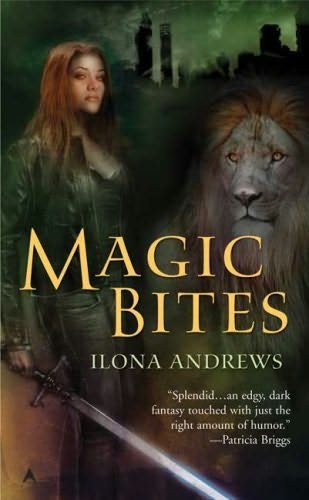
“Magic Bites” by Ilona Andrews

Magic Bites
by Ilona Andrews
2007

Since I reviewed Magic Gifts yesterday, I decided I needed to go back and introduce the universe. Magic Bites is the first in a seven-book series, five of which have been published at this point and two of which I am avidly waiting for. While each book has it’s own stand-alone plot, the characters develop across books. There are also four short stories and an upcoming book that are tangential to the main series.

But first, some background:

There have been a huge number of books published recently with:
1. Spunky female protagonist
2. Vampires
3. Werewolves

Off the top of my head, authors who have written these books are:
Patricia Briggs
Stephanie Meyer
Laurel K. Hamilton
Charlaine Harris
Robin McKinely
Ilona Andrews

And whole lot more.

These are, frankly, just the ones that I’ve personally read, and read recently. (Some of these I liked, some of these I didn’t, and I’ll tell you all about it if you ask nicely… or if you refrain from yelling “No!” loudly enough.) There were a lot more whose covers I’ve seen in bookstores and simply couldn’t bear to read because I was positively glutted with spunky female protagonists dealing with vampires and werewolves (SFPDwV&W).

However, I am still going to write a review of Magic Bites recommending this book to all of you other readers out there who are similarly glutted on SFPDwV&W.

It’s fabulous and you should read it.

Ilona Andrews the author, incidentally, is actually made up of a married couple: Ilona Andrews the person and Gordon Andrews her husband. I went to a convention they were at recently and got my copy of Magic Bites signed by Gordon Andrews. He wrote:

This book is terrible. Start with Magic Strikes. It’s the best.
To Rebecca
Gordon and Ilona Andrews
Don’t read this book!

I, on the other hand, am perfectly willing to tell you that despite being half of the author, he doesn’t know what he’s talking about and you should definitely read Magic Bites, and you should read it before reading Magic Strikes (which is the third book in the seven book series.)

Magic Bites is their first published novel and shows some of the uncertainty of a first book, but were it shines is in world building. This book is an introduction to the characters and to the world. The characters are fun and idiosyncratic and the world is magnificent.

It’s urban fantasy, set in Atlanta, Georgia, with magic, but the book explains how and why the magic is there, from an educated layperson’s perspective.

The werewolves aren’t just werewolves, they have an extremely contagious magic-based virus that has both physical and mental symptoms. They have a culture and a reason for that culture.

Vampires, on the other hand, are dead. They are dead and they are bloodthirsty and they will kill you unless piloted by a “Master of the Dead.” The Masters of the Dead have a massive corporate/cult structure of their own.

And our main character, spunky female protagonist that she is, has motivation and history and reason for all of her character strengths and weaknesses.

This book introduces the reader to a world that has vampires and werewolves and a spunky female protagonist and also, unlike pretty much all other others, makes sense.

(In fact, it makes enough sense that I can quibble about little mistakes in the logical structure of the world because there’s enough logic there for there to be mistakes! If you’re at all interested, I would absolutely love to nitpick in the comments section, because this is a book, and the beginning of a series, well worth reading and thinking about and nitpicking.)

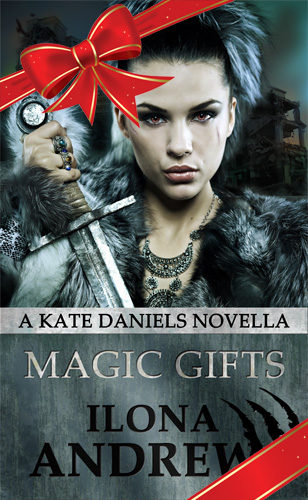
“Magic Gifts” by Ilona Andrews

“Magic Gifts”
by Ilona Andrews
2011

I like Vampire-Werewolf type books. And I have strong opinions regarding which ones are good and which ones… aren’t, but for now, I want to talk about something that one of my favorite authors did for Christmas:

She (actually “they” since Ilona Andrews is a husband-wife duo, but I’m going to go on and refer to her as her) gave her fans a novella. It’s free for download from her website, in pdf, kindle, or epub from her blog.*

The story has Kate Daniels (mercenary fighter and only recently acknowledged consort to Curran) and Curran (Beast Lord) dealing with vampires, attorneys, neo-vikings, and fae. All they wanted was to go on a nice date, but stuff keeps on happening. It’s awesome!

The events happen after the events of the fifth book in the Kate Daniels series and in the background of the sixth book (Gunmetal Magic, which focuses on Andrea Nash, Kate’s best friend and coworker).

As a heads-up, because this is a Christmas present, free to the fans, it was not given a professional lay out or a final professional proof reading, so expect a few typos and layout problems, but the story itself hangs together and the world building is where this author really shines and she shines here, too.

So thank you, Ilona Andrews, for a wonderful Christmas present, and I hope readers here enjoy it, too.

* This was posted late on Christmas Eve 2011, and will be available for two weeks. After that, it will be cleaned up and made available as a short story included at the end of Gunmetal Magic.