Atlas Shrugged by Ayn Rand, first impression

So this is my first live blogging experience and I’m going to be making multiple posts before handing this back to Anna next week. If nothing else, this book brings up a lot of issues. First, a quick review of my general impressions of the first five chapters of:
AtlasShruggedAtlas Shrugged
By Ayn Rand
1957

Atlas Shrugged has come up in various political discussions since I’ve been in college but it really got highlighted by Paul Ryan’s run for Vice Presidency. When Anna was contemplating reading it, I offered to read it if she did.

I went into it with really extremely low expectations. It has surprised me in the ways in which the book has been both better and worse than those expectations.

For the better:

It’s not bad writing. While there are some writing issues that I don’t care for (she has a very active narrator voice, with clear opinions, describing landscapes as “seeming” one way or another, even when there is no character to whom it seems anything), the writing is well done. Rand’s real strength is the way in which she delves into the thought processes of her characters. She also does a reasonably good job of building suspense.

Plus, my first reaction to the first chapter was that this was the beginning of one of the creepier (and more awesome) Doctor Who episodes and John Galt is probably either a Moriarty-type character or possibly even The Master. After reading the first five chapters, I’m still not sure this isn’t true.

For the worse:

It’s even more of a punch in the face of all liberals than I had expected. It’s less that there are some awful characters who mouth liberal concepts merely as hypocritical excuses (because, honestly, people like that do exist, much to my dismay), it’s that there’s no acknowledgement that these people aren’t actually liberals. The whole thing reminds me a bit of a quote that I half-remember from years ago: a bad Satanist is not the same thing as a good Christian. In this instance, the application is that an incompetent Capitalist is not at all the same thing as a successful Socialist. Rand, however, does not appear to see any distinction between these. (She also doesn’t see any distinction between monopolies and unions. I have severe doubts regarding her knowledge of business principals.)

For the depressed:

It feels like the writing of someone working through depression. I don’t actually know anything much about Rand’s life and haven’t even read her Wikipedia page, but I assume she was fighting depression and writing Atlas Shrugged was one attempt to deal with it.

One of the aspects of depression, as I know it, is the combination of thoughts that say (1) the world is an awful place, (2) I have a perfect understanding of how awful it is, and (3) I know with absolute certainty that there is nothing to be done about it.

Rand’s characters desperately want to make a connection with other people and yet are completely unwilling to put any effort into it at all and will self-sabotage any situation that might help. Since they know that no one can understand them, they refuse to see that there are other people out there, understanding them. They also know that certain people aren’t worth knowing. Anyone involved in business and politics are viewed as unworthy of any consideration to the extent that both Dagny and Rearden skip board meetings, ignore journalists, refuse to either ask or answer questions, and expect that nothing that those people can do would in anyway impact their own lives. They already know that those people aren’t worth their time without actually knowing anything about them.

This is a mindset that I find particularly frustrating, all the more so as I very much recognize it from dealing with one of my friends who struggles with both depression and with drug/alcohol addiction. Since he already knows that nothing can help him, there’s no point in trying to get help. Since he already knows that everyone hates him, there’s no point in trying to get anyone to like him.

This is a view of the world that I strongly disagree with. You can’t just know what someone else is thinking or doing without knowing them. There are always surprises and change is always possible if not inevitable.

That’s my perspective on the world we actually live in.

The world of Atlas Shrugged, however, is a dystopian world where values and morals are absolute, people are worthy or not worthy, and everyone knows it. This binary concept of values  is incredibly frustrating although it actually cracked me up a bit when it was applied to music in chapter four. The critics who dislike a piece of music write that, “The music of Richard Halley has a quality of the heroic. Our age has outgrown that stuff.” and “The music of Richard Halley is out of key with our times. It has a tone of ecstasy. Who cares for ecstasy nowadays?” Everybody knows the music is good, just the populace in Rand’s world apparently hate good music.

In one of my graduate classes focusing on intellectual property laws, the professor liked to remind us students that “reasonable people can disagree.”

In the world of Atlas Shrugged, reasonable people have a shared understanding of what is right and good and proper. If you disagree, then you are clearly incapable, incompetent, and morally bankrupt.

In conclusion:

This book is well-written and while it doesn’t suit my particular tastes, I can see how it would have a lot of appeal to some people. It brings up some interesting ideas and would likely help people define their thoughts and opinions.

My real problem is not with the book itself, but with the people who are reading it for guidance and direction rather than for thoughtful conversation. There are real politicians who are using this as a serious political treatise. It feels a bit like if, after reading The Hobbit and Lord of the Rings by J.R.R. Tolkein, a politician were to decide that every covert military action should include at least one untrained civilian to carry out some vital task. Or, after reading Ender’s Game by Orson Scott Card, one were to start recruiting child soldiers. These books are all good and thought-provoking and can certainly be used to develop one’s political stance, but they should not be taken as holy writ.
Atlas Shrugged (Chapters 1-5)

By Ayn Rand

Cover: Atlas ShruggedMy only previous references for Atlas Shrugged are Paul Ryan, of course, and a very funny recap of the movie version of the first half on Grantland. This, however, has not stopped me from judging anyone who spoke positively of the book. So, when a friend of mine listed Atlas Shrugged as one of her favorite books, I mocked her without restraint. She, of course, replied that maybe I should try actually reading it, which seemed like a fair point, so here I go with another round of semi-live-blogging.

A quick warning, though: I lean so far left, politically, that President Obama and the Democratic party are significantly right of me. In the 2008 Democratic primaries, I caucused for Kucinich (devastatingly unsuccessfully), and if there were a viable socialist party in the United States, I would probably be a member. I am very obviously not the audience for this book, and I am, under no circumstances, diving into it with anything close to an open mind. I intend to hate it, with my reward being that I can then mock its fans with complete impunity.

Rebecca, who has also never read any Ayn Rand, has agreed to join me in reading Atlas Shrugged and ‘live-blogging’ it for the next several weeks. Kinsey has already read The Fountainhead, so she got a pass. So, with no more delay, let’s get started with the spoilers! Continue reading

Twelve Fables of Aesop

AesopTwelve Fables of Aesop
narrated by Glenway Wescott
illustrated by Antonio Frasconi
1954

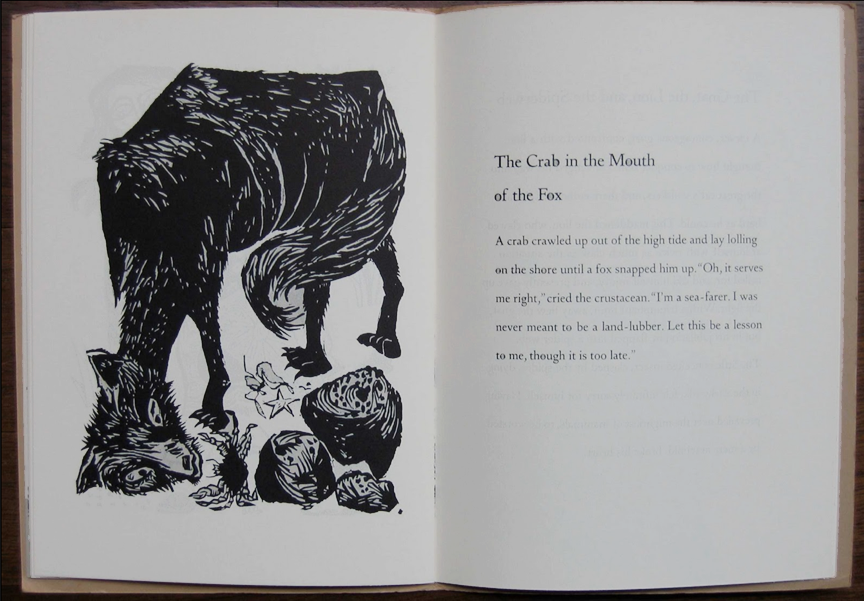
This is a gorgeous book with a series of really excellent woodcuts. I got it as a Christmas present and I love it. Gorgeous.

On the other hand, the text is kind of… um… odd? I remember Aesop’s fables in a sort of vague way from when I was much younger. They were short, yeah, but they tended to make sense. There were characters who did things and learned lessons, right? These versions, on the other hand, seem really pretty random. They’re actually oddly post-modern in their randomness.

This makes them hard to review. So in preparation for trying to review the book, I listened to The Dead Author’s Podcast (reviewed earlier by Anna) with guest Aesop.

It’s hard to tell how accurate/historical the podcast really is, but it’s certainly clear that I am not alone in thinking that some of these fables are really incomprehensible. And short.

So I loved this book for the art but I kind of suggest that you check it out for the stories for the bemusement factor as well.  It’s also really short. Twelve stories, none of them longer than two pages.

So to sum up: Beautiful but peculiar.

The Rest of 2012

When I read a really good book I almost always write it up on the blog, generally because I’m so excited I want to make everyone I know read it. However, when I looked back over the list of books I read in 2012 (yes, I keep a list, otherwise I can never remember) I realized that I read some awfully good things that never made it here. So, to wrap up 2012, here are the five best books I read this year that I never got around to mentioning.

1) How To Be A Woman by Caitlin Moran. This is such a fabulous memoir. Moran uses her own life story to make a lot of points about feminism, beauty, generally living life as a woman in this society. But she’s funny, while also being radical! She’s also hilarious on Twitter.

2) The Family Fang by Kevin Wilson. I feel like this book sells itself as story about family, yet at the end of the book I felt sort of repulsed by the whole idea of families. But it’s a fascinating book.

3) Bring Up the Bodies by Hilary Mantel. This is on everyone’s best of the year lists, for good reason. This one moved a lot faster than Wolf Hall, Mantel’s first book about Thomas Cromwell, but you need to read them both to make sense of it. I admit that Tudor history is an interest of mine, but the beauty of these books is that the characters are so well-drawn that the historical details are just a backdrop for Thomas’s story.

4) Angelfall by Susan Ee. The first in another series of YA post-apocalyptic novels. There is no shortage of these books out there, but I liked this one a lot. Dark, but an interesting premise in which angels are the cause of the destruction. It also takes an unexpected position on religion, and I’m intrigued with how future books will play that out.

5) Broken Harbor by Tana French. The fourth in French’s of mystery novels set in modern-day Dublin is actually less a mystery and more the portrait of a family falling apart. My favorite of her books is still The Likeness, the second book, but they are all completely compelling and very, very well-written. There are connections between the books, but they are not a series, really, and they can all stand alone. Feel free to start with whichever one sounds most interesting.

Sequels, Follow Ups, Trailers, and Recommendations

As the holidays come barreling towards us, I first want to point you toward my entry last year on good Christmas books. I haven’t started my annual rereads yet, but I need to get on that. It doesn’t feel like Christmas to me until I’ve read a few Connie Willis short stories.

https://biblio-therapy.com/2011/11/27/christmas-reads/

But if you don’t want to create an entire holiday reading plan, here a few other things that have come up lately that relate to some of my past posts.

Remember when I raved about The Girl of Fire and Thorns by Rae Carson? And said that I wasn’t sure whether it was going to be part of a series? It is! The second book, The Crown of Embers, is out now and it might be even better. I’m not going to go into any detail, since talking about this one would spoil the first one, but I loved it and it reminded me a lot of Bitterblue. The only downside is that it ends on a bit of a cliffhanger–Elisa’s story is clearly going to be a trilogy.

Now remember when I, and everyone else in the world, raved about Gone Girl by Gillian Flynn? I recently read one of the books she wrote before that, Sharp Objects, and it was equally compelling and creepy. In fact, if anything I felt even ickier after reading that one. So if you liked Gone Girl and want to read a disturbing mystery novel, Sharp Objects is perfect. (Also, we get a surprising number of Google hits on things like “gone girl linda holmes hugged the book.” So for the record, future Google searchers, I feel confident that she hugged the book at the point where Amy’s journal ends, and that next section of the book starts. Is that clear without being too spoiler-y?)

One of the best things about seeing the last Twilight movie in the theater (oh yes, I did), was that they showed about 10 different awesome previews. My sister was thrilled about the Catching Fire trailer, but I was most excited about City of Bones. I’ve already explained how much I like those books and, at least in the previews, it seemed like they had the look of everything right. I am too old to recognize any of the teenagers playing the leads in the movie, but I am excited about the parental-level casting. Aidan Turner, who was a vampire in the Being Human series (the BBC one, not the Scyfy remake), is Luke and Jonathan Rhys Myers is absolutely perfect as evil, creepy Valentine.

Finally, if you’re not already reading Tomato Nation, well, I don’t see what you’re even doing on the Internet. But just in case, one of the recent entries in her advice column, the Vine, asked readers for book suggestions for preteen/teenage readers. The comments on the entry are great, reminding me of YA books I loved and introducing me to some new ones. The comments to Anna’s recent Sunshine post included some discussion about what ages that book would be appropriate–the comments on that Vine post might provide some other great options.

Twilight, An Argument For

Last week, Rebecca wrote quite a scathing review of the Twilight series, identifying a whole range of problems, from bad writing to bad gender models. However, we also wanted to offer another perspective on the whole phenomenon, and since I am the one here who has read all the books, saw all the movies in the theater, and say in my own bio that I like the books, the favorable review fell to me. But this is a challenging assignment, because it’s not that I actually disagree with anything Rebecca said. I think she’s right about all of it. On the continuum of me, Anna, and Rebecca, I am clearly the most pro-Twilight among us, but I will freely admit that these are Not Good books. Nonetheless, I like them, and I’m going to try to explain why.

First, let’s quickly run through some of the key problems with the books, just so that you know I’m aware of them:

1) The Twilight books are not-well written. The Host, Meyer’s non-vampire sci-fi novel, is actually kind of interesting, giving me hope that she might be able to turn out okay material. The Twilight series is not that okay material.

2) Bella is completely uninteresting. Seriously, totally blah. Say what you will about Kristen Stewart, she makes that more character more interesting than the source material. Which leads into the biggest issue . . .

3) Wow are these not feminist at all. Like, let’s make sure that the female characters have no agency whatsoever, and are completely at the whim of stalker-y, creepy, borderline-abusive men!

NONETHELESS, I like these books! They’re like Cheetos–you know they’re not good for you and you know you will feel a little ill when you’re done, but in the moment you enjoy yourself. I don’t want a relationship like Bella and Edward’s, but I sure wanted to find out what happened to them. The characters didn’t feel like real high school kids, but I enjoyed thinking about how much more interesting high school would have been if there had been vampires around. I also found that I enjoyed the books and the movies more when I had placed them in the proper context. These aren’t sci-fi books featuring teenagers, or coming of age stories with a supernatural twist. These are teenage romances that happen to feature vampires. When you read a Harlequin romance novel, you know that there’s a formula involved and that you’re going to get a certain set of ideas and characters. A romance novel may not lead to any epiphanies, but it will entertain you. The Twilight books aren’t trying to create an intricate vampire mythology, but once I read them as romance novels telling sort of fantastical love stories, it made more sense.

Plus, I am fascinated by Mormonism, and I love how you can SEE Stephenie Meyer’s Mormon worldview coming out in crazy vampire plot points.

Look, sometimes when I read I want to be challenged or to learn something or to be comforted. And sometimes I want to shut my brain off so that I forget the world around me. I wouldn’t want this to be the only thing I read, and I wouldn’t want for young women to read these without having taken the number of feminist theory courses I have. But I have read a whole lot of crappy Dan Brown and Michael Critchon books in my day, and if I’m going to pass the time on an airplane or at the end of a stressful day with something, I’m happy to pass it with sparkly vampires.

The Uninvited Guests

A couple of weeks ago Anna posted about A City of Ghosts for Halloween, and I wished I had read something spooky so I would have a seasonal recommendation, too. If I had just finished The Uninvited Guests a bit earlier, I could have told you all to go read the creepiest thing I have come across in quite a while.

The book starts off as a fairly typical English house party story–an upper-class family has guests for the weekend, and everyone is very concerned with dressing for dinner and who will marry who, etc. But then things take . . . a turn. I don’t want to talk about the plot too much, because I don’t want to give anything away, so instead I’m going to talk about how the book made me feel. Which was waaay creeped out. I was initially reading this before I went to bed at night, but I started feeling such a sense of dread after each chapter that I had to start reading it only during daylight hours. Even when nothing obviously bad was happening, things still felt so ominous that at times I wasn’t sure I could finish the book. But I kept going and I was glad I did–the author did a beautiful job of building up to a very eerie climax, raising the tension so slowly that I almost didn’t notice at first.

And now I am going to go read Anne of Green Gables or The Railway Children or something else wholesome and happy so that I can sleep at night again.

The Handmaild’s Tale

By Margaret Atwood

Book cover: The Handmaid's TaleWarning: this is going to be a blatantly and quite politically biased post. As everyone, left- and right-leaning, has been saying, Tuesday is going to be quite a deciding factor for our country, and will take us in one of two very different directions. (I’m feeling a bit guilty myself for having moved my vote away from a key swing state this year.)

Early on in the campaigns, I was so taken aback by the backlash against Sandra Fluke and the willingness of conservative women to outrageously slut-shame other women with no awareness of how such language could eventually come back to bite them as well. In discussing this very fact, I read the below comment on Videogum, one of the blogs I read daily:

Has everyone read “The Handmaid’s Tale”? It’s a. GREAT, and b. set in a future America where a very repressive regime that is pretty shitty to women has taken over. There is a passing moment where the narrator talks about how a woman she knows used to be a great big televangelist who would always talk about how a woman’s place should be at home is turned into a chattel slave like every other lady once the new regime takes over, and how she seems mad that someone “took her at her word”.

After reading this comment, I thought perhaps The Handmaiden’s Tale could give me more insight into this kind of mindset.

This book is terrifying, far scarier than any horror story I could have picked for Halloween. My only comfort was that it seems unrealistic that such a drastic change could happen all within one generation. In the novel, the narrator went to college, got married, and had a daughter, all before she was restricted to being a “handmaiden,” a fertile woman supplied to couples unable to have children in order to surrogate for them by government orders, in her mid-30s. Although maybe Atwood’s point is that if you aren’t paying attention or participating in politics, it could run right over you before you even notice.

In addition to terrifying, though, the book is enthralling; I couldn’t put it down. I’d worried that it would be painful to read, but the narrator takes such a matter-of-fact tone that even the most stressful scenes had a comfortably numb tone that both made them easier to read and reflected the mental state one would have to be in to survive. I’d thought about ‘live-blogging’ my progress through it, but I devoured it in a matter of days, and then spent the next couple of weeks trying to write a post that encapsulates all of my feelings about it, which turns out to be impossible. Instead I’ve compiled a little game for you – it will be fun!

Here is a list of quotes, some from The Handmaid’s Tale and some from a variety of political leaders and pundits; can you tell the difference?

  1. “If you look at the Scriptures, I believe it’s clear that God has designed men to exercise authority in the home, in the church, in society, and in government.“
  2. “Our country might have been better off if it was still just men voting. There is nothing worse than a bunch of mean, hateful women. They are diabolical in how than can skewer a person.”
  3. “Money was the only measure of worth, for everyone, they got no respect as mothers. No wonder they were giving up on the whole business. This way they’re protected, they can fulfill their biological destinies in peace. With full support and encouragement.”
  4. “Nature demands variety, for men. It stands to reason, it’s part of the procreational strategy. It’s Nature’s plan. Women know that instinctively.”
  5. “The problem with women voting is that women have no capacity to understand how money is earned. They have a lot of ideas on how to spend it. And when they take these polls, it’s always more money on education, more money on child care, more money on day care.”
  6. “What we’re aiming for is a spirit of camaraderie among women. We must all pull together.”

Answers after the break.

Continue reading

A City of Ghosts

By Betsy Phillips

Since it is very possible that all three authors of this blog will lose power due to Sandy for the next week, I’m posting my Halloween post a few days early.

Book Cover: A City of GhostsKinsey and I were discussing the blog, sort of roughing out upcoming posts, and I mentioned how I like to read something spooky in honor of Halloween, but that I couldn’t actually remember ever reading a book that truly scared me, like so scared I don’t want to turn out the lights. (After more thought, the story of “The Monkey’s Paw” made me very unhappy at the time of reading it, though didn’t interfere with my sleep at all, and Steinbeck’s The Pearl has given me a lifetime phobia of scorpions, so those seem to be as close as I get to scared.)

Anyway, Kinsey lent me A City of Ghosts, which is a collection of ghost stories set in Nashville, self-published by the author in 2010. I was somewhat dubious about this book for a couple of reasons: 1) I am a huge snob about self-published books; and 2) I am a huge skeptic; not only do I not believe in ghosts, I can’t even imagine any evidence that would make me believe in them, up to and including seeing one for myself.

However, it was really, really good! Not spooky, but just super interesting. It was a comfort to me that the author notes in several places at the beginning of the book that this is a work of fiction, since then I could just enjoy the stories without picking apart the possible truth behind them. Although, Phillips writes in such an easy, first-person, conversational style that I had to reconfirm for myself several times that she did indeed state upfront it is fiction.

I read it more like a book of poetry, especially since the stories were very short, mostly ranging between one to three pages long. Phillips uses the small vignettes to flesh out (so to speak) aspects of Southern society, like the shadow of slavery and the ongoing racism and classism, that are hard to encapsulate in concrete terms on their own. I interpreted the ghost stories as metaphors for how events can become permanently embedded in our social consciousness and dictate how our lives are led even decades later.

The book is dividing into two sections, the first titled “April,” and the second titled “October.” The stories in “April” are a bit lighter in tone, reading a bit more like traditional ghost stories and addressing more individual cases; “October” has several stories that include flood waters, very clearly dealing with post-Katrina recovery. Even while typing this, I can see how ghost stories about the victims of Katrina sounds like it could be incredibly insensitive, but the stories instead describe the hurricane as a specter itself that hangs over the survivors with nightmares of the flood waters and grief over the victims.

I just found it very poignant, and in that way, much more lastingly enjoyable that I would more traditional ghost stories.

— Anna

Slaughterhouse-Five

By Kurt Vonnegut

Banned Books Week 2012Book cover: Slaughterhouse-FiveWhen I decided to read Slaughterhouse-Five for this year’s Banned Books Week (and the couple weeks following, as well, apparently), I was a little baffled that I hadn’t already read any of Vonnegut’s books because I like science fiction and I’ve had Vonnegut recommended to me multiple times. I even vaguely recalled meaning to read some books but never getting around to it.

Then, I got a couple of chapters in, and remembered that I hadn’t just meant to read his books before, I’ve actually started several of his books in the past, and put them down again. I just cannot get started into Vonnegut’s books, which is so frustrating because I really enjoy both sci-fi and social satire, and he is a king of both. So, I bring you this review in three Acts: Dismissiveness, Grudging Respect, Zealous Appreciation.

Act I: Dismissiveness

I spent roughly the first half of the book trying to put my finger on the problem. It isn’t as though I especially disliked it or thought it was a bad book; I just felt that I didn’t totally get what he was trying to say and that his writing style wasn’t one that speaks to me. When Tom asked if I was enjoying it, I had to admit that I wasn’t, and when he looked a bit disappointed, I followed up by saying that I thought it was a little too philosophical for me, like Vonnegut is communicating a theory about life, instead of sharing a concrete facet of life, and I get impatient with that. Tom nodded, because he has despaired of my disinterest in philosophy before, but I continued to mull over my answer.

And I think it was something even further, that his people weren’t interesting to me as characters. That they seem more like placeholders in his philosophical argument; their actions only serve to augment the message of the book. So, I didn’t have any vested interest in the future of the characters, which is especially true in this non-chronologically-linear novel where the future is all spelled out early on, and even the characters in the book don’t have much interest in it, either.

Acts II and III with spoilers and excerpt after the break…

Continue reading