Willful Impropriety

Edited by Ekaterina Sedia

Book Cover: Willful ImproprietyIn spite of considering myself an avid reader, I don’t actually buy books very often. I have a history of moving every 4-5 years, and after a couple of times moving countless heavy boxes of books, a large personal library just seems cumbersome. However, when I saw a copy of Willful Impropriety in the store, I bought it without a second thought. Young adult fiction, with some Fantasy elements, set in the Victorian Era? Yes, please!

Plus, I had originally heard of the book on the blog of one of the contributing authors, Genevieve Valentine, of whom I’m a big fan. (Also, she tends to contribute stories to more esoteric collections that are not picked up by my library.) Valentine is a bit of a conundrum for me, though. I love both her blog and her fictional writing, but they are shockingly different. Her blog is very funny with acute analysis of current popular culture, while her fiction has a lyrical and melancholy tone, and her story in this collection is no exception.

I was also pleasantly surprised that another of the authors, Caroline Stevermer, was the co-author, along with Partricia C. Wrede, of Sorcery & Cecilia, which I’ve already raved about here. Her story was probably my favorite of this collection, and has inspired me to track down some more of her books Another author, M. K. Hobson, whose story felt a bit like a P.G. Wodehouse story but with magic, also wrote The Native Star, which Kinsey recommended to me a while ago, and while is definitely going on my to-read list.

The introduction to the book describes that young adult literature set in the Victorian Age seemed like a complimentary match, since YA Lit is often about rebelling against the status quo to establish an individual identity, and the Victorian Age sure had a lot of status quo to rebel against. But after more than a dozen stories, I was a little saddened by how many of them ended with the heroine finding a solution in a relationship with a man.

Which, of course, is one of the few historically accurate ‘happy endings’ for women, but the stories didn’t stay so rigidly accurate in other features, so having them return to that trope was a bit of a bummer. The stories that did not include such a pat ending stood out all the more, though.

— Anna
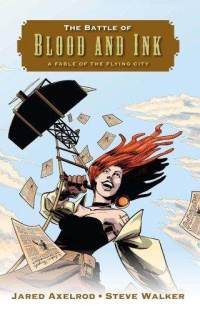
The Battle of Blood and Ink by Axelrod and Walker

The Battle of Blood and Ink: a Fable of the Flying City
Jared Axelrod and Steve Walker
2012

This book has my qualified approval. Without the time (or ability to concentrate) for reading a full book, I recently read a graphic novel instead. Given the adage “a picture is worth a thousand words,” if all of your descriptions can be replaced by images, a graphic novel can be read a whole lot faster than a traditional novel and in fact I read The Battle of Blood and Ink in about forty-five minutes.

On the up-side, it was wonderful to just relax with a book and this one had fun characters and interesting intrigue and really beautiful illustrations. The art is both lovely and lively and was what first attracted me to the book. Then, the characters drew me in, as well as how the authors addressed moral issues regarding ethics versus pragmatics and personal versus political responsibility. It was both beautiful and interesting.

The story is about a woman, Ashe, who grew up as a street kid on a flying city and now makes her living printing a newsletter regarding city events and happenings. The city is a place of wonder, but from Ashe’s perspective, we see some of the gritty underpinnings of how things actually work, and so too does her readership. This gets her into trouble with the city ruler and events progress. Since the role of information and censorship are currently particular interests of mine, this plot was just right for me.

On the down-side, the climactic scene relies on a lot of world building that wasn’t actually presented previously in the book. Given the setting is a flying city, the universe is obviously a science-fiction/fantasy one, but the physics of the world isn’t really explained at all, and the climax depends on certain premises that I hadn’t expected.

Having read and enjoyed the book but feeling a bit bemused by the ending, I discovered that the book was intended as a stand-along sequel to a set of 44 online pod casts (i.e., audio recordings). I listened to the first two of them and was not nearly as impressed by them as by the graphic novel. The world building issues may or may not be addressed in these pod casts, but of the two that I listened to (each about 15 minutes), both times the speaker rambled for a significant period of time before getting to the story and then the story was filled with poorly written descriptions that were much better presented as images in the graphic novel.

So, on the whole, while there are serious flaws in this graphic novel, it’s still lovely, fun, interesting, and well worth the half-hour to an hour that it would take to read. If you want to get a taste of it, the first twenty or so pages are available online.

The Many Books of Cassandra Clare

Sometimes when I see an interesting book and realize it’s the first in a series, I feel overwhelmed by the task in front of me and don’t even both starting. Too many pages! Too much commitment! So I understand that recommending two interconnected series of seven books (so far!) is dicey. But don’t panic! Cassandra Clare’s Mortal Instruments series will not be a weight upon your reader’s conscience. This series just makes me happy, because I know I can count on more books coming.

City of Bones, the first book in the series, tells the story of Clary, a New York City teenager who finds out that she’s actually part of a world of demon hunters and vampires and werewolves, etc. I know there are a million young adult books out there with this same basic plot, but Clare creates a very detailed world and whole giant cast of interesting characters. There’s passionate teenage love, parents who don’t understand, fairies who strike bad bargains, a magical city in another dimension, secret governments, warlocks–it goes on and on. I don’t necessarily think the characters are that realistic (they really don’t read like teenagers to me) and the books aren’t going to offer tremendous insight into the problems facing our world now (for that, go read Bitterblue). But they’re fun and dramatic and surprising and engaging and ultimately satisfying.

There are five Mortal Instruments books so far, and clearly at least one more coming. I initially said that there are seven because Clare has started a second, companion series, set in the same universe but 100+ years back in Victorian London. The Infernal Devices has two books so far and I think I might actually like it better that the modern day books right now (but I am a sucker for period stories set in England). So please give Cassandra Clare a chance, starting with either City of Bones or Clockwork Angel. If you don’t like the first, you don’t have to read any more because they’re very similar. But if you like them, just think–you won’t have to worry about having something fun to read for many, many hundreds of pages. They’re also in the process of making the first one into a movie and I’m pretty sure they’re going to position it as the new Hunger Games, so just think how ahead of all the teenagers you will be!

Rosemary and Rue

By Seanan McGuire

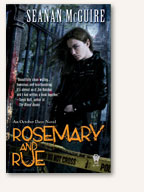
Cover Image: Rosemary and RueRosemary and Rue…isn’t terrible. It is one of those books that is perfectly serviceable, but also demonstrates how difficult writing really is. I joke about my fantasy ‘trash’ books, but the truth is that my favorite authors manage to create empathetic characters in a relatable world, even when that world is so crawling with vampires, werewolves and fairies that it bears very little resemblance to the real world. They make it seem so effortless and natural that I can laugh off the books as ‘trash,’ until a book like Rosemary and Rue reminds me how much skill really goes into writing fantasy by showing me the pitfalls that other authors have avoided.

In case I haven’t damned it enough with the faintest of praise, Seanan McGuire writes like I would, constantly having to remind the reader (and possibly herself) of the perimeters of the supernatural elements of her world, that amateur error of telling (over and over) instead of showing. Unfortunately, even the telling often contradicted itself, to the point where I seldom fully understood what was going on in the plot. Some examples after the spoiler cut:

Continue reading

Whispers Under Ground

By Ben Aaronovitch

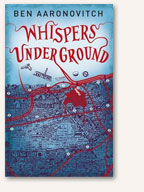
Book cover: Whispers Under GroundI have been eagerly awaiting this third book in the series for several months now, and I should have been using that time to reread the first two books. Whispers Under Ground does not stand alone very well, and unfortunately I’d forgotten a lot more of the previous books than I’d realized. No doubt due to my poor memory, the plot seemed a bit muddled, but the characters were just as charming as ever (seriously, PC Peter Grant is one of the most likable characters I’ve ever read).

Addressing the characters, however, leads me to a bit of a rant about the book publishing industry: why don’t the people writing the blurb on the back of the book actually read the book?! Here’s the last few sentences of the back cover description for Whispers Under Ground:

“…It’s up to Peter to plumb the haunted depths of the oldest, largest, and —as of now—deadliest subway system in the world. At least he won’t be alone. No, the FBI has sent over a crack agent to help. She’s young, ambitious, beautiful…and a born-again Christian apt to view any magic as the work of the devil. Oh yeah—that’s going to go well.”

I first read that and was actually kind of dreading this new character, which seemed like such a fantasy and mystery trope: the mismatched partners, with the protagonist having to scramble to cover all evidence of anything magical. I don’t think it is a spoiler to say that this character doesn’t exist in this book. There is an FBI agent; she is female, smart and ambitious; the book never mentions her religion or level of attractiveness. I liked her, and I was impressed by Aaronovitch writing her. I’m not impressed with the author of the back blurb trying to fit an unusually professional relationship into a trite drama.

Okay, rant over and back to normal programming: Aaronovitch, who previously wrote episodes for Dr. Who, is clearly, and endearingly, a huge fan of the entire fantasy genre. Affectionate references to the Lord of the Rings, Avatar: The Last Airbender (cartoon, not movie), Dungeons & Dragons, and The X-Files are sprinkled throughout the text. It became kind of a game for me to try to track down all allusions.

—Anna

The Far West by Patricia C. Wrede

The Far West
Patricia C. Wrede
2012

So much fun! I love this series and I love this book. Anna already reviewed the first two books, but The Far West just came out this month and I got a copy immediately. In hardcover, even. One of the things that impresses me about this entire series is the world-building and this book continued the process magnificently, continuing to delve into both the theory of magic and the unknown wildlife of out in the unexplored far West.

As you may have noticed from previous posts, I love me some world-building and Wrede does it beautifully. The series is set in the days of the settlers except that there’s magic, which has made a significant difference in history and national politics as well as ecology. There are three main theories of magic: Avrupan, Aphrikan, and Hijero-Cathayan, each with their own structure and way of manipulating magic. While these were each introduced in the prior books, The Far West looks more closely at the differences and similarities of each type as Eff, the main character, goes on an exploratory expedition further West than anyone else has gone before… or at least further West than anyone else has returned from. There’s new wildlife and new magical theories and a small group of people trying their best to figure out the world and survive the process long enough to report back.

One of the many wonderful things I appreciate about the book is that there’s no bad guy. There are disagreements and personality conflicts and wild animals and danger and adventure, but it’s all situational. There’s no one out there specifically trying to do evil… it’s just a dangerous world and Eff and the rest of the expedition have to work hard to survive. They don’t all get along, they certainly don’t all agree, but they all have a common goal.

The one thing that I really did not like about this book, however, was the fact of the epilog. Not that it was bad, but that it existed. Wrede did that thing where the epilog gives brief descriptions of the future lives of each of the main characters: So-and-so went on to do such-and-such, what’s-his-name went on to do this-and-that. It ended the series. This is book three of a trilogy and Wrede decided to tie it off the loose ends, at least as far as character development went. But there’s so much more out there. It’s this rich world and complex characters and no hope for another book in the series. Hmph. I will have to sulk and re-read it some more.

Thirteenth Child and Across the Great Barrier

Patricia C. Wrede

Book Cover: Thirteenth ChildPreface and warning: I have been a HUGE Patricia C. Wrede fan ever since my best friend gave me Talking to Dragons for my birthday when I was twelve. At the time, I’d never read anything like it: adventure, fantasy, humor, and light romance all together in a book with a narrating hero that a preteen girl can empathize with and a heroine that she can admire. Wrede is particularly clever with creating characters and narratives that subvert traditional fantasy tropes: clumsy knights, ditsy princesses, wizards that melt with soapy water, and dragons that demand complicated etiquette, I believe to date that I have read all of Wrede’s books, even though they tend to be quite young, “young readers” rather than “young adult.” (Upon a quick consultation with amazon, there is actually one of her books I have not read – a ‘junior novelization’ of The Phantom Menace, and I think I can be excused for not only not reading it, but pretending it simply doesn’t exist.)

She also manages to blend the fantasy genre and period-piece genre better than almost any author I’ve read. I won’t totally divert this review, but Sorcery & Cecilia is just such a wonderful fantasy story set in the Regency period, and is just such a perfect blend of historical romance and fantasy that it seems so easily done, but it clearly isn’t*.

Book Cover: Across The Great BarrierAnyway, the Frontier Magic series is set in an alternative universe that is obviously similar to our pioneer days in the United States, but with a world that developed with magic. The main character and narrator is a young girl who is born the thirteenth child in her family, which is considered extremely unlucky, to the point where relatives insinuate she probably should have been “taken care of” at birth. Within the first book, Thirteenth Child, she grows from about 5 years old to 18, growing up, going to school, and learning magic, and then the second book continues for the next couple of years, where she takes on her first magical job as a young adult. The third book, The Far West, sounds like it starts off where the second book ends.

Both books are a bit more atmosphere-driven, and less crisis-driven, so it has a leisurely pace that can take a little adjustment as a reader of rip-roaring adventure stories. However, it is such a charming book in every way, from the magical elements to just the frontier elements—it reads a bit like a fantasy version of Little House on the Prairie. And, seriously, what could be better than that?

—Anna

*Aside rant: how is this so difficult? Seriously, one would think the two would go hand in hand—vampires and all sorts of other magical creatures are immortal, after all. The audience that reads fantasy books has a pretty big overlap with the audience that reads historical novels and romances, I believe. How is almost every period-piece fantasy book I’ve read just terrible?

Bitterblue

One of the hazards of writing a book review blog is that if you’re not careful about what you review, giving books as presents becomes tricky. Your friends won’t be surprised by the books you give them for their birthday if they’ve already read your glowing review, and since probably 90% of the presents I give are books, this has made shopping somewhat challenging. So now when I read something that I know I want to give as a gift, I avoid writing a review even if I love the book. When I read Bitterblue a few months ago I knew immediately that it would be perfect for my friend Hannah’s birthday, so it’s only now that she’s opened the present that I will tell you how awesome Bitterblue is.

Kristin Cashore has written three young adult fantasy books set in the same world–Graceling, Fire, and Bitterblue–and they’re all great. I wouldn’t quite call it a series, since they all center on different characters and jump around in time quite a bit. But there a lots of overlapping characters and plotlines, so it helps to read them in that order. I loved Graceling, thought Fire was perfectly niceand now think that Bitterblue might be the best of the bunch.  But telling you even the teeniest bit about the plot of Bitteblue will give away all sorts of things about the other books, so instead I am going to just list some of things I like about all of them.

  1. They all feature strong young women at the center, but the women are very distinct. One has incredible physical/athletic strength, while another is a bookworm whose power is more political. They show a nice range of different ways a girl could be in control of her life.
  2. The world they are set in is, in some ways, your standard YA fantasy fiction world: castles, princes, magic, sailing ships, etc. We’ve all read a ton of these, but this one feels original and complete, and the magic follows some very specific and interesting rules. Cashore even manages to make the political part of the story–which kingdoms are trying to overthrow which other kingdoms–compelling, and that is generally my least favorite part of any fantasy book.
  3. I found the story resolutions in each book unexpected. I did not know where any of these were going, right up until the end.
  4. Cashore addresses some pretty intense political topics, while still keeping these young adult books. I’m going to assume she was not actually trying to create a parallel of post-Qadaffi Libya, but it was still an interesting take on what that might be like for these characters in this world.
  5. On a similar note, all three of the books do feature some romantic storyline, but the relationships that the characters have are all very complex and layered. Especially in Bitterblue, I was impressed by how willing the story was to leave a lot of the romance storyline up in the air.
  6. All of the books are big and long and chewy. I read fast and it can be disappointing when a good book only lasts a day or two. With Bitterblue I stayed up until two in the morning, on multiple worknights, reading as fast as I could. Each of these kept me busy for a while.

So I guess I’m recommending that you make a 1000+ investment, since I think you really need to read the first two before you get to Bitterblue, but it’s worth it! I’m now just waiting for the next one.

Gunmetal Magic by Ilona Andrews

Gunmetal Magic
by Ilona Andrews
2012

This is a pretty mixed review given that it’s for a book that I enjoyed in a series that I loved.

I enjoyed this book a lot. There was fun banter and exciting action and all sorts of fun. On the other hand, it wasn’t exactly the best work of literature I’ve run across, not even the best by this author. The plot depends more on shiny-magic-handwaving than it does on logic and the characterizations are pretty dependent on introductions from previous books. There are also a few scenes that seem to have been included for no particular reason at all.

I assume those scenes are part of the set up for the next book, actually. That actually brings me to skirting around a spoiler that I wrote about in one of my spoiler posts, regarding how this book was written primarily in order to set up some circumstances in preparation for the events in the next book. This book is well-worth reading as the next building block in a really awesome series, but I don’t think it can or should stand alone. I definitely recommend the series, though, but start at the beginning and read them in chronological order. While the main series is planned to have seven books, I would say that this counts as book 5.5. While focusing on a side character, the events of this book are necessary to the development of the series in general.

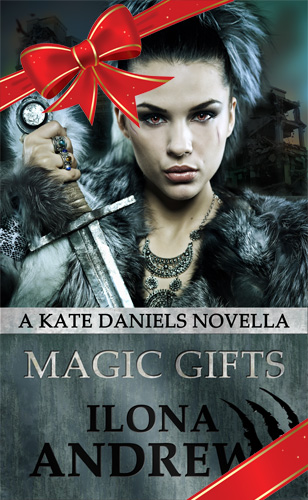
The suggestion to read the books in chronological order includes, incidentally, the suggestion to read the novella, Magic Gifts, which is included at the back of this book, before reading Gunmetal Magic. Which means, that when you get the 448-page book, the first thing to do is to flip to approximately page 330 and start reading. Magic Gifts is the story of what Kate Daniels, the main character of the series, is doing in the background during Gunmetal Magic, which focuses on the adventures of Kate’s best friend Andrea.

Anyway, a couple of things about the book in particular:

On the plus side: One thing that I really appreciated about Gunmetal Magic is how deftly it managed to flirt with but then avoid the classic romance-novel cliché of the love triangle in which one girl must choose between two guys. While the structure is still there, Andrea deals with the situation in a realistic fashion without all the angst and general waffling that I had feared. I was impressed. The characters were fun, the banter was fun, and I was pleased at the romantic resolution.

On the minus side: This could be a plus or a minus, depending on your perspective, I suppose, but the book covers some heavy ground regarding extreme childhood abuse very lightly. Maybe a bit too lightly. It’s not that I want to read a realistic depiction of how extreme childhood abuse affects adult relations (which I assume would be horribly depressing,) but I kind of think that introducing the issue and then not dealing with it might be worse. On the other (third?) hand, I’m willing to handwave away some of that with a vague explanation of magic and societal changes, etc.

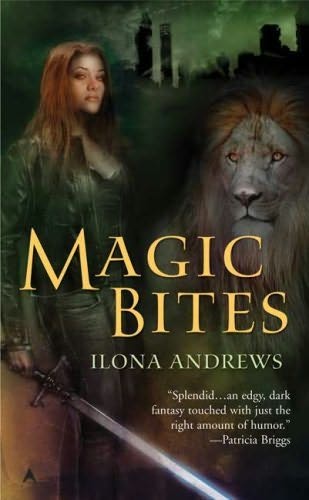
So I will end this review with the suggestion that you go read Magic Bites (Kate Daniels, Book 1)

Ilona Andrews Spoilers, part 2

As I mentioned in the previous post, I attended a book signing by Ilona and Gordon Andrews yesterday evening. In the first part, I described what they said regarding some of their books and stories that were published prior to a week ago. This post describes Gunmetal Magic and future Ilona Andrews publications.

First, there are a few general things about upcoming books, and then more specific spoilers under the cut.

The Kinsman series (currently consists of Silent Blade and Silver Shark) seems to have been primarily written by Ilona (the woman) with less input from Gordon than the other Ilona Andrews (the author) stories. Thus, it was a bit disappointing when she said she didn’t really have any ideas regarding what to write for any future stories set in this universe. Too bad. But she did say that they had plans to write something to post for free on Christmas as a present to their readers, and that story could potentially be set in that universe. I’ll live in hope.

The next book set in the Edge series is planned to be the last of the books. They sold the rights to a TV series, which would be awesome, and is yet still extremely unlikely to actually come to fruition. Depending on reader and publisher interest, Gordon seemed to think there might be another book following a slightly more grown up Jack and George, but there are no real plans for it at the moment.

However, there are solid plans for a Jim and Dali book which should come out after the Kate Book 6 book but before Kate Book 7.

And now, for the real spoilers. If you don’t like spoilers, don’t click the link below.


Continue reading