The Best Books of 2015 (according to the world’s coolest 12-year-old)

Happy 2016, everyone! In late December/early January I typically write a post highlighting the books I’ve enjoyed most over the past year. But I’ve already posted on most of the things I’d want to talk about (Station Eleven, The Martian, Carry On), so let’s do something a bit different. Anna and I were lucky enough to spend New Year’s Eve with some dear friends and their children. I’m sure this won’t come as any surprise, but our friends are also bookish sorts, so we’re always talking about what we’re reading and trading around/gifting each other favorite books. One of the fun parts about watching our friends’ kids get older is seeing them become bookish and getting to introduce them to books we loved as children. But the oldest of the kids is twelve now and it’s become clear that she doesn’t need us to recommend books to her–she can find great things on her own and we should probably start taking recommendations from her. She kindly agreed to contribute a guest blog for us, so here are her top three books of 2015 (all of which are now on my library list):


Ava

1) The Strange and Beautiful Sorrows of Ava Lavender by Leslye Walton. “I love how this book tells the story of many generations of Lavenders. I also love the fact that Ava is actually born with wings!”


stead2) Goodbye Stranger by Rebecca Stead. “This book tells about a girl who has been through a terrible accident and all of her friends. I feel like you can really connect with them, because they do things that real 2015 teenagers do.” [Note: we’ve talked about Rebecca Stead here on the blog before and my love for her now feels validated.]


theo3) Kid Lawyer (part of the Theodore Boone series) by John Grisham. “I love that this kid, Theo, is not afraid to stand up to adults. He is a junior lawyer who knows a lot and stands up for his beliefs. I love reading about his adventures and how he always helps everyone out.”

The Scorpio Races

We’ve talked before about how certain books fit certain times of the year. I wrote a whole post a few years back about good Christmas reads, and Anna has mentioned that A Night in the Lonesome October is an excellent creepy story for Halloween. This year, as the darkness and cold began to descend, I decided to branch out from my typical winter reads and try a couple of new things that I’d seen recommended on social media.

A few people mentioned The Dark is Rising as an excellent Christmas re-read, and it was. This is the second in a series of five middle-reader books by Susan Cooper about children encountering mystical forces in England. The first one in the series is actually my favorite, but The Dark is Rising stands alone so you don’t need to read the others. It’s great for this time of the year because it takes place during Christmas and Advent and feels very winter-y. And although these books are not that old–they originally came out in the 1960s–they feel timeless, and read like classic children’s fantasy without any sort of modern angst or issues.

What I really want to talk about now, though, is The Scorpio Races by Maggie Stiefvater, a book I’ve been avoiding for years but which has now officially joined my To Be Reread Every Year list. Stiefvater has a series of YA books that starts with The Raven Boys that I’ve reviewed here before and enjoyed just fine but didn’t looove. I’d seen discussions online about how The Scorpio Races was her best work–it was a Printz (like the YA Newberrys) honor book in 2012–but the descriptions of the book always sounded so grim, often quoting the very first line of the book: “It is the first day of November and so, today, someone will die.”  Does that sounds cheery? No, it does not. But I finally decided to give it a shot and it’s not a cheery book, but it is suspenseful and exciting and touching and I loooved it.

When I describe the plot this is going to sound like a crazy fantasy novel: every November, on a small island off the coast of (I think?) Ireland, magical, dangerous, predatory horses that live under the water come up on land. It’s island tradition to try to catch one of these horses and keep it under control long enough to win an annual race, which has now become a tourist attraction that is one of the few sources of income on the tiny island. I know, weird. However, once you’ve accepted this premise, the rest of the book is remarkably realistic. There are young people trying to figure out how to make a life and a living on a remote island, sibling dynamics, challenges of established gender roles, some solid villains, and a love story (which I am always a sucker for). The characters feel modern and relatable, but the remote island setting and lack of discussion of cell phones or other technology make the story feel out of time, like it could be taking place anytime from 1900 to today. And it’s always raining or foggy, and everyone’s always cold and wrapping up in sweaters, so it really is the perfect thing to read while under a blanket, drinking hot tea in the early winter darkness.

It took me a little time to get into this book, because the first few chapters felt so ominous. For the first 100 pages or so I had to talk myself into reading it each night because I was so so worried about what might happen next. After a little bit I got so swept up into the story that I couldn’t put the book down, but I definitely felt anxious at first. I don’t want to give away any spoilers, so let me just say that if you start the book and you’re thinking, like I was, “Everyone and everything I love in this book is going to come to a terrible end,” don’t worry. Things get intense, but you’ll come out of it with hope, not despair.

Kinsey’s Three Word Review: Nerve-wracking autumnal adventure.
You might also like: The New Policeman, by Kate Thompson, another YA book set in Ireland with a supernatural twist, and So You Want to Be a Wizard, a childhood favorite of mine that always leaves me with the same emotionally wrung out feeling as The Scorpio Races.


Ms. Marvel Volume One: No Normal

I have a complicated relationship with graphic novels and comic books. Short version: I don’t like them. I want to like them, I’ve tried to like them, I completely believe that they are a valid art form and that these artists and writers are on the forefront of innovations in storytelling. It’s just, whenever I try to read one, I get distracted and eventually give up. I end up annoyed that I have to skip around the page to look at things and find information, and inevitably wind up thinking that all those pictures take up SO MUCH SPACE and things move SO SLOWLY. Wouldn’t the plot move so much faster if they just wrote it out in words? I like TV and movies and paintings and other visual arts, but there’s something about sitting down with a book that makes my brain expect narrative text. I mean, I’ve read Maus and Fun Home like a responsible citizen and those were fine, but I couldn’t help thinking that I’d have rather just read traditional books about those stories. So at some point I just accepted that graphic novels and comic books weren’t for me.

But recently some things happened that made me decide to give graphic novels another shot:

  1. I mentioned in my last post that I was recently on vacation in France, where I visited approximately one thousand four hundred old churches. In one of them (the cathedral at Rouen, to be precise) we had an awesome young tour guide who spent a lot of time talking about how the stained glass windows would have been like comic books for medieval churchgoers. She said that while these peasants may not have been able to read, they understood how to approach the windows as a story, and how to interpret certain visual cues (like a woman in blue, or a man with a key) as concrete characters and plot points. I love stained glass (Jane Brocket is a longtime favorite blogger of mine who has been on a stained glass roll lately) and the idea of viewing comic books or graphic novels as modern-day church windows is very appealing to me.
  2. On that same vacation, I had a long conversation with a woman about audiobooks, another thing I long ago decided was just not for me. She talked about how she had initially hated audiobooks too, but that she spent time actively practicing listening to audio fiction and came to really love it. She said that it became clear to her that listening to a story was a different sort of attention, and that she had to get used to it, but she was so happy that she had. I figured this might be the same with graphic novels–in order to fully enjoy them, I would need to learn and practice a new way of reading.
  3. The folks on Pop Culture Happy Hour, who have been the source of so many things I love, spent an episode raving about Ms. Marvel, a series about Kamala Khan, a teenage Muslim girl living in Jersey City who develops superpowers.

A modern-day teenage girl’s coming of age story with supernatural elements? it’s everything I love! I decided to give it a shot, and got the first volume of collected issues from the library. And . . . I liked it! I found the characters surprisingly nuanced, especially Kamala’s family. As I started reading, it seemed pretty clear that her parents would be the conservative force she had to push against and her older brother was portrayed as a fairly radical Islamic scholar. But they all became more real and complicated as the story went along. The high school dynamics felt real, and there was even the early set up for a future love story. I also tried to really pay attention to the pictures. Instead of just reading through all the text, one panel after another (my first instinct), I stopped and tried to really look at the drawings and all the details. And I did like the style of illustration–I don’t have enough comic book vocabulary to accurately describe it, but it seemed more straightforward and less . . . floofy than some graphic novels I’ve tried to read in the past.

I’m not sure I’m 100% converted. Things still moved awfully slowly and it didn’t feel like all that much had happened by the end of Volume 1. I suspect that this is largely because I am thinking of the physical Volume 1 as a book and I have certain expectations of a book–I want some things to happen and some resolution of some sort. It’s probably more accurate to see a volume as a few episodes of TV, with an on-going storyline. But also, this volume consisted of five issues and it took me about an hour to read. As much as I enjoyed looking at the pictures, it doesn’t feel like something I would read over and over. I’m lucky that I live in an area with a great library system that has the three available volumes in its collection. But if I had to buy these, they would cost me around $10-$15 each. Which feels like a big outlay for limited reading material? Finally, I came into this story at a point where there already were three complete volumes out, so I imagine that I’ll be able to cover quite a bit of ground right away. But it looks like individual issues (one fifth of a volume) are released monthly, and I cannot imagine I would ever have the patience to read a story at that pace. Maybe you have to be raised on comic books to able to handle that?

I’m definitely going to get the next couple of volumes to find out how Kamala balances her new power and her high school life and her family. But I’m still not sure if I am enjoying reading this graphic novel, or if I’m enjoying this story despite the fact it’s a graphic novel. I will report back.

Carry On

My past entries here have made it clear that I am a Rainbow Rowell person. Eleanor and Park is one of my favorite books ever, and I loved Attachments and Landline. Plus, Rainbow is adorable both on Twitter and in person. (I am not a stalker, I promise.) But I was nervous when she announced that her latest release would be a sort of spin off of Fangirl. Rebecca reviewed Fangirl here on the blog, and while I think I liked that book more than she did I agreed that the pacing was a little odd. And I was pretty indifferent to a major plot point of that book–the Harry Potter-esque book series that the main character wrote epic, popular fanfiction about. Fangirl didn’t actually contain any of this fictional story, but you heard a lot about it over the course of the book. While I liked Fangirl‘s treatment of fanfiction, I wasn’t particularly interested in the wizard-y story itself–it didn’t seem worth my time to think about these characters that felt extra, extra, fictional (books within books!). So when I heard that Carry On would be an entire book those Harry Potter-like wizards fighting evil at a magical boarding school, I was not excited. But then Nicole Cliffe at The Toast (Best Website Ever) started raving about it, and The Toast published a lovely interview with Rowell. And I always knew I was going to read it, so I bought it to take on vacation. And hear me now: it was so good and I was so wrong.

Honestly, Rowell herself seems to have worked a magic trick here. Carry On is clearly inspired by Harry Potter and uses Harry Potter as scaffolding in some ways, yet has an entirely different feeling. Despite the presence of magic, it’s a bit less of a fairy tale and is grittier and funnier–it definitely has a more modern feeling that I would have predicted, based on the descriptions in Fangirl. The book is clearly meant to the culmination of a long series of adventures (as if it were the seventh Harry Potter) and it refers to all sorts of past events, but I was never lost or confused by what was happening. The writing made it feel like you were jumping right into conversation with beloved characters. Rowell also introduces some new, clever ways of dealing with magic. For example, in her world spells are not made-up Latin-y words, but are cliches or nursery rhymes or lyrics–words whose power comes from people using and knowing them. Like, there’s a scene where a u can’t touch this spell doesn’t work on a dragon because the dragon doesn’t know the song. And Carry On does something that I don’t think Harry Potter even quite manged–it tells a really charming, compelling love story, which is really the heart of the book.

As I said, I read this on vacation and I almost wish I hadn’t because once I started all I wanted to do was keeping reading. On multiple occasions I chose to read this rather than pay attention to what was around me, even though what was around me was France. (I liked the book so much, I actually feel okay about this.) This would be the perfect book for a long plane flight or rainy weekend, when you just want to immerse yourself in a new world and ignore everything around you.

Also, I want to note that you don’t have to have read Fangirl to follow Carry On. This book is completely free standing and independent of Fangirl and (I think) is much better. Although I like Fangirl more now, knowing that it eventually led us to this.


Kinsey’s Three Word Review:
Suspenseful, magical romance

You might also like: I’m going to assume that everyone has read Harry Potter and that you’ve all been listening to me and reading Rainbow Rowell’s other books. With that in mind, I’m going to recommend John Green and David Levithan’s YA writing. They both have more famous books, but their collaboration on Will Grayson, Will Grayson is one of my favorites and has a similar feeling to this. Neverwhere by Neil Gaiman is another solid recommendation featuring a clever magic world, although it’s a bit darker.

Moving Pictures

While this is a book blog and we are all book people, we are not anti-TV. We love TV! (Basically, we are just indoor kids.) None of the books I am reading at the moment lend themselves to blogging, but I have watched some GREAT TV this summer* and look, I have a blog! So here are my summer TV recommendations:

UnREAL–This Lifetime drama is set behind the scenes of a fictionalized version of the Bachelor. Did every element of that sentence just make you roll your eyes? Listen, this is not a typical Lifetime show and it’s not really about reality TV. It’s a drama about the trade-offs people make between professional success and personal happiness, and about how far you can bend, ethically, before you break. The most amazing thing about the show is the main character, who I have seen described as a female anti-hero, a reality show Walter White. Shiri Appleby (who I have loved since Roswell and who was great in Life Unexpected, which only I watched) plays Rachel, a producer on the show. She does terrible things, but your heart still breaks for her. Also, she generally looks awful, especially when compared to the glammed out contestants, which was genuinely surprising to see from a woman on television. The first season is just 10 45-minute episodes, and every one gets wilder and wilder. I watched this on my cable’s OnDemand but I think it’s also on the Lifetime app and/or website.

Catastrophe–This is a tiny little show, 6 half hour episodes, and my only complaint is that there is not enough of it. The premise is that an American business man goes to London, has a week-long fling with a British woman, and she gets pregnant. He decides to move to London to be with her and the baby, and the show is them trying to navigate this weird situation like grown-ups. It’s hilarious and raunchy and awfully sweet. As a bonus, Carrie Fisher plays his mother, who is awful. This is available on Amazon, free for those of us with Prime.

The Fall–We all knew that Gillian Anderson was cool, but I am now dedicating my life to becoming her character in this show. Stella Gibson is a British police officer who goes to Belfast to investigate a series of murders being committed by a remarkably well-adjusted serial killer (played by Jamie Dornan). The show spends equal time with these two main characters so, as a viewer, you always know what’s going on–this isn’t a whodunit, it’s about the cat-and-mouse game of the police desperately chasing this guy and him evading them. But the best part is that Stella is this whip smart, sarcastic woman with no patience for men, who always wears the most perfect silk blouses, and is always in control of the situation. My friend Lisa brilliantly summed her up by saying that she’s what Claire Danes’s character on Homeland could have been, if she weren’t so busy crying and falling in love. The show itself is dark and creepy and made me check the chain on my door over and over, but it’s also hypnotic. Watch it on Netflix and turn on the closed captioning so you don’t miss anything between the whispering and the accents.

*One of things that has allowed me to watch all this awesome TV is that I recently got a Roku. I really do not understand all this fancy technology the kids have these days, but I asked my little sister what I needed to do to make Netflix show up big on my TV and she told me to buy a Roku. It was $80 on Amazon, it took me 20 minutes to set up, and it’s amazing.

Finally, just to spread the love across media platforms: a podcast. I have an annoyingly long commute and podcasts keep me sane. Mostly I listen to pop culture podcasts, but I recently found the History of English podcast and I am hooked. This is a VERY detailed review of the history of the English language, starting with it’s earliest origins. Have you ever wondered why sometimes we pronounce the letter c like an s and sometimes like k? There’s a whole episode about that! Would you like to know how the ancient Hittite language is related to English? You’ve come to the right place. This is maybe the geekiest thing I think I have ever been interested in, and that is saying A LOT. There are 60 episodes and counting, so this is an investment, but that’s a plus for me as I look into a future of morning rush hours. Plus, as someone who had years of speech therapy and can still just barely control what sounds come out of my mouth, I am fascinated by linguists who can demonstrate what Old English or Proto-Indo-European would have sounded like. That ability feels like a superpower to me, and the host of this podcast does a great job of it.

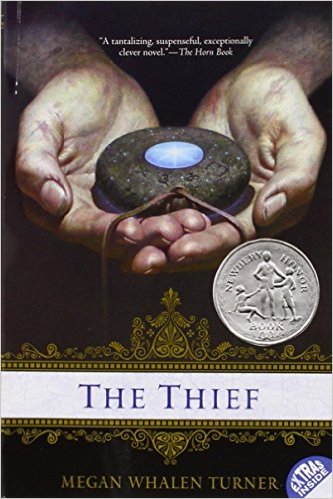
The Thief

thiefAges ago–maybe two or three years ago–Anna sent me a Kindle book called The Thief, by Megan Whalen Turner, as a gift. She told me it was YA fantasy/adventure book that she really liked and she thought I would like too. And I read it and I thought it was fun and and well written and had an interesting twist at the end, and I moved on with my life and didn’t think about it again. Then a few weeks ago I was on vacation, sitting on the beach, and when I finished my trashy romance novel I didn’t feel like walking back the beach house to get another book. So I started poking around my Kindle, looking for something else to occupy me until I was willing to leave the beach, and The Thief popped up. I started re-reading it and was reminded of how much I enjoyed it and then a tiny voice emerged from somewhere in the depths of my memory: could there be . .  did Anna say . .  is there a sequel? You guys, there wasn’t just one sequel, there were THREE, and apparently two more books on the way. And as much as I liked The Thief, the two books that came after it were so so good that I am now completely obsessed and desperately waiting for number 4 to come in at the library.

So The Thief is about a thief (yes) named Gen who we first meet in the king’s prison after he was caught stealing something audacious and then bragging about it in the pubs. Enter the king’s magus, who offers to get Gen out of prison if he will use his considerable thieving skills to steal something important for the king. The thief, the magus, and the other folks in their little party then ride around dodging soldiers, looking for this mysterious object, and trying not get killed by any of their enemies. The actual thing they’re trying to steal was a bit of a MacGuffin for me, but Gen is a smart, tricky character, and up until the last minute it’s never quite clear who’s using who and how much Gen is controlling the situation. It’s suspenseful with a dark edge (there are deaths along the way and prison is not sugar-coated), but Gen himself is very entertaining.

It’s the second and third books that take the action to a whole new level with intrigue and awesome characters and complexity. However, it’s challenging to talk about these, because you can’t even describe the most basic plot elements of any books past the first without ruining the fun of the first book. So I’m not going to say a word about what happens in the rest of this series–I’m not even going to write out the titles. You’re just going to have to trust me when I say that books get twistier and darker and better.

This is like when I owned paperback copies of the Philip Pullman’s Sally Lockhart books, a YA Victorian mystery trilogy he wrote before his famous His Dark Materials trilogy. They’re great books that I was constantly loaning to people, but reading even the first line of the description on the back of the second book just about ruined the first one, so I taped post-it notes over the back of the books so that I could hand someone the whole stack with spoiling them on the plot before the were ready. So consider this review a virtual stack of books with post-its taped on the back. I love these books. The third one is my favorite, but these are quick reads and fit nicely together as one whole story. I should have listened more carefully to Anna when she initially told me about these, since she’s always right these things. Don’t make my mistake!

Kinsey’s Three Word Review: Dark, complicated adventures.

You might also like:
The Phillip Pullman books that I mentioned, actually, as well as a number of things that we’ve already raved about here: the Graceling books by Kristen Cashore, The Girl of Fire and Thorns trilogy by Rae Carson, and the His Fair Assassin trilogy by Robin LaFevers (the killer nun books). You might also like Cinda Williams Chima’s series that starts with The Warrior Heir, a fantasy YA story that did a number of interesting things and that hasn’t gotten nearly the attention it deserves–it’s the better version of the Mortal Instruments series.

The Royal We

royal

One of my favorite places on the internet is Go Fug Yourself, which you could describe as a celebrity fashion blog. However, the site is so much smarter and kinder than that makes it sound. Heather Cocks and Jessica Morgan, the two women who run the site, do post pictures of celebrities and discuss their clothes, but a few things make them very different from TMZ or some of the other less savory celebrity sites:

  • They are VERY careful to criticize the clothes and not the person, so their comments often end up being along the lines of, “You are so much better than this is outfit!”
  • There is really no body shaming at all
  • They are interested in fashion as an industry and an art, and cover fashion shows as well as celebrities
  • Their Friday links round ups are great
  • They are legitimately good writers, so their commentary is smart and often spins off on these hilarious tangents. Like, they’ve created a whole persona for Jennifer Lopez, so whenever they cover one of her outfits, the commentary is all from her (fictional) point of view, and fictional Jennifer Lopez is a total badass.

While Go Fug Yourself is still going strong, in the past few years Cocks and Morgan have turned their writing skills towards books, starting with a YA series that includes Messy and Spoiled. I thought those were nice if not exactly my cup of tea, but I am all in for the recent adult title The Royal We.

First you have to know that Cocks and Morgan are obsessed with the various royal families around the world—they will happily review the fashions at the wedding of minor royals from Luxembourg—but with Will and Kate specifically. They’re not alone in that, certainly, but they turned their obsession into a charming romantic novel. Their premise is that a fun American college student went to study abroad at Oxford for a year and met, and fell in love with, a young Englishman who just so happens to be in line to be king. The tabloids go wild, but what is actually happening behind the scenes? What is it like to be the focus of all that attention?

The book walks a careful line, in that it’s clearly inspired by Will and Kate and the current House of Windsor but it changes enough to keep from being a flat-out Lifetime movie retelling or feeling exploitative. (They branch off from official British history around Queen Victoria.)  And Cocks and Morgan have done their research—the story includes details about life at Oxford and in Buckingham Palace, and the descriptions of dressing for the cameras and running from paparazzi clearly reflect their years of writing about celebrities. And they manage to make the characters, including the Queen, feel like real people.

My sister read this book before I did, and her entire review was: fun, but a little too long. And I think she summed it six words what it is going to take me hundreds to do here. While things could have been a little tighter at the end and the story spins off into an unnecessary sub-plot with the Kate character’s twin sister, overall the book was a very enjoyable way to spend some summer afternoons. If you spend as much time reading People and Hello magazines as I do, you’ll especially enjoy matching the fictional characters to real people. But even if you’ve never gotten at 5:00 in the morning to watch a royal wedding on TV, the story is still chatty and fun, with a sweet love story at the heart of it. Also, how cute is that cover image?

Kinsey’s Three Word Review: Sharp, sexy, and sweet.

You might also like: something by Meg Cabot (she’s written about a zillion, but the Size 12 is Not Fat series has a similar flavor) or Liane Moriarty (What Alice Forgot is my favorite) for more smart rom-coms. If you like how-the-1%-live stories, Crazy Rich Asians by Kevin Kwan is fun. If it’s the British aristocracy that catches your attention, the non-fiction To Marry an English Lord is a super-entertaining history of the rich American girls (including Winston Churchill’s mother!) who went to the U.K. and married cash-poor British nobles after the snooty American upper crust snubbed them for being new money. And if you just want more celebrity fashion discussion, Genevieve Valentine (an author Anna has talked about here before) writes fabulous red carpet rundowns that discuss pretty dresses and how celebrity fashion is actually an elaborate, coded form of communication.

The Martian

Sometimes you want to read a carefully-crafted literary masterpiece, where each sentence is like a tiny poem, where you find yourself going back to re-read passages just to enjoy the language. If that’s what you’re looking for, let me suggest that you pick up All the Light We Cannot See by Anthony Doerr or The Bone Clocks by David Mitchell. But sometimes you’re sick of depressing, heavy prose and you just want to read something FUN and AWESOME that makes you stay up reading until 2:00 in the morning because you absolutely have to know what happens next. In that case, go find The Martian by Andy Weir.

Part of the fun of the story is not knowing what’s coming next, so here’s all I’ll say about the plot: Mark Watney is an American astronaut on mission to spend two months on Mars. But six days into the mission a disastrous series of events leaves him stranded on the surface. He’s alone, NASA thinks he’s dead, he has no way to communicate with Earth, and both his air and food are limited. What’s he going to do? The author prided himself on being as accurate as he could be (in a book about people on Mars, anyway) so there’s a lot of very technical discussion–not science, exactly, more like engineering–and, I’m going to be honest here, a lot of math. But it was easy to skim over the various calculations of air volume and explanations of how things work and focus on Mark himself, a resilient, resourceful smartass who you start rooting for immediately.

Andy Weir has gotten all sorts of press for the Cinderella story of this book–he initially published the book chapter-by-chapter on his website, then self-published on Amazon before getting picked up by a publisher and getting on all the best-seller lists. And the book somehow feels like a self-published serial story, but I don’t mean that in a bad way. The plot moves like a freight train, and Mark has a very clear, strong voice. I am not sure whether Weir’s going to be able to follow this one, but I had lots of fun reading The Martian more than anything I’ve read in a long time.

Kinsey’s Three Word Review: Completely un-put-downable fun.

You might also like: Space movies! Specifically, Apollo 13 and Gravity, which are both more like this book than anything else I can think of. And, in fact, The Martian is going to made into a movie starring Matt Damon, who is exactly who I would have picked to play the smart and likable main character.

Special Father’s Day Alert: Is your dad as impossible to shop for as mine? If you’re also at loose ends for a Father’s Day gift, consider The Martian! While I loved this book, it also struck me as a very Dad Book. I am aware that dads are different, but mine is getting a copy of this because it is perfect for him–science-y, funny, space-y, guy-ish, full of problems to be solved, etc. Very Dad.

Non-Post-Apocalyptic YA Omnibus

We are big fans here at Biblio-therapy of YA books, and we’re big fans of sci-fi/fantasy/urban magic/werewolves and vampires/teenagers living in a post-apocalyptic wasteland books. And after The Hunger Games, the publishing industry turned out so many YA fantasy novels that you could have used them all to build a compound to protect yourself from the inevitable zombie hordes. There’s even a parody Twitter account–Dystopian YA Novel, brought to you by them same writer as the genius Guy in Your MFA account that Anna mentioned recently–gently mocking some of the Katniss stereotypes that have popped up. I have read many many many of these books, and the recent Divergent movies have reminded me of my love for world problems that can only be solved by teenagers. But sometimes you don’t want to read about the savior of the remains of the human race and her love triangle, you just want an old school YA romance book. I’ve recently read three YA books that are, well, it’s not fair to call them simple, because they’re all well-constructed, thoughtful books, so let’s say straightforward. Teenage boys and teenage girls and high school and parents and all that stuff we’ve all dealt with, minus any future overlords or factions or teenage warriors.

How To Love by Katie Cotugno tells the story of Reena and Sawyer, long-time family friends, who get together in a terribly romantic fashion, but she gets pregnant, and he leaves homes without realizing that she’s having the baby. Two years later he shows up again–how will Reena and Sawyer and their complicated, prickly families put all these messy pieces back together? (The story moves around in time, so this isn’t really spoiling anything.) My favorite thing about this story is that it would be very easy for the book to be judgmental about Reena getting pregnant as a teenager. And there are characters who judge her for it, and she sometimes judges herself, but the book itself is very neutral and (thankfully!) does not turn into an anti-teen pregnancy PSA.

Althea and Oliver by Cristina Moracho first won my love by being set in the mid-1990s, time of my youth. But that’s really secondary to the plot, about two childhood friends who might be moving towards more. There’s a whole thing where Oliver has a weird sleep disorder, and Althea might have another boyfriend, but their relationship is the heart of the book and it rings true. Althea and Oliver also both feel real, while at the same time being unlike other teenager characters I’ve read.

Finally, All the Bright Places by Jennifer Nevin is the book I am wariest of recommending for a couple of reasons, but I’m including it because I’ve kept thinking about it days after finishing. This is another boy-meets-girl story, but it starts out from a darker place that you might expect and doesn’t get much brighter, despite the title. The point of view alternates between high-school students Violet and Fitch. Violet, in particular, came across as a very cool girl I would like to be friends with, and the politics of high school were felt painfully accurate. But I also found the character of Fitch unbelievably annoying–like, every smart-ass guy I have ever hated all rolled into one. I also hesitate because something happens at the end of the book that I found very upsetting. I know not everyone is a delicate flower like I am when it comes to books, but I hate to recommend something that will be disturbing to readers. I don’t want to give away any critical elements of the book, but if anyone wants more spoiler-y details, I’m happy to be more specific in the comments. So, as long as you’re prepared for things to turn a bit dark and Afterschool Special, the writing and characters definitely stand out.

I should say here that all of the books get pretty R-rated. Characters have sex. I mean, I’d rather my hypothetical children read any of these well-written, full-of-heart stories than Twilight or the Sweet Valley High books that I read as a kid. But I probably wouldn’t give these to any of the children I know without making sure their parents had read them first.

Finally, have you read Eleanor and Park by Rainbow Rowell yet? If you haven’t read Eleanor and Park, go start your YA reading with that, since it remains one of the best things–YA or anything else–that I have read in years.

Station Eleven

It’s still early in 2015, but I feel pretty confident saying that Station Eleven by Emily St. John Mandel will be on my list of the year’s best. I just loved this book. And I think that almost everyone could love this book, because it is so cleverly structured and covers so many kinds of stories without being too dense or 1000 pages long.

The short plot summary is that at some point much like today a pandemic swept the planet and killed 99.9% of the population. Twenty years later, a traveling symphony/theater company tours around the Great Lakes, playing music and performing Shakespeare for small settlements of survivors. This makes it sound very grim and futuristic, but it isn’t. The story jumps around in time and from character to character, so there are bits of stories happening long before the pandemic hits, and then during it, and at different points in the years afterwards. Which means that part of the book is “what you do when the world is falling apart” and part is “how we live in the new normal,” but another big piece of the story is about actors and artists trying to balance fame and creation and marriage in current-day Hollywood. The brilliant Swistle called the shifts in time and characters a relief, and that’s the perfect word–just when I would start to think I couldn’t handle what was happening in a particular story, the narrative would move forward or back and let me take a deep breath and keep reading.

In general, I appreciated that the story wasn’t unbearably dark. While the pandemic certainly doesn’t sound like any fun, Mandel focuses mainly on the very beginning as people are realizing what is happening, and then on life years later as people have adapted to to world post-pandemic. Maybe some people want the realism of The Road, but I am a delicate flower who can’t handle reading that sort of thing. And I was much more interested in hearing about how even with all the losses, there is still beauty in the world (painted on the side of the traveling symphony’s caravans is the motto “Because survival is insufficient”). I also loved the question that came up over and over of whether it was better/easier to remember what once was, or to have been raised only knowing what is possible now.

I always joke that my plan for the zombie apocalypse is to die in the first wave and not have to try to survive, and I stand by that. But this is one of the first books I’ve read that managed to make me incredibly grateful for air travel and refrigerator lights and antibiotics, while also making me feel like the World After might have some hope after all.

Kinsey’s Three Word Review: Graceful, sad, and hopeful.

You might also like:
This book has the DNA of about 12 different books–it reminds me of everything. If you like the world-falling-apart bits, I’d recommend reading the Susan Beth Pfeffer Life As We Knew It trilogy, the The Age of Miracles by Karen Thompson Walker, or How I Live Now by Meg Rosoff (one of my favorite books of all time, although it’s so sad I’ve never been able to reread it). For more of the how-society-rebuilds pieces, try The Passage by Justin Cronin (actually mentioned by Mandel in Station Eleven). But if you like the traveling band of actors/Shakespeare parts the most, you might try The Great Night by Chris Adrian or the Canadian TV show Slings and Arrows. And while Could Atlas is a hard book to recommend–long and dense and people tend to love it or hate it–it has a similar “a bit of everything” feeling to it.