The Archer by Paulo Coelho illustrated by Christoph Niemann translated by Margaret Jull Costa 2020
I picked this up randomly at the library when I was searching for something else, and I’m glad I did. It’s a short book (only 160 pages) with beautiful illustrations, and it feels like a combination of Zen and the Art of Archery by Eugen Herrigel and Sun Tzu’s The Art of War. The text is not quite poetry, but I want to refer to the verses rather than paragraphs, due to the care and curation that has gone into the prose. It’s a short book but not a quick read, not because it’s difficult but because it leads me to slow down and take breaks and think about what it’s saying.
It has an extremely basic framing story where a boy discovers that the local carpenter in his little village is a famous archer, and asks him how one masters archery. The archer says that he can tell the boy how in an hour, but doing so takes years. The bulk of the book is made up of the short descriptions on what it takes to master a skill and thus master oneself. It’s essentially a book of meditations, with the skill of archery being itself a framework for self improvement.
The framing story sets this book as fictional with characters and events — that was what had originally drawn me to it and I enjoyed both the opening and the closing chapters — but it feels more like nonfiction to me. This book consists of the advice man gives to a boy about how to live a good life: how to be a bow, aim an arrow, pick a target, and be respectful of it all.
Also, the illustrations really are gorgeous, in a very simple style.
A Sunny Place for Shady People by Mariana Enriquez translated by Megan McDowell 2024
This is not at all my usual genre, but I really enjoyed it and was impressed by it. I noticed only after reading it that while I got it from the New Releases section of my local public library, it is marked as ultimately intended for the Horror section. I probably wouldn’t have given it a chance if I’d noticed that before, but the title, the cover, and the blurb about a fantastical and hypnotic view of Argentina drew me in. The twelve short stories are horror, but more significant to me is the way they lean in to the magical realism of living in a world where the supernatural is right around the corner. There’s a dream-like quality to all the stories with no clear line between reality and hallucination. And a decided implication of: maybe all the hallucinations are real.
While I often read stories in anthologies out of order, I read this book from front to back, in order, and it was absolutely the right choice. The stories feel like steps down into deep water, creating a path that doesn’t dunk the reader too quickly and also gives a good exit. The first story, “My Sad Dead”, is nearly soft in its portrayal of death, and the trauma for both the dead and surviving. And the second story, the titular “A Sunny Place for Shady People” is a love letter to the people who enjoy delving into the macabre. The sexual violence that comes in the third story “Face of Disgrace” is merely a prelude to the body horror. By the eleventh story, “A Local Artist”, I was reminded of Hieronymus Bosch paintings of demons and temptations. But the twelfth story, “Black Eyes”, felt like a happy ending: they got through, they got out. None of the stories are directly related to one another, they all have different characters and different scenarios, but together they create a version of Argentina that is filled with people trying their best to live their lives even when violence and trauma has left long lasting wounds.
On the one hand, this book kind of needs all the content warnings — body horror, medical horror, psychological horror — but on the other hand, none of it felt gratuitous, and it was really well done. Those warnings would have put me off reading this, so I’m glad I didn’t get them. I also consider these stories an example of the noir genre, which is another genre that I don’t particularly care for, presenting a deeply cynical perspective on humanity. But that the perspective of every person being deeply flawed and just doing what they can to survive, feels like a kindness rather than a condemnation in these stories.
I really enjoyed these stories, even though I had to read them one by one, taking a break between each one. They’re extremely well done and well worth reading and I want to highly recommend them, while also giving the caveat of: take care of yourself.
It is all too easy to buy a whole bunch of really cool graphic novels from either Small Press Expo or Toronto Comic Arts Festival, be absolutely delighted with them all, and then go home and get distracted from actually reading them, in part because there are so many and where do I even start? (It turns out collecting books and reading books can be two separate hobbies!) But I don’t want to forget about these in my ever-growing to-read pile, and so here are another three graphic novels that I acquired, read, and enjoyed.
She Walks With The Giant by John V. Slavino 2022
This is a beautifully illustrated book with gorgeous vistas set in a post-apocalyptic world in a fantasy ancient Asia. The girl is an orphan in a ghost town who first sees the giant robot appear, and decides (much to the giant robot’s dismay) to follow along. The first part of the book is an exploration of the world as it is, while the second part is an exploration of the history that brought it to this point, where the giant came from, and how there’s no real escape from being part of that history.
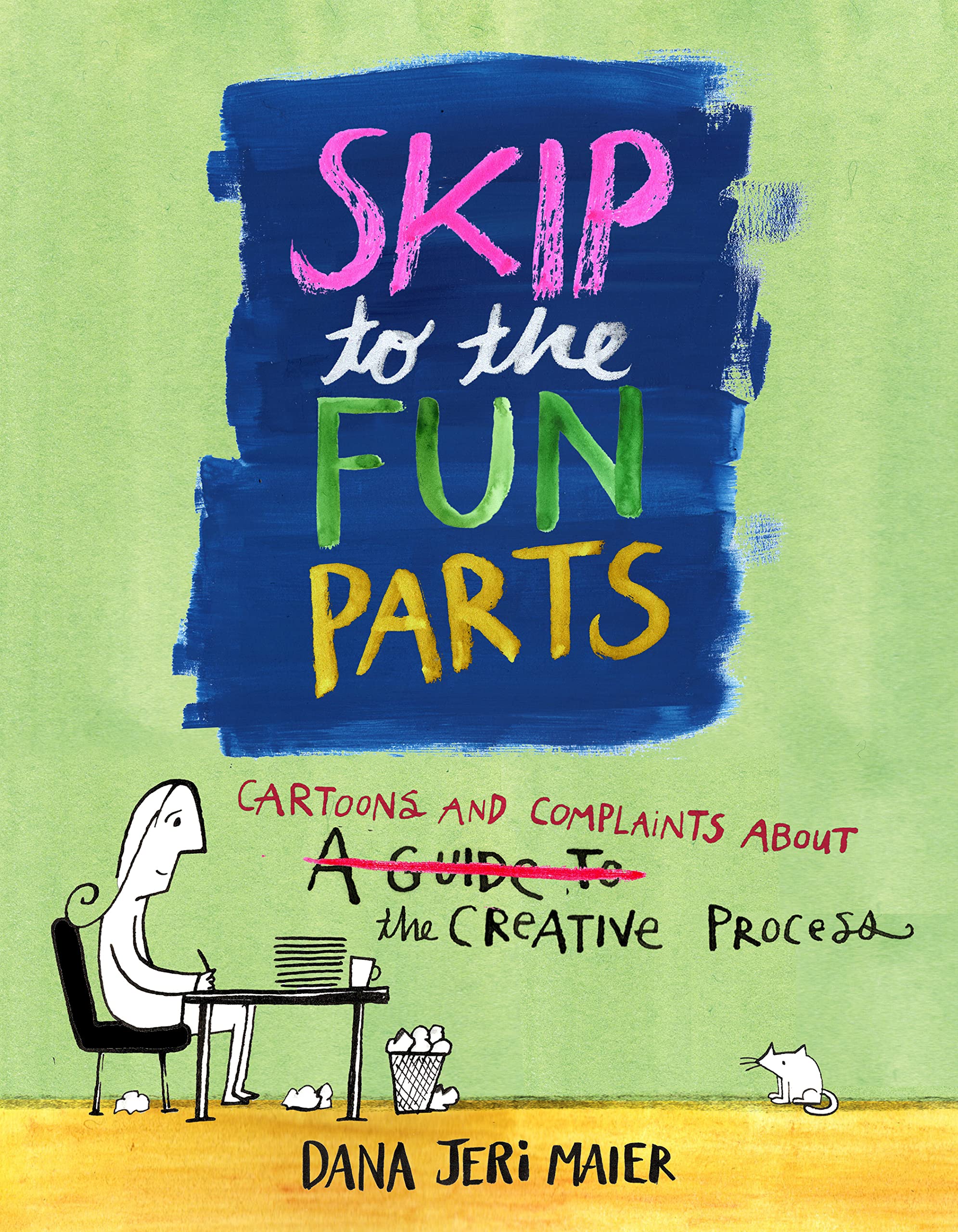
Skip to the Fun Parts: A Guide to Cartoons and Complains about, the Creative Process by Dana Jeri Maier 2023
Admittedly I bought this with the expectation that this would be something of a guide to the creative process written by a published graphic novel writer/artist despite the clear strike-through of those exact words, and it’s decidedly not that, but I still found it remarkably reassuring and comforting, and also extremely funny and with a few good ideas thrown in. It felt comforting to see someone successful face some of the same issues I am with energy vs inspiration, and still persevering with good humor.
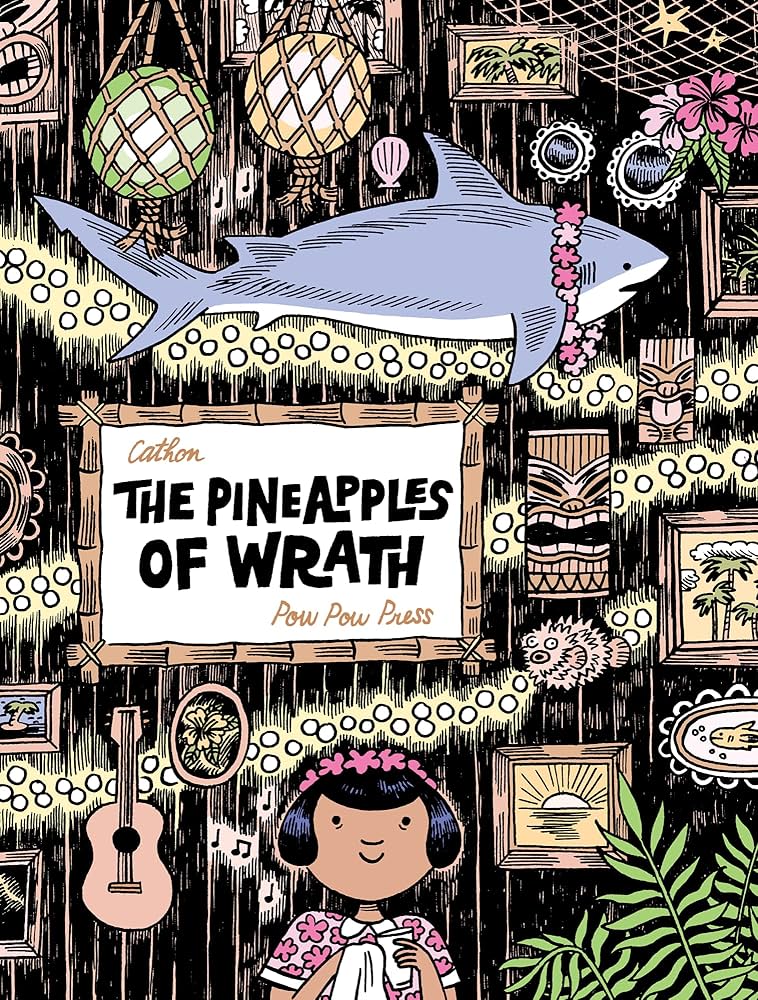
The Pineapples of Wrath by Catherine Lamontagne-Drolet 2018
A friend who wasn’t particularly interested in graphic novels was curious to try one out and asked for a recommendation, so we asked her what genres she generally read, since graphic novels come in all genres. At which point she asked for a cozy mystery and Anna and I were both stumped. Graphic novels do come in all genres… but that was a rare one! However, we persevered and found a cozy mystery graphic novel: The Pineapples of Wrath, which is hilarious and adorable and has quite the body count as Marie-Plum, bartender and mystery-reader, determines that her elderly neighbor was murdered and if the police won’t investigate, then she will! The setting is a fictional little-Hawaii neighborhood in Québec, Canada, and it is just as ridiculously touristy as you can imagine and maybe a bit more.
The Incredible Story of Cooking: from prehistory to today, 500,000 years of adventure written by Stéphane Douay drawn by Benoist Simmat translated by Montana Kane 2021, 2024
This is such a fabulous premise, and at first glance it looked well done, with good art and nine chapters creating an interesting outline about a truly fascinating topic. I was extremely pleased to acquire it at the last Small Press Expo. After reading it, though, my conclusion is that it was… decent. But it didn’t live up to the premise and that was ultimately disappointing. As a 200-page graphic novel covering 500 thousand years of global history, it was obviously always going to be a quick skim over the topics, but it often felt more like disjointed trivia rather than even a summary. There was some general overview and where there wasn’t, the trivia was still fascinating.
What really struck me, though, was that the authors don’t seem to appreciate or enjoy food. Given that it was about how people throughout history had developed all sorts of wild cuisines, it was weird and off-putting how the authors’ distaste for those cuisines came through so much stronger than the historical figures’ enjoyment of them. There was more focus on the politics of food distribution than there was on the development of the dishes, and the text was often felt both judgemental and mocking.
There were a number of basic recipes that were referenced in the text, but of course were very generalized in such a way that you couldn’t actually follow them, which makes sense for being embedded in the story. However, there’s also a section at the end that contains 22 recipes from around the world and throughout time, and they just aren’t good recipes. It’s not that the dishes aren’t good, but that the instructions are poorly written, with ingredients and processes skipped or listed out of order, and written in ways that introduce a lot of ambiguity. An experienced cook or baker could probably fill in the blanks, but they are clearly written by someone who doesn’t cook or know how to write directions for others to follow a process.
I don’t want to just slam this book, because it was interesting and well-illustrated, but it was such a great concept. Why couldn’t it have been better?
I’ve enjoyed Novik’s writing for years (decades?) at this point, so it comes as something of a shock to realize that this anthology increased my opinion of her as a writer. How was that even possible? Did I not already know that she was a fabulous writer? But this books has such an incredible breadth of stories, each with their own world-building and characters and tone. Some of the stories I liked more than others, but all of them impressed me.
There are thirteen short stories and/or novellas in this collection, and I’m not going to specifically review them all, but just call out a few:
“After Hours” was a wonderful return to the Scholomance, after the events of that trilogy, with the introduction of another whole culture of magic, because the world is full of different cultures, and so too would be an international school.
“Spinning Silver” is the original story that later grew into the novel, and thus has a lot of duplication, but also some fascinating differences such that I’m torn between which I like more.
“Seven Years From Home” is a stand-alone story in an entirely new universe, a science-fiction universe that almost takes as its premise that anything sufficiently understood is science rather than magic, and addresses politics and war profiteering. It’s almost comforting in its cold ruthlessness and dissection of the hypocrisy that can saturate a seemingly benign culture.
“The Long Way Round” is a story that’s not precisely a stand-alone one, but is a test piece for a new universe that Novik is working on, something that may well grow into a new novel or even a new series, developing a world and characters with a magic system, and political lines, and social structures. And this is the first view of it, and it is fascinating.
The Full Moon Coffee Shop by Mai Mochizuki 2020 translated by Jesse Kirkwood 2024
This is a charming story about interconnected characters facing difficulties in their various careers getting their lives sorted out and on a better path, via dreams of a little pop-up coffee shop run by cats/gods who explain their astrology charts to them.
So, to break that down:
It’s charmingly written. Kudos to both the author and the translator!
The characters are all adults struggling with adult issues, which I definitely appreciated.
I also really enjoyed the magical-realism that merges very real world issues with mystical coffee shop: it’s hilarious as each character has their own approach to responding to having a magical experience in an otherwise non-magical world.
The explanations of the astrology charts got a bit repetitive for me as the reader and that was not helped by the characters responding with complete confusion at first but then quickly agreeing that now they understood where they had gone wrong with their lives and what changes they needed to make given what the planets said about them.
I was reminded of the Mrs. Piggle Wiggle series, which I last read as a grade-schooler so my memory could easily be faulty, but had the same structure applied to kids having bad habits and a mystical person with powers teaches them to be better. A very cute series of morality tales, targeted young.
However, I did really enjoy the seemingly random interconnections of the characters, where each vignette includes as a side character the protagonist of the next vignette, as well as a reference to how much better the prior protagonist is doing having implemented the changes they needed.
The epilogue explaining why this all happened and how these character were connected by a good deed as children and thus earned the gratitude of the cat gods felt both unnecessary and contrived, as well as a bit disappointing, in that it restricted the possibilities of who might wind up finding this mystical pop-up coffee shop to just that one group.
But I did really enjoy the softness of showing characters struggling with failing career paths, finding a way forward into success and happiness.
All that to say: I enjoyed it but not without qualifications. I recommend it to readers looking for some soft reassurance and willing to put up with some basic lessons in astrology.
I love going to the Small Press Expo every year and seeing what new and unusual things are available and buying a whole stack of comics/graphic novels, and hanging out with a really fun crowd of creators. This was the first year that I attended some of the workshops in addition to the panels and vendor market, and they were so much fun and extremely inspiring. I bought a stack of new comics and have already read a number of them:
Garibaldiology: Japan Travelogue 1 by Garibaldi, 2014 This is an extremely cute little travelogue/drawn journal about the artist going on a trip to Japan, and is quite funny in a day-in-the-life manner about exploring a new place and meeting new people being a little gremlin. What particularly struck me is how non-judgemental, good or bad, it is in narration even as the person is judging the things around them. Their opinions are their personal opinions and not to be taken as anything greater than that. The over-all effect is just: wow, this is a thing that happened. And it’s just very cute.
Myths of Making: True Tales and Legends of Great Artists by Julien-G, 2024 The art is really striking restricted pallet of only three colors, that works to excellent effect, with retelling 25 stories and legends from pre-64,000 BCE, up to 2022. I really enjoyed both the art and the stories, but what really caught my eye was the book binding, which is beautifully done sewn pages onto a fabric spine with heavy board covers, such that a quite thick volume can be opened to lay flat without any concern for the gutters. I do have an appreciation for the artistry in bookbinding.
No Pants Revolution #8: Acceptance by Andrea Pearson, 2024 This is the eighth issue in a series for which I haven’t ready any of the preceding issues, but it’s okay because each one is a stand-alone auto-biographical collection of thoughts and experiences. In this particular issue, the author is contemplating acceptance as in a stage in grief, a prayer for serenity, and part of self-care.
I Got a Tattoo Every Month of 2023 and Now I’m Broke, by Clau, 2024 I got this at the same stall as No Pants Revolution, because it is very small accordion format zine and I liked the way the artist used a cartoon kewpie figure to show where the tattoos were located. It also seemed like a representation of how many people are struggling to get through the year, finding their own methods for motivation.
Body Issues: Comics About Body Image, art by Babs New, 2022 One of the workshops I went to at this small press expo was a life drawing (ie, nude model) class hosted by the artist/author of The Cadaver Diaries, which I’d bought and enjoyed last year, and modeled by Babs New, the non-binary artist for this book. This book is composed of short accounts by people talking about their struggles with feeling comfortable with their own body and societal perception, and illustrated by this artist. Each speaker has a little cartoon animal representative and then concludes with a simple line drawing of them in the nude, revealing the body they’ve been struggling with.
The Cycle by Jerel Dye, 2023 This is gorgeous little accordion book that is so beautifully crafted that I bought it without even really considering the story, but the art is lovely and the story is both simple and increasingly deep as I continue to think on it. I do love the use of gold foil on the cover. It’s drawn as a single scene in both the front and the back but it’s also a timelapse of events, scanning over a scene. The author makes excellent use of the different ways the book can be read.
Far Distant by A Liang Chan, 2023 This is a beautifully illustrated stand-alone short story graphic novel about a researcher stationed alone on a distant outpost in charge of managing some transmissions, but receives a series of transmissions that at first seem to simply be corrupted, but instead are a communication from something else entirely. This is a really excellent example of stories that require thought to tease out the implications rather than having everything be explicitly told, and I really enjoyed it. It also felt like a good companion piece with The Cycle, although they are completely unrelated.
Devil in the Pines by Natasha Tara Petrović This is a beautifully illustrated “short comic about the tragedy of the Jersey Devil“, which I hadn’t particularly known about before, but this is beautiful and tragic, and makes me sad for a little devil who’s own mother cursed it. It’s just 16 pages long, and feels like it sits in the middle ground between a comic book and a picture book. It’s just a little devil who was born that way, does no harm, and is lonely being it’s own unique self.
Coextinct by Edea Giang, 2024 This is just 12 pages in black and white, a short but direct manifesto about how extinction events are happening across all species, not just the cute and beautiful ones, and how important it is to not ignore the small and unsightly. It looks specifically at the louse that lived exclusively among the feathers of a single species of bird that was also going extinct. The rescue workers who successfully managed to pull the bird species back from the brink of extinction, were also the ones who killed the the last examples of the louse. There was no evidence it actually hurt the bird at all, merely that it lived among the feathers. And no one knows what the relationship was between the louse and the bird.
Black Box by Carlos Chua and Regina Chua, 2024 This is the first issue in a proposed comic book series, so it’s just setting the premise but the premise is both a delight and a horror: it’s a fantasy world based on magic, but it’s also a modern world with capitalism and stock exchange, and our main character is an oracle who’s feeling burnt out after years of running prophesies about how stocks will fluctuate, and finally quits after she prophesies a major disaster and her boss reams her out for not suppressing that in her report. It felt remarkably realistic.
2020 was HELL but the KPOP was good! by Kori Michele The first workshop I attended at small press expo was held by this author, about making extremely small zines, with simple folding techniques: teaching us how to make them and showing us examples of artists who had used them to good effect. This isn’t an example of those folding techniques, but is an example of her philosophical approach, which was to just make a zine as a way to give information to her friends and families: such as a playlist of the songs she was enjoying. The workshop was both fun and inspiring, and I got one of the authors larger books as well, but I haven’t read it yet. I also got this little zine, because it was a fun introduction to a music genre I’m not particularly into. I have since watched/listened to all the music videos, and it was a fun intro, even though it’s still not my music genre of choice. But it remains an inspiration of a fun way to create a modern mix-tape, leaving it to the reader to actually acquire the songs.
And, of course, these are just the relatively short comics that I’ve already read in the week since I got them. I have another stack of five larger and more extensive graphic novels that I need to read. But just, I do love the Small Press Expo and the whole range of people and creations that I see there.
This is really good and I highly recommend it. It’s Afrofuturistism with the plot beats of a YA novel but a complexity to the characters that makes it feel more adult. It’s set in a relatively near future that grew from our current world. It’s scifi with technology that has continued to advance from what we have, but with a thread of mystical realism that makes me look at the current world and wonder if that is how a religious true believer sees the world. (I’m in this with the main character, AO, who is solidly atheist and yet is beginning to wonder…) It’s set in Nigeria, which is a culture that I’m not particularly familiar with and thus can’t always tell what is based on reality and what has been fictionalized. But the characters and the world are so beautiful and so difficult.
The plot is that our two main characters have each been through separate traumatic attacks in which they defended themselves with lethal force. But they both know that society does not recognize them as having the right to self-defense at the cost of their attackers’ lives. Our primary main character, AO, was born with severe birth defects and now uses extensive and experimental prosthetics, that make many of the people around her question if she is truly human or not. On the run from both her own actions and societies judgement of her, she learns more about other people on the outskirts of society and the exact nature of the experiments that have been done with her and her prosthetics.
The plot also just feels very timely as it comments on how easily the terms “attack” and “defense” can be swapped back and forth when someone’s mere existence is considered a threat to a dominant power in society. And how useful having such a threat can be in maintaining that power, right up until it turns out to actually be a threat rather than carefully massaged propoganda.
Anyway, I really enjoyed and highly recommend this.
This is a fascinating little independent publication that I can’t find listed anywhere online, but ran across on my uncle’s bookcase, after he had apparently found it in a little free library. Poems by Crow and illustrations by Oubi, the really fascinating part is that they’re all collages, both the visual and the text.
I’m familiar with collage art and immediately recognized it when I saw it, and these were fascinating and fun examples of that. But I hadn’t even heard of collage poetry before, the closest I’ve come is erasure poetry: using found text and erasing everything except the words the new artist wants to highlight for their poem. Instead of that, this collage poetry samples lines from other written works and combines them in new ways. Crow also points out that there’s an extra level of collaboration that came from the way most of the samples were from translated works: so there’s the original author, the translator, and then Crow, each providing a different context.
Poetry isn’t really my reading genre of choice, but I do love seeing people do new and interesting things with text. And while I could admire the poetry without any particular understanding or critical thinking, I really enjoyed the afterward talking about the process, and also the Sources list, which ranged between works I’ve never read to works I’ve never even heard of.
I just read Penric & the Bandit, the 13th and most recent addition to the Penric & Desdemona series by Lois McMaster Bujold, and it was a lot of fun, although not necessarily a stand-alone story. I highly recommend the whole series, and the books set in the same universe, and pretty much everything by this author. However, reading this latest story reminded me of how there was some really excellent fanfic set in Bujold’s Five Gods universe that I highly recommend.
One of the real benefits of fanfic, as a genre separate from the canonical source material, is that it can explore ideas that are mutual exclusive to one another, and explore endings without actually concluding the story. Several of these stories deal with what happens to Desdemona when Penric eventually dies.
End of the Road by Gwynne Summary: Desdemona has moved from one rider to another a dozen times. This is just one more. My review: This is short, only 975 words, and brings tears to my eyes every time I read it, but it’s not sad: it’s glorious. Penric dies a peaceful death that he and Desdemona had prepared for, but this death is different from any of her previous riders and Desdemona is different too and the god recognizes and rewards that.
After the End by allonym Summary: Given the choice of jumping to her, or being dissolved in the unfathomable energies of the Bastard’s Hell, Penric kin Jurald’s demon had chosen its destruction. Somewhere, the Bastard is laughing at Eleni. My review: This is a fabulous continuation of Gwynne’s End of the Road, showing events and consequences for people who did not have the perspective to see the meeting between demon and god. And also includes Penric’s funeral, as a beloved saint of the Bastard, and those funerals are always hilariously chaotic.
Penric’s Last Ride by Zarz Summary: Pen and Des have had a long and happy partnership together as demon and rider, but Des is well aware that humans don’t live forever, and one last mission to deal with an invading army proves to be Pen’s last. Now Des is stuck as an unwilling ascended demon with an unresponsive rider. Des may be struggling after outliving yet another rider, but being eaten by a saint and dissolved back into chaos isn’t her preferred outcome either. But maybe, just maybe, the Lord Bastard has more grace for His demons than any of them ever realized. My review: This is a different take on how Penric dies and what happens with Desdemona, that really leans into the idea that the gods are parsimonious, and use the deaths of their saints to further their goals just as they used their lives, but it works out because their goals are to their people’s benefits as well.
Inheritance by silverbirch Summary: Generations after the events of Paladin of Souls, an old man finds an heir, and a young man finds a new vocation. My review: Once more, this is a story about the death of a sorcerer and the response of the demon, but instead of Penric, it’s Foix dy Gura, a character from the books The Curse of Chalion and Paladin of Souls, with Penric mentioned as the author of a book written centuries before. This reads very much like a reprisal of the first Penric & Desdemona story, Penric’s Demon, while also being a short look into the future of those characters we met in the first two novels, and I love both of those things.
The Saint, the Scholar, and the Whale by Neotoma Summary: Ista in Jokona meets an unusual divine on an unusual mission. My review: In contrast to the other stories in this list, this is not about death, but a pure adventure that shows Desdemona continuing on being her immortal self with a new host and a new set of friends and family around her, centuries after Penric, who is still loved and remembered as an imprint, but there are other things to think about and new people to save and demons and befriend and saints to interact with. Life goes on and it’s an adventure!
I do love the way fanfic is a modern version of storytelling around the campfire, where anyone and everyone gets a chance to offer ideas and insights into what could or couldn’t happen in all sorts of scenarios real or imaginary.