The Prophet by Kahlil Gibran

the_prophetThe Prophet
By Kahlil Gibran
1926

This is a really gorgeous piece of writing. The version I read was also a beautifully illustrated version, with Gibran’s own illustrations. The text also happens to be available online for free.

It is essentially a collection of poetry essays addressing a variety of issues regarding life and faith and living life in a spiritual manner.

While it’s relatively short (less than 90 pages in the version I read), it is not a quick read. It is made up of 28 chapters and it’s the kind of text that you can read a bit at a time and spend a lot of time thinking about. The wording is beautiful, the imagery is beautiful, and the philosophy is beautiful.

In many ways, it reads a bit like the very best of Bible passages, but while it’s clearly deist, it’s not any one religion. I highly recommend it to pretty much everyone ever.

While it’s gorgeous in it’s own right – to the extent that I have a hard time describing it without making it sound significantly more schmaltzy than it is – I would also recommend it to anyone who has to give some emotional speech. If I ever need to give a speech or a toast or something at a wedding, a graduation, a funeral, or whatever, this will be my first go-to book for inspiration and quotes, before either Shakespeare or the Bible.  (I am clearly not the only person to have this thought, though, since I recognized several quotes from it.)

But anyway, I highly recommend it. Go forth. Read it. Or listen to it. Whichever.

Twelve Fables of Aesop

AesopTwelve Fables of Aesop
narrated by Glenway Wescott
illustrated by Antonio Frasconi
1954

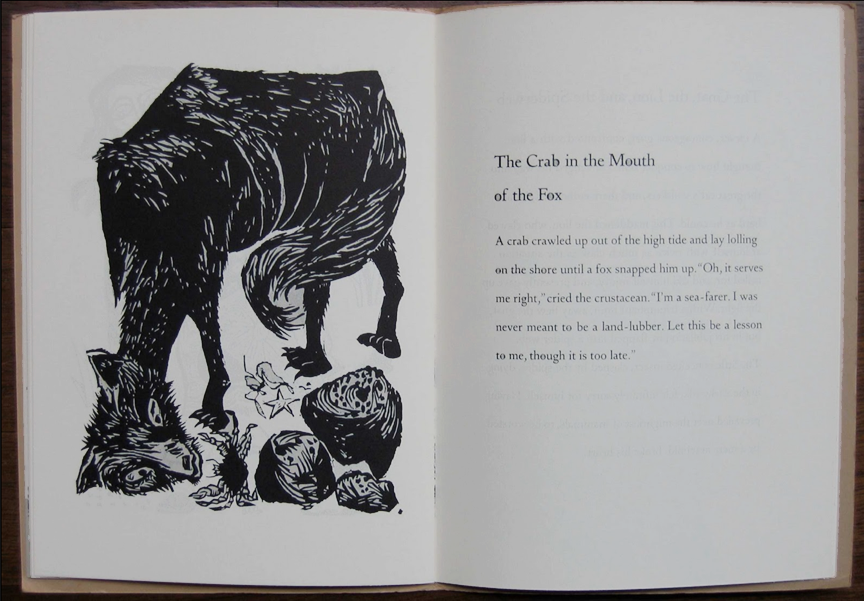
This is a gorgeous book with a series of really excellent woodcuts. I got it as a Christmas present and I love it. Gorgeous.

On the other hand, the text is kind of… um… odd? I remember Aesop’s fables in a sort of vague way from when I was much younger. They were short, yeah, but they tended to make sense. There were characters who did things and learned lessons, right? These versions, on the other hand, seem really pretty random. They’re actually oddly post-modern in their randomness.

This makes them hard to review. So in preparation for trying to review the book, I listened to The Dead Author’s Podcast (reviewed earlier by Anna) with guest Aesop.

It’s hard to tell how accurate/historical the podcast really is, but it’s certainly clear that I am not alone in thinking that some of these fables are really incomprehensible. And short.

So I loved this book for the art but I kind of suggest that you check it out for the stories for the bemusement factor as well.  It’s also really short. Twelve stories, none of them longer than two pages.

So to sum up: Beautiful but peculiar.

Captain Vorpatril’s Alliance by Bujold

Captain Vorpatril AllianceCaptain Vorpatril’s Alliance
by Lois McMaster Bujold
2012

This is an excellent fast-paced romantic adventure comedy. I sped through it in two days and kept giggling to myself. It just leaps from one ludicrous situation to another and yet, the plot still tracks beautifully. I can see why and how these situations came about, and I can also see why and how these characters managed to get themselves into these situations, even if I want to slap them upside the head for doing some of the things they do.

Interestingly, it takes place prior to Cryoburn, which might explain why Cryoburn made so few references to off-planet events in general, less to avoid spoilers than to avoid a sense of WTF?.

There’s an elopement with the use of a box of instant groats, a 100-year-old buried treasure, a 30-year-old hidden bomb, a handful of beautiful ladies (all of whom are extremely wily), a handful of wily men (many of whom are extremely beautiful), cross cultural laws and smuggling rings and bounty hunters. And, in the middle of all of this, is Ivan Vorpatril, who has, much to his dismay, lots of experience regarding such insanity.

In previous books in this series, Ivan generally gets drawn into his cousin Miles’ crazier plots despite his own efforts to remain an innocent bystander. In this book, though, Miles appears in only a quick cameo, and Ivan manages to get involved in a crazy plot all on his own. The book also develops a few other secondary characters from the series, showing more of Byerly Vorrutyer and Simon Illyan than we’ve gotten previously.

While it’s more than a bit self-indulgent, the book maintains its self-indulgence with aplomb and delivers an immensely fun roller-coaster of a story that I enjoyed immensely.

Twilight by Stephanie Meyers

Twilight
By Stephanie Meyers
2005

In honor of the last of the Twilight movies coming out, Biblio-therapy is going to be posting two reviews: one positive and one negative. I’m posting the negative review. I read it when the series was only just becoming a phenomenon. Someone told me that I’d love because I like young adult fiction and I like vampire books.

Alas, I did not like it, but I also wasn’t horribly offended by it.

There were a few good scenes, a few interesting premises, but overall the characters and plot didn’t hold together for me. The only character I actually felt any empathy for was the main character’s poor beleaguered father. I took this as a sign that I was, perhaps, finally aging out of my YA fiction reading days, and got on with my life.

It’s not that it’s a bad book, per se, because, let’s face it, I have read and enjoyed many quite bad books. The problem is that it’s bad in ways that I can’t wave away with a thoroughly suspended disbelief or a good faith effort to believe some character is not an idiotic milksop in need of a spine.

I am perfectly capable of overlooking all of the weird and outdated sexual advice presented in metaphor that has offended so many readers. At least the advice is presented metaphorically and in regards to vampires rather than outright (I’m looking at you, Barbara Cartland).

Belle is something of an idiot, making peculiar and random decisions, trusting strangers too much and her family too little. I found her mostly confusing. Why does she do the things she does? Is it just the “she’s a teenager” excuse that lets her get away with random acts of idiocy? I have apparently become an old woman, shaking her head at “kids these days.”

Edward is an unfortunately standard paradox of a stoic individual, putting great effort into showing how stoic he is so that everyone else can look at him and see that he’s really hurting inside and is a soft woobie. Also, as any strong guy (vampire or not) should know, that excuse of “I can’t help myself” is not a valid excuse for anything. If you have the strength to hurt someone then you had damn well better have the control to refrain from doing so.

Some of the basic premises of the story are even more problematic than having characters that I simply didn’t care for.

Bella enters school as a new student, having been nothing special before, and is suddenly the most popular and desirable person there. This is completely random. There’s no reason for it, either internal to the high school social structure (why did the kids like her?) or external to the plot arc (what did it bring to the plot?).

Despite first appearances, the trope of instantaneous and unexpected popularity is not inherently terrible; it can be done well. In fact, Meg Cabot has a few books that deal with exactly that issue and do it well: How popularity occurs and/or is manipulated, and what some of the related issues are. Stephanie Meyers, in contrast, avoids all of the real complexities and looks at the issue of popularity very much from the perspective of an unpopular student: I want to be popular but I don’t want to be like those popular girls*, and if I were suddenly popular I would show a becoming amount of humility and talk about how I really didn’t want it, so there.

Then we come to the sparkly vampires. This is possibly the best thing ever since the Care Bears and/or My Little Ponies. I’m not even joking. Here are Vampires that can’t go out into the sun because they Sparkle! How is that not awesome?

However, it does raise the question: why can’t they go out into the sun and share their sparkly magnificence with the world? They have none of the traditional vampire weaknesses:
• They don’t fall dead during the day.
• They can’t be staked.
• They’re too fast to be snuck up on.
• They’re too strong for it to matter if they are snuck up on.
• They have family and community ties.
• They aren’t creating enemies by eating anyone.

So why are they hiding?

If you answer: “Edward is a teenage boy (no matter how long he’s been that way) and doesn’t want to let anyone know that he naturally looks like he’s covered in glitter,” I would definitely agree with you. That would be an awesome answer. Unfortunately, it’s not Stephanie Meyer’s answer.

She doesn’t give an answer. Vampires hide because they’re vampires and hiding is what they do.

Admittedly there are bad vampires, too, who do go out and make enemies by killing people and fail to make allies by, you know, killing people. However, they still have all the other strengths of these Meyer Vampires. So why are they hiding out in the wilderness rather than simply living in a house and eating anyone who tries anything?

The vampire culture, such as it is, is a hold over from the traditional vampire cultures of other books, all about angst and dark secrecy. The problem is that Meyer has changed the vampire mythos so much already that it’s disappointing that she didn’t follow through on the repercussions of those changes.

So, to sum up, it was a story about stupid people making random decisions in a world that didn’t make sense. This was not, alas, the worst book I have ever read, or even real competition for the title, but it was still pretty bad.

However, one good thing about this book (and movie) is:

It’s very popular and has gotten a lot of creative people talking about it (positive and negative) and a lot of those responses are quite hilarious.

* I must have been really lucky in my high school because the popular girls that I knew (not very many of them, admittedly) were all very nice. They were popular because they were nice and outgoing and people wanted to be their friends. That’s what made them popular.
WikiLeaks and the Age of Transparency by Micah Sifry

WikiLeaks and the Age of Transparency
By Micah L. Sifry
2011

This is a fascinating read which is correctly introduced as being a presentation on information transparency from a guy with a highly pro-transparency bias. It’s not a manifesto, per se, but there’s no real attempt to present a balanced discussion of the issues or present even a straw target of the counter arguments. Instead, there are a lot of examples of both successful and failed attempts to achieve transparency in government and reporting. Examples come from the United Kingdom, the United States, various countries in Africa and in Europe.

Sifry is describing the world of information and of government responsibility as he sees it and I think it’s a very useful perspective to understand. I even agree with him to a large extent. Not completely though.

The title is also a bit misleading. I had originally intended to read it to gain an understanding of WikiLeaks specifically. I’d only vaguely followed the WikiLeaks situation in the news and want to know more. In this eight-chapter book, however, only the first and last chapters are actually about WikiLeaks. The majority of the book provides a much broader presentation on information transparency in general.

It was an engaging and informative read. I recommend it to anyone who is interested in politics, or journalism, or just information issues in general. It is, however, very subject specific so if you aren’t interested in the subject, it’s unlikely to transcend that disinterest. Since I find the subject fascinating, it was a good book and well worth reading.

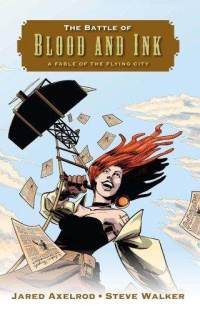
The Battle of Blood and Ink by Axelrod and Walker

The Battle of Blood and Ink: a Fable of the Flying City
Jared Axelrod and Steve Walker
2012

This book has my qualified approval. Without the time (or ability to concentrate) for reading a full book, I recently read a graphic novel instead. Given the adage “a picture is worth a thousand words,” if all of your descriptions can be replaced by images, a graphic novel can be read a whole lot faster than a traditional novel and in fact I read The Battle of Blood and Ink in about forty-five minutes.

On the up-side, it was wonderful to just relax with a book and this one had fun characters and interesting intrigue and really beautiful illustrations. The art is both lovely and lively and was what first attracted me to the book. Then, the characters drew me in, as well as how the authors addressed moral issues regarding ethics versus pragmatics and personal versus political responsibility. It was both beautiful and interesting.

The story is about a woman, Ashe, who grew up as a street kid on a flying city and now makes her living printing a newsletter regarding city events and happenings. The city is a place of wonder, but from Ashe’s perspective, we see some of the gritty underpinnings of how things actually work, and so too does her readership. This gets her into trouble with the city ruler and events progress. Since the role of information and censorship are currently particular interests of mine, this plot was just right for me.

On the down-side, the climactic scene relies on a lot of world building that wasn’t actually presented previously in the book. Given the setting is a flying city, the universe is obviously a science-fiction/fantasy one, but the physics of the world isn’t really explained at all, and the climax depends on certain premises that I hadn’t expected.

Having read and enjoyed the book but feeling a bit bemused by the ending, I discovered that the book was intended as a stand-along sequel to a set of 44 online pod casts (i.e., audio recordings). I listened to the first two of them and was not nearly as impressed by them as by the graphic novel. The world building issues may or may not be addressed in these pod casts, but of the two that I listened to (each about 15 minutes), both times the speaker rambled for a significant period of time before getting to the story and then the story was filled with poorly written descriptions that were much better presented as images in the graphic novel.

So, on the whole, while there are serious flaws in this graphic novel, it’s still lovely, fun, interesting, and well worth the half-hour to an hour that it would take to read. If you want to get a taste of it, the first twenty or so pages are available online.

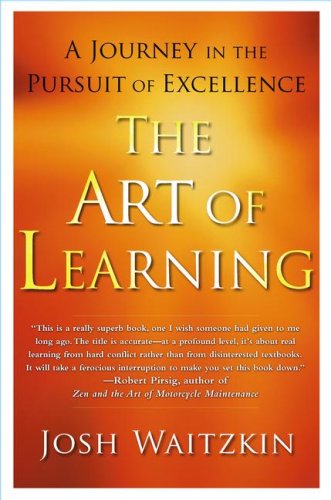
The Art of Learning by Josh Waitzkin

The Art of Learning: A Journey in the Pursuit of Excellence
by Josh Waitzkin
2007

I’m still working my way through some of the books on that list of 40 suggestions and at the moment I’m feeling a bit like Goldilocks, because I recently started three, dropped two and absolutely loved one.

I read the first eight pages of Never Eat Alone by Keith Ferrazzi and stopped because it made me think the author was an asshole. The introduction was essentially: here’s how I inserted myself into rich people’s lives and made good off of their connections while mocking anyone who took those connections for granted.

Then I read the first twelve pages of Zen Mind, Beginner’s Mind by Shunryu Suzuki and stopped because it made me think that I was an asshole. The text is very traditional zen discussion and I’m wondering how much is real and how much is playing to a stereotype, concentrating less on the actual concepts as I am on the meta relationship of author to publisher to readership.

Then I started The Art of Learning: A Journey in the Pursuit of Excellence by Josh Waitzkin and continued to the end because it was just right. No really. It really was just right and I actually plan on purchasing a copy so that I have it on hand to reread at times, focusing on learning the methods discussed in certain chapters.

First, about the author: Waitzkin was a chess prodigy and national champion as a child and he has since gone on to become a Tai Chi world champion as an adult. Plus he’s a good writer and appears to be a nice guy, too, which is actually kind of irritating because surely people that good at multiple things should have a few fatal flaws.

But anyway, the book is essentially an autobiography but it shows his life by means of his training and development from a highly theoretical perspective. He picks apart how he learned and and improved his various skills, looking at both successes and failures, evaluating the advice and assistance from academic studies and training centers, and discussing his role models, as well.

Keep in mind that I like strategy games, I like martial arts, and I like theoretical discussions, so this book fits my tastes perfectly. I am willing to acknowledge that other people may not like it as much, but I still strongly recommend it to basically everyone ever. It’s a fun read and it has some really important lessons about how to think about learning.

Management of the Absurd by Richard Farson

Management of the Absurd: Paradoxes in Leadership
by Richard Farson
1996

This was one of the books from the list of 40 that I posted about previously. It is essentially 33 quite short essays regarding some counterintuitive issues in management. I have mixed feelings about it.

On the one hand, I liked it a lot better than any of the other management books I’ve had to read. In some ways, it is very much a response to other management books, even. I’m not sure it would even stand alone very well if you haven’t already read others, since so much of the time it is pointing out flaws in common management techniques. It does give some background for the points it makes, so maybe it could stand alone. I’m just not sure. But anyway, I believed a much larger percentage of this book than I did any of the other management books I’ve read.

The main piece of advice that the book gives is that managers should treat people as people and give them some respect. Human interactions are complex and most people will react badly to managerial manipulation. This is a conclusion that I appreciate a great deal.

On the other hand, the book is more a series of philosophical discourses rather than any specific advice, and a lot of the examples the author uses are rather dated. Farson comes across as a bit of a technophobe with too much nostalgia for ‘the good old days.’ (And the fact a book published in 1996 comes across as dated makes me kind of depressed. I’m getting old! 1996 wasn’t that long ago, surely?) He also really likes the words “absurd” and “paradox,” using them whenever he possibly can.

Anyway, I would say that this is not an inherently good book, so I don’t recommend it as such. But, if you’ve read a lot of management books or are interested in management, this is a very useful book to give you an alternative perspective from the standard ones and I highly recommend considering that alternative.

The Far West by Patricia C. Wrede

The Far West
Patricia C. Wrede
2012

So much fun! I love this series and I love this book. Anna already reviewed the first two books, but The Far West just came out this month and I got a copy immediately. In hardcover, even. One of the things that impresses me about this entire series is the world-building and this book continued the process magnificently, continuing to delve into both the theory of magic and the unknown wildlife of out in the unexplored far West.

As you may have noticed from previous posts, I love me some world-building and Wrede does it beautifully. The series is set in the days of the settlers except that there’s magic, which has made a significant difference in history and national politics as well as ecology. There are three main theories of magic: Avrupan, Aphrikan, and Hijero-Cathayan, each with their own structure and way of manipulating magic. While these were each introduced in the prior books, The Far West looks more closely at the differences and similarities of each type as Eff, the main character, goes on an exploratory expedition further West than anyone else has gone before… or at least further West than anyone else has returned from. There’s new wildlife and new magical theories and a small group of people trying their best to figure out the world and survive the process long enough to report back.

One of the many wonderful things I appreciate about the book is that there’s no bad guy. There are disagreements and personality conflicts and wild animals and danger and adventure, but it’s all situational. There’s no one out there specifically trying to do evil… it’s just a dangerous world and Eff and the rest of the expedition have to work hard to survive. They don’t all get along, they certainly don’t all agree, but they all have a common goal.

The one thing that I really did not like about this book, however, was the fact of the epilog. Not that it was bad, but that it existed. Wrede did that thing where the epilog gives brief descriptions of the future lives of each of the main characters: So-and-so went on to do such-and-such, what’s-his-name went on to do this-and-that. It ended the series. This is book three of a trilogy and Wrede decided to tie it off the loose ends, at least as far as character development went. But there’s so much more out there. It’s this rich world and complex characters and no hope for another book in the series. Hmph. I will have to sulk and re-read it some more.

40 Modern Nonfiction Books Everyone Should Read

40 Modern Nonfiction Books Everyone Should Read
by Marc, of Marc and Angel Hack Life: Practical Tips for Productive Living
2009

I have, of course, read nonfiction books for classes, but I don’t tend to read them for pleasure. There are a few exceptions, but not many, and they certainly don’t include self-help books.

However, I was recently sent a link for this list of 40 Modern Nonfiction Books Everyone Should Read, all of them self-help oriented, and I was actually pretty impressed.

I started skimming the list, wondering if I had been assigned to read any of them and how much I had (or would have) disliked them. Instead, I was actually kind of impressed by the collection. Several of the titles and descriptions popped up as ones that I really should read.

There are four that I am actively excited to read. I checked that my library has them and I am looking forward to reading self-help nonfiction.

There are more about which I agree with the author of the article, that it would probably do me good to read, and not just in a putting-serious-effort-into-picking-out-some-small-amount-of-wheat-from-the-chaff type of good that I mostly see in self-help books. There are an additional ten of the books that I plan to check out and see if they live up to Marc’s descriptions. Because I think they might do me good without being too painful.

Of course, there’s also the other 26 books that I have no intention of reading, either due to disinterest or out-right dislike, but I still feel that, given a list of 40 books in a genre I don’t read, having a third of them look good is an amazing percentage and deserves some kudos.

I’m not going to list out here which books I thought were appealing and which I didn’t* because I think it’s well worth your time to skim the list yourself and see which ones you think sound interesting or useful for you.

So check it out and see what you think.


* There will be reviews here in the relatively near future of the some of the books I thought looked good as I go through the ones that I liked.