The Selection by Kiera Cass

The SelectionThe Selection
by Kiera Cass
2012

I stumbled across this book on Pinterest. As you may have noticed, I enjoy fanfiction, but I also enjoy fanpics, ie, fan-created artwork and illustrations. It’s for this that I started following Book Nerd’s Pinterest boards. But s/he also has a Books too read : D board, and in that board was The Selection.

You know how you’re told not to judge a book by it’s cover? I’ve never been particularly good at following that advice–I regularly judge books by their covers. And this one is pretty much exactly what it’s cover lead me to expect. Which is good, because I really needed a bit of frivolous fun with societal angst and fancy settings. The last few weeks have been intense, and a dystopian Cinderella story for young adults was just what I needed, with the right mixture of fluff and emo, and pretty much no tension at all.

The premise reminded me of Sherwood Smith’s A Posse of Princesses, while the over-all feel of the book and the dystopian setting reminded me of Maria V. Snyder’s Poison Study. Those were also some fun relaxing reads, although quite different from each other. Alternately, it’s bit like if The Hunger Games universe featured a show like The Bachelor rather than, well, the hunger games.

The thing is, that I don’t actually have much to say about The Selection. It was enjoyable. I read it in an evening. It’s a nice balance of fairy-tale and individual empowerment, touches on a great many issues of social injustice and inequalities, but doesn’t particularly linger.

I liked it, and I’ll probably check out the second book (The Elite) and possibly even the third book (The One) when it is released. There’s not actually a whole lot of tension, though: the first chapter of the first book explains what the Selection is, at which point the titles of the other two books become spoilers. However, like any fairytale, it’s nice to just relax into a well-recognized story.

Shadows by Robin McKinley

Shadows Robin MckinleyShadows
by Robin McKinley
2013

I have a complex relationship with Robin McKinley’s books. I love The Blue Sword and Beauty. They were wonderful. I thought she was doing something interesting with Rose Daughter, since it was a second rewrite of the story of Beauty and the Beast, and yet quite different from her first version, Beauty. And then she wrote Sunshine, which is really in contention for being the best book ever, and won her (in my mind) a life time achievement award: she was thereby a favorite author and I loved her writing.

Where it gets problematic is that I don’t actually care for many of her other books. I found Deerskin unpleasant, Chalice seemed more like a semi-written outline for a book rather than a complete book in and of itself, and I never even managed to get past the first chapter of Pegasus due to the extreme level of twee.

So I’d mostly decided that I would love her intensely and pretend that she wasn’t writing anything anymore. And yet, when her newest book came out, I checked it out from the library.

And I liked it a lot.

The first chapter or so made me wince with the over use of made-up slang and general teenage fraughtness but then it settled into the plot and I discovered that I actually really enjoyed it. The characters and the character interactions and the world they live in are all fun. However, much like how, with Rose Daughter, McKinley had apparently decided that she wanted to try a variation on Beauty, Shadows reads a like McKinley decided she wanted to try a variation on Sunshine. (Even the titles parallel each other!)

Sunshine is so fabulously good that it can definitely support a knock off. In fact, a knock off of Sunshine is a whole lot better than many originals. But, it does add an odd quality of double vision to reading it, see how the characters, plots, and descriptions in the two books map to each other.

One useful distinction, though, is that Sunshine is intended for an adult audience, while Shadows is a teen reader. By this, I mean that the romantic relationships in the two books as well as the level of gore are variably age-appropriate. But they both look at magic and reality and perspective and hope and determination and making due with what you have.

Anyway, I definitely recommend this book, but it doesn’t do much to resolve my issues with McKinley, since now I can’t even rely on her writing books that I don’t want to read. (I also find it somewhat irritating that she really doesn’t like fanfiction and is one of those authors who has their attorneys send cease-and-desist letters. Which is particularly questionable of her given that she apparently writes AUs of her own stories.) Also, just as with Sunshine, I would love to see a sequel of Shadows, or a prequel, or anything else further exploring the world contained within.

The Fall of Ile-Rien

The Fall of Ile-Rien
by Martha Wells

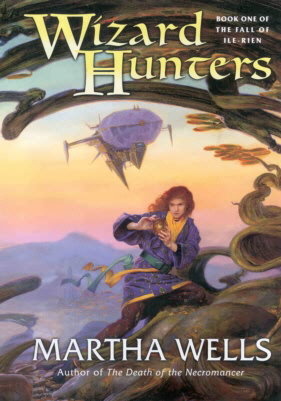
wzcovThe Wizard Hunters
2003

shipsofair250The Ships of Air
2004

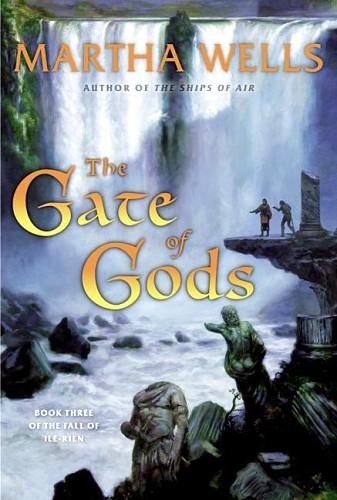
gateofgodsThe Gate of Gods
2005

So, it’s possible that I overdosed slightly on Martha Wells. After reading all three of The Books of the Raksura, I went immediately to the library and got Wheel of the Infinite, and after reading that, I went back and got all three books of The Fall of Ile-Rien. I loved each and every one of these books, but by The Gate of Gods, I was flagging a bit and needed a break.

However! It’s still really good and I want to read the prequels, The Element of Fire and Death of a Necromancer. I’m just aware that it’s probably a good thing that the library doesn’t have them and I’ll have to take a break to figure out how to get them through inter-library loan.

Anyway, this series starts off with a ludicrous mess of a plot that I wouldn’t have bothered reading by an unknown author. However, as I’ve mentioned before, Wells has an amazing ability to bring new life to old tropes and she does it extremely well here.

There’s a lot going on in these books: the kingdom of Ile-Rein is sort of like a magical version of a 1920s Europe, but is currently being attacked by (and losing to) an invading army that appears to come from nowhere. Tremaine Valiarde, our heroine, is from this world.  It turns out the bad guys, though, are invading from a different world, although tracking exactly how is a main plotline for the series. Ilias is from a more agrarian society in an entirely different world. Also his society is a matriarchy, which allows Wells to be delightful in her exploration of gender norms and social expectations.

Normally, the thing that most attracts me to a book is the world building, but while the world building here is excellent, it’s really the characters who shine. Both Tremaine and Ilias are broken in their own ways, but also too strong to let that stop them. And while they’re not outcasts from their respective societies, neither of them quite fit in at home. Wells does an amazing job of showing how out of sync both of them are, even with their friends and family, and yet those same idiosyncrasies allow them to fit together in a way they don’t with anyone else.

Plus, I just really love how Wells approaches bringing them together. Some things simply appear impossible: there’s a war going on, there’s no time for relationships. Other things are so easy and without angst for much the same reason: there’s a war going on, no need for unnecessary waffling.

But for all that Tremaine is clearly set up as the central character, the real main character is the war itself. It is ever-present and affects everything that happens. There is a large cast of characters who are all struggling to do their best to achieve their goals, because the war doesn’t effect just one person and can’t be fought by just one person. There are dozens of main characters, all working, either together or in opposition, but all with the knowledge that something needs to be done and no one has the option to sit out these events.

I really liked this series a great deal. I think I might have a new favorite author, as well.

Fanfiction Selection

The last month (or two, or three) has been somewhat frenetic for me, and I haven’t really had the energy or focus to read full books. However, I couldn’t not be reading something, and what I’ve been reading is fanfiction. I’ve introduced the genre before, so I thought I’d take a moment to recommend a few more short fanfics.


Friends Across Borders
by MueraRashaye

To understand these stories, you need to be familiar with Mercedes Lackey’s Valdemar universe.

Summary: Two long-time enemy nations can’t become meaningful allies overnight. Stories from the lives of a border-guard Herald and Sunpriest, from their first meeting to the end, and insights into just how Karse and Valdemar were able to turn around their relationship so fast.

Warning: This is a series rather than a single story. The first three stories are complete, but the forth one is still a work in progress. Each of the first three stories can absolutely stand on their own, though, so if you won’t want to take a chance on a half-completed story, it’s okay to just not start the fourth story until it’s been completed.

Why I like it:  This takes a part of my childhood and makes it a tad bit more realistic, but without ever tarnishing the joy of the original. The main characters are both a delight and their mutual bewilderment regarding their developing friendship is a joy to behold. Also, one sign of a good series, in my opinion, is that the individual stories can stand on their own. So you don’t have to commit to reading the whole series to enjoy just the first story: Enemy, It’s Cold Outside.


Monster
by Laura JV (jacquez)

To understand this story, you need to be familiar with the character of Methos from Highlander and Sesame Street in general.

Summary: “Someone new moved in, Chris, next door to Gordon! Come meet him with Elmo.”

Why I like it: This is super short but it’s sort of like a John Donne poem in its own way. Without ever directly saying anything, it plays with the different meanings of the word “monster.” And, let me reiterate: it’s a Highlander/Sesame Street crossover. 😀


The Whole Truth (So Help Me God)
by Metisket

To understand this, you should be at least passingly familiar with the new Teen Wolf tv show. Although, actually, I read and enjoyed it without ever watching the show, just knowing the basic premise.

Summary: And this is a Stiles character study, so there you go. It’s multiple POV and set around “Night School.” Mostly because it will never stop being hilarious to me that Stiles punched Jackson viciously in the face and the only person who was remotely surprised was Allison. XD WHAT WERE YOU LIKE AS A CHILD, STILES?

Why I like it: First, I have to admit that I don’t watch Teen Wolf, I just really like the fandom. Fan authors can, and often are, much better than, say, MTV script writers. My pleasure in this fandom comes, in large part, from how the character of Stiles is treated, and this is just a concentrated look at how hilariously fascinating Stiles is and why the other characters wince when they have to deal with him. I wouldn’t necessarily want to be around him, but I sure like reading about him. It just makes me laugh.


A Perpendicular Expression
by leupagus

To understand what’s going on here, you should know the tv show Person of Interest.

Summary: Pissing Finch off never actually ends well; usually it ends like this, with John scaring the shit out of her at two in the morning.

Why I like it: There’s a certain joy in reading about super-competent people who just fail at being reasonable human beings. And Joss Carter is hilarious as she has to put up with them and explain basic social behaviors like not stalking your friends.


Kissable Fanatic, Unhinged Minim Artists
by Basingstoke

This fic is set in the X-Men universe, although the X-Men characters appear only briefly. If you are aware at all of the character Toad, in Magneto’s Brotherhood of Mutants, you know enough to read this.

Summary (provided by thefourthvine): Best FF featuring a powerful anti-drug message; namely that if we spend all our time stoned we might fail to notice critical things in our environment, like that one of our friends is actually green.

Warning: This is not family-friendly or work safe, i.e. any sort of filter at all should filter out this story. There’s drugs, profanity, and graphic homosexual sex.

Why I like it: I fought with myself over including this particular story because so far all my recommendations have been intended for a general audience (which is not necessarily common in fandom) and this one is absolutely not. This is, in fact, the first story I’ve recommended that includes a serious warning. (It’s standard policy with fanfiction to include warnings, a policy that is immensely helpful for maintaining some sanity when wandering dark corners of the internet.) However, this story is just too good to not recommend. Basingstoke takes Toad, a character that is treated as a barely 2-dimensional character in the comics, and makes him fully human (as it were). This story makes him real and that is one of the things I really love about fanfiction: that it will take minor characters the original author threw in to take up space and develop those characters into the main characters of their own lives. This story is just really, really good with that.

Christmas Present from Ilona Andrews

For those of you crazy people out there who don’t obsessively check in on their favorite author’s websites, we at Bibliotherapy here for you!

Ilona Andrews is one of my favorite authors currently writing and she has quite an active website, in which she posts regular snippets of stories, and, more to the point, posts Christmas presents to her fans.

Her Kate Daniels series is all told from the point of view of Kate Daniels, but has Curran, the Lord of the Beasts and Kate’s love interest, as another main character. The Christmas present is a collection of short snippets retelling pivotal moments in the Kate Daniels books from Curran’s point of view. It’s quite fun and while I recognize several of the snippets from having been posted individually on prior occasions, other snippets I don’t recognize at all.

So, if you enjoy the Kate Daniels’ series: here’s a “Merry Christmas!” from Ilona Andrews.

Wheel of the Infinite

Wheel-of-the-InfiniteWheel of the Infinite
by Martha Wells
2000

Having thoroughly enjoyed The Books of the Raksura by Martha Wells, and going through a bit of withdrawal from reaching the end of the series, I checked out an older book of hers and am extremely glad I did so.

I love stories that involve gods and godlike powers and the difficulties faced by both the people who struggle against those powers with just human strength and the gods who struggle to avoid unintended consequences. (Some of my all-time favorite books deal with these issues:  Isle of the Dead by Roger Zelazny, Curse of Chalion by Lois McMaster Bujold, Nameless Magery by Delia Marshall Turner.)

The world-building here is amazing particularly as it comes to the rules of magic and religion, and we get it from two perspectives:

Maskelle is The Voice of the Adversary, a highly ranked priestess, but she was exiled (rightly so) for murder and treason some years back. She has been summoned back to the Imperial and religious center of the land by the request of the Celestial One to help regarding a problem with the Hundred Year Rite, in which the Wheel of the Infinite recreates the world. (A problem with the re-creation of the world is, rather obviously, quite a problem.) But she approaches the people and the magic with deep familiarity and deep discomfort given her past.

Rian is a bodyguard from a far distant land who ran away from an unpleasant situation, and manages to fall in with Maskelle on her return trip, and sees the political and religious situation with fresh eyes.

And that is the premise. From there, stuff happens: after all, there’s a problem with the ritual that recreates the world. Stuff. Happens. I love the exploration of the world that is inherent in our main characters’ investigation of what has happened.

In addition to the amazing world-building, I also just love the characters. Rian’s culture shock is somewhat hilarious (especially as it mirrors the reader’s own shock at this culture). And Maskelle’s deadpan practicality, even as she struggles with her own issues, is a delight.

Another thing I appreciated about this book was that Maskelle was middle-aged and black. The book is high fantasy, in an entirely different world, so clearly she’s not African or African-American, but she and her whole culture are dark-skinned and her hair is in braids.  Scifi and fantasy, for all their alien species, tends toward the homogenous white humans, in both writers and characters. (The one exception to this that I can think of off hand is Octavia Butler, but her books tend to be both excellent and extremely hard hitting. Wheel of the Infinite is readable purely for fun.)

The first chapter of Wheel of the Infinite is available online, so you can get a taste. I highly recommend this book.

Oscar Wilde and Walt Whitman

This is going to be a super brief post, because it’s essentially a single link out to someone else’s article:

I got linked this article some time back, and I have no idea why I didn’t post a link here immediately, but I happened to mention it this afternoon to Anna and she assured me that it needed to go up, pronto. Thus, I give you:

Literary Trysts It Gives Me Great Joy To Think About: Oscar Wilde and Walt Whitman
by Mallory Ortberg
the-toast.net
September 17, 2013

Because mine is an evil and a petty mind, suitable more to wallowing in the sordid sexual goings-on of literary giants than in reading their work, I take every opportunity I can to inform people who may not have known that Walt Whitman and Oscar Wilde almost certainly had sex in 1882.

You are either the kind of person to whom this matters a great deal, or the kind of person to whom it matters not at all. To the latter I say: yours is the narrow road and the straight, and I extend to you a hearty and fulsome handshake, as well as my sincerest wishes for your continued good health. To the former I say: Want to hear about the time Walt Whitman and Oscar Wilde (probably) hooked up??

(For more, click the link that is the whole excerpt, and it will take you to the original article.)

Marching Powder

marching-powderMarching Powder
By Rusty Young
Read by Adrian Mulraney
2003

This was a fascinating book, but, once more, this was a book that I would not have managed to get through in anyway other than an audiobook. Even as an audio book, I almost quit it multiple times.

It’s essentially the memoirs of Thomas McFadden, a young British drug smuggler, about his years in Bolivia’s San Pedro Prison. I say “essentially” because I’m a bit unclear on why this book isn’t listed with two authors: it’s written in the first person and there are direct descriptions of how Rusty came to the prison and recorded McFadden’s story on audio cassettes.

The hardest part of getting through this book is that there was no one in the book that I liked. There were better and worse people. And there were definitely situations that no one should have to live through, no matter how nice or not they are, but being a victim doesn’t always make a person innocent. I went into this book knowing it was about a prison and a drug smuggler, but he’s described as being very personable, and I guess he is? But it came across to me as a highly manipulative, almost psychopathic type of personability where I couldn’t actually feel a connection and, through his recounting, couldn’t feel a connection to anyone else, either. As the book described actions, reactions, and motivations, I found myself just generally disliking both Thomas (the narrator) and Rusty (the author) and most of the other people too, regardless of whether Thomas was trying to present them in a good or bad light.

Surprisingly, while the people made the book difficult to get through, the events recounted were not as difficult. I’d gone into this book prepared by Hollywood and stereotypes to hear the conditions of a third-world drug prison (ie, awful, awful, awful conditions). I was surprised that while, yes, at some points in time and in some circumstances, it did live up to those expectations, at other times and in other situations, the prison as a whole acted more like a small city-state with strict immigration laws: ie, you couldn’t leave, but it wasn’t a half-bad place to settle down, start a business, and raise a family.

The corruption described is so prevalent that the it struck me that this wasn’t a corrupt justice/prison system at all, but was something entirely different, merely masking itself to the outside eye as a justice/prison system. It seemed like more of a state-run hostage business or some other money-making scheme that I don’t quite understand, but certainly wasn’t interested in either justice, rehabilitation, or even punishment. This is not is a justice/prison system marred by corruption, because the corruption has taken over. The corruption is so prevalent that it creates it’s own structure, completely replacing the structure that might otherwise have been there.

I’ve been trying to think of a good simile and the best I can come up with is that calling this part of a justice system with some corruption would be like calling a fishing net a sailboat sail with some holes. They can’t really be compared.

To sum up, I’ll steal Kinsey’s three-word review style and say, this book was: informative, interesting, off-putting.

Melting Stone

Melting-Stones-Tamora-Pierce-unabridged-compact-discs-Full-Cast-Audio-books-MMelting Stone
By Tamora Pierce
Full cast audio
2007

This was interesting.

Tamora Pierce was a guest speaker at the National Book Festival this year and I was delighted. I was also somewhat shocked that the line to get a book signed by her started forming in front of the signing tent at least an hour before she gave her talk at a completely different tent, and several hours before she would start signing anything.

I’m pleased that she’s popular, but I think the kids in that line made a mistake in going for a signature rather than listening to her speak. She’s a wonderful and witty speaker, with a certain acerbic quality that I enjoy. Seeing her at the festival was also my first notice that her next book has come out: Battle Magic.

I put a hold on it at my local library and checked out Melting Stone.

I grew up reading Tamora Pierce and I still love her books, but I hadn’t gotten around to reading Melting Stone, in large part because it was a born-audio book. While it also came out in traditional book format, that was only after it was published as a full-cast audio-book: meaning each character was voiced by a different voice actor and some sound effects were included, too.

This is not the only thing that’s unusual about this book.  The main character, Evvy, was first introduced in a different book, Street Magic. Street Magic, in turn, in the second book that focuses on the character of Briar Moss. Both of those books focused on Briar Moss are single parts in four-book series. Melting Stone also references a lot of events that happen in Battle Magic, a book that was only just published recently in 2013, some six years later. It’s hard for me to tell exactly, given that I know this book series quite well and for some time, but I think this book was intended to be able to stand alone and even introduce the universe to a new generation of readers, who can then go back, if they’d like, and read the backstory of the original books, but don’t have to if they don’t want to, and can continue to read future books as they come out.

Anyway, it was fun, even though it was also intended for a younger audience even than most of Pierce’s books. As Kinsey noted in her last post, we all like reading YA fiction, but generally the audience of those books are teens or the particularly precocious, and the intended audience for this book was more elementary school.

One of the things I love about well-written fiction is that it’s often also well-researched and you can learn a fair bit of non-fiction facts along with enjoying a story with characters and plot-arch. This book, in particular, I thought did a good job of including some basic geology for kids.

So while I enjoyed the story and the characters, I was mostly interested in my own meta analysis of this book. Are audiobooks really becoming more mainstream and standard? Regardless of format, it’s rather brilliant of Pierce to break up the continuity a bit in order to bring in a new generation of kids. I wonder: are there people out there who grew up reading her books who are now introducing them to their own kids?

The Books of the Raksura

The Books of the Raksura
By Martha Wells

Raksura_TheCloudRoadsThe Cloud Roads
Feb. 2011

Raksura_TheSerpentSeaThe Serpent Sea
Jan. 2012

Raksura_theSirenDepthsThe Siren Depths
Dec. 2012

Please, please, let there be more coming soon!

So I started reading The Cloud Roads on the recommendation of an online friend and thought it was decent but not fabulous. My ambivalence was mostly due to the fact that most of what should have been unique about the world building, I’d seen before in either George Lucas’ Star Wars or in Bujold’s Sharing Knife series.  The characters seemed a trifle flat, although nothing out of the ordinary when the focus is on world building. The plot and character interactions were still fun, and I enjoyed it enough to check out the second book.

Half way through the second book, I put a request in at my library for book three. Then I finished book two, which ended perfectly satisfyingly with no cliff-hanger in sight, and yet I still desperately wanted to see more of these characters and this world, both (all?) of which had finally come into their own.

And then the third book was just as awesome as expected. Awesome!

And now I want more, more, more!

Anyway: the world Wells created is a complex one with an unknown number of sentient species all living in their own communities and groups, but also very much interacting. The bar in Star Wars, where Luke and Kenobi meet Han Solo would not be out of place in one of this world’s cities.

Our main character, Moon, is introduced while living with yet another group of people, trying to fit in with a species not his own. The trouble is that Moon doesn’t know what species he is. He lived with only his mother and siblings before he was able to care for himself, and they all died when he was still quite young.

In The Cloud Roads, the first book, Moon discovers his own people. Or rather, he is discovered by his own people. In The Serpent Sea, Moon settles in and finds his place among his own kind. And in The Siren Depths the comfort that he has found is challenged.

One of the things that particularly impresses me with Wells is the way she introducing the reader to a person and a culture who are decidedly not human and yet are completely sympathetic. Each book adds more layers of complexity and subtlety over the cultures and individuals, making them increasingly enthralling. I also love the way Wells plays with gender roles and how societal expectations vary from society to society and how even societies with established hierarchies always have to deal with a few exceptions. And Moon, as both our main character and an outsider to all societies, gives the reader a wonderfully bemused perspective on it all.

If you want a taste of these books, the first chapter of each book is available online. In addition, Wells has posted a short story, The Forest Boy, which shows Moon as a kid, before the start of the books.  (She also has other short stories and missing scenes posted, but the others should wait until you’ve caught up to those events in the books.)

Overall, they’re just kind of adorable books with wonderfully nuanced takes on some standard tropes. And I really hope there’s more soon.