Havana Nocturne by T. J. English

HavanaNocturneHavana Nocturne: How the Mob Owned Cuba…and Then Lost It to the Revolution
by T. J. English
read by Mel Foster
2008

This was another audio book on my commute and it was interesting. It left me both extra cynical and moderately reassured about politics: that politics have always been extremely shady and the extremely wealthy are always trying to take advantage of their positions to make more money while accomplishing less and less with that money.

The book is really like a verbal flow-chart/timeline, describing the people involved in the mob’s financial invasion of Cuba and how they make connections and how those connections changed over time. This is not a negative review — I do love a good flow-chart — but perhaps a bit of a warning to potential readers who don’t. But it’s a fascinating situation and interesting characters and the author does a good job of laying it all out and showing who the players were and how it all came together.

While not a proponent of the time-period, per se, the author is clearly a fan who loves it*, which leads to him using some pretty purple prose and hollywood gangster-slang in an unironic way. English also has a habit of switching up how exactly he refers to a given individual, so it was a bit confusing in the beginning until I’d memorized the various nicknames, for instance, Meyer Lansky = “The little man” = “the Jewish mobster” = “the Jewish mobster from Brooklyn”. When English is feeling particularly dramatic, he stitches them all together: “Meyer Lansky, ‘the little man’, the Jewish mobster from Brooklyn”. The author was having a bit too much fun with all the gangster talk.

He’s also discussing an extremely sexist time period without any particularly acknowledgement of that, so the whole book comes across as sexist. Women and women’s attention are treated as desirable commodities that get bought and sold, both in and out of official prostitution.**

While the focus is on the American mob’s rise and fall in Havana, Cuba, their position was entwined with that of Fulgencio Batista and thus in conflict with Fidel Castro, so that regime and revolution were discussed as well. What I found particularly heartbreaking is how much potential both Batista and Castro had to do amazing amounts of good, that they each threw away in their rise to power, although Batista more than Castro, if only due to the fact that Castro only came into power in the final chapter of the book.

The epilogue discusses how involved the American Mob was with the CIA in their attempts to assassinate Fidel Castro and how bitter the mob was about the massive losses they had to the loss of their gambling empire in Cuba. The author seemed moderately sympathetic for the loss. I was less so: they gambled and they lost. That’s part of gambling and they should have known it.

* It would not surprise me at all if he had the entire Godfather trilogy memorized. He certainly references The Godfather, Part II often enough.

** Although it’s kind of amazing how heterosexuality is still the norm (with the acknowledgement that homosexuality exists but to the side) while the main porn star that *everyone* wanted to see was a guy with a massive dick. I’m like: the women are interchangeable but all the guys wants to see this one guy’s dick in action? That’s… something.


Defying Doomsday

defyingdoomsdayDefying Doomsday
edited by Tsana Dolichva and Holly Kench
2016

It was probably not my best idea to read this anthology of apocalyptic and post-apocalyptic short stories while dealing with a local black-out caused by heavy storms. It’s the type of situation that’s all the worse for the stories being really well-written and interesting. Beyond just dealing with the apocalypse (“just”, I say), the theme that brings these stories together is disabilities.  The heroes and heroines of each story have some disability — physical, sensory, and/or mental.

The introduction made a really good point about how so many post-apocalyptic stories act like people with disabilities will be the first to die and are a burden to those around them. The stories in this anthology refute that. A few of the authors look at how something that our modern world calls a disability could well be an adaptive feature in a massively changed one. Most of them, however, look at how people who are used to living in a world that doesn’t cater to their needs have experience and practice that more abled people don’t get in our modern world. Reading my kindle by candle light was already highlighting to me how unprepared I was for any sort of harsh living: I live a very catered-to life.

I’m not going to write individual reviews about each story, although I certainly thought about it since the stories are all very good, but also all significantly different from one another. Instead, here are my top three:

“Something in the Rain” by Seanan McGuire is probably my favorite. I find the apocalypse situation particularly terrifying and I like the heroine the best with her ruthless perseverance. And spoiler: the cat lives.

“Given Sufficient Desperation”, by Bogi Takács, felt like a wonderfully subtle modern take on Gordon R. Dickson’s classic, “Danger-Human”.

“No Shit”, by K. L. Evangelista, is an subversion of a couple of classic post-apocolyptic tropes that also directly addresses the issue of how just the idea of roving bands of robbers would impact the people who survive.

The whole anthology a love song to the old adage: what doesn’t kill you makes you stronger. What doesn’t kill you can make you more broken, but it also gives you the experience of carrying on anyway. I definitely recommend it.

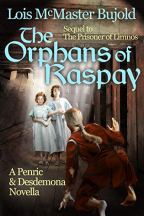
The Orphans of Raspay by Lois McMaster Bujold

OrphansOfRaspay1The Orphans of Raspay
by Lois McMaster Bujold
2019

Yay! Another Penric & Desdemona short story by Bujold! For the first time, Amazon’s update email was actually useful to me despite going out a full week after the novella was published on July 17th. Normally I stalk Bujold’s listing much more carefully but I’ve been busy recently and thus only learned about this title on the 24th when Amazon finally got around to emailing me.

It is a delight! It’s also a novella of extreme self-indulgence, with both plot and character arc being mostly absent, but adventure and swashbuckling in quantity!

This is also an amazing example of what you can get away with if you set up the world-building right. Because in this fantasy world, there are five gods (father, mother, son, daughter, and bastard) and Penric is a devotee of the Bastard: literally the god of luck (good and bad) and all things out of season. And thus, it actually makes perfect in-universe sense for Penric to have amazingly good and bad luck in all things, especially when one takes into account his demon Desdemona who sheds chaos even as she also provides him with extraordinary powers.

The story starts with his ship being attacked by pirates and continues on in wacky hijinks after he’s taken on the temporary guardianship, as best he can, of two young orphans who were also taken by the pirates.*

This is an utter delight and I have no idea how comprehensible it is to anyone who hasn’t read the rest of the series but I’d be interested to know if it’s so indulgent that it actually can stand on its own. It’s essentially a day-in-the-life (or, in this case, week-in-the-life) of a temple sorcerer in a fantasy world.  And I love it!

* While I love this story, here’s a warning for pirates being pirates and actually genuinely bad and there are threats of sexual assault.

Stones into Schools by Greg Mortenson

StonesIntoSchools coverStones into Schools
by Greg Mortenson
read by Atossa Leoni
2009

What is particularly wonderful about this book is the pervasive optimism. At a time when I often feel hopeless in the face of atrocities I can’t fight, this is a story about a guy who figured out how to fight. And by fight, I mean arrange the building of schools for girls in rural Pakistan and Afghanistan.

I may be the last person to know about this book since it’s a sequel to “Three Cups of Tea”, which I vaguely recall from that having been on the New York Times Best Seller list for a gazillion weeks some years back, but I never read. I now probably need to do so. But I picked up “Stones into Schools” kind of randomly as one of the few audiobooks at my local library that looked like an interesting read for my work commute. And it really was.

Apparently, in the first book, Mortenson talks about having been a mountain climber who got lost in Pakistan, winding up in a small rural village where a very goal-oriented young child wrangles a promise out of him that he will return and build her a school in her village. There’s some extreme mission creep, as happens, and he winds up with a nonprofit that builds a number of schools in a number of rural villages.

The second book, this one that I’ve just read (ie, listened to), starts with Mortenson checking in on one of these schools along the Pakistan-Afghan border, when horseriders come down from the Afghan mountains to meet him. They explain that they had heard he was in the area, and by area, they meant a mere six-day horseride away, and had come to ask him to build a school for their community of nomadic yak herders in the heights of the mountainous Wakhan Corridor. This was in 1998.

The book covers the next ten years of Mortenson’s attempt to get that school built, through the rise of Taliban and the complex series of relationships, favors given and owed, with all the people and communities along the way.

The book does an amazing job of introducing the people he meets and works with, in all their complexities of personal histories and motives, and how, in the end, they align in trying to bring literacy to rural girls. It also really introduced me for the first time to exactly how horrific the Taliban was to the people it claimed as its own, and how few they truly numbered for all their viciousness. The Taliban created an unsustainable society that hates its own women, but the women and the men who cared for them continued to strive for better.

This book makes me feel hopeful. And that is something I desperately need right now.

When I checked my library catalog to make sure they had “Three Cups of Tea” for my future reading/listening (they do), I discovered another book “Three Cups of Deceit” all about how Mortenson is a liar and a fraud and just the title felt like a slap in the face after such optimism. I looked up both that book and Mortenson on Wikipedia to figure out what the actual truth was and, as far as I can tell, the “Three Cups of Deceit” guy was angry that Mortenson isn’t perfect, nonprofits are always weird, rural schools for girls haven’t immediately created peace in the middle east, and decided to ride the coattails of fame with a clickbait title, while doing his best to turn optimism into cynicism and hope into despair. Mortenson promotes his successes and talks less about his failures and there’s no more financial shenanigans in his nonprofit than in many others. I think the ultimate lesson here is: you don’t have to be flawless to still be good. Find a quest, like-minded people will join you on the quest, and do as much good in the world as you possibly can.


Love for the Cold-Blooded by Alex Gabriel

coldbloodedLove for the Cold-Blooded: Or: The Part-Time Evil Minion’s Guide to Accidentally Dating a Superhero
by Alex Gabriel
2014

This is such an amazingly delightful and hilarious book! I highly recommend it! It had me chortling to myself. It also had so many scenes that I would have expected to hit my second-hand-embarrassment squick but instead sailed right past it with a derogatory look of: don’t expect these characters to be embarrassed by anything they do or allow anyone else to be embarrassed on their behalf. They are just fine with rolling with the situations.

And as a warning to Anna: it does have graphic sex scenes, that are not only graphic but also involve significant character development and plot progression so they can’t just be skipped.

This is the world of superheroes at it’s best: the superhero world of Saturday morning cartoons where the good guys win but the bad guys get away and no one is ever permanently harmed. The drama is high, the philosophy is pointed, and the aesthetics are amazing.

It also reminds me a bit of The Rest of Us Just Live Here since Pat, our main character who does the occasional part-time duty as a minion to whatever supervillain is currently making a bid for world domination, is mostly a college student who loves his major and has a pretty decent part-time job. He’s just so irrepressible and he loves his mom and dad and his sisters and his studies to be an urban developer and even being a minion is often annoying but sometimes fun and just part of life.

And Nicholas Andersen is the Tony Stark / Bruce Wayne of this world: the billionaire philanthropist tech-genius with awkward social skills who starts out thinking that Pat is the prostitute he requested sent up. (And Pat isn’t about to say “no” to sex with a hot guy who apparently wants to have sex with him.) And then life happens and it is all so ludicrously delightful and I love it!

stillwatersStill Waters
by Alex Gabriel
2015

As soon as I finished “Love for the Cold Blooded” I went to check out the author’s page for more. Sadly, there’s not much else and nothing in the last three years, but this novella is still really good.

It packs a fascinating amount of world-building around a very character-driven fantasy plot. Anyone who has read a lot of urban fantasy knows that it comes in a wide range of styles: from dark/gritty/game-of-thrones-esque to light/fluffy/romcom-esque. Are werewolves vicious slavering creatures going on murderous rampages or are they people who turn into puppies? In this story, they are both! Because the background premise is that there are rips that will occasionally allow people from one world to pass into a different world.

Drakjan, going by Julian, is one such individual. The world he’s from is a dark and dangerous fantasy world in which vicious creatures fight and kill and the world he’s now in is a softer fantasy world in which those same fantasy creatures share borders and have council meetings and are shocked when one of their own is murdered!

One of the great things about this book is Drakjan’s perspective because the whole world is so foreign to him even after  he’s settled in to the periphery of life in the new world, giving up the joy of killing for the pleasure of peace. But he’s still very much an outsider looking in, not quite understanding how (or even why) to fit in with the rest of the society.

The plot happens when someone else comes through another rip. (Two someones actually: a love-interest and a plot-point.) The plot is extremely straight forward but the characters and the world building are amazing and it’s just as well that the plot doesn’t get in the way of that. I would love to read more but it’s also self-contained as is.

Knife Children by Bujold

knifechildrenKnife Children
by Lois McMaster Bujold
2019

I love that Bujold is enjoying her retirement by writing short stories set in the various universes she created with her novels. Previously, she’d been writing in the Challion and Vorkosigan universes, but this story is set in the Sharing Knife universe.

And somehow I never actually reviewed any of the Sharing Knife quartet here?
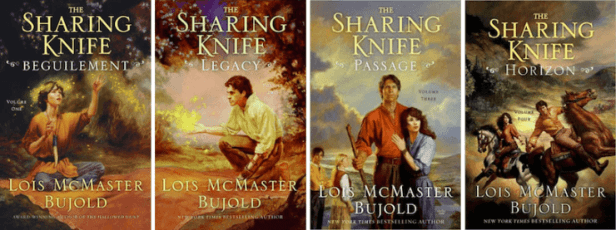
sharingknife-series

The Sharing Knife: Beguilement (2006)
The Sharing Knife: Legacy (2007)
The Sharing Knife: Passage (2008)
The Sharing Knife: Horizon (2009)

They are each their own independent book, with plot arcs and character arcs that come to excellent conclusions, but they also form a quartet that has it’s own overarching plot arc, more so than just a series of four books. And the world they have is amazing!

It’s a fantasy world with a frontier era with towns and farms and blacksmiths homesteaders, etc, but also with a significant bit of cultural conflict between the Farmers (settlers and city people) and the Lakewalkers (nomadic tribes with a type extra ability that they consider normal but that Farmers consider magic). And then there’s the malices. (“Malices” to the Lakewalkers who hunt them, “blight-boggles” to the Farmers who don’t always believe they exist.)

The first book starts the romance between a young Farmer woman, Fawn, and a significantly older Lakewalker man, Dag, but it’s also about starting: starting, or starting again, and trying, and doing ones best, even if you don’t quite know where you’re going or how it’s going to work out. Sometimes you just have to do something and see where it gets you. I don’t want to spoil events by even starting to summarize the others books, but continue to follow Fawn and Dag as they find their place and places in the world. And a strong theme having to work to communicate across cultures but that it’s possible and it’s worth it, and it works if both sides are trying and not so much when either side isn’t.

And deal with malices along the way, because there’s a lot of adventure too, mostly to do with hunting (and being hunted by) malices.

The world building is amazing, especially when it comes to the malices, which are these magical beings that suck the life out of everything around them, and are immortal. Rather than the traditional definition of immortal (can’t be killed), Bujold has created these creatures that don’t know how to die. And thus the “sharing knives”, which are special bone knives capable of holding a death that can then be shared with a malice. And just the thought that goes into the magic and the culture and the misunderstandings and just, oh so good!

I recommend them all.

But coming back to Knife Children: it’s set a dozen or so years after the end of the book series. It follows Barr, a character introduced in Passage, as a young ass of a Lakewalker who slowly becomes a better person over the course of two books, and his teenage half-Farmer daughter Lily, who was not previously aware of her half-Lakewalker heritage. Unlike the books, there’s only peripheral malice conflict, and the plot is driven almost entirely by the character arcs, and those characters are wonderful.

I’m not sure how well the short story stands on its own, but it was certainly intended to. And I’d be interested in hearing if anyone tries it, what their thoughts are.

But mostly I want to reiterate that Bujold is amazing and I highly recommend her and all of her writing.

short stories on tumblr

Since the management of tumblr appears to be going insane as they implement rules to destroy their own user base, I’m going to recommend these stories while they’re still around to link to. None of these are fanfic, but they’re very much in that mode, ie, much more character driven than plot-driven.

How to Bury a Gentile
by Tentacular Investigations

This is a really interesting short story in the intersection of religion and supernatural fantasy, that strikes me as similar in tone to Manly Wade Wellman’s short stories in Who Fears the Devil?. If you haven’t read those, then you absolutely should as well. But in this as well as in Wellman’s stories, spirits and humans have intersecting needs and if you’re lucky, you can deal with the situation that occasionally arise without ever learning what the consequences of failure would have been.

In response to the prompt: You are the wind’s interpreter. What’s it saying? 
by CaffeineWitchcraft

This is hilarious and while I wouldn’t mind a full novel about it, it’s also a very cute if somewhat sketchy short story of high fantasy style with kings and castles and swords and sorcery. And it opens with the line, “Tell Miles, the wind whispers, that he’s a little bitch.” Which just cracks me up.

In response to the prompt: With all the instances of people getting retrieved from the fae, I think it would be pretty interesting to free a person that you aren’t looking for. 
by ElsewhereUniversity

This is really quite short, less than a full scene even, maybe half a scene?, that is pretty much exactly what the prompt says. And it’s hilarious!

My Sister, the Serial Killer by Oyinkan Braithwaite

mysistertheserialkillerMy Sister, the Serial Killer
by Oyinkan Braithwaite
2018

This book was very good and I highly recommend it, but it was also not at all what I expected even though I’m not quite sure what I was expecting. I’ll start by saying that it’s Nigerian noir. I haven’t read very much Nigerian literature or very much noir, so I’m not sure if it was one of those aspects or something entirely unique to the author that had the characters and their interactions fall into a sort of odd uncanny valley for me. It was unnerving and I was never quite sure what to expect. And despite it being less than two hundred pages, I had to take multiple breaks to relieve my poor nerves, as I walked around the house going, “oh no…., oh, no….”

The premise is pretty much exactly what the title says: at the beginning of the book, Korede’s sister Ayoola has just killed her third boyfriend “in self defense.” One time, sure: that’s terrible but good for her for defending herself. Two times, is terrible, how can these things keep happening to her just because she’s so beautiful. Three times, though, three times, Korede feels is just increasingly unlikely to be self-defense.

Then Ayoola shows interest in dating the guy Korede has a crush on. And events proceed.

The book was very factual and never gory but it sure ramped up the uncertainty of events as they happen while at the same time revealing in bits and pieces events from the past.

Anyway, I highly recommend this not only because it’s excellent but also because I desperately want to hear someone’s take on it. I’ve now read a bunch of other reviews online, but this is pretty much the perfect book for a bookclub where the members can get together later and talk about it with a lot of waving hands and inarticulate noises of amazement and distress.

The Tomato Thief by Ursula Vernon

The Tomato Thief
by Ursula Vernon
2016

Some time ago I bookmarked this short story, intending to read it later, and then mostly forgot about its existence until I was searching through some old bookmarks wondering why I had so many of them.

It’s really good! It’s sort of magical-realism, fairy-tale like, with a cranky old woman as the main character and is a delight.

It reminds me of Zen Cho’s short stories, including “Prudence and the Dragon” which Anna reviewed previously, and the stories in “Spirits Abroad” which apparently I never got around to reviewing here, but are also fabulous.

But you should go ahead and read The Tomato Thief here.

Your Black Friend and Other Strangers, by Ben Passmore

yourblackfriendYour Black Friend and Other Strangers
by Ben Passmore
2018

I saw Ben Passmore speak on a panel discussion at the Small Press Expo this year. And he was one of the better speakers about doing nonfiction journalism in graphic novel format. I definitely wanted to read his book, which is twenty short stories in graphic novel format – between 1 and 21 pages each. All twenty combined are 120 pages.

The first story, the titular “Your Black Friend”, was remarkably hard to get through. It was fabulous, but it was also deeply uncomfortable because it pointed out my own problems and how none of us get to opt out of a racist society. We can do our best to try to improve society and make it less racist, but we’re all impacted. Black people don’t get to opt out of being oppressed and white people don’t get to opt out of being the oppressors. And here’s a constant struggle with stereotypes in both directions and from all sides.

When reading it, I could feel myself becoming defensive (“I don’t mean it that way!” the white person’s version of “not all men!” etc.) and that itself was an important realization to have, and a reaction I know to guard against.

Once I got through that one though, the rest were (relatively) smooth sailing. Some of them were more impactful than others, and they tended to deal with just different issues that Passmore had run into during his life and travels, many of them about racial inequality but certainly not all of them, and a few that were pure navel-gazing philosophy.

All the stories are good, but a couple of that I want to call out in particular are:

“It’s Not About You”, which does a hilarious and fantastical job of addressing the fact that we’re all dealing with our own issues and struggles and yet that doesn’t excuse us from acknowledging other people’s issues and struggles.

and

Ally I Need is Love”, which is a hilarious and biographical story from his past as a pedicab driver dealing with intersectionality issues, generational changes, and stereotyping.

Anyway, the art isn’t my usual style preference but it carries the stories well and is distinctly his Passmore’s own style, which I can now semi-reliably recognize in other contexts (such as on The Nib, which I follow on Instgram.)

I definitely recommend this book.

In writing this review and checking some links, I also discovered that “Your Black Friend” (the short story, rather than the whole book) got turned into a 3-minute youtube video available here.)