New Development in Publishing

I just finished Rainbow Rowell’s Attachments, which Kinsey has already reviewed, so I’m just adding on that I LOVED it, and everyone should go read that, too (right after Good Omens). It was seriously one of those books where I was disappointed that it actually ended because I would have been happy to keep reading it for months.

Anyway, this is not a post about Attachments, much as I loved it. In order to get some more Rainbow Rowell after finishing the book, I immediately went on twitter and followed her, and she is currently talking about a very interesting new event in the literary world: Amazon is buying the rights to tv shows in order to try to monetize the corresponding fanfic.

It is all very new and embryonic, so no one is quite sure how it is going to work, but just that it is certainly going to change things up and it will be quite interesting to see how. Rowell and her followers bring up some very interesting points about what it means to monetize a previously free art form and to normalize a fringe culture (particularly a female-dominated creative outlet into a male-dominated media field).

Rebecca has previously given a basic overview into the world of fanfic here, and wants to think over this new development before commenting (she concurs with Rowell’s tweet, that she has many thoughts but few opinions yet on this news).

Discussing it with Rebecca, though, it occurred to me that this isn’t quite as much a sudden new development as it is being reported. Rowell brings up that every author after Stan Lee that used the character Spiderman was in essence writing fan fiction. Sherlock Holmes works continue to be published long after Conan Doyle’s death. Publishing houses have already started searching out popular fanfic authors for original works, and have even published fanfic pieces, just with changed names. So we keep moving forward at a fairly steady pace, I guess?

—Anna

Good Omens

By Neil Gaiman and Terry Pratchett

Book Cover: Good OmensThis is less of a book review, since I’ve read Good Omens at least half a dozen times, and more of a PSA:

GO READ THIS BOOK!

Seriously, it is awesome! The basic premise is inspired by Antichrist-genre movies, such as “The Omen” (which I also love, but you don’t need to in order to love this book), but with a twist: what if the Satanic nuns, who were supposed to switch the infant Antichrist with the newborn of the American consulate, accidentally misplaced him instead, and he ended up being raised by perfectly normal and very British middle-class parents in a small English country town?

After introducing the premise, settings, and characters within the first 60 pages, the majority of the book takes place over the four very busy days before The End Of The World. High-jinx ensue, of course, and there is a surprisingly wide array of players, including angels, demons, nuns, witches and fortune-tellers, witch hunters, nosy neighbors, and, of course, the Four Horsemen of the Apocalypse.

Both Neil Gaiman and Terry Pratchett excel at creating literary screwball comedies with dozens of characters all running around at cross-purposes. To my mind, though, the two authors are so perfectly matched because each balances the other’s weaknesses as well. Gaiman can get a bit melodramatic, while Pratchett is often too silly for me, so the two of them together create a fast-paced story with a light touch that doesn’t get bogged down in either symbolism or puns.

—Anna

Red Glove and Black Heart

By Holly Black

I previously reviewed the first in this trilogy, White Cat, which I absolutely loved. I can’t really review these subsequent books, though, because it is the kind of series where even reading the back blurb of each book gives away brilliant twist endings from the previous book. I can’t just not review them, though, because they are awesome! I wanted another chance to tell everyone to go out and read the whole series. I swear you’ll just devour all three in one lost weekend of literary debauchery!

Book Cover: Red GloveAnyway, without any spoilers for any of the books, Red Glove really brought home to me what I love so much about these books: they are noir mysteries, full of old school gangsters and con men and corrupt cops, but also noir-lite, set in high school, or rather an up-scale preparatory school. Our protagonist is classic teen boy, often angry and with poor decision-making skills, but is also a very amusing and often clever smart-ass.

Red Glove spends more time in the school itself than White Cat, which I appreciated. I really love world-building and just the mundane details of the school life were fascinating to me (I especially loved the school scenes in Harry Potter, too).

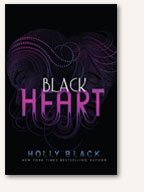
Book Cover: Black HeartEach book, too, gets a little wider in scope. White Cat deals with the protagonist’s direct family, while Red Glove extends more into the criminal world surrounding the family (I swear, these are all elements introduced right off the bat, and not spoilers). Black Heart goes even further and deals with the politics and government of the world. Unfortunately, I believe that this series has been planned as a trilogy with no subsequent books anticipated, though I would be a happy reader if Holly Black decided to revisit it.

—Anna

Free Comic Book Day

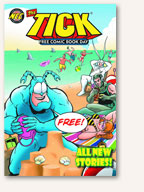
Free Comic Book Day Comic: The TickIt’s that most wonderful time of the year (tomorrow)! On the first Saturday of May each year, comic book stores around the country host Free Comic Book Day, where they offer free special edition comics from the various publishers, as well as store-wide sales and raffles. The free editions aren’t the best stories, of course, but they can be good introductions to new series, and if you are a comic book fan, it is just a fun community event. The official website has a store finder, and I definitely recommend just stopping by your local store if you have any interest in comic books.

—Anna

Vampires in the Lemon Grove

By Karen Russell

Book cover: Vampires in the Lemon GroveMy wonderful friend Lori sent me this just because she thought I’d like it and it arrived in the mail in the middle of my Atlas Shrugged doldrums, and it was such a mood lifter, just having it on my to-read shelf. The cover is just so bright and graphic!

I had heard of the author, Karen Russell, through a brief review of her previous book Swamplandia!, which I had assumed was a comic narrative of Florida craziness á la Elmore Leonard. If it is anything like this book, though, (and I believe it is, according to the blurbs on the back cover) my assumptions are way off. Vampires in the Lemon Grove is the strangest book! It is a collection of short stories, and when I described the premise of each story to Rebecca, they just sounded kind of absurd:

“All silkworms in the Western hemisphere have died, so China is now the sole proprietor of silk, and in order to meet the now increased demand, they have discovered a way to turn women into more efficient silk worms.”

Rebecca said, “hmm.”

But, this story and the others are just beautifully written and poetic, even. Russell emphasizes the senses in her writing, describing not just the sights, but also the sounds, smells, tastes and touch of the worlds she builds. In the titular lemon groves, she describes the sun on the fluttering leaves, the feel of the wind that blows through the grove, the smell of lemon that pervades, and the sweet tartness of the lemons and lemonade.

The silkworm story took a bizarre and, quite frankly, almost silly premise and created layers upon layers of symbolism. The disenfranchised, used for production and others’ profit, find hope in self-identity and transformation. Each story was like this; reading them felt like scuba diving or spelunking, moving deeper and deeper through layers of alien landscapes. The stories themselves, too, seemed to each move a little deeper into the human psyche, getting darker and darker, until the last two broke my heart. So, take that as a caution: don’t avoid reading the book, by any means, but just be emotionally prepared.

It wasn’t a quick read because I wanted to savor each story for several days after reading it and before reading the next one. The only criticism I have is that each story ended too soon, almost abruptly, and each time I was left sort of blinking my way out of the story’s world and wanting to know far, far more about the characters.

Three word review: “otherworldly, emotionally devastating”*

*I’m not promising to always follow Kinsey’s lead with the three word reviews (though I love her addition), but I found these in the NPR review, and they just seem spot-on.

—Anna

Anna Dressed in Blood

By Kendare Blake

Book Cover: Anna Dressed in BloodThis book title jumped out at me in the library months ago (for obvious reasons), but then we started the marathon of reading Atlas Shrugged, so I back-burned it for a while, knowing it was going to be my palette cleanser after Rand. At the worst parts of Atlas Shrugged, I just pictured Anna Dressed in Blood waiting for me. And I couldn’t have asked for a better palette cleanser!

It is cheesy and spooky and just awesome! It reminds me a bit of Twilight, actually, if a better writer had written the characters and situations in a way that makes more sense in a rational world. Also with some gender turnaround: Cas moves to a small town in Ontario with his single mother, starting a new school in his senior year and is immediately popular. Sound familiar? He’s also brooding and rude and immediately drawn to the titular female character. He’s kind of both Bella and Edward, but everything he says and does actually makes sense.

Cas is a ghost hunter, a talent and career that he inherited from his now-deceased father. He and his mother travel to new towns that have killer ghosts, settle there long enough for Cas to draw out and dispatch the ghost, and then move on to the next town. He is immediately popular at his new school because he makes an effort to be; he needs access to the gossip mill as quickly as possible in order to do his job. He knows that by being brooding and a little rude, he’ll be considered even more attractive, so he does that on purpose as well. I just love rational characters who have a goal and then follow logical steps toward it!

I felt like the plot got a bit scattered toward the end; I can’t quite put my finger on it, but the pacing just felt kind of odd to me. Even with that, though, this was a very satisfying book with which to recover from Atlas Shrugged. I would be somewhat cautious about recommending it for young readers: there was a fair amount of violence, and I can’t attest to fear factor because I have already described how I completely unfrightening I find ghosts.

—Anna

Atlas Shrugged (Part 3, Chapters 8-10)

By Ayn Rand

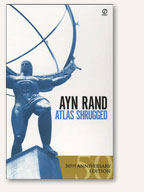
Cover: Atlas ShruggedChapter 7 broke me, people. I only got through it with a generous bribe of Starbucks. I would go into the Starbucks, get my mocha, and force myself to sit there and read Chapter 7 until I’d finished at least 15 pages. You are lucky that Rebecca recapped that section because my idea was to just post:

Atlas Shrugged (Part 3, Chapter 7): tl;dr

Anyway, I’ve gathered the shards of my broken psyche together enough to just get through the final three chapters for you, dear readers. They were actually pretty fast-paced and action-filled, and I would have enjoyed them a lot more before my aforementioned breakdown. Continue reading

Atlas Shrugged (Section 3, Chapters 3 and 4)

By Ayn Rand

Cover: Atlas ShruggedMuch appreciation for Rebecca, who took over for me for Chapter 2 this week since I fell so far behind in my reading because of my head cold. Also, I found Section 3’s first two chapters, set in Galt’s Gulch (yeah, that’s what they call it – try it out loud) almost unbearable. You know how hearing someone describe a dream is pretty much the most tedious thing ever? It was that for over a hundred pages.

This weekend, however, I was on a strict schedule of reading in order to catch up, and I’ve plowed through Chapters 3 and 4, which were thankfully back in the quickly decaying outside world and much more to my liking. Continue reading

Atlas Shrugged (random musings at the half-way point)

By Ayn Rand

Cover: Atlas ShruggedOkay, so I lied about the previous post being my last for the week, but I have to celebrate making it to the halfway point somehow. It is all coasting downhill from here on out, right?

I’m working (sort of) at trying to understand the philosophy behind this book.* The idea of the poor little rich guys being forced by an equalitarian government into supplying their innovations to unappreciative consumers who believe it is their right to get any new product, not a privilege for which they have to work, is hard for me to wrap my mind around – not because I believe that her argument against such a thing is wrong, per se, but because it doesn’t bear any resemblance to the world around me at all.

It is the rare CEO nowadays that actually has direct involvement in the production of his or her company, which leads to more and more of them looting their own companies. In fact, today’s CEOs and Presidents more closely resemble Rand’s despised Washington men than any Hank Rearden or Dagny Taggert. (As an aside, even Rand’s protagonists seem to want their cake and to eat it, too: they complain of the inefficient officials who are always blaming their ineptitude on “unforeseen” and “unpreventable” circumstances, but whenever something interferes with the protagonists’ efficiency, it always turns out to be unforeseen and unpreventable, as well.)

However, as I was mulling this over, a Metallica song came on, and I started thinking about their history. They were on the forefront of the battle against illegal downloading of music, and got a ton of flack for basically being selfish and money-grubbing. Musicians in general are creators and innovators who are caught between unfavorable contracts to corrupt studios and consumers who are trying to fight back against the price inflation of the studios. Honestly, Lars Ulrich is this generation’s Hank Reardon!

Several days later, though, another thing occurred to me, though: when trying to get paid for his work, Lars Ulrich was asking for government regulations to stifle a new technology, which is what the bureaucrats do in Atlas Shrugged. So, he is actually both sides of the coin, really, which is a bit of a gray area that exists a lot in the real world and not at all in this novel.

—Anna

*Tom and I had a short discussion on whether you can call yourself “trying to understand” something when you are simultaneously unwilling to let go of your disdain for it, and I was arguing that you cannot, which seems to have come back to bite me in the ass for Atlas Shrugged.

Atlas Shrugged (Section 2, Chapters 8 and 9)

By Ayn Rand

Cover: Atlas ShruggedA double shot for my last recap of the week!

Have we already mentioned how we are getting through this book? Rebecca and I have both found that the best place to read is at the gym because it combines two very unpleasant activities. Whenever Atlas Shrugged gets too much for me, I put it down for a bit, but then I don’t have anything to distract me from the stationary bike, so I just pick it up again. I did a lot of bicycling for these two chapters.

Continue reading