How Lucky

By Will Leitch

Man, it is my season for finally getting around to reading novels by authors that founded beloved defunct websites. Will Leitch co-founded Deadspin, and while he often wrote about sports, he was so clever and witty that I read all his posts anyway. Anyway, I was very much looking forward to reading a mystery by him, and it only took me four years!

I love an unlikely detective, and this was specifically recommended to fans of The Curious Incident of a Dog in the Night-Time, which was one of my first of the genre. In this novel, protagonist Daniel suffers from spinal muscular atrophy (SMA, described as similar to infant ALS), with a predicted lifespan of 21 years tops, though he is beating the odds in his early 20s and living independently though with round-the-clock assistance. He can’t speak verbally or move without his wheelchair, but still participates in more of life than many of us, which becomes a clear theme of the novel.

While sitting on his porch each morning, he regularly sees a young college student walking to class, and when one morning she gets in a car and then disappears, he appears to be the only witness. He is promptly dismissed by the police in the face of his disability, and his two closest friends jump in to help him continue to get his statement heard. This brings him to the attention of the kidnapper, which really ramps up the suspense.

The crime itself is fairly straight-forward, and is secondary to showcasing a number of socially-marginalized characters and how much they contribute to society as a whole. The end takes a startling swing toward high action, which felt a little jarring, but I’m not sure that wasn’t intentional as well. If at times the theme felt a little blunt, it is definitely a message that is needed more and more today: that everyone can contribute to our society in large and small ways, and that you get out of life what you put into it.

Women’s Hotel

By Daniel Lavery

This novel is less about telling a story than evoking a place and time, but it does that so well that I didn’t mind the slight plotting at all. In fact, with everything currently going on, a sort of gentle pastiche of the past might be exactly what I needed.

Daniel Lavery, a favorite author of mine, can just really turn a phrase that had me giggling at basically just clever nonsense (which I mean as a high compliment). Almost every sentence is packed with both witticisms and what I assume is meticulously-researched details of the period, and though it could make for an occasionally dense style, it is also a most welcome distraction from everything in the present.

I’ve seen some low-star reviews complaining that you must love the narrative voice, because there’s not much else going on, and while I suppose I agree, I absolutely love the narrative voice! For me, Lavery does a great job of recalling the absurdist comedy of Three Men in a Boat and Wodehouse. And even with the very light touch, he fits in some poignant themes of personal responsibility, social responsibility, and the frequent conflict between the two, which is very relevant today and helpful to hear, like a gently prodding pep talk. This book won’t be for everyone, but for those of us it is for, it is marvelous!

Unsatisfactory Cozies

Only the Cat Knows by Marian Babson

Yeah, yeah, I know… I didn’t particularly like the earlier book I read, but just like that one, I was suckered into the premise. After a suspicious fall puts his twin in critical conditional, a renowned ‘female impersonator’ takes her place in the strange rich guy’s compound where she lives and works. The whole cast of weirdos all hanging on to an enigmatic millionaire is very reminiscent of Elizabeth Peters’ excellent Summer of the Dragon, and this book suffers by the comparison.

As I found in the first book, Marian Babson lacks the key charm necessary to write a standout cozy mystery, though her plots are fun enough. The bare bones are there, but a lot more goes into a decent cozy than the average reader (or writer, I guess) realizes. The end, too, felt fairly abrupt, just wrapping up with the nearest available weirdo being the culprit without much setup, and the happily ever after for the rest of the characters felt fairly unearned as well.

A Deadly Walk in Devon by Nicholas George

Maybe it’s me or maybe it’s 2025, but cozy mysteries are taking an increasing amount of suspension of disbelief, and I may have reached my limit. I already have to accept that the police are concerned with justice and safety in this fantasy world (at least this particular protagonist is already retired), but also that murder is always wrong. Hear me out: maybe if someone is an absolute nightmare to be around at all times, when they eventually push someone too far, that’s just natural consequences.

So, I’m already struggling to believe that our protagonist is a good guy, though he is sympathetically written, and now I have to convince myself that the main investigation is even worth doing. Nicholas George is a capable writer, but this is a steep uphill demand. Overall the majority of the book felt like following a basic outline for a cozy mystery with all the boxes checked off in order, though the end took a bit of a dramatic turn. I’m guessing that George will find a more natural flow in later books, though I’m not invested enough to see.

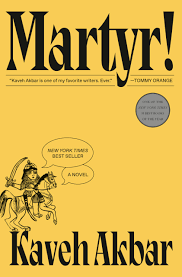
Martyr!

By Kaveh Akbar

This is capital-L Literary novel about a depressed young poet searching for the meaning of life and death, and I should absolutely hate it, but I was riveted! I guess that’s a testimony to the writing. The protagonist is still quite annoying, the sort of drug-fueled tortured artist that intrigued me in my 20s and just exhausts me now. But even within the first few pages, I ran across lines that I knew would stick with me for a while.

I never would have even picked it up if it hadn’t been recommended by what is becoming one of my favorite e-newsletters, Death by Consumption.* The recommendation includes this quoted passage:

Everyone in America seemed to be afraid and hurting and angry, starving for a fight they could win. And more than that even, they seemed certain their natural state was to be happy, contented, and rich. The genesis of everyone’s pain had to be external, such was their certainty.

And I thought to myself, well, yes, of course we all want to be happy, contented, and rich; who doesn’t? So I felt like I needed to read the book to find the counter argument. I didn’t really get an answer, but instead got a lot to think about over the next few days and weeks. (Danny also calls it “short but expansive” and I believe his definition of short has been warped by the enormous tomes he usually reads, since this comes to a healthy 331 pages, but it was a quick read, with short chapters from rotating viewpoints that pull you in for ‘just one more.’)

Also, about halfway through the book, there’s a surprise twist that adds a significant mystery that I wasn’t expecting at all, but helped balance the tortured artist side of it all. That said, I found the ending both confusing and upsetting, which could have been intentional but I got the sense that I was getting caught up in details and missing the big point of it all. I was incredibly grateful to google for autofilling my search of “Martyr! Kaveh Akbar…” with “ending explained” and finding an hour-long lecture on youtube, as well as a decent sized reddit thread.

*Side recommendation: I first started following Danny Gottleib’s writing when he was doing a tongue-in-cheek Julie & Julia thing called Danny & Gweneth, where he tried to make all of Gweneth Paltrow’s recipes with ingredients he could find locally in the Midwest. He ended up moving to NYC and switched to a general media recommendation newsletter that I look forward to every week.

The Hymn to Dionysus

By Natasha Pulley

Ooh, Natasha Pulley just keeps getting better and better at her special talent, which is weaving truly brutal social commentary through a cover of fantasy action. I went into this one with less trepidation after The Mars House, and I’m sort of wondering if The Mars House was a setup. There are enough notably similar themes between the two novels that I began to think of them as a pairing of sorts, though very, very different in setting, character, and plot.

The Hymn To Dionysus has an even more light-hearted tone right off the bat. Our protagonist is a happy child soldier in ancient Thebes, and if it doesn’t exactly sound like a happy existence to a modern reader, well, sometimes that’s just the case with fantasy, especially historical fantasy. I mean, look at the majority of children’s and young adult media, right? The Hunger Games and Naruto, just to name a few right off the bat – full of deeply traumatizing events for young children who just sort of make do, and that’s what our protagonist does, too. His life has some downsides (murdering, enslaving, etc.) but there’s plenty of upsides, too (his military unit is like a family to him, he gets to travel and see all sorts of sights). He and everyone else in Thebes are just going along, until Dionysus, the god of madness, shows up and suddenly they can’t just go along, and the full awareness of it all starts crashing down on them, and it is devastating, for both the characters and the reader.

As if all that wasn’t enough, there are some striking comparisons to our current world. My ancient Greek history isn’t up to much, but I started getting the impression this was set toward the end of the Grecian empire, with a years-long drought devastating all levels of civil society. As field slaves run away, figuring capture and death is better than starvation on the stringent food rations, the military is charged with rounding up ‘criminals’ to work the fields for the necessary food for the city and given a quota to meet, which rang direly true.

It ends as satisfactorily as possible, more so than I’d imagined it being able to after a whole series of gasp-worthy twists, and left some scenes indelibly imprinted in my head, so I’d generally recommend this, though I am looking forward to returning to something a little more gentle next (spoiler: I didn’t do that).

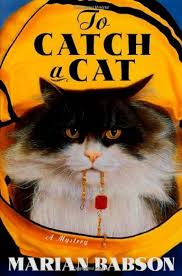
To Catch A Cat

By Marian Babson

For such a charming cozy premise, this mystery is surprisingly grim and nasty, which is not necessarily a pan but definitely a surprise. Within the first ten pages, 11-year-old Robin has been dared to steal a neighbor’s prized cat but while in the house, witnesses the husband brutally beat his wife to death. I guess I’d expected more of a ‘closed door’ mystery, where all the violence is off-screen so to speak, but it’s really quite explicit. We continue to get intermittent chapters from the husband’s unhinged viewpoint, which are unpleasant and I imagine would be very triggering to anyone experienced in any sort of domestic abuse situation.

At the same time, Robin is staying with his aunt and her less violent, but still verbally abusive boyfriend, and honestly, this novel is not very generous to any sort of post-pubescent male characters. Individual scenes are darkly funny, but the overall situation is grim enough that it is hard to fully enjoy the mystery. Robin is, at best, severely neglected by the variety of self-centered adults around him, with his only real comfort and companion being this cat that he has successfully smuggled out of the murder house.

All the adults are fairly useless in general, with the only real support and help coming from other children and teens. The several divergent plot strands come together in a neat (and fairly quick, at less than 200 pages) ending, and like any decent cozy, it all concludes satisfactorily, though disconcertingly so, considering everything everyone has been through.

Manners and Monsters

By Tilly Wallace

I’d run across a couple different recommendations for this book, and the premise is fascinating! Set in a fantasy England in the early 19th century, a biological weapon created in the Napoleanic wars has turned several hundred members of the English aristocracy, primarily women, into zombies of a sort. Honestly, the worldbuilding is so clever, this is more of what I would have liked to see in Pride and Prejudice and Zombies! The aristocracy, being the elite, have made it a whole song and dance, with a whole new set of ridiculous etiquette around their living-dead members.

When the etiquette is broken quite violently with a zombie-esque murder (missing brains, of course) at a grand ball, chief investigator Viscount Wycliff, on the fringe of haute ton himself, must pry into secrets of the various ‘unfortunates’ in attendance. In order to ruffle as few feathers as possible, he is accompanied by Spunky Heroine™ Hannah, the unassuming daughter of a surgeon specializing in undead ailments. And here’s where the novel lost me a little.

I generally liked Hannah, but both protagonists are fairly flatly written: Wycliff is brusque to the point of insulting, while Hannah pines for love at least half a dozen times throughout the book. The two are very clearly destined for each other, which wouldn’t bother me if they didn’t seem like an exceptionally bad match. I’d be reading along, enjoying the general zombification of the Regency era, and then their personal interactions would be a sour note. Romance really is trickier to write than people realize!

An additional big kudo to author Tilly Wallace, though: she sells all of her books directly through her website, tillywallace.com, where you can pay and promptly download an epub file. As someone trying to cut my very last tie to amazon (those pesky self-published ebooks), I very much appreciated this, and hope that more self-published authors follow suit!

The Mars House

By Natasha Pulley

You know how there are rare authors that you as a reader just trust implicitly? Like, even if the story doesn’t seem to be making sense or clicking, you know they’ll pull it off in the end. Well, I don’t trust Natasha Pulley – in fact, I actively distrust her. This is not to say that her books aren’t consistently excellent. They are! She just has a real habit of throwing in some actual crime against humanity, and having all the characters shrug it off like no big deal.

I wouldn’t even read this one until Kinsey read it first and gave me the all clear, and even then, I read it in a sort of mental flinch state. This also made me very suspicious of the slightest hint of genocidal tendencies in characters, so I was extra judgmental of them all and not quite able to actually like them as much as perhaps I would have otherwise.

Our main character is a principal ballet dancer for the Royal Ballet who has to flee the climate crisis in London for a colony on Mars. There, he is consigned to manual labor until a conflict with an anti-immigration politician forces the two of them into a contractual marriage (it makes marginally more sense in the context). This would all be brutal to read if the protagonist wasn’t such an utter golden retriever, just overall cheerful (and a little egocentric) regardless of harrowing circumstances around him.

It seemed clear from the outset that the politics were not all that they seemed, but I stayed extremely wary of Pulley trying to trick me into rooting for a war criminal or some such. Instead, though, she wove a very satisfyingly complex mystery that pulls in geopolitics, gender and cultural identity, disability rights, and so much more. The core relationship is, of course, the draw, but I find myself continuing to think through the various linguistic and cultural extrapolations Pulley creates here.

The Black Girl Survives In This One

Edited by Desiree S. Evans and Saraciea J. Fennell

A collection of horror short stories with an assured survival? Yes please! (Though the authors occasionally split hairs by ending the story before the perhaps inevitable conclusion.) In my enthusiasm, however, I’d overlooked that this is very much for young adult readers (and is clearly branded so). The fifteen stories all feature black girls in high school or college, all feeling the impatience for adulthood and independence that makes middle-aged me feel tired (and sympathetic for the adults around them).

So, I wasn’t exactly the audience for this, but the stories covered a truly impressive variety of horror subgenres and intersected them with Black life in a really fascinating way. Southern gothic hits a lot different with the added generational trauma of slavery, but also how do the cults of wellness MLMs punish Black bodies even more than white? Remote nature spaces can already be uninviting to many Black people, with or without supernatural horrors, and what would that look like in futuristic space exploration?

But then, there’s also the comfort in reading these, knowing that you won’t be exposed to an onslaught of abuse. In these stories the Black girls fight back, survive, and often triumph, even if occasionally leaving a truly impressive amount of destruction in their wake.

The stories varied in quality and my personal taste, of course, like any anthology, but I was really impressed with what a comprehensive overview it provided. I always particularly enjoy short story anthologies as a way to be introduced to new authors, including here two up-and-coming writers who won an open call with their submissions that fit in beautifully.

Nicked

By M. T. Anderson

Described as a “wildly imaginative, genre-defying, and delightfully queer adventure,” I knew Nicked was going to be weird, but I hadn’t expected it to be quite so laugh-out-loud funny. In many ways, the humor had both a dryness and absurdity that reminded me of Catch-22, without being nearly so bleak, which is saying a lot for a 11th century setting.

A lowly monk is voluntold by his local bishop to accompany a ‘saint hunter’ in ‘liberating’ the reliquary bones of St. Nicholas from its celebrated gravesite and temple to the monk and bishop’s own town. In the middle of a plague, they hope the reportedly healing bones will be able to save the populace, so there is some redeeming motivation. The author claims that this based on a true story, and has the references to back it up, though he also explains that any deviation from strict accuracy is also highly representative of medieval nonfiction, which took plenty of licenses of its own (his afterward is well worth a read).

The humor comes from both the strangeness of the period in general and the quest in particular, and the familiarity of political and religious bickering across all times and geographies. The common people everywhere make due during times of great upheaval, and every interaction is a delight. The heist is also so well written, with setbacks and twists and turns that kept me agog. My one caveat is that there is a framing narrative that sometimes gets very philosophical and that I couldn’t always follow, but it is also used sparingly, so I didn’t find it a detraction.