A Dreadful Splendor

By B. R. Myers

This is apparently the author’s first adult novel after a slew for young adults, and I have to admit that I’m not convinced it is fully aged up. Genevieve, the teenage protagonist, is very Feisty™ in a particularly young adult way (i.e. with all the common sense of a young adult). She is confident and sassy in situations that she would probably be better suited just observing or even fading into the background, and then acquiescent at times when she should really take a stand. She jumps to a number of fairly obviously wrong conclusions, which she then has to apologize for, which always makes me cringe.

All of that out of the way, the plot is a quite juicy gothic mystery surrounding the tragic death of a beautiful young heiress. Genevieve, raised as a scam medium under the tutelage of her mother, has been brought in to contact her spirit by two different men at cross purposes, one to set the other’s mind at ease, and the other to uncover a murderer. Once in the classic gothic sprawling estate of decaying wealth, she begins to experience strange occurrences that test her skepticism. I love a false medium/real ghost scenario!

While the writing continued to read juvenile to me, with a lot of the sort of repetition one offers to younger readers to make sure they are following along, the plot really did hold up all the way through. I was full of guesses but had no solid predictions of the final reveal, and felt it held up in a suitably melodramatic way.

The Seven Moons of Maali Almeida

By Shehan Karunatilaka

Work is sending me to Sri Lanka tomorrow, so I scrambled to check out several travel guides from the library. They weren’t really holding my attention, though, so I had the thought to track down a fictional novel by a Sri Lankan author and set there. Unsurprisingly, the vast majority focus on the long and brutal civil war, and that wasn’t what I was looking for in this particular moment.

The Seven Moons of Maali Almeida has a fascinating premise, and was described as “bawdy, wisecracking” and “comic, macabre, angry and thumpingly alive,” which seemed more like it. However, it was very much also about the civil war, which upon consideration makes a lot of sense: the 26-year war only ended in 2009, recent enough that it would probably be absurd for any novel to not feature it someway or another. (I also think it worked: I have a much better general sense of the recent history and culture, though I had to frequently remind myself that I was reading a critique of the most negative side.)

The novel opens with Maali Almeida, a photojournalist, arriving in the afterlife, which spotty memories of his life and none of his death. The very bureaucratic helper explains to him that he has seven moons before his chance to move to the next stage, whatever that will be, closes. As he travels around Colombo, revisiting old homes, family, and friends, dodging various other ghosts and demons, pieces of his life come back to him, and he scrambles to make meaning of it before he must go on.

Maali not a very likeable man, though neither is anyone else, and the situation in Sri Lanka is impossible. The tone of the book in general reminded me of Catch-22, in that it was actually quite funny when showing truly horrifying circumstances. Upon reading the first chapter, Rebecca said it reminded her a bit of Slumdog Millionaire, and perhaps there is genre of books that reveal the worst of humanity through the darkest of humor. For all that, though, it ended in a surprisingly optimistic view of humanity and life in general, which caught me off guard but that I really appreciated. (As an aside, the beginning of the book caught me off guard with its second-person present tense, which is an usual style that can be difficult to get into, but I adjusted more quickly than I expected and came to really appreciate it.)

The City Beautiful

By Aden Polydoros

Published in 2021, Aden Polydoros notes in the afterward, “I wanted to write a book where the Jewish characters weren’t just passive victims, but where they fought back and rose above the people who wished to do them harm.” The political climate today is a little trickier, but it does feel like both Hamas and IDF are doing their best to erase the beauty of Jewish culture each in their own way. Polydoros, however, does a powerful job of capturing the complexity of Jewish immigrant experience, in this case in Chicago in the late 1800s.

The City Beautiful packs in a lot, actually – it is a YA historical fantasy murder mystery, tying together the historical realism of immigrant life in the Chicago tenements with Jewish folklore in an enthralling story. Years after a traumatic Atlantic passage and the death of his father, Alter Rosen is focused on staying out of trouble and earning enough money to bring his mother and sisters to America. The disappearance of young men in his neighborhood is common enough that he doesn’t pay it much heed until his roommate and unrequited crush is found drowned. When preparing the tahara, the ritual purification ceremony for dead, he is taken over by the other boy’s dybbuk, or vengeful spirit, and driven to uncover the murder in order to free himself and lay the spirit to rest.

He is assisted by friends and neighbors who all represent varied facets of Jewish and immigrant experiences, occasionally in conflict with each other. The novel captures how messy and uncontained life is, and by contrast how false and damaging stereotypes and propaganda are, even if they seem more easily digestible on the surface. At a more basic level, it is also an absolutely thrilling mystery and ghost story, and a sweet YA-appropriate romance.

Grave Expectations

By Alice Bell

I guess I just really love the very specific premise of a real psychic, who finds it easier to pretend to be a fake medium, has to solve a murder mystery in an old English country estate, because I loved A House of Ghosts and I loved this one! Despite the obvious similarities above, Grave Expectations has a much lighter, quirkier tone, at least partially due to the modern setting.

30-something Claire has been ‘haunted’ by her best friend ever since Sophie was mysteriously murdered when they were both in high school. This has clearly been a mixed blessing for both Claire and Sophie, but they have settled into a relatively routine life at the novel’s start. Claire makes a basic living as a medium, using Sophie mostly just to eavesdrop and dig through personal items for information.

Claire and Sophie are very reluctantly drawn into a murder investigation by a recent ghost, and their apathy is only matched by their ineptness, which makes for some really excellent comedy. Oddball members of the deceased’s family, both living and dead, join in the investigation, adding to the general hilarity. Halfway through, I was already hoping this is the start of a series.

I was snorting and giggling along, and was completely blindsided (in a good way) by the surprising pathos of the crisis point, when the author gives us a peek into the much more realistic trauma of two women struggling to come to terms with one of their unnatural deaths. I’m only a little ashamed to admit that I teared up. …And then we were back to slapstick reveal and denouement, poking fun at many of the traditional murder mystery tropes! I would have expected it to have felt uneven; it was jarring, but in a really skilled way that used the precarious balance of comedy and drama to strengthen the impact of each.

The Last Ghost Series

By M Dressler

I See You So Close

Book cover for I See You So Close

I read a teaser that this was a small town murder mystery but with a twist: the investigating protagonist is a ghost disguised as a human! I was immediately hooked, wondering how does a ghost disguise themselves as a human?! It wasn’t until I had it in my hands that I realized it’s a sequel (I’ve done this before). I decided that it looked like it was enough of a reset in plotting that I could start with it, and the author does a fairly skillful job of getting any new readers up to speed, I thought.

Our protagonist ghost, Emma Rose, is traveling west to outrun ghost hunters, and it quickly established that this is a world in which everyone is aware of the existence of ghosts, but enough of the living find them troubling that ghost hunters are sent to “blast” them much as one would bring in an exterminator. So, I’m sympathetic to our protagonist’s wariness around humans, but her trigger finger to just kill them before they try anything makes me think the ghost hunters are probably all for the best.

Emma Rose ends up in a small town so wholesome and welcoming it immediately sent up a whole bushel of red flags for me, though it takes her a bit longer to realize that there is a dark secret lurking in its gold rush-era history. It is a really interesting look at what life and existence means, whether in current or after-life, and whether a “live and let live” philosophy should be extended to those not actually currently living. For me, the characters seemed a little flat, not stereotypes exactly, more just simplified, and the plot somewhat fussy and over complicated. Additionally, I found the language a bit stilted, and even wondered whether it was the fault of a weak translation, but not only does that not seem to be the case, the various cover blurbs raved about the poetics of the language.

The Last to See Me

HOWEVER, I went back to read the first novel, and it is so much better! It is much more introspective, focusing on the parallel plots of Emma Rose in life leading to her death, and her afterlife as she works through what this existence means, both to her and others. It all takes place in the same small coastal town in which she lived and died, with a much smaller cast of characters, so the book can really delve into the themes of life, freedom, and justice in really powerful ways. Both novels are told in first person by Emma Rose, who is complicated enough to be not necessarily likeable, which gives some really nice philosophical depth to this first book. I think this same narration may have contributed to some of the flatness of the other characters in the sequel, since they are only really seen through Emma Rose’s eyes and thoughts.


Between reading these two books out of order, my twitter feed was full of  SF/F twitter justifiably furious at a reviewer for panning a sequel for not standing alone, leading to this extremely thorough and entertaining takedown. For many reasons, I did not commit nearly her level of insult (I’m writing on my personal blog with a small audience, these are not epic fantasy novels, etc.), but even in this case, it really brought home to me what a disservice I’d done to both books. I think the second book isn’t as good as the first, but now I’ll never have a chance to read that second book fresh but with the knowledge of the first behind it, so I can’t ever be sure. I enjoyed the first book much more than the second, but I think I would have liked it even more without the spoilers I picked up from the second.

Tuesday Mooney Talks to Ghosts

By Kate Racculia

Tuesday_MooneyThis book deserves a better reader than I am right now. I absolutely loved Racculia’s previous novel Bellweather Rhapsody and tore through it in a few days. I loved Tuesday Mooney, too, but it took me two weeks to read because my attention span is a fruitfly at this point.

It starts a little slow with introductions of all the characters, and Racculia really excels at characters – they were all interesting, distinct, and sympathetic but also clearly flawed in their own ways that kept them from being too likeable. Five of our central protagonists are at a Boston hospital fundraiser – the titular Tuesday Mooney being a researcher for the donor relations department– when an older gentleman keels over while bidding $50k for a meet-and-greet with New Kids on the Block. (I feel like this level of detail is characteristic of Racculia, and the book continues to be a love letter to all things Boston, as well as the adventure, murder, romance, ghost story it is.)

Even though he dies in the first chapter, I count the older gentleman as one of the protagonists, because it is his post-mortem scavenger hunt that leads the rest of the story, and his own (interesting, distinct) personality is threaded through it all as well. Through the scavenger hunt, the cast of characters expands to family and friends of the deceased as well as more random hunters, and we get lovely peaks into many of their lives. It was here that I would happily sit down for an hour or so to read and feel satisfied with the story, but then turn blank-eyed to the TV afterwards, which is very much a criticism of my own coping skills and not the novel itself.

However, when the villain is revealed to both the protagonists and the reader, that’s when I really got hooked, and stayed up far too late a couple of nights. In retrospect, I realize that I like a story to have more darkness to it than the first half had, focusing on the riddle and puzzle solving. It is quite a race to the end, and in retrospect has a well-crafted pace that exponentially speeds up over the course of the book. The finale is incredibly satisfying, tying up more loose ends than I’d even quite realized Racculia had threaded (though not all of them, keeping it a bit realistic), and I plan to read this again when I’m no longer quite so hollow eyed and empty headed.

A House of Ghosts

W.C. Ryan

House_of_GhostsThis novel is a murder mystery, spy thriller, and ghost story all in one, and manages to be laugh-out-loud funny, uneasily creepy when reading late at night, and solemnly poignant about the horrors of war. Any of these is a rare achievement, but combining all together make this something really unique. Set in England during the first world war, spiritualism is on the rise, as so many young men are missing/presumed dead on the front.

The Highmount patriarch made his fortune in weapons manufacturing during the war, but has since lost both his sons. In their grief, he and his wife have retreated to their remote island estate, which is converted from an old abbey and rumored to be haunted. They plan a house party over the holidays, inviting several spiritualists to attempt to make contact with their sons.

There are the charlatans, of course, like Madam Frey, with all sorts of tricks up her sleeves. But there are also the real deal, like Kate, friend of the family and ex-fiancé to one of the Highmount boys, who can actually see ghosts, but finds it so socially embarrassing that she hides it as well as she can. And there’s spiritualist Count Orlov, who can perhaps see ghosts but may find it more convenient to fake the séances?

Add to all that, some confidential weapons designs have been discovered in the wrong hands, and three undercover personnel, who have complicated relationships to each other, are suborned into attending the house party, under a variety of subterfuges, causing even more confusion.

Of course, there is also a light romance, which is so deftly done that I had to double check that the author is male. The two protagonists have a slow growing attraction toward each other, built on mutual respect and good communication, which is also awfully rare and a very pleasant surprise in novels.

As I Descended

517Jbn75RULThis isn’t a full review, but I wanted to pop in and say that readers who enjoyed Anna’s post in the spring about seeing Sleep No More, the immersive theater take on Macbeth, might like As I Descended by Robin Talley. It’s a YA version of the story, set in a Virginia boarding school, with two teenage girls positioned as Macbeth and Lady Macbeth. I really enjoyed seeing how the grand story of kings and battles scaled down to the stakes of high school–theoretically smaller, but still life and death to the characters. And if every version of this story has to decide which of the more fantastical elements are happening in the characters’ heads versus which are real, this one leans heavily towards the spirits and ghosts side of things. Which makes it a great, creepy read for this time of year, as we edge into the dark of fall and winter.
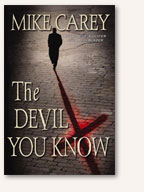
The Devil You Know

By Mike Carey

Book CoverThis book is chock full of pretty much every popular supernatural creature (okay, no vampires have shown up, but I wouldn’t bet against them appearing later in the series), but they are all treated in very unusual ways. The were-beasts are sort of dim, while the zombies are snarky, and the succubae are downright vicious. The story starts off kind of slow, and reminded me quite a bit of an adult version of Anna Dressed in Blood, which I only moderately liked. (Also, just about every reviewer on GoodReads compares it favorably to the Dresden Files, which I concur with.) Once it really gets going, introducing a whole new supernatural being pretty much ever other chapter, I had trouble putting it down again.

The world-building premise is both basic and clever: what if suddenly and inexplicably the dead began to return, like a reverse apocalypse? Our reluctant hero has a natural talent for sending them back again, and works as an exorcist-for-hire when money gets tight. If all this hasn’t already sold you on this summer escapism, let me just tell you that I reserved the second book of the series at my library as soon as I finished the first one.

—Anna

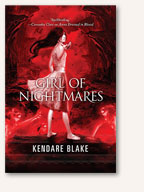
Girl of Nightmares

By Kendare Blake

Book Cover: Girl of NightmaresGirl of Nightmares is the sequel to Anna Dressed in Blood, which I enjoyed as my palette cleanser after a brutal few months with Atlas Shrugged. Anna Dressed in Blood was an awesome way to recover from Ayn Rand, but wasn’t so engaging that I was intending to read the sequel. However, I was looking for casual reading over the holidays, so I picked it up on a whim at the library, figuring it would be a fun distraction.

And it was! It was actually even better than the first book! My one complaint about Anna Dressed in Blood was awfully vague, just that the pace of the plotting seemed odd to me in a way I couldn’t quite put my finger on. Well, I’ve figured out what the plotting issue was because Girl of Nightmares doesn’t have it at all. So, here’s the thing, I like a very linear storyline: protagonist has a problem, works towards a solutions, and finally succeeds. It is a little simple, perhaps, but that’s how I like it. Anna Dressed in Blood had a lot of red herrings as the protagonist and supporting characters tried to figure out what challenge they were facing and then how to solve it, but this book is more straight-forward.

Girl of Nightmares starts just a couple of months after the end of Anna Dressed in Blood, and picks up the same story, so is definitely not a standalone. I can’t really describe the plot at all without spoiling Anna Dressed in Blood, so I’m not going to do that, beyond saying that the other thing I really like is that this book is sort of the flipside of the first book. The first book follows the protagonist Cas as he hunts murderous ghosts and sends them to the afterlife; in Girl of Nightmares, Cas is trying to bring a ghost back from the afterlife. I just love that kind of mirror-image reversal treatment in sequels!

Cas also travels to London to meet with a group that sounds very similar to the Watcher Council, and any similarity to Buffy the Vampire Slayer is a-okay with me!

—Anna