By Ayn Rand
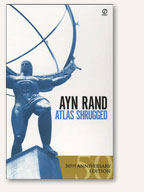 Okay, so I lied about the previous post being my last for the week, but I have to celebrate making it to the halfway point somehow. It is all coasting downhill from here on out, right?
I’m working (sort of) at trying to understand the philosophy behind this book.* The idea of the poor little rich guys being forced by an equalitarian government into supplying their innovations to unappreciative consumers who believe it is their right to get any new product, not a privilege for which they have to work, is hard for me to wrap my mind around – not because I believe that her argument against such a thing is wrong, per se, but because it doesn’t bear any resemblance to the world around me at all.
It is the rare CEO nowadays that actually has direct involvement in the production of his or her company, which leads to more and more of them looting their own companies. In fact, today’s CEOs and Presidents more closely resemble Rand’s despised Washington men than any Hank Rearden or Dagny Taggert. (As an aside, even Rand’s protagonists seem to want their cake and to eat it, too: they complain of the inefficient officials who are always blaming their ineptitude on “unforeseen” and “unpreventable” circumstances, but whenever something interferes with the protagonists’ efficiency, it always turns out to be unforeseen and unpreventable, as well.)
However, as I was mulling this over, a Metallica song came on, and I started thinking about their history. They were on the forefront of the battle against illegal downloading of music, and got a ton of flack for basically being selfish and money-grubbing. Musicians in general are creators and innovators who are caught between unfavorable contracts to corrupt studios and consumers who are trying to fight back against the price inflation of the studios. Honestly, Lars Ulrich is this generation’s Hank Reardon!
Several days later, though, another thing occurred to me, though: when trying to get paid for his work, Lars Ulrich was asking for government regulations to stifle a new technology, which is what the bureaucrats do in Atlas Shrugged. So, he is actually both sides of the coin, really, which is a bit of a gray area that exists a lot in the real world and not at all in this novel.
—Anna
*Tom and I had a short discussion on whether you can call yourself “trying to understand” something when you are simultaneously unwilling to let go of your disdain for it, and I was arguing that you cannot, which seems to have come back to bite me in the ass for Atlas Shrugged.


 Biblio-therapy