The Martian Chronicles

Whew, barely made it for Banned Books Week! I did not care for Ray Bradbury’s The Martian Chronicles, and this is a  lengthy review of me thrashing around for a reason.

The Martian Chronicles was published over 60 years ago, in 1950, and it reads like it. Ray Bradbury imagined amazing technology, but the social norms feel very grounded in mid 20th century to the point where I struggled to even understand, let alone empathize, with any of the characters. Every female character is either resignedly submissive to an overbearing husband or an innocent child even in adulthood (or sometimes both—I’m looking at you, Ylla).
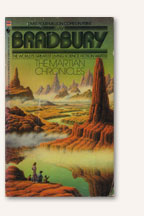
Photo: The Martian Chronicles Book CoverThere is greater variety in the male characters, but they too seem outdated. They all feel like characters from old TV shows, either the stern but kind father figure, the intelligent and care-worn authority figure, or the brutish and ignorant everyman.

The technology is an extension of what was cutting edge in the 1950s—robotic houses and people and rockets. Which, of course, we still don’t have today, but that isn’t the direction technology went. There is no way Bradbury could have anticipated the microchip and then the Internet, but those inventions changed how our entire society thinks about technology. To way oversimplify, we’ve gone smaller, not bigger, and into intangible information-sharing realms, not large metal structures. So, it reads a bit like looking down a path we didn’t take as a society, but less interesting.

And then, even more pervasive but harder to describe, there is the overall messages of the book. The United States had dropped atomic bombs on Japan, and the Cold War was brewing. People were starting to think about and be terrified by the power of destruction we as a society held. Sadly, at this point, this is all pretty old hat. Sure, we all have the power to blow each other up; it probably won’t happen, but if it does, well, that’s life, right? I think previous all-consuming fear has turned into mild concern but mostly apathy for today’s population, and that early panic feels melodramatic and a bit naïve.

As with Lord of the Flies, I wondered how I would have felt about this book if I’d read it in high school 20 years ago. The book starts in the year 1999, and concentrates mostly in the early 2000s, so it would have still been set in the (very near) future. 20 years ago, our space program was still thriving, and our idea of the cutting edge of technology was still concerned with the idea of androids instead of nanorobotics.

I was commenting to a friend how disjointed the book reads, and he told me that it was a compilation of short stories that Ray Bradbury had previously published individually in magazines. That helped me understand the structure of the book somewhat better, but it made me wonder if perhaps Bradbury had shoehorned short stories into a Mars setting that had previously nothing to do with Mars?

My favorite section, the recreation of Poe’s House of Usher as an automated haunted house, had very little to do with colonizing Mars, and was much more a Catch-22-like commentary on out-of-control bureaucracy. Maybe I liked that part so much because that’s one aspect of our society that hasn’t changed a bit.

I think that’s both the positive and the negative of The Martian Chronicles; it doesn’t read like one complete book, so it shifts in tone, characters and plot wildly. That means if you don’t like one section, there’s a good chance you’ll like another one.

(I should cut Bradbury some slack; this review is even more scattered than The Martian Chronicles! I will call it an homage.)
The Anastasia series by Lois Lowry

When Anna suggested that we each write something for Banned Books Week, she sent me to the ALA site that lists the most-frequently challenged books. Those lists are topped by the expected things (Harry Potter, Judy Blume, etc.) but number 75 on the Top 100 Banned/Challenged Books 2000-2009 shocked me: the Anastasia series by Lois Lowry. I LOVE Anastasia Krupnik! I wanted to BE Anastasia Krumpnik! How could anyone object to Anastasia! I could not remember a single thing about any Anastasia book that I could imagine anyone objecting to. But it had been quite a while since I had read them so, while I didn’t have time to reread all six of the Anastasia books that I own, I did pull them all out and glance through them. (This was harder than it should have been, since a couple of years ago I followed an Internet trend and arranged all the books in my bookcase by color. People always ask me if it makes it hard to find my books and I always say no, but this is a lie. It does. Did you know that each of the Anastasia books is a different color? Assembling them all took a while. Take my advice and don’t arrange your books by color, no matter how cool it looks.)

As a quick overview, the Anastasia series consists of nine books that follow the adventures of a girl named Anastasia Krupnik, who lives in Boston with her parents and her little brother Sam. And when I say “adventures,” I mean things like having to do a science fair project and having her best friend go away to summer camp. These are low-drama books. However, looking through them, I was reminded of what I loved so much as a child about the books: Anastasia was smart. She wasn’t always right, but she was always thinking and planning and having ideas, and her (slightly neurotic) inner life seemed to more closely resemble my own than that of most kids’ book characters. Looking through them now as an adult, I can also see more clearly that while Anastasia is smart, she is still a kid and is still making some of the crazy of leaps of logic and wild decisions that kids make. In my favorite of the books, Anastasia On Her Own, thirteen-year-old Anastasia is in charge of the house while her mother is away on business and decides (for a variety of reasons) to cook a dinner that includes Ragout de Veau aux Champignons (I like to imagine this was a Julia Child recipe). Anastasia uses some fairly creative problem-solving and does manage to successfully cook the dish, but the dinner itself turns into a disaster. The whole situation ends up being absurd, in the way that a thirteen-year-old’s decisions are absurd. And yet, I can also see myself ending up in the same situation at that age.

According to Wikipedia, these books have been challenged because of “references to beer, Playboy Magazine, and a casual reference to a character wanting to kill herself.” This makes me wonder if the people who are apparently out there complaining about these books today have read ANY of the dark young adult fiction that has come out in the last ten years. Which is not to say that I think that books that actually show children DRINKING beer, rather than just referencing it, should be banned. (I think it’s safe to say that I am against book banning in general.)  I actually think that the fact that books as innocent as these end up on the list makes it easy to dismiss people who try to get books pulled. They come off seeming like crackpots for complaining about nothing and I don’t even bother taking them seriously. But, we should take them seriously, because sometimes they succeed. And it make me sad to think that some smart, neurotic girl out there might not get to read an Anastasia Krupnik book because one of the characters has the nerve to discuss a Playboy magazine.

So, in conclusion, banning books is bad and Anastasia Krupnik is awesome, and it is ridiculous to me that the two even have to be in the same sentence. Also, Wikipedia tells me that an Anastasia book came out in 1995. Considering that I was 20 in 1995, I’m fairly sure that I haven’t read that one yet, and will need to make a trip to my library soon. Yay for more Anastasia!

“And Tango Makes Three”

And Tango Makes Three
Written by Justin Richardson and Peter Parnell
Illustrated by Henry Cole
(2005)

I am hardly the first and I won’t be the last person to read a book purely because it was banned. In fact, it’s a bit of a tradition for Banned Book Week: go out and read a banned book. I decided for a couple of reasons to go straight to the top of the banned books: here’s a book that’s the most contested, most banned book in the entire United States for four out of the last five years. (It was knocked down to second most banned book in 2009, but it rebounded back up to first place in 2010.)

This book has owned the American Library Association’s banned book list every year since its publication. Wow.

And then there’s the other reason why I picked this book. It is, in no particular order:  nonfiction, a picture book, intended for a kindergarten audience, and about penguins.

“Um…,” I hear you say. “Why exactly was it banned?”

Perhaps you ask tentatively because, well, the mind kind of boggles at the potential horrors that are being done to and with penguins.

They are… nesting and raising babies. This is the kind of thing that penguins do. In fact, most species do. They find themselves a mate, they make for themselves a nest, and they have babies, generally rather cute babies.

“Um…,” you say again. “So why…?”

Well, the book focuses on a specific penguin couple and their specific little baby penguin at New York City’s Central Park Zoo. The two adult penguins are both male. The egg they hatch was given to them by one of the zoo-keepers. (Noted in the author’s note at the back, the egg came from the nest of one of the other penguin couples who had a bad habit of abandoning the second of their two eggs.)

The story is about this couple of male penguins who put together a nest, and raise a baby penguin.

cover picture for And Tango Makes Three Shall I reiterate the fact that it has topped the banned book list for four out of the last five years?

So the fact that this book is so often banned is rather appalling for at least three different reasons:

Continue reading

Lord of the Flies

Banned Books Week (Sept. 24-Oct. 1, 2011)In high school, I had an excellent English teacher, Mrs. Fort. She was tough with students and passionate about her job. Every year she had to do battle with the conservative Texas school board. Because of her, I was able to read and discuss Mark Twain’s Huckleberry Finn and Ralph Ellison’s Invisible Man in a classroom setting. However, she wasn’t able to win every fight.

On graduation day, the Valedictorian gave a speech criticizing censorship in our schools, and mentioned both William Golding’s The Lord of the Flies and Ray Bradbury’s The Martian Chronicles as books that got cut from our reading lists. Before I fell asleep (I was the second person across the stage in a graduating class of 400), I determined that I would go back and read both of those books.

Continue reading

“To Know a Fly” by Vincent Dethier

To Know a Fly
written by Vincent G. Dethier
illustrated by Bill Clark and Vincent Dethier
Forward by N. Tinbergen
(1962)

This is a side-splittingly funny nonfiction book about the study of flies.

Take a moment to consider that, and now give me the benefit of the doubt for a few paragraphs to prove how this seemingly impossibility is not only possible but true.

Consider being in a laboratory setting. There are serious educated men (this being the 1960s, they were all men except for the cleaning lady), mysterious lab equipment, official white lab coats, a sterile environment, and, of course, the lab animals…who are all flies. Now consider those serious educated men attempting to coral those flies (not easy), keep that environment sterile (virtually impossible), and perform little experiments with them (a bit of a hit-or-miss proposition). This is the story told by Vincent Gaston Dethier, a leading American entomologist, i.e. a scientist who studies bugs. He writes in the same manner that I image he spoke at dinner parties, about the amusing and amazing things that had happened that day, intended for an audience made up of whoever his neighbors happened to be.

Continue reading

The Lady Julia Grey Novels

Silent in the Grave, Silent in the Sanctuary,
and Silent on the Moor
by Deanna Raybourn

Silent on the Moor book coverI am currently halfway through the third book in this series of murder mysteries set in Victorian England, and it looks like there are at least three or four more books already published in the series. They were recommended by my friend Kinsey, and I’m really enjoying them; the books are well-written and the heroine is very likeable, which are pretty much the most important qualities for me.

In fact, for me, the heroine and the romantic hero reminded me of what Gail Carriger was trying to go for with her supernatural heroine and werewolf hero in her very poorly written Parasol Protectorate Series. A strong, independent woman raised solely by her father with unusual freedom in the Victorian Era and a detective with rough edges on the fringe of society. Only, Carriger’s are even less than one-dimensional, if that’s possible, while Raybourn’s are relatable and engaging. (I’m hoping to get a friend who enjoys Carriger’s books to write a review on them later.)

Continue reading

My Year of Meats

Photo of Book Cover: My Year of MeatsThis is a cautionary tale about my book-recommending abilities:

My friend Kinsey has a superpower: she can recommend a book to anyone, even books she hasn’t read to people she hasn’t met. It doesn’t matter, they will love whatever book she recommended. I’ve always been, not jealous exactly, more wistful, wishing that I had the same talent. Unfortunately, instead, I’m Kinsey’s kryptonite.

The first time my antipower reared its ugly head, I was trying to find a Christmas present for Kinsey and while shopping, ran into another friend. He recommended My Year of Meats by Ruth L. Ozeki, describing it as a funny culture-clash story about an Asian American woman working as a translator in the meat industry. That sounds interesting and sophisticated, I thought to myself, so I bought it and gave it to Kinsey for Christmas.

SPOILERS

Continue reading