A Reliable Wife

By Robert Goolrick

Book Cover: A Reliable WifeA Reliable Wife is apparently a quintessential workplace “water cooler” book. It was among the books literally stacked on top of the water cooler at my old job, and is one of the books in my new job’s kitchen (though on a table diagonal from the actual water cooler). I had admired the cover (I like the maroon and gray color scheme) and read the back blurb* several times while filling my water bottle, but had been reluctant to read it. It sounded like it could go two different ways, either a high-brow character portrait or a low-brow romance, and I like to at least claim that I don’t enjoy either, though I’ve been known to indulge in both.

I had asked a coworker whether this was an inspirational, love-conquers-all kind of story, and she said no, but I wasn’t entirely sure I believed her. Then, my previous book, the fifth in the Lady Julia Gray series, made me so irritated with romantic leads that I decided I wanted a book with at least the possibility of two people in a relationship scheming against each other until one kills the other (I wasn’t even that particular about who killed who, though I’m usually pretty biased toward the wife).

Anyway, without spoilers, it is not really a love-conquers-all story, though it could perhaps stretch to be interpreted that way. It is a bit of both high-brow and low-brow, and I really enjoyed it! There is lots of character portraiture of the two main protagonists, background to demonstrate how they each got to be at this current point in their lives, interspersed with some fairly unexpected intrigue and deceit. It was not exactly the book I was looking for when I started to read it, but I was quickly engaged and then satisfied with it in the end.

In addition, this book is all about sex. The characters all have sex, talk about sex, imagine having sex, imagine other people having sex, etc. Sex drives most of the characters and their motives most of the time. I’m always kind of on the fence about reading about sex; it often makes me feel uncomfortably voyeuristic. At the same time, it is a fragile story of two very damaged people coming together and trying to do right by each other and themselves, which resonated a bit more for me than all the sex.

P.S. – This book is also ALL about the small tragedies of everyday life, so clearly not for you, Kinsey.

*Here’s the back blurb: “He placed a notice in a Chicago paper, an advertisement for a ‘reliable wife.’ She responded, saying that she was ‘a simple, honest woman.’ She was, of course, anything but honest, and the only simple thing about her was her single-minded determination to marry this man and then kill him slowly and carefully, leaving herself a wealthy widow. What Catherine Land did not realize was that the enigmatic and lonely Ralph Truitt had a plan of his own.”

—Anna

That’s not funny

I hate writing negative reviews of books. There are so many awesome books out there that I would far rather spend my time and words directing people to things I think they would love. Plus, a lot of times the books that I don’t like aren’t bad, exactly, they just didn’t work for me. So rather than a negative review, let’s consider this more of a question about why I am sometimes so out of sync with what other people think.

I recently finished The Imperfectionists by Tom Rachman, which is essentially a series of interlocking short stories about the staff members of an international newspaper based in Rome. The paper is in the process of going out of business, and the book tracks both how the paper came to be and how the staff members are dealing with its slow decline. The book got wonderful reviews, many of which mentioned its humor. The New York Times Books Review called it “alternately hilarious and heart-wrenching.” Janet Maslin in the New York Times said it was “smartly satirical yet brimming with affection.” When you look at the reviews on the Amazon page, you get a lot of big-name publications using words like “funny” and “charming,” saying that you’ll laugh and cry, etc. I thought it was horrible. Not badly written, I actually think it was very well-written. But I found it heart-breaking and full of awful people,  plus some good people that awful things happen to. I only kept reading because I assumed that somehow things were going to get better and the book would resolve in a satisfying way. Instead, the things that happened to these characters got worse and worse until the very end when I had to remind myself very sternly that these were all imaginary people and there was no reason to let the horrible things that happened to them ruin my day. I wish I could pull an Eternal Sunshine of the Spotless Mind and remove the memory of this book from my brain, I found it that upsetting. Again, I’m not saying this was a bad book–it clearly had a huge impact on me. But not every book is for every person and I long ago decided that books about the small tragedies of everyday life are just Not For Me. What is baffling me here is the number of people who seem to consider this book funny. There was nothing in this book that I thought was funny. There were things that the characters seemed to think were funny, but my reaction to that was that those characters were horrible people for laughing at the pain of others.

I had a similar experience with The Lonely Polygamist by Brady Udall. Reviews for this called it “uproarious,” “entertaining,” and “funny.” But I should have paid way more attention to the words like “bittersweet,” because then maybe I would have realized that the book would just make me feel bitter, minus the sweet. The title here is pretty self-explanatory, but this is a novel about a guy with multiple wives who is struggling to keep all of them happy and support his family. Again, I found nothing funny here. The only things that I can imagine someone else might find funny just made me cringe because they seemed to be drawing humor from the fact that the characters were not happy or successful and would never be happy or successful. I went in expecting something at least somewhat witty or entertaining and ended up despairing about how we all just die alone and there’s no point in even trying to talk to any one else since it will all only go terribly wrong.

I don’t expect every book out there to make me laugh–I do recognize that the point of some books it to tell a sad story or to point out more poignant aspects of life. And I am fine with a sad book. One of the best things I have read in recent years was The Book Thief by Marcus Zusak and that made me sob and sob on the train like a crazy person. What I find odd is when I read these reviews that say that I will laugh and cry, and I can’t even see why anyone would ever laugh. When sources I trust repeatedly refer to the humor in a book, I don’t expect that book to leave me feeling horrible about myself, and the people in the book, and humanity in general, which is how I felt after both of these. Considering how far off my reactions to these books seem to be from the norm, I can only assume that I have some sort of enormous comedic blind spot.

Have you read either of these books? Did you like them? And more importantly, did you think they were funny?

Temeraire by Naomi Novik

His Majesty’s Dragon
Naomi Novik
2006

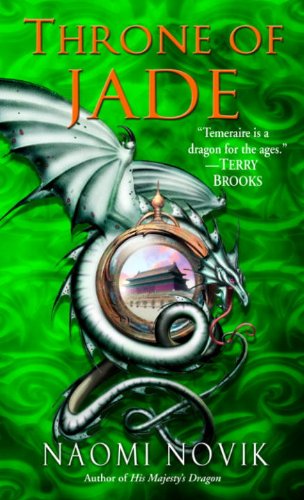
Throne of Jade
Naomi Novik
2006

In honor of Crucible of Gold being released this last Tuesday, I have to go back and review His Majesty’s Dragon and Throne of Jade, the first two book in the Temeraire series.

The books are:
His Majesty’s Dragon
Throne of Jade
Black Powder War
Empire of Ivory
Victory of Eagles
Tongues of Serpents
Crucible of Gold

I have to admit that I’ve actually only read the first two books. However! The reason for that is that I am clearly insane. Despite how I don’t do this for any other series in the world, I can never seem to start the third book without wanting to go back and re-read the series from the beginning. There are so many good scenes and characters and dialog that I can’t resist it. So I go back and read the first two books, at which point I discover that these are really wonderfully dense books in which the plot and action just keeps coming, and so I can’t really read more than two in a row without beginning to feel a bit glutted. But glutted with awesome!

Eventually I’ll have simply memorized the first two, and then I’ll be able to move on to the third and fourth book, I suppose, and I’m very excited about that prospect. But in the mean time, I have to go back and re-read the scene in which Temeraire hatches, and their first air battle, and when Laurence confronts Rankin, and has dinner with Roland, and… and… and…!

Anyway, plot: This is historical fiction based around the Napoleonic War… with dragons. As it turns out, I like historical fiction a lot more when there are dragons inserted. Especially these dragons.

The main character is Captain Will Laurence, formerly of the British Navy. A variety of circumstance, however, lead him to harnessing a young dragon, Temeraire, at which point, he was, perforce, part of the British Aerial Corp. While the war is, of course, a large driving force for the plot, a larger part circles around the differences between the very formal British society that Laurence is accustomed to, the more casual environment of the Aerial Corp, which bridges that of British society and that of the dragons, and the dragon perspective. While Will Laurence and many of the other characters are definitely characters of their time period, the dragons often act as an outside perspective on events and social mores. Dragons, for instance, have their own perspective on sexism and slavery and right and wrong, which isn’t really anachronistic because, well, they’re dragons.

His Majesty’s Dragon and Throne of Jade both really come together because Temeraire is an absolute delight, Laurence is wonderful in his awkward formality and concepts of honor, and they are absolutely devoted to each other, which just makes their differences with and regarding the world around them all the more apparent.

It’s a story about the love of a man for his dragon, and a dragon for his man. Anyway, these are wonderful books and I definitely recommend them.

Please don’t talk to me, middle seat person. I’m reading.

I spent the last two weeks traveling on business, which meant that I was too exhausted at the end of the day to put two words together for a post, but I got LOTS of reading done in airports, on airplanes, and in hotel rooms and lobbies. While I will spare you descriptions of the many in-flight magazines and celebrity tabloids I read during the enforced no-electronics portions of my flights, here are quick summaries of the books that kept me sane as I criss-crossed the country:

The Marriage Plot by Jeffery Eugenides
This was fine, I guess? I was interested in all the characters and I wanted to find out what happened, so it was compelling reading. On the other hand, it was really long and nothing much actually happened and there was almost no resolution of any sort and just because I was interested in the characters didn’t mean I liked them. In fact, pretty much everyone in the book was extremely unpleasant or shallow, so it was a bit like watching a very long, slow train wreck as these characters messed up their lives over and over. I had initially written here that I wanted to warn people about an unflattering portrayal of a character with a mental illness, but all of the characters were portrayed in unflattering ways so the manic depressive actually came out pretty well, comparatively speaking. I loved The Virgin Suicides, so Eugenides has credit in the bank with me, but while The Virgin Suicides felt airy and impressionistic, this dense, heavy, weighty novel feels like it was written by someone else entirely. English majors might like it though, since it seems to feature a lot of inside jokes about literary criticism.

Let the Great World Spin by Colum McCann

Remember how back in the 1970s a French guy strung a tightrope between the two World Trade Center towers and walked back and forth between the buildings, a hundred floors up with no safety net? This novel describes what was happening in the lives of a number of New York residents on that day, and how they were all connected to the wire walker and to each other. Although it does feature the walker (in real life, his name was Philippe Petit and you can watch an amazing documentary about his walk called Man on Wire), the story isn’t really about him at all. It’s really about New York, and America, in the 1970s–Vietnam, crime in the cities, race, immigration, and how all these things play out in the life a few individuals. As a general rule, I don’t like books that follow multiple characters connected only by the thinnest of threads. However, in this book each character is beautiful and heart-breaking and I found that they all looped together in really satisfying ways. Sad, but lovely.

The Thrift Book by India Knight
I think I’ve explained here before that I want India Knight to be my best friend, so I adored this book, even though it is basically just a list of fairly obvious ways to save money. You know, cook at home, make Christmas presents, grow your own herbs, don’t be fooled by fancy skin creams. Knight puts a fun spin on it by focusing not on getting out of debt or being as cheap as possible, but by talking about all the ways her strategies make you feel (to sound English about it) posher and more glamorous by not trying to hard or getting caught up spending on foolish thing. Plus, she’s funny. At one point she refers to playing Scrabble online as her “ongoing Alzheimer’s prevention project,” which is exactly how I think of Words with Friends. However, if you are not trying to befriend or become India Knight, it’s probably not necessary to read this.

Ready Player One by Ernest Cline

Really fun, and absolutely perfect airplane reading. A sci-fi story that manages to be both a puzzle/treasure hunt and a celebration of 80s pop culture. I think is truly aimed at folks a few years older than I am who spent much more time in video arcades, but I loved it and was so absorbed I was able to read it in even the loudest terminals and restaurants.

Hiring the Best by Martin Yate

Hiring the Best: A Manager’s Guide to Effective Interviewing and Recruiting, Fifth Edition
By Martin Yate
2006

This is yet another assigned book. One day I will again read for pleasure, but that day will likely not be until the summer. Sigh.

In the mean time, though, I was surprised and pleased to discover that I actually enjoyed this book. Job interviews are not a topic that I consider particularly interesting, beyond the sheer necessity, but the book wound up being enthralling. It goes through all sorts of questions, discussing what those questions are actually asking, how to pick which questions to ask, and how to interpret the answers that you get back. It was also a really slow read, because I was constantly scripting out how I would answer certain interview questions.

As the subtitle states, the book is about recruiting and interviewing. Yate does an amazing job of introducing and concluding with a thorough discussion of how to think about recruiting. Then about half the book in the middle lists and discusses potential questions to ask in a job interview, going over hundreds of possible questions.

It covers what traits an employer should be looking for in potential employees for different positions and then how to tailor a job interview to get at those traits. As someone who is more likely (I hope) to be in a job interview next as an interviewee rather than an interviewer, I found it helpful to consider what these questions are actually asking and how the answers will be judged. However, given my one and only experience running job interviews from the other side of the table, I am extremely grateful that I will never again be quite as incompetent at it as I was then.

Yate writes with a blunt conversational style that I enjoy, and while I don’t agree with his perspective on a couple of things (he’s very corporate sector while I’m more nonprofit sector,) it’s not a pervasive issue. It’s more of a sense that I like him but I wouldn’t talk politics with him for fear of changing that.

Despite the fact that I’m not all that interested in management, I do acknowledge that it’s useful to know about and Yate seems to know what he’s talking about and describes it well. I strongly suggest this book to anyone who’s on the job market or in management.

The Fabulous Clipjoint

By Fredric Brown

Let’s talk a little bit about Pulp Mysteries. I LOVE them, even though they are deeply offensive by most of today’s standards, and the mindset of a hardboiled detective is about as far from my own as it is possible to be.

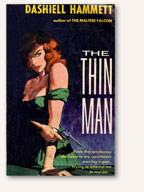
Book Cover: The Thin ManI was first introduced to them in high school, when my family went through a phase of watching movies from the 40s, including The Maltese Falcon, The Big Sleep, and The Thin Man. I went from there to reading Dashiell Hammett, who I absolutely love, and a little Raymond Chandler, who threw around the n-word enough to make me too uncomfortable to read most of his books.*

For a while, I looked for contemporary authors who also used the hardboiled style, and found Robert B. Parker (entertaining fluff that my mom accurately criticized for never allowing his characters to grow), Bill Pronzini (who has a nice gimmick of having a narrating detective who is never given a name), and my then favorite Joseph Hansen (featuring a gay insurance investigator who is as tough and stoic as any Sam Spade or Philip Marlowe).

Book Cover: Detective DuosSeveral years ago I picked up a collection of short stories titled Detective Duos, and was introduced to Fredric Brown’s Ed and Am Hunter, who immediately supplanted all other pulp mysteries in my heart forever. He wrote seven novels and one short story about the detective pair, all of which were published between 1947 and 1963 and are currently out of print, as far as I know. Tracking down each precious copy might have added just a little bit to my love of the series. (Much thanks to my wonderful sister for finding the seventh and rarest novel for me as a Christmas present a few years ago!)

In my opinion, Fredric Brown has not gotten the recognition he deserves as an author in any genre, though he is more known in the science fiction genre. I haven’t actually read any of those, but my impression is that they fit in fairly well with other contemporary science fiction novels, while his pulp mysteries really stand out from the rest.

The first book of the series, The Fabulous Clipjoint, introduces us to Ed Hunter, who is just 18 and teams up with his uncle, Ambrose “Am” Hunter, to solve the murder of his father. They live in gritty noir-ish Chicago, and feel the bitterness and cynicism of every other pulp detective, but Brown writes them with honesty and vulnerability that makes them more relatable and likeable than any other pulp mystery characters I’d read. I knew this book was something special when Ed makes a speech about wanting to have a drink of whiskey in honor of his dad, downs a hefty shot of whiskey, and promptly throws up.

Funny story, though: My first copy of The Fabulous Clipjoint ended with a plot dead-end with the detectives stumped, and I was a little taken aback but impressed at Brown’s moxie at showing that real-life mysteries don’t always end in tidy packages. Then, I ran across another copy in a used book store, and realized that my first copy was missing the last third of the book. The actual ending isn’t as bravely unusual, but is a lot more satisfying as a reader.

*Rereading The Fabulous Clipjoint, there are more casual racial slurs than I’d remembered, which is very unfortunate. They never actually describe a specific character, which is something of a poor salve for my conscience, but one I have to hang on to or else quit pulp mysteries forever.

—Anna

Dark Road to Darjeeling

By Deanna Raybourne

I wasn’t really intending to review this book because it is the fourth in a series that I’d already talked about, but I haven’t posted in a while and I had a serious issue with the conclusion, which I’m going to spoil the hell out of below the break.

But first, some non-spoilers. One thing I really appreciated is that the Dark Road to Darjeeling takes place at least several months after the third book, which is kind of refreshing. So often each mystery novel in a series happens within a week of the last one that it becomes kind of ridiculous how often the main characters run across murders.

Again, like the first few books, the relationship between the hero and heroine kind of wavered for me. Pretty much scene-by-scene I would go between appreciation and irritation. The relationship is very progressive for the Victorian setting (perhaps anachronistically so), but also very repressive by today’s standards, so when I recalled the Victorian setting, I would be impressed with the relationship, but when I compared it to my own relationship, I would get my feminist self all riled up.

Anyway, this book is set in a remote area of India, and I found the descriptions of the setting and various peripheral characters the most interesting of any of the books in the series so far. And, after the mystery was solved, there was an additional twist that didn’t bother me nearly so much as the mystery solution and which bodes for some interesting characterization in the fifth book.

Alright, so now that the pleasantries are taken care of, I’m going to spoil the entire murder mystery of the book after the break. I actually feel a little hesitant to do this, like I’m breaking a reader’s cardinal rule, but here goes:

Continue reading

The Non-Designer’s Presentation Book by Williams

The Non-Designer’s Presentation Book
By Robin Williams*
2010

Yay! This is a good book. The streak of unpleasant books has ended! This book is current, it has good advice, and, I admit, it’s also pretty (lot’s of sharp pictures illustrating the various principles.)

Like the other books I’ve read recently, this covered a lot of basic foundational concepts, but this time I felt they were covered in a way that respected me as the reader.

I’m now a bit daunted by the thought of actually trying to give a good presentation and a bit retroactively embarrassed by some of my previous presentations. I think the main argument to this book is that it’s important to learn how to actually use a presentation program (like PowerPoint or Keynote or a couple of the other program) and to not ever depend on their templates. You can create really excellent and elegant presentations with these programs if you know what you’re doing and what to pay attention to.

It’s a challenge; I’m going to have to spend some serious time with a PowerPoint tutorial before putting together my next set of presentation slides. But I think my next presentation will be a lot better than my various previous ones.

I imagine this book will go out of date relatively quickly, by say 2015 or 2020 at the latest, as the norms of presentations change again and the technologies described here get replaced by something newer and fancier. But for now, it’s current and lovely. I definitely recommend it.


* This is a woman, and not an actor.

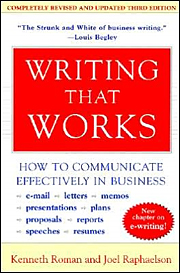
Writing that Works by Roman and Raphaelson

Writing That Works
By Kenneth Roman and Joel Raphaelson
2000

I don’t generally read books that I don’t like. Why bother?

As it turns out, the answer to that is, if they are assigned, then it matters to my grade and thus I had better go ahead and read them.

But really, this makes four for four for this one class, and I just want to read something that I unambiguously enjoy.* At least this book was relatively short and easy to speed read.

Writing That Works is a how-to book that is both extremely basic (know the meanings of the words you use and don’t confuse “its” and “it’s”) and highly dated (a lot of people are now using this crazy thing called “e-mail” to communicate with.)

The simplified nature of the rules it gives for writing means that they remain true. As important as it was to learn them in elementary school, it’s probably equally important to review them periodically. I just get irritated by being told rules that I already know AND that I would argue are often best demonstrated by their exceptions.

It is important to know the rules so that when you break them, you do so intentionally.

Oddly, Writing That Works acknowledges that some rules are meant to be broken but only in the chapter on political correctness, quoting Bernard Shaw’s definition of a gentleman as someone who “never insults a person unintentionally.” While admitting that you may occasionally want to insult someone, it fails to acknowledge that sometimes you don’t want to use the most common words in short sentences.

Sometimes it is useful to use rarer words and complex phrases. I quote Mark Twain: “The difference between the almost right work & the right word is really a large matter—it’s the difference between the lightning bug and the lightning.”

So overall, I would say that if you want to improve your writing, this is a somewhat useful book. But read it with the goal of thinking about what it says as if the statements were suggestions for you to consider rather than rules for you to follow.

* Although being able to grammatically write “four for four for” might well make it all worth it.** It’s not quite up there with “I, where you had had ‘had,’ had had ‘had had;’ ‘had had’ had had a better effect.” but it’s still fun.***

** Actually another thing that makes it worth reading is it introduced me to the story of David Ogilvy and his Russian matryoshka dolls. Ogilvy would give these dolls to his board members with notes saying: “If you hire people who are smaller than you are, we shall become a company of dwarfs. If you hire people who are bigger than you are, we shall become a company of giants.”

*** The fact that enjoy these examples of phrases which are grammatical but excruciatingly difficult to parse may have something to do with the fact that I didn’t enjoy a book about writing in a simple and straight-forward fashion.

Bargaining for Advantage by G. Richard Shell

Bargaining for Advantage: Negotiation Strategies for Reasonable People, 2nd Edition
By G. Richard Shell
2006

I’m going to start off by saying that I recommend this book: it’s well written and it’s useful.

That is not to say that I enjoyed it. But for now, I’m going to focus on the “useful” aspect.

Bargaining for Advantage did an amazing job of teaching me a topic that I really wanted to avoid and doing so in as enjoyable a manner as possible, which just wasn’t all that enjoyable. It was kind of like having a really nice, capable guy for a dentist. He’s a nice guy, it’s a necessary experience, and wow do I not want to deal with it.

As I mentioned in a previous review, I did not find Difficult Conversations particularly useful because the conversations that book dealt with were not the ones that I find difficult. What do I find difficult? Bargaining.

So, my first reaction is to shudder in horror at the title. I hate bargaining, I consider myself quite bad at it, and I avoid it whenever possible. I don’t even like thinking about bargaining. To me, paying a higher price for something is an irritating but acceptable price to pay for not having to bargain.

Despite this, once more and for the same class, I read a book that I found painful to force my way through. However, I’m willing to acknowledge that it’s my own idiosyncrasies that made it so, and the book itself is actually quite good. It’s both well written and provides useful information and good advice on implementation.

The book has two main parts: the first half discusses the foundations of any negotiation and it just made me cringe because I didn’t want to have to deal with any of them. The second half is about the negotiation process and that, while still painful, was also somewhat soothing to my poor introverted and avoidance-heavy sensibilities. It walked me through how to deal with the six foundations previously introduced. I still don’t want to deal with them and I’m not looking forward to any actual bargaining experiences, but I do think I have a much better handle on how to approach those situations when they’re necessary.

Also, the negotiation styles and techniques were all illustrated with a plethora of examples from around the world and throughout history. The stories were all fun, fascinating, and informative. They consisted of little anecdotes about modern and historical figures, familiar and foreign cultures, and successes and failures at the bargaining table. They were pretty much the saving grace of this book for my sanity, since every time I started to worry too much about having to (oh dear god) deal with some bargaining technique myself, there would be some bit of historical or cultural trivia coming my way.

So to sum up, I hated reading it, but it was still an excellent book and I learned a lot.