Fair Game

By Patricia Briggs

Book Cover: Fair GameA couple of weeks ago, I wrote about the first two Alpha & Omega books, and mentioned that the third one was out in hardcover. Fortunately for me, my new local library had it, so I was able to read it without paying a hardcover price. My expectations were moderate since Briggs has a tendency to lose steam with her ongoing series, but I was satisfied with Fair Game. It wasn’t as well-crafted as Cry Wolf, the first book, but I thought it stood on par with the second book, Hunting Ground, but in a different direction.

Cry Wolf had a really good balance of fantasy and mystery, while Hunting Ground tipped more toward the fantasy, pushing the mystery into the background a little bit and focusing more on the dynamics of the werewolves and vampires. Fair Game goes in the opposite direction, being a pretty surprisingly straightforward murder mystery with the fantasy elements just adding a bit here and there. Now, I really like murder mysteries, so this was a-ok with me, and if given my preference would almost always chose for the mystery to come first and the fantasy second.

I wish I’d thought to mention this in my previous post, but Briggs does this so well that while I really appreciate it, I don’t always notice it, if that makes sense. Her Alpha & Omega books are all written from multiple points of views, changing the narrating voice by chapter, or occasionally within different sections of chapters. It reads a lot more naturally than you’d think it would, with different characters stepping in when they have information that the reader needs. In the previous two books, the narrators have all been werewolves; in Fair Game, for the first time, one of the narrators is a human investigator, which is a refreshing outside perspective and emphasizes the mystery aspect of the story.

Spoiler-y, but not really: the very end does something very, very interesting with the world Briggs is building in the these books, so I’m actually now super-excited for the next books in both this series and the Mercedes Thompson series, which both take place in the same world, since there are going to be some dramatic changes.

— Anna

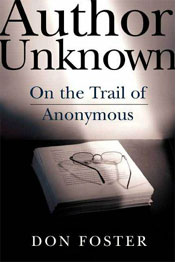
Author Unknown

Author Unknown: On the Trail of Anonymous
Don Foster
2000

I like books and I like reading but, while I am capable enough of literary analysis to have graduated from high school, I admit to a somewhat patronizing attitude regarding the field. My reaction opinion has generally been: well, if you want your life’s work to be looking for “hidden meaning” in texts, go for it, but really, what’s the point?

In Author Unknown, Don Foster answers that (rhetorical) question with six anecdotes about the real-world application of literary analysis.

A couple of the chapters support (in my opinion) my previous stance of: who cares? It was interesting to see how Foster investigated the authorship of a particular poem written centuries ago, but in the end, what does it matter?

However, other chapters demonstrated much more immediate relevance: Tracking down the authors of terrorist manifestos can save lives.  Proving the authorship of witness tampering documents in the White House can threaten administrations.

Each chapter describes the process of literary investigation and analysis, of a piece of writing with the intend to prove or disprove the authorship of the piece, relying on internal evidence. While Foster does look for external evidence as well (could the author have known of events the piece is discussing?), the investigations in this book are all focused on internal evidence (what person would have written these words in this way?) The way Foster comes to his conclusions and the evidence he looks at is pretty fascinating. Each chapter can also be read alone, as an individual story.

Chapter 5, Wanda, the Fort Bragg Bag Lady, is my favorite of the stories. It may not demonstrate a great deal of real-world impact but it does present a real-world black-humor farce, involving multiple anonymous authors, obsessions, murders, suicides, Hells Angels, bad poetry, good poetry, beat poetry, and a complete absence of bag ladies.

Over all, the book is fun and Foster has a lightly humorous way of writing even as he delves into close readings of archaic documents. For anyone who has doubted the importance of literary analysis: read this. I feel a nice combination of convinced that literary analysis is important after all while still vindicated that a lot of the use it’s put to is pretty darn silly.

The Cranes Dance

I am fascinated by any sort of TV show that shows people behind-the-scenes at work. Deadliest Catch? Ice Road Truckers? Dirty Jobs? Any of those 24 Hours in the ER things? I’m in. I love watching people do their jobs. So it was predicable that I would get completely sucked into Breaking Pointe, an extremely cheesy summer reality show on the CW. It’s set behind the scenes at a ballet company in Salt Lake City, following a number of young dancers and they fight for roles and get ready to perform their big ballets of the season. Unfortunately, Breaking Pointe spends way too much time on the dancers’ (completely dysfunctional) relationships, and not enough time letting us watch them get yelled by Russian teachers in rehearsals. Luckily, The Cranes Dance by Meg Howrey was there to meet my needs.

The Cranes Dance is fiction, told from the perspective of Kate, a twenty-something professional ballerina in New York City. Kate’s younger sister Gwen is a more successful dancer in the same company, but it’s clear from the very start of the book that Gwen has had some sort of mental breakdown and has been taken back home to the Midwest by their parents to recover. Left by herself in New York, Kate has to sort out how she feels about her caretaker role as the big sister, where she fits into the ballet world without Gwen, and whether she is still the “sane” one if there’s no one there to compare herself to. Oh, and all this is happening while she’s rehearsing for performances and dealing with a serious neck injury, partner problems, and other assorted daily ballet annoyances.

I initially picked this up because I wanted to read all the behind-the-scenes stuff about bleeding toes and eating disorders and ballet company politics, and all that is there in spades. Howrey was a dancer and you can tell. But I ended up being much more moved by the emotional story of the book than I expected. Kate is a really compelling character, smart and capable and funny even when she’s making terrible decisions. I’ve seen reviewers compare this book to Black Swan and there are similar elements, but they feel very different. While Black Swan was about someone falling apart, I found The Crane’s Dance to be more about Kate fighting her way out of the darkness. The book does fall somewhat into that category of first-person stories that show the main character going crazy by making the writing crazier and crazier (the two books like this that jump to mind are The Egypotologist and House of Leaves, both of which I found disturbing). I’m not usually a fan of that technique, but this only does a tiny bit of it and it works well.

My one quibble with the book, when I first finished it, was that things wrapped up awfully swiftly at the end and it felt a little jarring. But the more I think about it, the more true to life the ending feels–sometimes there’s not a huge event that helps snap us out of a cycle, it’s just the forward momentum of life, and that’s what The Crane’s Dance describes.

The Dead Authors Podcast

By Paul F. Tompkins

So, I’m still atoning for my recent lack of posts, but haven’t read any new books to review, so here’s a link instead.

I first heard about this podcast in the comments section of a pop culture blog I follow regularly, and several people there recommended it. I’ve only just started getting into following podcasts, primarily because my job currently entails checking long documents page-by-page to make sure nothing screwy happened during the saving process.

The Dead Authors Podcast is a live performance at the Upright Citizens Brigade Theatre in Los Angeles, and the premise is that H. G. Wells uses his time traveling machine to bring famous, now deceased authors from a variety of times to be interviewed on his talk show.

The actor playing H. G. Wells, drops interesting true-life biographical details of the various authors into the interviews, which are quite interesting. The actors playing the guest authors have done variable jobs of research, so some seem more in character (H. P. Lovecraft) than others (P. G. Wodehouse), which for me makes the podcasts varyingly entertaining. However, in each episode the actors/comedians are having such a good time doing it that it is very infectious.

Of the nine episodes currently available, I’ve listened to four, and “Appendix B: Friederich Nietzsche and H. P. Lovecraft” was by far my favorite, just for the bat-shit-crazy verve that the actors bring to those two authors. It was also the first one I listened to, and each subsequent one seemed to get a little less funny for me (Emily Dickinson, P. G. Wodehouse, Dorothy Parker), which might mean that the podcast doesn’t exactly match my personal sense of humor or that I was getting increasingly grumpy about my current work document. Those two possibilities seem equally possible, quite frankly.

I am still looking forward to listening to the chats with Aesop and Charles Dickens later this week, though.

— Anna

Alpha & Omega Series

By Patricia Briggs

Sigh.

Sorry about the recent lack of posts. At the beginning of the month, I moved halfway across the country from Boulder, Colorado to the Washington, D.C. area. I was all prepared with three prewritten posts to get me through the chaos of the actual move itself. What I hadn’t predicted is that I would get so overwhelmed with everything being new and different that I would immediately retreat into simply rereading my trashy comfort books, which is what I’ve been doing for the past few weeks at a furious pace.

I’ve reread all five of Ilona Andrew’s Kate Daniels books, which Rebecca has already written about, and both of Patricia Briggs’ Alpha & Omega books, which I figured I’d introduce here, since it could be a little while since I read anything new.

Briggs is better known for her Mercy Thompson series, featuring a female mechanic who shape-changes into a coyote, but was raised by a pack of werewolves. It is your typical werewolf/vampire genre series, but just done far better than most. Whenever I run into Charlaine Harris fans, I always make a point of recommending Patricia Briggs, since Mercy Thompson is everything Sookie Stackhouse isn’t: smart, independent, funny, etc. The first two books are immensely entertaining (I might read them next), and the third one is equally good but delves into some unexpectedly difficult-to-read territory (I am not going to read that next). After that, Briggs seemed to lose interest a little bit, and the subsequent books do not have the same quality of writing and plotting.

However, Briggs then turned her attention to a new series, the Alpha & Omega series, currently with two books in paperback and one in hardcover, which I haven’t read yet because I’m very much against hardcover books. This new series is great! It features peripheral characters from the Mercy Thompson books who are a little darker and tortured, which I always appreciate, and is set smack in the middle of the werewolf pack, instead of on the fringe.

The series actually kicks off with a short story/novella in the book On the Prowl, which is often shelved in the romance section and has a cover that will embarrass you to be seen carrying around. On Rebecca’s advice, I haven’t read any of the other stories in the book, but the Alpha & Omega story is actually good enough to be worth the full cost of the book, in my opinion. (Although, on a side note, the story is available on its own for the Kindle through amazon.com, which is one of the best arguments for a kindle that I’ve heard so far.) The story does set the entire series up to the point that the reader would be missing serious background information if they started with the first full novel.

Book Cover: Cry WolfThe first full novel is Cry Wolf, and just really delves into the characters and their relationships with each other, all within the confines of a very well structured and paced narrative. The second novel, Hunting Ground, doesn’t have quite the same tight plot structure, but is still very entertaining. I’m somewhat afraid I’m seeing a bit of a pattern with Patricia Briggs, so I’m mentally preparing myself for the third book being a potential disappointment, but I’m still very much looking forward to reading it. Right at this moment, I’m more into comforting fluff books than quality, so I’m sure it will live up to that.

— Anna

Troubled Waters

Last week I read A Visit From the Good Squad, Jennifer Egan’s Pulitzer Prize-winning novel, and it was fine. It was well-written and had a very interesting structure (moving back and forth between characters and time periods) and the famous chapter told in PowerPoint slides was quite affecting. But everyone in the book seemed miserable and my main reaction was to wonder if most people in the world are really that unhappy, because I am not and most of the people I know aren’t. Are all the sad, mean people just clustering together in literary novels? So while I would be happy to discuss Goon Squad more in the comments if anyone else has read it, what I want to talk about instead is the next book I read, Troubled Waters by Sharon Shinn.

I love Sharon Shinn. When I’m poking around on Amazon or on my library’s catalog and realize that she has a new book coming out, I have been know to let out a little squeal of happiness. Her books generally follow a predictable pattern–they are virtually all fantasy stories in which a strong female lead character has to overcome some of obstacle and falls in love along the way. There are often royal families involved, and magic, the characters generally have to come to understand and embrace the powers they have. But don’t think I’m complaining about the books all having mostly the same plot–they’re great! There’s action and romance and excitement and well-drawn characters, and I know that I am going to be satisfied and will enjoy every minute. There’s also a nice feminist foundation underneath it all. The books aren’t explicitly about women overcoming their oppression by men but you get the clear sense that the author is a feminist, and her female characters are fully-realized people.

It can be tricky to figure out where to start with Shinn’s books, because she’s written a ton. There’s a series of middle-reader books that starts with The Safe-Keeper’s Secret, which are fine but a little young for my tastes, and a number of stand-alone books including a futuristic re-telling of Jane Eyre. But the ones I love, and where I would recommend someone start, are the Samaria series and the Twelve Houses books. These are both multi-book series set in two different universes. The Samaria books are about, well, angels. I don’t want to give too much away, but that series has a slightly more sci-fi twist and includes some entertaining Biblical references, even though it is really not at all religious. The Twelve Houses books are a little more traditional fantasy stories about kings and queens and knights and magicians, but I find them nicely grounded with a focus on the people involved and their emotions. I vastly prefer these kinds of stories when they are told on this smaller scale, especially when compared to Game of Thrones-esque enormous epics that seem more interested in the politics rather than the people.

Now that I’ve got all that explained, Troubled Waters isn’t in either of those series, but I’m hoping it’s the start of a new one. It’s the story of Zoe, a young girl who lives with her father in a tiny village far from the capital of her land. When her father dies (which happens on about page 2, no spoilers), one of the leaders of the country appears to take her back to the capital so she can marry the king, and things all spin off from there. There is royal intrigue and magic and a love story and I found the whole thing just charming. The conceit of of the magic in this book is that it is centered around the elements. Zoe has a particular affinity for water, but it feels like Shinn is setting things up for additional books to follow stories of the other elements. As you can probably tell from how brief my review is, Troubled Waters is not breaking any new ground, but I will happily read as many books about this world as Shinn wants to write.

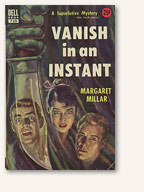
Vanish in an Instant

By Margaret Miller

Book Cover: Vanish In An InstantI previously wrote about my love of pulp and noir mysteries, showcasing some of my favorites, and from the list, you can see that it is very much a man’s genre. Which makes sense, I guess; there weren’t as many published women at the time, and the kind of nihilism described in noir novels is kind of the antithesis of traditional femininity.

Margaret Miller is the exception, though, and she is brilliant. Vanish in an Instant, published in 1952, is my favorite, but I’ve read and enjoyed many of her other novels. The thing that makes Vanish in an Instant so exceptional that it is a love story in addition to a murder mystery, which should negate the noir style but only serves to emphasize it, as the two characters cling to their love as a fragile and temporary way to stave off the full bitterness of the world.

This quote captures Miller’s writing, and noir writing in general:

“Outside the wind was fresh, but he had a sensation of suffocating heaviness in his throat and chest, as if the slices of life he had seen in the course of the morning were too sharp and fibrous to be swallowed.”

Yay! I have no idea why this kind of writing gives me such satisfaction, but I do love these noir books and reading them actually brings me a sort of comfort in a way that I cannot analyze at all.

*I’d like to add that my copy is a reissue from the 70s and has much more subtle and attractive cover art.

— Anna

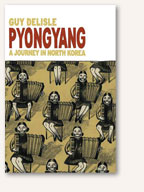
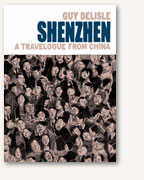
Pyongyang: A Journey in North Korea; Shenzhen: A Travelogue from China

By Guy Delisle

Kinsey, these may be the comic books for people who don’t really like comic books. They are really more travel journals that use the illustrated panels to give atmosphere in a way written descriptions can’t quite capture.

The author is an animator who gets sent to various sites to oversee the outsourced animation, so in addition to the interesting locales, he also throws in a few details about the animation business, which is equally interesting to me.

Book Cover: PyongyangPyongyang: A Journey in North Korea was published in 2005. A couple of pages in, I realize that this is Eloise for adults! He lives out of a hotel for the entire trip, and has a guide and translator who serve as nannies for him, escorting him anywhere he travels outside of the hotel. The atmosphere he describes in North Korea also sounds very similar to that in Eloise in Moscow, first published in 1959.

Shenzhen: A Travelogue from China, published in 2006, is a disconcerting contrast to Pyongyang, still very foreign, but in an almost diametrically opposite way. After being immersed in the very communist North Korea, every mention of Rolexes and Gold’s Gyms comes as a bit of a shock.

Book Cover: ShenzhenAt the beginning of Shenzhen, Delisle says that he has trouble starting the writing/drawing process, and I have to say that it shows. It is much more a collection of vignettes and is a little disconcertingly random, while Pyongyang has a much tighter story narrative. I think that Delisle found his stay in Pyongyang not more enjoyable, exactly, but more interesting, just due to the foreignness of it all. He finds Shenzhen a bit of a grind, and it shows. I would recommend reading both back to back like I did, since I think they are good companion pieces, but if you are only going to read one, go with Pyongyang.

(From my quick amazon.com research, he has also done graphic chronicles of Jerusalem and Burma, both of which I very much look forward to reading.)

The Song of Achilles

I just finished up some work travel, during which I seemed to have terrible reading luck and suffered through one bad book choice after another–overly-dense historical non-fiction, some ridiculous self-help that made me roll my eyes, etc. Luckily, I finally hit a good one and The Song of Achilles entertained me through the last little stretch of  waiting out summer thunderstorms in various airports.

Written by Madeleine Miller, it tells the story of Achilles, the great Greek warrior who led Greek troops in the Trojan War and was (spoilers!) ultimately killed by one of the princes of Troy. Now, there are certainly plenty of stories out there about the Trojan War, including The Iliad, if you’re in the mood for some epic poetry. The twist in this one is that the narrator is Patroclus, a young Greek prince who is exiled from his home and raised with Achilles. Patroclus is right there alongside Achilles as he is taught by a centaur and fights the Trojans and moves through all the other relevant bits of Greek mythology. And in Miller’s version of the story they become lovers and life partners.

After I finished the book I reviewed some of the stories of Achilles on-line, and it’s clear that Miller did a tremendous amount of research. The book includes references to some very minor points of mythology and even touches on how stories change over time (that whole Achilles heel thing only came up in later stories, so it doesn’t come into play here). If you’ve read any of Marian Zimmer Bradley’s modern retellings of story of King Arthur or Troy, this book won’t seem all that revolutionary–Miller’s not striking any new ground here by putting a new spin on a classic story. And it looks like that there has long been scholarly debate about the nature of the relationship between Achilles and Patroclus, so even that aspect of the book is based in history. However, the writing is refreshingly crisp and straightforward and the action moved quickly. Even knowing the basic structure of the story, I was whipping through the book as fast as I could, desperate to find out what would happen next. It was a perfect book to keep my attention while smushed in an airplane seat.

And just this week this book won the 2012 Orange Prize, the British award that “celebrates excellence, originality and accessibility in women’s writing from throughout the world,” so apparently this book is even more well-regarded than I thought. (Plus, the chair of the judges this year for the Orange Prize was Joanna Trollope, who I also love–go read The Rector’s Wife!)

Short Story Glut

I really like collections of short stories – I think they are a great way to get introduced to new authors and to see a lot of different authors’ perspectives on a shared topic. However, I’ve started to get irritated with these collections recently published that all feature a subset of the same best-selling authors the fantasy genre. It seems like such a blatant money-grab.

I love Patricia Briggs but do not care for Charlaine Harris, so instead of just publishing a book of Briggs’ stories, there is always one of hers in a collection that also includes Harris and other authors I have no interest in. And, I’m sure fans of the other authors feel that way about Briggs. So, this seems like a very calculated ploy on the part of the publisher to try to make us all buy books in which we are only interested in about a quarter or even less of the content (especially disappointing if that quarter turns out to be not all that great, either).

I fell for it and bought two such collections, but wizened up this time and went to the library, and am very glad I did. I originally intended to gather all of Patricia Brigg’s short stories that I hadn’t already read, but an Ilona Andrews story slipped in, too.

Book Cover: Naked City1) Naked City, with the tagline “Tales of Urban Fantasy,” has a nice theme of each story being set in a recognizable city that the author gives some attention to describing. Of the five stories I read (out of the 20 in the book), four of them featured plots that were very specifically tied to a feature of the city, which was very interesting. Oddly, though, the fifth, Melissa Marr’s “Guns for the Dead,” was actually my favorite, taking place in an Old West type environment that is kept somewhat generic purposefully for the plot reveal.

Patricia Briggs’ “Fairy Gifts,” was my second favorite, of course, with new characters for her and set in Butte, Montana, which is just so interesting to read about given the complete lack of romanticism around that city. Briggs clearly loves the area, though, and writing about immortal beings such as vampires and fairies allows her to delve into the history of the place.

Book Cover: Home Improvement2) Home Improvement: Undead Edition, with the tagline “All-new Tales of Haunted Home Repair and Surreal Estates,” also features Patricia Briggs and Melissa Marr, and theirs were the only stories I read out of the twelve. This theme didn’t work as well – perhaps it was too specific? Again, Marr’s story edged out Briggs’.

Marr’s “The Strength Inside” features a protagonist of a supernatural kind that I didn’t recognize from any of the normal Western mythologies. I’m not sure whether she was dipping into a more esoteric mythos or whether she invented it herself, but it was interesting either way. And, it is about battling Home Owners’ Associations, which is always entertaining, even if a little clichéd.

Brigg’s “Gray” features a vampire, though not one of her regular characters, buying and renovating an old condo. It has some very sympathetic characters, but isn’t anything original.

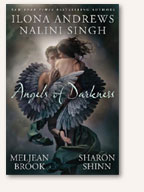
Book Cover: Angels of Darkness3) Angels of Darkness features Ilona Andrews, and was the most worrisome to me when checking it out. The cover looks more like paranormal romance than fantasy, and I knew that Andrews’ books walk that line more than my other favorite authors. And, I was absolutely right to be worried, though it was even worse than I feared.

You know how people criticize the story “The Beauty and the Beast” for basically being a romaticization of Stockholm Syndrome? Imagine Ilona Andrews tried to take that idea, make it super overt, but still try to keep it romantic. It is even more appalling than you are imagining right now.

At 124 pages, her “Alpha: Origins” story is more of a novella than a short story, and is set in a different universe than either her Kate Daniels series or her Edge series. It took me almost a week to finish it because I kept having to put it down because it made me feel kind of dirty, reading about this level of subjugation in a clearly romantic plot.

It reminded me of a call for submissions of fantasy romance books by a publisher that Rebecca told me about. They specified that the story had to feature an older or in some other way societally superior hero and the heroine had to be somehow in his power. It made me gag a little bit.

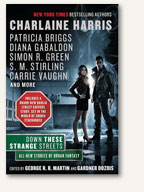
Book Cover: Down These Strange Streets4) Down These Strange Streets was my favorite collection, leaning toward the noir side of urban fantasy and mystery. There were some really terrific stories, and some not-so-terrific stories, but the great thing about a collection of short stories is that after a couple of uninspired pages, I can just move on to the next story.

It did bring home the point that a good noir mystery is harder to write than people think; the author has to somehow steep the entire story in a casual grimness. A surface gloss of darkness doesn’t cut it, and is quickly recognizable when reading a series of stories by different authors all in a row.

Once again, though, Briggs’ story took second place, this time to a really engrossing story by Laurie R. King, who I had previously known only as a mystery writer. Her fantasy mystery, “Hellbender,” was subtle, realistic, and unfolded with perfect plotting, and I would love to read a full book of the same characters and universe.

Briggs’ story, “In Red, with Pearls,” was my favorite of hers that I read in this glut, and featured one of her regular but peripheral werewolf characters, Warren, and his boyfriend Kyle. The short story structure didn’t give her as much time to explore characters and relationships as I would have liked, but was still a very entertaining mystery.

* * * * * * * * * *

Kinsey’s very acute analysis of her preference in memoirs made me revisit my short story collection preferences, and I think it is very similar. The more collections I read, the more I respect the editors. It seems like they need to tread a very fine line, where collections should have a common theme that tie all the stories together, but not such a narrow theme that the stories seem repetitive. “Urban fantasy” is too generic; “house renovations” is much too narrow.

—Anna