A Fun Story…

So, it’s been a week, hasn’t it? I have a treat for us all to see us into the weekend.

We occasionally link to other blogs that we have found particularly interesting, but I don’t know that we have ever linked to a specific piece of writing floating around the internet. However, Rebecca sent me this link that has been blowing up Tumblr over the last week or so, and it made me laugh until I cried, so if any of you haven’t seen it yet, treat yourself to what is being called by appreciative readers “Porn Prison”:

http://ofgeography.tumblr.com/post/94085997576/so-heres-a-fun-story-about-this-movie-guess-who

(Despite the title, this is completely fine for work; well, the content is fine – you will absolutely audibly laugh.)

—Anna

Fanfiction: the Winter Soldier edition

On my last fanfic post, it was pointed out that the characterization of Bucky Barnes in one story felt a bit off. One of the great things about fanfic, though, is that there are a gazillion different takes on any given character. On AO3, at the time of writing this, there are 9323 fics that have Bucky Barnes as a character.

Since I’ve gone a bit crazy recently with how many of these I’ve read, I figured I would share with a selection of stories covering a range of different Bucky-recovering-from-Winter-Soldier characterizations.*

All of the following stories are fanfic based on Captain America: Winter Soldier.


Bucky Characterization: Fragile

[untitled Bucky-on-a-bus fic]
by WinterSoldierFell

Summary (aka the first line of the story): It’s hot on the bus, and Bucky’s trying hard to keep away from the people next to him.

Why I like it: The story is a reminder that along with all the other evil things that were done to him, his surgery and prosthetic were also done without consent. And yet, this story is hopeful. Bucky is still very much lost but there’s hope that even if he doesn’t manage to discover himself, he will be able to create something new.


Bucky Characterization: Cold-blooded

Stone Cold
By Sassaphrass

Summary: There had maybe always been a part of Bucky Barnes, that was a stone cold killer… the history books may have forgotten that, but Steve hasn’t.

Why I like it: A lot of Bucky-recovering-from-being-the-Winter-Soldier stories stress the differences between Bucky and the Winter Soldier, reassuring everyone that Bucky was in no way responsible for his actions as a brainwashed assassin. Fair enough. This fic, though, focuses on the way Bucky and the Winter Solider are the same. This is also a character study of Steve Rogers as much as it is of Bucky Barnes.


Bucky Characterization: Long-suffering

Too Late to Apologize
By Verity

Summary: Bucky goes to the big Trader Joe’s in Union Square for toilet paper and peanut butter cups. When he gets out, his minder is across the street, conspicuously reading a newspaper in the middle of the sidewalk. Bucky has to squint to make out the headline, which is CAPTAIN AMERICA ARRESTED IN ZUCCOTTI PARK. “Oh, come on,” he mutters beneath his breath.

Why I like it: The whole super hero business takes a back-seat in this story, to just the tasks of regular life. Bucky is still piecing together his life but he’s always going to be there for Steve. (And Steve is still going to get himself in trouble standing up to bullies.)


Bucky Characterization: Determined

Soft Spot for the Hell Raisin’ Boy
By ifeelbetter

Summary: The Winter Soldier takes an interest in Sam Wilson. Bucky Barnes wants to tell him how to be Steve Rogers’s best friend.

Why I like it: This is kind of ludicrous but I like it, because while Steve Rogers is desperately trying to find Bucky Barnes, Bucky thinks Sam Wilson will make a better best friend to Steve than he will. Sam is clearly a saint to put up with this.


Bucky Characterization: Laid-back

Four times an Avenger met Bucky and didn’t know who he was, and one time they were all introduced
By Odsbodkins

Summary: What it says on the tin. In which Tony is kidnapped, Clint is a fangirl, Bruce sees echoes of the past and Thor is Thor.

Why I like it: All of these people have had seriously messed up lives and for any of them to be functioning at all, they have to have learned to just roll with it. Here is a Winter Solider/ Bucky who basically fits right in with the rest of the Avengers.


Bucky Characterization: Robot

Clint Barton’s Home for Wayward Mind Wiped Assassins
By roguewrld

Summary: “Where ever you were, whatever you did and whoever you did it for, it’s over. You need to pretend to be a person now, okay?”

Additional comment: This is the Clint Barton from the recent Hawkeye comic books. You don’t actually need to have read them to enjoy this, but it does add depth to the story if you have.

Why I like it: This is almost more of a Clint Barton character study than a Bucky Barnes ones, and yet, I do think it does a wonderful job of showing Barnes’ recovery from being a brainwashed assassin to being a human being who gets to make choices and have friends.


Bucky Characterization: Feral cat

That Kind of Day
By Neery

Summary: Carolyn Brown’s having one of those days. Her truck’s been stolen, she’s about to lose her job, and now a crazy Hydra assassin has broken into her apartment to ambush Captain America.

Why I like it: First of all, it’s an outsider perspective which is always hilarious because regular people have a very different take on the craziness that is superheroes. Second, the Bucky in this is like a really dangerous feral cat. He wants to come in, but he’s not quite sure how to.


And finally some complete crack,** just in case you didn’t think any of the previous characterizations were too ridiculous:

Bucky Characterization: Domesticated maybe? Flirtatious definitely

I once started out to walk around the world but ended up in Brooklyn
By suzukiblu

Summary: Captain America is not in New York, so the Winter Soldier is.

Additional comment: The other main character in this is Darcy Lewis from the Thor movies. I’m not sure how comprehensible this fic would be if you don’t know Darcy Lewis or Jane Foster.

Why I like this: A story doesn’t have to have good characterizations in order to be a whole lot of fun. This story is absolutely ridiculous but still makes me grin.


* It was really hard to narrow this down. I kept on wanting to recommend ALL THE STORIES!!!

** In fanfic circles, “crack” describes the really ludicrous stories that no one is even going to pretend is likely or makes-sense, but it still a whole lot of fun. I’m not sure where it came from, but I’ve also run across the phrase “[the author] smoked crack so you don’t have to” in reference to some stories.

The Yellow Wallpaper

By Charlotte Perkins Gilman

Rebecca linked to The Toast in an entry a while ago, and since then, I’ve become a complete Toast convert, going to back and trying to read just about every entry. One of my favorite series is the “Texts From…”, which is imagined text dialogues involving famous authors or characters.

Texts from The Yellow Wallpaper was so particularly good that I was inspired to read the original, a 6,000 word story first published in 1892 and available on the Kindle for free. It was so good! The story is narrated by a woman confined to a room for her health, and it is considered an early feminist narrative, which didn’t actually increase my desire to read it, since I find that capital-F feminist writing can be overly sincere for me. However, the writing and characterization are so subtly creepy that it was really just a terrific suspense story first, with feminist commentary second, and it can all be read in just an hour or two.

Oh, and I haven’t had a chance to properly explore this, but Rebecca insisted I mention it. The Toast recently promoted another website that reviews works that are on the public domain: http://publicdomainreview.org/

It is understandably somewhat overwhelming, since that is a lot of content, but it should also be hugely interesting and worthwhile.

—Anna

The Bible: Deuteronomy

First: urg, this is literally Moses giving speeches recounting the events and rules of Exodus, Leviticus, and Numbers. It is called Deuteronomy because it’s the second telling. Urg.

Second: There is more than a bit of revisionist history going on here, not so much regarding the major events themselves as the motivations and details of intent and blame.

Third: Some of the rules that hadn’t been mentioned before are surprisingly specific. For instance:

Deutronomy 25:11-12:

If men get into a fight with one another, and the wife of one intervenes to rescue her husband from the grip of his opponent by reaching out and seizing his genitals, you shall cut off her hand; show no pity.

It sounds to me like there’s a story there, possibly involving Moses fighting with a married man and getting grabbed by the wife.

Fourth: Oh the genocide. The amount of genocide that god is demanding is more than a little disturbing. It is explicit that God is “giving” the Israelites land that is already inhabited by other peoples and plans to either kill or enslave the current inhabitants. The killing of all the current inhabitants is a recurring theme throughout the whole book, but chapter 20 is particularly specific. For instance:

Deuteronomy 20:10-13:

When you draw near to a town to fight against it, offer it terms of peace. If it accepts our terms of peace and surrenders to you, then all the people in it shall serve you at forced labor. If it does not submit to you peacefully, but makes war against you, then you shall besiege it; and when the Lord your God gives it into your hand, you shall put all its males to the sword.

And

Deuteronomy 20:16-17:

But as for the towns of those peoples that the Lord your God is giving you as an inheritance, you must not let anything that breathes remain alive. You shall annihilate them – the Hittites and the Amorites, the Canaanites and the Perizzites, the Hivites and the Jebusites – just as the Lord your God has commanded,

Fifth: In the U.S. we have (in theory at least) a rule of “innocent until proven guilty.” In Deuteronomy 31-32, by contrast, there appears to be the rule of “guilty even before you are guilty.” Moses, and in his recounting God as well, do this thing that I find extremely irritating: They go off on what their audience is going to do and how mad they (Moses and God) are with their audience regarding what they (the audience) are going to do. Moses is giving this speech to the Israelites before they cross the river Jordan in order to take over the lands (and commit a minimum of six different genocides*), but apparently they’re going to get rich and fat off the land and forget the lord their god and worship other idols and God is going to be so furious with them that he’ll cast them out of the land and let their enemies defeat them, while sending plagues and disasters to bring the Israelites down. Moses even makes up a song all about the disasters God is going to bring down on the disrespectful heads of the Israelites after they betray God after they’ve grown fat and forgetful in the land that they haven’t even entered yet.

I’m not quite sure how this message is supposed to be taken: Don’t worry about the future? Because the immediate future is going to be so wonderful that you’ll forget about your extremely temperamental God and in the long run he is going to beat you down into the dirt?

Anyway:

Sixth: God treats the Nation of Israel as a single entity rather than as a group of individuals. It’s possible (likely) that I’m biased by living in a society that focuses so much attention on individuality, but it’s kind of disturbing how little the concept of individuals seems to mean to this god, as anything other than a part of the whole. Thus, one person acting in a displeasing manner can cause God to abandon the whole Nation, while one person acting in a pleasing manner can cause God to change his mind. But, even more to the point, God has promised to make of Israel a great nation, but also seems to think that as long as there is one survivor, it doesn’t matter how many of them he kills, because he can just rebuild the bloodline from the single survivor. Not only does this point towards the necessity of unpleasant levels of incest (something that God had just made illegal!), but also seems to imply that God figured the whole flood/Noah/ark thing was a great idea and could definitely be repeated, by means of plague this time, because he wouldn’t be breaking any promises as long as there is a single surviving descendant.


Summary: Moses is about to die and so he gives three sermons on the past, the present, and the future of the Israeli tribe: how God rescued them from Egypt, the rules of society and sacrifice, and their future of wealth, betrayal, and punishment.

Moral: You (yes: you) are too stubborn to be blindly obedient like you should be, so you’ll be beaten down into the dirt for your sins.

* (1) Hittites, (2) Amorites, (3) Canaanites, (4) Perizzites, (5) Hivites and (6) Jebusites

Next up: Joshua

The Gift of Fear

By Gavin De Becker

Book CoverSeveral years ago, Kinsey introduced me to Ask A Manager, a blog in which an experienced HR professional offers job advice and answers reader-submitted questions. It sounds like it should be dry, but she has a very entertaining writing style, and some of the letters are downright crazy. Reading through some of the older entries, someone had written in about the possibility of a coworker stalking her. She wasn’t sure about it, so she wanted advice about whether to talk to HR.

The advice was a resounding “talk to HR now” and also read Gavin De Becker’s The Gift of Fear, which many of the comments then seconded. They all said that it does a great job of advising when to actually be afraid of violence and what kind of action to take. I thought this would be really helpful to me, since I suspect that I’m often afraid in situations I need not be, and then not at all afraid in situations in which I should at least show a bit more caution.

I found the book both more entertaining than I had expected and less instructional than I’d hoped. Gavin De Becker himself is truly fascinating: his childhood in a violent home has led him to dedicate his life to predicting and preventing acts of violence, and he runs a corporation that provides security for politicians and celebrities. The book is chock full of tabloid-like stories, which reinforced a lot of the same themes (fame leading to complete loss of privacy and increased vulnerability to the people around you) from The Cuckoo’s Calling, which I was reading concurrently.

After the majority of the book details individual cases and De Becker’s analysis of them, the final chapter is a general summation, and was more of what I’d expected from the entire book: advice to the average reader on how to live safely and without unreasonable fear. My main takeaway was that we, as people, tend to put a lot of our energy toward general anxiety, which both exhausts us and does nothing to keep us safe. If we trust our natural sense of fear enough to ignore it until it alerts us, and then pay attention when it does alert us, we would have a much better ability to keep ourselves safe.

My main criticism of the book is that while I think this is excellent advice, I bet this is easier said than done, and most of the book is spent trying to convince the reader of this fact instead of instructing how to change to this way of thinking. I would have even liked some mind exercises, perhaps, that could help with training yourself to a general alertness. He does have several follow-up books so perhaps they go more into that. I am interested in continuing with his books, though perhaps after some more fiction.

Some other interesting asides from the book:

  • The life of a celebrity is INSANE! I truly don’t think that all the fame and money is worth the lack of privacy and the entitlement that the general public feels toward them. He has a story toward the end about a particular celebrity, which I’m not going to spoil, but just believe me that it is crazy.
  • De Becker claims that traffic jams caused, not by accidents themselves, but by people slowing down to gawk at them, are due not to our macabre fascination, but  to an instinctual need to analyze potential danger. I’m not sure I agree, but it makes me slightly less annoyed at those traffic jams.

—Anna

The Devil You Know

By Mike Carey

Book CoverThis book is chock full of pretty much every popular supernatural creature (okay, no vampires have shown up, but I wouldn’t bet against them appearing later in the series), but they are all treated in very unusual ways. The were-beasts are sort of dim, while the zombies are snarky, and the succubae are downright vicious. The story starts off kind of slow, and reminded me quite a bit of an adult version of Anna Dressed in Blood, which I only moderately liked. (Also, just about every reviewer on GoodReads compares it favorably to the Dresden Files, which I concur with.) Once it really gets going, introducing a whole new supernatural being pretty much ever other chapter, I had trouble putting it down again.

The world-building premise is both basic and clever: what if suddenly and inexplicably the dead began to return, like a reverse apocalypse? Our reluctant hero has a natural talent for sending them back again, and works as an exorcist-for-hire when money gets tight. If all this hasn’t already sold you on this summer escapism, let me just tell you that I reserved the second book of the series at my library as soon as I finished the first one.

—Anna

The King in Yellow

By Robert W. Chambers

Thomas and I both really enjoyed “True Detective” on HBO this spring, though Thomas’ philosophy background gave him more insight than I had. Very mild spoiler for the television show: I recently read on io9, a site I very much recommend for all your geek culture news, a very interesting argument that the story was in fact supernatural, the author’s primary proof being the many illusions to “The King in Yellow.”

The King in Yellow is an early collection of horror/fantasy short stories, published in 1895. The common element through the stories is the existence of a play titled “The King in Yellow,” set in Carcosa, which will drive mad anyone who reads past the first act. The stories are mostly about various readers, and while there are occasional excerpts, the play itself is never written out in a comprehensive whole.

The book is available for free on Kindle, and I’ve been reading it on my commute. The writing is surprisingly fresh, not feeling dated much at all, and the author does a particularly good job with an unreliable narrator, I thought.

Some of the stories are certainly grotesque, but also fairly tame by today’s standards, and I found the general tone of quiet gloom to be soothing. In fact, this gets a little spoilery, so I’m putting it after the cut: Continue reading

The Bible: Numbers

While not neatly divided into sections, there are really two themes in the book of Numbers*: ledgers and travelogues. Plus a really disturbingly positive view on genocide.

First: Ledgers

This book is appropriately named Numbers because it’s chock full of them. We have the results of two census, instructions on camp layout, a donation ledger, descriptions of a bunch of maps, plus a lot of additional instructions for how to make sacrifices.

The camp layout and census information was long and detailed enough that I thought it would be useful to create an info graphic, to get a sense of what all the numbers mean. You can see the results below:


Numbers

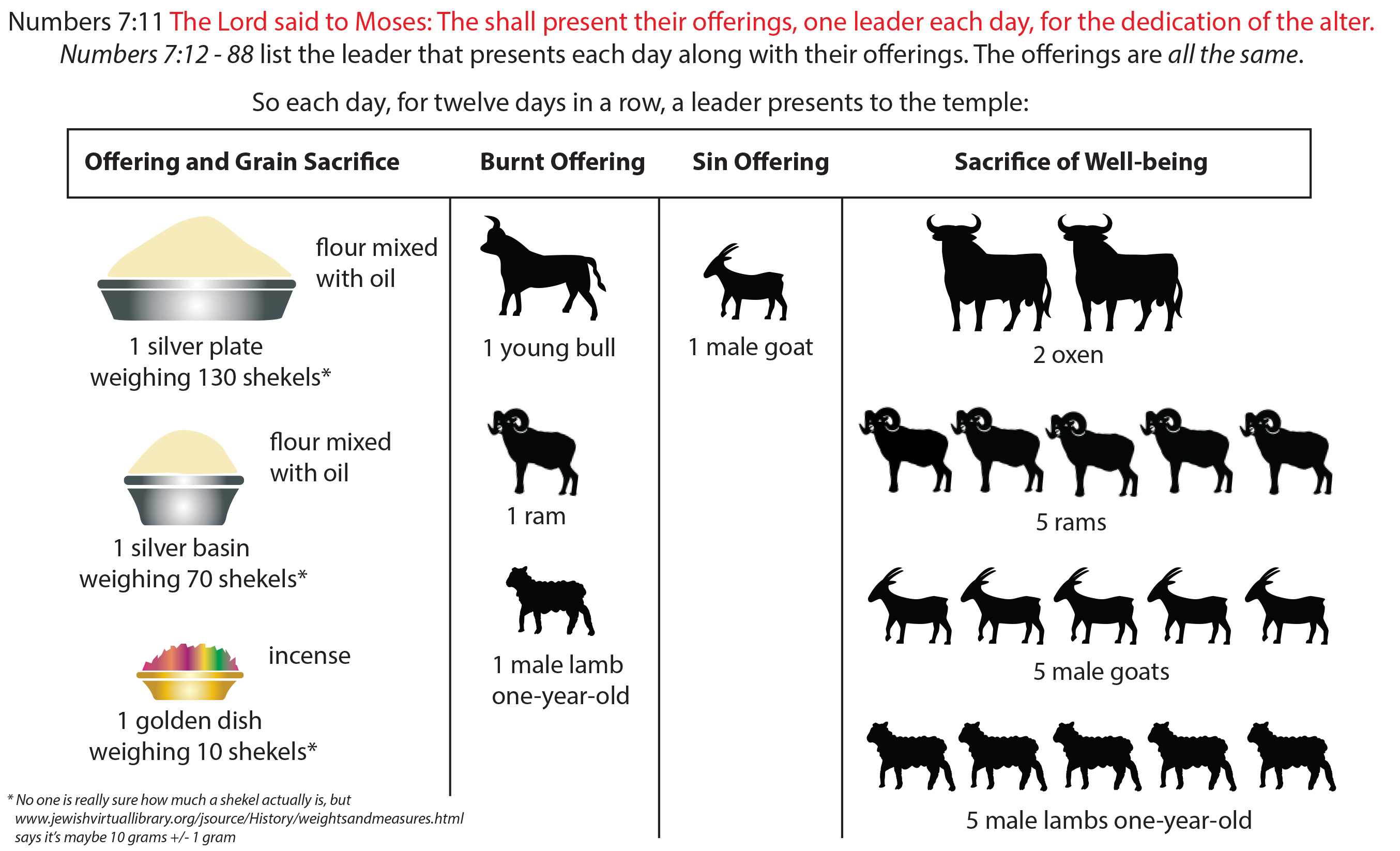
The donations ledger was both detailed and incredibly repetitive. Each day for twelve days, the exact same offerings/sacrifices were made, in the same order and for the same amounts. And over the course of 77 verses, those offerings/sacrifices were listed twelve times. I decided that this needed an infographic too, so I’ve included one below:

Numbers 7

Second: Travelogues

There are also a bunch of stories about different characters. These stories are each so complex and yet so concise that there’s not much point in summarizing them. They include several failed rebellions against Moses’ leadership, several stopped (or at least restricted) massacres by God of the Israelites**, and a foreign magician who is repeatedly hired to curse the Israelites but blesses them each time instead.

The one story that really stood out to me*** was in Numbers 20:14-21. This is the first time I felt any real sense of apprehension about the events. Moses sends a message to the King of Edom requesting permission to pass through the lands of Edom. The message is all nice and sweet, asking for permission and promising to do no harm, and I just thought to myself: say ‘no’, something terrible will happen to you if you say ‘yes’. And luckily Edom said ‘no’—politely, firmly, and without insult or excuse—and the Israelites traveled a different way and I felt so much relief for Edom managing the avoid so many travesties.

Not many other people were able to avoid the repercussions of coming into contact with them.

Keep in mind that at this point the Israelites are a landless, traveling army-nation of between 603,550 and 601,730 warriors along with their families and their herds of cattle, sheep, and goats. God is appearing to them as a fire at night and a dark cloud during the day. When the dark cloud moves, the whole army nation packs up and moves too, settling down only when the dark cloud stops and they can settle the temple around/under God.

And this God has given them many rules to live by but also promised them a land of milk and honey that already belongs to other people, with the instructions that they will simply take that land from those other people.

Which brings us to the prevalence of genocide.

While there’s many examples of genocide in this book, Numbers 21:3**** and Numbers 21:34-35***** are good examples of casual slaughters, Numbers 31 contains the one I find the most horrific because it’s the most specific.

Back in Numbers 25, we discover that some of the men of Israel had started to date some of the women of Moab and been invited into Moab homes and temples. God was infuriated and started a plague that killed 24,000 Israelites and only ended when one of the Israelite priests skewered an Israelite man and a Moabite woman on a spear in the man’s tent.

Well, in Numbers 31, God demands “revenge” on Moab, apparently for their women dating the men of Israel. So Moses calls together a war party of 12,000. These soldiers go into Moab kill every last man and burn to the ground every last town, but took back with them all the treasure they could carry, all the herds of animals, and all the women and children.

When the war party returns to the Israelite encampment, Moses is enraged because the soldiers hadn’t killed enough people. They weren’t supposed to take the women and children captive, they are only allowed to take the female children captive.

Numbers 31:17-18: Now therefore, kill every male among the little ones, and kill every woman who has known a man by sleeping with him. But all the young girls who have not known a man by sleeping with him, keep alive for yourselves.

And because this is the Book of Numbers, we know the numbers: once the soldiers were done slaughtering their prisoners, there were still 32,000 virgin girls as prisoners to distribute to the various tribes. Making the (somewhat dubious) assumption that the Moab population consisted of equal numbers of adult men, adult women, male children, and female children, this means that the soldiers invaded and killed 32,000 Moab men in the land of Moab, and then killed an additional 64,000 of their prisoners (adult women and male children) at the border of the Israelite camp.

I’ve actually been researching various genocides of the 20th century for my day job and there are some pretty horrifying details. And knowing the details of some of those genocides gives me a more realistic perspective on these biblical genocides which I might have been able to skim past when I was much younger.

I really want some door-to-door missionaries to come around soon so I can ask them about their take on the Old Testament and then possibly yell at them.


Summary: God is a micromanager and the Israelites are a landless army-nation that is traveling across the land killing wherever they go.

Moral: You want as little to do with God as you can get away with.


* I’ve switched translations from the English Standard Version Bible (that I was reading on my kindle) over to The New Revised Standard Version Bible (for which I have a hardcopy.)

** The argument that really seems to hold weight with God regarding why he shouldn’t just kill all the Israelites is that so many people saw God claim the Israelites as his own and God would be seen as weak and ungodly if they were to all die. (Numbers 14 and 16)

*** Although Numbers 23:19 actually made me laugh out loud, because Balaam (the magician) speaks his prophesy and talks about how God never changes his mind. God changes his mind all the time, mostly about whether or not to kill all of his chosen people.

**** Numbers 21: 3 The Lord listened to the voice of Israel, and handed over the Canaanites; and they utterly destroyed them and their towns; so the place was called Hormah.

***** Numbers 21:34-35: But the Lord said to Moses, “Do not be afraid of him; for I have given him into your hand, with all his people and all his land. You shall do to him as you did to King Shihon of the Amorites, who ruled in Heshbon.” So they killed him, his sons, and all his people, until there was no survivor left; and they took possession of his land.


Next up: Deuteronomy

The Cuckoo’s Calling

I’m a little late to the party here, because although I followed all the revelations* about J.K Rowling writing a mystery novel under a pen name (Robert Galbraith), I just now got around to actually reading the book. Which was a shame, because The Cuckoo’s Calling is really a cracker of a mystery novel.

I like mysteries and have read a trillion of them, but I tend to get disillusioned with how much they blend together. Yes, I realize that most mysteries are going to have a formula, but I have read enough “death in a quiet English village” books and “death in a major American city” books to last me a lifetime. Rowling’s book may not stray far from the formula, but it is so well done that it definitely doesn’t blend in with anything else–it has it’s own distinct voice and feeling. The basic story is that a down-on-his-luck PI in modern-day London is asked to investigate the death of celebrity. The police have ruled it a suicide, but her brother is convinced it was murder. So far, so formulaic. But the details and the characterizations in this story are fab. All of the characters are crisply drawn–my favorite was the PI’s temp assistant, a great, smart female character who is not the typical genre girl assistant. The details about life in London make the city feel like a character itself, and the mystery was twisty enough that I didn’t see the solution coming.

As I was reading the book I was asking myself, as I’m sure everyone was, whether I would have ever guessed it was by Rowling without being told. And the answer is . . . of course not. It’s a mystery novel written for adults and it’s not like any of the characters suddenly start casting spells. But once you know she’s the author, there are definitely elements that feel familiar. Like, the character names have a Harry Potter-ish ring to them: the murder victim is Lula Landry, and the PI’s name is Cormoran Strike. And, as many reviewers have pointed out, the plot leads to a lot of musings about celebrity culture and the paparazzi; one has to imagine that Rowling’s thoughts on this come from personal experience.

While the book wraps the central mystery up quite nicely, lots of threads are left hanging with the characters, who clearly have lots more to do. I found myself curious about how the PI would handle his disastrous love life, and whether the assistant would get do some real sleuthing of her own. Which is convenient, since the second Cormoran Strike novel, The Silkworm, was just released, and I am definitely looking forward to it.

Kinsey’s Three Word Review: Twisty, modern mystery

You might also like:
Case Histories, or any of the Jackson Brodie mysteries by Kate Atkinson, or the Duncan Kincaid mysteries by Deborah Crombie. Both of these are series set in today’s Great Britain, and both have an of-the-moment, edgy feel. I’ve also heard fabulous things about Denise Mina’s books, but I have been defeated by my to-read list and haven’t gotten to these yet–someone else should read some and report back!

*I know that Rowling is doing perfectly fine and there’s really no need for me to feel sorry for her, since I’m sure she’s perfectly happy somewhere counting her piles of money, but it does seem sad that it’s apparently impossible for her to trust the people around her with even a fairly unimportant sort of secret. How can one hope to have any sort of normal life like that? As Bill Murray says, “I always like to say to people who want to be rich and famous, try being rich first. See if that doesn’t cover most of it.”

75 Greatest Living Female Authors

This is a short post, just to let you know that Abe Books has posted a reader-generated list of the 75 greatest living female authors. Everyone should go check it out:

75 Greatest Living Female Authors

I’ve read books by only 21 of them, and really enjoyed the ones by 18 of them.

Also, if you don’t know Abe Books, they’re a super useful resource. If (when) Amazon lets me down regarding finding some esoteric book or I’m looking for a specific edition of a book, then Abe Books is extremely helpful.