The Raven Boys

First of all, let me say that the people I write this blog with are very, very smart. I haven’t been writing many reviews lately because I’ve been too busy with things that they’ve already told you about. But just in case you missed any of Anna and Rebecca’s previous recommendations, I add my full endorsement to :

The Lizzie Bennett Diaries–these are so good, I now own merchandise.

White Cat–as I said in a comment on Anna’s review, this whole series was like Harry Potter meets the Sopranos.

The Tightrope Walker-very 70s and fun.

Frost Burned–one of the more enjoyable of the recent Patricia Briggs books.

But I finally got around around to reading something new. The first Maggie Stiefvater I read was her teenage werewolf trilogy that starts with Shiver. The story was fine, if maybe a little weighted down with teenage romance, and maybe sharing a little too much DNA with the Twilight books. But The Raven Boys, the first book in her new Raven Cycle, felt much more original and confident.

The boys of the title are teenagers attending a fancy school in Virginia, and Blue is a local girl who gets caught up with their efforts to solve a supernatural mystery. Magic is treated very calmly here–Blue is from a family of psychics, and ghosts and time travel and Arthurian legend are all just common currency–so don’t expect a lot of explanation for how anything works. And since this is clearly intended to be the start of a series, a whole lot of guns are introduced in this first act that have yet to go off. But I liked the characters and, even more, liked the tone of the book. This isn’t a bleak story, but it is creepy and ominous, and it gave me the shivers reading it at night. The second book in the cycle, The Dream Thieves, just came out on Monday, and I have that squiggly sort of feeling about reading it–I can’t wait to find out what happens, but I’m not sure I can bear to find out, since I know things can’t possibly end well for everyone. It’s going to be an excellent thing to read as the year races towards Halloween.

Kinsey’s Three Word Review: Eerie, magical mystery

You might also like:  White Cat, or Grave Mercy, or Beautiful Creatures, or any of those young adult magic/fantasy series. But let me also recommend another YA book about a boarding school that has a similar melancholy, atmospheric tone, minus the magic: Jellicoe Road by Melinda Marchetta.
Dark Triumph

By Robin LaFevers

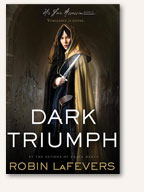
Book Cover: Dark TriumphKinsey recommended the first in the His Fair Assassin series, Grave Mercy, just a couple of weeks ago as a fun historical romance about deadly nuns. I was at the library when I read her post, and figured, why not? I checked it out, despite the size of the book (large), the cover of the book (beautiful girl posing melodramatically), and the inside blurb description (“For how can she deliver Death’s vengeance upon a target who, against her will, has stolen her heart?”), and I gobbled it up within the next week. It is just nonstop fun with the historical intrigue, which I liked better than Kinsey, and lots of romantic hijinx. I had a great time reading it, but wasn’t sure I was going to continue to read the series until I read the little teaser for the sequel in the back, at which point I immediately went back to the library to get the sequel.

Dark Triumph follows a peripheral character introduced in Grave Mercy, another, more troubled novice of the nunnery for the God of Death. The book focuses more on the character and her past than the surrounding politics, and is thus able to make her more nuanced and interesting to follow. The two books remind me a bit of Ilona Andrew’s Edge series, where the first one is lots of fun action with somewhat generic heroine and hero, and the second one takes the more interesting side character and continues his story. While I liked Grave Mercy, I loved Dark Triumph, and literally struggled to put in down at times within the three to four days that I devoured it. So Grave Mercy is worth reading if only to then read Dark Triumph (which does not stand alone, so needs to be read sequentially).

I would be reading the third book in what I believe will be a trilogy if it was out already, but unfortunately I have to wait until Spring 2014. I’m not terribly intrigued by the heroine, already introduced in the background of both books, but I’m hooked on the series now. In the meantime, I will leave you with a phrase from a critic’s praise for Grave Mercy that I found amusing (from the back cover panel of Dark Triumph): “a plot that nods to history while defying accuracy.” (Yep, that seems about right.)

P.S. – While looking for the book cover image, I ran across the author’s website, where she has posted the first chapter of Dark Triumph, which gives an excellent preview to the book, and also does spoil Grave Mercy a bit, so use caution.

—Anna

Grave Mercy

Have you been thinking that there are not enough young adult novels out there about nuns who kill people in the name of the god of death? Well then, I have the book for you! But seriously, I really enjoyed Grave Mercy by Robin LaFevers, and it’s lots of fun to tell people that you’re reading about assassin nuns.

Set in Brittany (now part of France) in the 1400s, the story follows Ismae, a teenage girl who is saved from an abusive father and an arranged marriage by joining a convent dedicated to Mortain, the god of death. And this convent teaches it’s novices some very specific skills, training them to be sent out into the world to kill those people marked by Mortain for death.

This was clearly published in the wake of The Hunger Games and Divergent and all those other teenage dystopian future series (this is the first in what looks like a planned trilogy), and it feels very much like those books. But if you’re a little sick of dystopian futures, like I am, this offers a nice twist by being set in the past. And while there is a bit of the magic/supernatural happening with the god of death and all, it’s really mostly a historical novel about life in medieval Europe. It featured a little more political intrigue than I would have preferred (However will the Duchess keep her crown? I don’t really care all that much!) but it also had adventure, romance, and strong female characters with a lot of agency. And it sure wasn’t like anything else I’ve read lately.

Kinsey’s Three Word Review: Dramatic, historical, romantic.

You might also like:  Scott Westerfeld’s Pretties/Uglies series. Those are set in the future, but the books felt very similar. And I consider those really fun books, so.

Seven Daughters and Seven Sons

By Barbara Cohen and Bahija Lovejoy

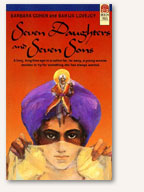
Book Cover: Seven Daughters and Seven SonsRebecca and I were discussing the other day whether it is possible to have a romantic storyline with the old trope wherein the heroine dresses as a boy without including even a hint of homophobia. You know: girl is disguised as boy, girl meets and falls in love with boy, and boy discovers the disguise when he also falls in love with girl since he just knew he could never have those kinds of feelings for another boy. The Fourth Vine writes up an excellent analysis of the inherent homophobic issues in Georgette Heyer’s The Masqueraders here.

I had suggested Robin McKinley’s Outlaws of Sherwood as a possibility, in which Little John says that after he began to have feelings for an apparent boy, he studied her more closely to see what was attracting him since he had never before felt that way for a boy, and then saw through the disguise. It is a fine point, but an important one that he didn’t automatically know that she was a woman because of his feelings, so he wasn’t immediately repudiating homosexual attraction. Confusion instead of repulsion.

Rebecca suggested Seven Sons and Seven Daughters, in which the middle daughter in a family of seven daughters dresses as a man in order to go out and make her fortune in trade like her male cousins do. I’d never read it, but was at loose ends, book-wise, so figured I’d give it a shot. It is also quite short, since it is more Young Readers than Young Adult (I would estimate late elementary/early middle school). It does still have some of the inherent anti-gay sentiment, though more by omission in that it never occurs to the love interest that he could be romantically attracted to a boy. Either he has a strong brother-like friendship with a young man or a great romance with a young woman, and the gender of his person of interest will determine that. Considering that this book is the retelling of an eleventh-century Iraqi folktale, that is pretty good.

More interesting than the treatment of the romance-in-disguise, though, was the description of the evolution of Sharia law in the Middle East. The heroine Buran’s family is very poor and pitied by the locals because having seven daughters and no sons at all is clearly a curse from Allah. Sons are how one gains wealth and prestige, and Buran’s wealthy uncle is considered additionally blessed with his seven sons. When coming up with her idea to set out as a man, Buran thinks back over the previous centuries, when women were free to be “musicians, scholars, warriors, poets, and merchants,” and describes how the caliphs had given their power away to the conquering Persians, who brought with them the hajib, and then the Turks, who brought even stricter restrictions for women.

Even though the book itself is very clearly pro-women, the pervading anti-women sentiment in the general society can be a bit shocking to modern ears. One reason Buran is able to stay disguised as male for several years is that no one believes that women have the minds for business strategy, so if someone is successful in business, that person is unquestionably male, all appearances aside.

As evidenced by this quite long review, this 220-page, large print book for young readers gave me quite a bit of food for thought, especially in our current political discourse on the Middle East, Islam, terrorism, gender roles, definitions of traditional families, and sexual equality. Not so bad for a couple day’s reading of a folk tale and love story.

—Anna

Code Name Verity

I’ve been home sick from work for a couple of days now, and while I am tired of coughing and sick of my couch, I did get a chance to finish an AMAZING book: Code Name Verity by Elizabeth Wein.

This WWII story is about a young, female British intelligence agent who is captured in Occupied France while on a mission, and is writing her confession for her Gestapo captors. But telling her story also involves describing her friendship with a female pilot, so while it’s a war novel, there’s also this lovely thread of friendship running through it. I’m a sucker for WWII stories and this one is clearly impeccably researched. It’s also really cleverly put together–things are not the way they may appear on the surface of the story, which is completely appropriate for a tale told by intelligence officers. As I was reading, I had a sense that something else was going on, but was still surprised by how things came together at the end. It was difficult to read, at times, but so well constructed. After Eleanor and Park, this was the best thing I’ve read this year.

One note: my library classified this as YA, but I found it pretty disturbingly violent. Realistically violent, not gratuitously so, but still. I would call this a book for adults or maybe older teens.

Kinsey’s Three Word Review: Harrowing, heart-breaking, and gripping.

You might also like: The Book Thief by Marcus Zusak, or How I Live Now by Meg Rosoff, or Gone to Soldiers by Marge Piercy

Red Glove and Black Heart

By Holly Black

I previously reviewed the first in this trilogy, White Cat, which I absolutely loved. I can’t really review these subsequent books, though, because it is the kind of series where even reading the back blurb of each book gives away brilliant twist endings from the previous book. I can’t just not review them, though, because they are awesome! I wanted another chance to tell everyone to go out and read the whole series. I swear you’ll just devour all three in one lost weekend of literary debauchery!

Book Cover: Red GloveAnyway, without any spoilers for any of the books, Red Glove really brought home to me what I love so much about these books: they are noir mysteries, full of old school gangsters and con men and corrupt cops, but also noir-lite, set in high school, or rather an up-scale preparatory school. Our protagonist is classic teen boy, often angry and with poor decision-making skills, but is also a very amusing and often clever smart-ass.

Red Glove spends more time in the school itself than White Cat, which I appreciated. I really love world-building and just the mundane details of the school life were fascinating to me (I especially loved the school scenes in Harry Potter, too).

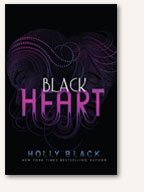
Book Cover: Black HeartEach book, too, gets a little wider in scope. White Cat deals with the protagonist’s direct family, while Red Glove extends more into the criminal world surrounding the family (I swear, these are all elements introduced right off the bat, and not spoilers). Black Heart goes even further and deals with the politics and government of the world. Unfortunately, I believe that this series has been planned as a trilogy with no subsequent books anticipated, though I would be a happy reader if Holly Black decided to revisit it.

—Anna

Eleanor and Park

Back in October, I wrote a review of Rainbow Rowell’s Attachements, mostly focusing on how sweet and charming I thought it was. Based on that, I assumed that I would like her new novel, Eleanor and Park, as well. I was not prepared for how much I LOVED this book. People, you have all got to go read Eleanor and Park.
Here is a short list of the things about this book that were awesome:
  • It’s a love story between two misfits (that’s Eleanor and Park), and for once the misfits actually seem like they don’t fit in. Eleanor is not a nerdy girl who takes her glasses off and then she’s a model–she (and, in his own way, Park) are truly complicated people who struggle to blend in and relate.
  • The portrayal of high school life–with it’s tentative and ever-shifting alliances–is as on-point as I’ve ever read.
  • The point of view alternates between Eleanor and Park, and both of their voices are so distinct and clear–it felt like I got to know two different people. I also love it when a book gives me an insight into teenage boys, and Park is a really stunning character.
  • It’s set in the 90s, so if you’re old like me, it will bring back fun memories. (They listen to the Smiths on a Walkman–raise your hand with me if you also did that!)
  • It made me cry on an airplane, but also made me so happy that I am planning to buy my own copy so I can read it whenever I want.
My library classified this as YA and I wouldn’t hesitate to recommend it to teens, but it’s complex enough that I might consider it an adult book.

Kinsey’s Three Word Review: Better than words.

You might also like: Nick & Norah’s Infinite Playlist (read the book, then see the movie–they’re both good)

E. L. Konigsburg

This past Friday, E.L. Konigsburg died. In case you don’t recognize the name, she wrote From the Mixed Up Files of Mrs. Basil E. Frankweiler and was one of the most influential children’s book authors of the 20th century.

If you haven’t read From the Mixed Up Files of Mrs. Basil E. Frankweiler, you should really go track it down immediately because it is delightful. It is about two suburban children–Claudia and her little brother Jamie–who run away from home to New York City and set up house in the Metropolitan Museum of Art. They eat from automats and sleep in the museum’s Tudor bed and end up solving a mystery before returning safely home. When I first read it, I lived in a tiny town in Texas and Claudia’s New York City seemed like another world. But I desperately wanted to see her world, and I put at least some of the responsibility for my love of big cities and current city residence on this book. Plus, the first time I went to New York, I went to the Met and tried to find the fountain where Claudia and her brother took their baths and collected coins. (I never did find it–I think if it ever was a real fountain, it’s not there anymore. Also, I’m sad I can’t eat at an automat.)

When I saw the news about Konigsburg (via Twitter, of course, because how else do I learn things these days), the first thing I thought of was From The Mixed-Up Files. But when I looked up her full catalog, I was reminded that she wrote a whole pile of books that I loved as a child–a partial list includes:

A Proud Taste for Scarlet and Miniver
Up from Jericho Tel
Father’s Arcane Daughter

Jennifer, Hecate, Macbeth, William McKinley, and Me, Elizabeth

Both as a kid and now as an adult, I loved that her stories always seemed to have a twist. A Proud Taste for Scarlet and Miniver is about Eleanor of Aquitaine, but rather than a simple historical fiction biography for kids, it is about Eleanor looking back on her life from Heaven, while waiting to see whether Henry II will get in. And Up From Jericho Tel is your basic friendship-between-two-outcasts except that in this case the two kids end up also befriending the ghost of Tallulah Bankhead. Yes, really. I also loved the way all these books give a lot of power to the opinions and needs of kids, without turning into “message” books. For example, in From The Mixed-Up Files, Claudia decides to run away from home not due to any dark secret, but because she is ready for adventure and feels like there is more to life than her elementary school routine. Sure, Claudia comes off as a little overdramatic, but the message I always took from the book was that it was imminently reasonable to wish for more. And while Claudia ultimately decides that she misses her family and the comforts of home, she also doesn’t give up on her adventure until she feels like she can return with something new and special that will change her everyday life. (I’m trying not to spoil this 40-year-old book, just in case someone decides to track it down for the first time based on my review.)

Konigsburg gave kids a lot of credit, both by creating child characters with agency and ideas, and by trusting that her readers could handle some ambiguity and the occasional ghost of an actress or queen. I was sorry to hear of her death, but so glad that she wrote as many wonderful books as she did.

Kinsey’s Three Word Review of E.L. Konigsburg: Go read everything!

You might also like: The Westing Game always reminded me of her booksa story with a heart where nothing is too obvious.

Anna Dressed in Blood

By Kendare Blake

Book Cover: Anna Dressed in BloodThis book title jumped out at me in the library months ago (for obvious reasons), but then we started the marathon of reading Atlas Shrugged, so I back-burned it for a while, knowing it was going to be my palette cleanser after Rand. At the worst parts of Atlas Shrugged, I just pictured Anna Dressed in Blood waiting for me. And I couldn’t have asked for a better palette cleanser!

It is cheesy and spooky and just awesome! It reminds me a bit of Twilight, actually, if a better writer had written the characters and situations in a way that makes more sense in a rational world. Also with some gender turnaround: Cas moves to a small town in Ontario with his single mother, starting a new school in his senior year and is immediately popular. Sound familiar? He’s also brooding and rude and immediately drawn to the titular female character. He’s kind of both Bella and Edward, but everything he says and does actually makes sense.

Cas is a ghost hunter, a talent and career that he inherited from his now-deceased father. He and his mother travel to new towns that have killer ghosts, settle there long enough for Cas to draw out and dispatch the ghost, and then move on to the next town. He is immediately popular at his new school because he makes an effort to be; he needs access to the gossip mill as quickly as possible in order to do his job. He knows that by being brooding and a little rude, he’ll be considered even more attractive, so he does that on purpose as well. I just love rational characters who have a goal and then follow logical steps toward it!

I felt like the plot got a bit scattered toward the end; I can’t quite put my finger on it, but the pacing just felt kind of odd to me. Even with that, though, this was a very satisfying book with which to recover from Atlas Shrugged. I would be somewhat cautious about recommending it for young readers: there was a fair amount of violence, and I can’t attest to fear factor because I have already described how I completely unfrightening I find ghosts.

—Anna

As You Wish and Sisters Red

I’ve been reading a stack of non-fiction lately–books that are interesting, but not necessarily things I want to blog about. That is, unless folks are interested in a giant autobiography/oral history about the Mob hitman who killed Jimmy Hoffa? But I broke up all the history with a couple of lovely young adult fairytale retellings that seem like they might fit well into the YA vibe we generally have going here. Jackson Pearce clearly has the knack for reframing classic stories into modern young adult stories–she’s got a whole catalog of them. The two I read were As You Wish and Sisters Red and both were totally charming, easy reads.

As You Wish is the story of a depressed teenage girl who accidentally conjures a jinn (or genie) who has to stick around until she makes three wishes. But she doesn’t really want to fix her life with wishes, and he ends up getting interested enough to want to stay. The book is pretty short–almost spare–but it does a wonderful job creating a back story for the jinn with a minimum of information. In fact, the whole book gets across a lot of information and plot while staying very simple and not getting overly flowery. Sisters Red is a more complex story, wrapping together werewolves and the Little Red Riding Hood story, but adding in a relationship between sisters that really touches on the kind of layers that love and obligation create.

This might be making a fine distinction, but I found both these to be more like YA books plus a little fantasy, rather than fantasy books aimed at younger readers. There are no elaborate maps of fantasy kingdoms or complicated world building, but both books present a nuanced picture of teenagers and the serious issues they face, magic and mundane.

Kinsey’s Three Word Review: ABCFamily-esque modern fables

You might also like: Before I Fall by Lauren Oliver or Robin McKinley’s Beauty and the Beast retellings.