In the Garden of Beasts and A Thousand Lives

I do most of my reading at night, right before I fall asleep. Which can be problematic when I’m reading something creepy, since I end up either laying in bed listening for suspicious noises or having nightmares where I’m chased by evil book characters. So it probably wasn’t very wise of me to read In the Garden of Beasts: Love, Terror, and an American Family in Hitler’s Berlin by Erik Larson and then follow it up with A Thousand Lives: The Untold Story of Hope, Deception, and Survival at Jonestown by Julia Scheeres. This late-night unsettling reading, combined with the Nyquil I’m taking for a cold I picked up traveling last week, has led to some very bizarre dreams. But I would recommend both books to people reading during daylight hours, and they work surprisingly well together. They each examine why people choose to follow madmen who lead them to do terrible things, both to themselves and others–the difference is in the scale.

In the Garden of Beasts is about the American ambassador to Germany in the 1930s, and describes his family’s life in Berlin as Hitler rose to power. It focuses on 1933, the turning point when Hitler consolidated his power, and it’s basically an entire book of foreshadowing. Larson is describing elegant Berlin parties and the love interests of the ambassador’s daughter, but we all know how this story ends. I occasionally got a overwhelmed by the level of detail, and I wished I had an org chart to help keep all the minor diplomats and German politicians straight. However, Larson does a wonderful job of creating a sense of oppression and fear. I could feel myself getting more and more tense as I read, wishing I could jump into the pages and tell all these people to get out of Berlin before things got any worse.

A Thousand Lives tells a much smaller story. Scheeres uses FBI documents to describe the rise of Jim Jones, from his very early days as a minister in Indiana to his horrible end in Guyana. (I can’t bear to type out any details, if you don’t know the story you can check out the Wikipedia page.) She follows a number of individuals, detailing why the church originally appealed to them, how their views of the church evolved, and how they ended up in Guyana. I hadn’t realized how initially progressive Jones’s teaching on race and class issues was and that was fascinating, but it’s an ominous, disturbing book. Not all of the individuals profiled in the book died in Jonestown, but there aren’t any happy endings here.

I liked both books, but I think Larson did a better job of explaining how good, rationale people could get caught up in such a situation. I was struck by the number of people who thought from the very beginning that Hitler and his cronies were lunatics, but chose to stay in Germany because they assumed that at any minute sense would prevail and the Nazis would be thrown out of power. By the time they realized that madness was going to win the day, it was too late for them to get out and Hitler had too much power to defeat. Sheeres also describes how people had serious doubts about Jones and his church, and how many tried to escape or stand up to Jones. However, for me she doesn’t get to the heart of why people followed Jones when he was so obviously mad. Hitler had the power of the German state behind him to enforce his choices, but it seems like Jones’s followers could have walked away once he he started abusing children and talking about conspiracies. (At least, they could have while they were in the U.S.–Scheeres makes it clear that once Jones got his followers to Guyana, they were trapped and had virtually no way to escape.) Maybe it is personality trait: I can imagine myself deciding not to emigrate away from my home country, choosing instead to stick it out and hope things improved, but I find it very hard to imagine giving up my life and following a religious leader to a foreign country. As thoughtful as A Thousand Lives was, it still didn’t explain the attraction of Jim Jones, while Larson created a disturbing picture of a society that is too easy to imagine myself in.

I have got to find myself some more cheerful things to read, but if you’re interested in some 20th century history and ready to start building a time machine so you can go back and rescue people, I would recommend In the Garden of Beasts and A Thousand Lives.

The Wilder Life

Early in The Wilder Life Wendy McClure explains that there are two kinds of Little House on the Prairie people: people who loved the books, and people who loved the TV show. If you’re a Michael Landon/Melissa Gilbert/70s TV fan, you can really stop reading right now. I am a book person and so is Wendy McClure. But she took it a step further, diving into Laura Ingalls Wilder’s writing as an adult and making it her own personal project to do whatever she could to get to what she calls “Laura world.”

In addition to rereading all the books, McClure buys a butter churn and makes butter in her Chicago apartment. She reads the (surprisingly extensive) academic research on the Ingalls family and checks out the online homeschooling communities that use the books in their teaching. And then she starts travelling around the Midwest, to Wisconsin and South Dakota and Missouri, making a pilgrimage to the places Wilder lived. She drags her boyfriend into this all, as well, and basically allows her modern urban life to be temporarily subsumed by her obsession with Little House on the Prairie. (Not that she abandons modern life entirely: McClure occasionally Tweets as Laura at http://twitter.com/#!/halfpintingalls. My recent favorite: “Pa wants to leave Facebook because he says we have too many neighbors now! And, truth be told, he never had much luck playing Farmville.”)

Are you wondering whether stories of urban butter churning are enough to build a book on? Yeah, probably not. The book mostly reads like memories of scenes from the books, interspersed with stories of driving across South Dakota.You learn a little about Wilder’s life and how it differed from the books, but it’s not a history or biography of the family. McClure’s road trip stories, especially one that involves an accidental camping trip with a cult, are funny and sharp, but it’s not a travel book. And while there is a brief discussion in the book about how McClure was, at least partially, using the books to deal with the loss of her mother, that’s mentioned only in passing. It’s an entertaining, fun read–McClure’s writing is very engaging–but it feels more like stories you would tell your friends over drinks than like a fully-formed narrative memoir.

But I don’t mean to make that out as a bad thing, necessarily. It’s like this: a few years ago I saw a stage production of Little Women in London that was awful. Each actor failed at an American accent in his or her own distinct way. They’d mucked around with the timeline and added a bunch of forgettable songs. At one point an actor in a white dress actually played the ghost of Beth. (However, to go on a brief tangent, somehow this terrible production managed to fix the one thing I never liked about Little Women–Professor Bhaer. In the book he seemed so old and serious that it felt like Jo totally settled, but in this show he was played as young and adorably goofy, sort of like Marshall on How I Met Your Mother. That whole relationship finally made sense to me.) But I still enjoyed myself, because I read Little Women so many times when I was little that it was like watching a reenactment of my own childhood. I could tell from the conversations around me that the Brits in the audience weren’t familiar with the book and that the show was not connecting with most of them. But at each new scene I would be bouncing in my seat, “It’s Amy and the limes! It’s the piano!” The Wilder Life made me feel the same way. While the action sort of meanders along, reading McClure talk about Laura and Mary and the Long Winter and the dugout house was like having a conversation with a smart friend about our childhoods. If you didn’t love the Little House books as a child, or if you want a tight, plot-driven story, this book isn’t for you. But if you can remember exactly what Laura got for Christmas, or what Almanzo ate in Farmer Boy, or that you should stay out of creeks because there might be leeches in there for God’s sake, The Wilder Life might warm your heart just a little bit.

“And Tango Makes Three”

And Tango Makes Three
Written by Justin Richardson and Peter Parnell
Illustrated by Henry Cole
(2005)

I am hardly the first and I won’t be the last person to read a book purely because it was banned. In fact, it’s a bit of a tradition for Banned Book Week: go out and read a banned book. I decided for a couple of reasons to go straight to the top of the banned books: here’s a book that’s the most contested, most banned book in the entire United States for four out of the last five years. (It was knocked down to second most banned book in 2009, but it rebounded back up to first place in 2010.)

This book has owned the American Library Association’s banned book list every year since its publication. Wow.

And then there’s the other reason why I picked this book. It is, in no particular order:  nonfiction, a picture book, intended for a kindergarten audience, and about penguins.

“Um…,” I hear you say. “Why exactly was it banned?”

Perhaps you ask tentatively because, well, the mind kind of boggles at the potential horrors that are being done to and with penguins.

They are… nesting and raising babies. This is the kind of thing that penguins do. In fact, most species do. They find themselves a mate, they make for themselves a nest, and they have babies, generally rather cute babies.

“Um…,” you say again. “So why…?”

Well, the book focuses on a specific penguin couple and their specific little baby penguin at New York City’s Central Park Zoo. The two adult penguins are both male. The egg they hatch was given to them by one of the zoo-keepers. (Noted in the author’s note at the back, the egg came from the nest of one of the other penguin couples who had a bad habit of abandoning the second of their two eggs.)

The story is about this couple of male penguins who put together a nest, and raise a baby penguin.

cover picture for And Tango Makes Three Shall I reiterate the fact that it has topped the banned book list for four out of the last five years?

So the fact that this book is so often banned is rather appalling for at least three different reasons:

Continue reading

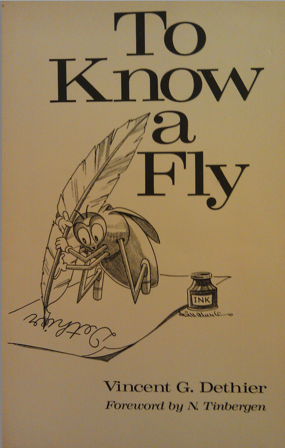
“To Know a Fly” by Vincent Dethier

To Know a Fly
written by Vincent G. Dethier
illustrated by Bill Clark and Vincent Dethier
Forward by N. Tinbergen
(1962)

This is a side-splittingly funny nonfiction book about the study of flies.

Take a moment to consider that, and now give me the benefit of the doubt for a few paragraphs to prove how this seemingly impossibility is not only possible but true.

Consider being in a laboratory setting. There are serious educated men (this being the 1960s, they were all men except for the cleaning lady), mysterious lab equipment, official white lab coats, a sterile environment, and, of course, the lab animals…who are all flies. Now consider those serious educated men attempting to coral those flies (not easy), keep that environment sterile (virtually impossible), and perform little experiments with them (a bit of a hit-or-miss proposition). This is the story told by Vincent Gaston Dethier, a leading American entomologist, i.e. a scientist who studies bugs. He writes in the same manner that I image he spoke at dinner parties, about the amusing and amazing things that had happened that day, intended for an audience made up of whoever his neighbors happened to be.

Continue reading