The Hare with the Amber Eyes

I can’t believe that I haven’t already written about The Hare with the Amber Eyes: A Family’s Century of Art and Loss. I loved it so much I was sure that I had written a review of it, but it must have slipped between the cracks, which I cannot allow to happen. This book has been all over the place lately so I know I’m not exactly letting you in on a secret with this recommendation, but sometimes books are popular for a good reason. This is a non-fiction family memoir written by an English ceramics artist whose family was one of the richest, most powerful Jewish banking families in Europe in the 19th century. He traces the history of his family as they climbed to the top of European society, and then were devastated by two World Wars and the anti-Semitism that was always waiting just under the surface of polite society.  (As I said to my sister when I was about 2/3rds of the way through the book, “This has been really enjoyable so far, but now it’s 1930 and they’re Jews in Austria. I feel like things are about to take a turn.”)

There are plenty of WWII memoirs out there–what makes this one stand out is that the story is all told in the context of the family’s art. Specifically, de Waal traces a collection of small Japanese carvings known as netsuke–how his family obtained them, how they fit into the rest of the family’s collection, and how they survived the twists and turns of history to end up in his possession. Political events are a major part of the story, but even those are filtered through the lens of how they affected the family’s patronage and collection of art. The book is more art history than history, and it makes what is a familiar story feel fresh and interesting. One thing did puzzle me: the book did not include any pictures of the netsuke. Lengthy, lengthy descriptions of the tiny carvings and pictures of the family, but no pictures of the carvings themselves. That seems like it must be a deliberate decision, to make sure that the readers’ focus is on the family and the people instead of on the things, even though the fate of the netsuke is the hook the entire book is based around. I ended up going to Wikipedia to find out what these things actually looked like, and then falling down an internet-rabbit hole about Japanese art. If you’d like to see some very detailed pictures of netsuke, let me recommend JapaneseNetsuke as a starting point.

Also, although I linked to the Amazon page, I would recommend not reading the reviews there before you read the book, because they give away some of the major twists. I’m not someone who gets overly concerned about spoilers, but I went into this book blind and I think that especially well.  I knew that the netsuke collection survived the wars, but I learned how that happened as the author did, and I think that made the experience more powerful. It can be hard when reading history to remember that the things that happened in the past were not inevitable or destined, but that life at those moment in the past was just as fluid and unpredictable for the people living it as our lives feel today. Having only a general sense of what was going to happen made following the story of this one family, and this one collection of tiny objects, feel like a thriller.

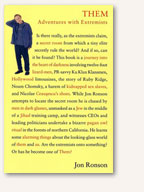
Them: Adventures with Extremists

By Jon Ronson

I am very much a believer of Occam’s Razor—that the simplest answer is usually the correct one—which makes me pretty much anti-conspiracies. I have to admit, though, that Jon Ronson’s Them gave me pause.

The front cover has this description:

Is there really, as the extremists claim, a secret room from which a tiny elite secretly rule the world? This book is a journey into the heart of darkness involving twelve-foot lizard-men, PR-savvy Ku Klux Klansmen, Hollywood limousines, the story of Ruby Ridge, Noam Chomsky, a harem of kidnapped sex slaves, and Nicolae Ceausescu’s shoes. While Jon Ronson attempts to locate the secret room he is chased by men in dark glasses, unmasked as a Jew in the middle of a Jihad training camp, and witnesses CEOs and leading politicians undertake a bizarre pagan owl ritual in the forests of northern California. He learns some alarming things about the looking-glass world of them and us. Are the extremists onto something? Or has he become one of Them?

Book Cover: ThemI had previously discovered Jon Ronson when he was on a hilarious episode of NPR’s This American Life, talking about his most recent book, The Psychopath Test. (If you haven’t heard the episode, you definitely should—they bring in a psychologist to administer the “psychopath test” to the NPR staff.)

I promptly picked up the book at the library and realized that I had experienced Jon Ronson before—he wrote the book Men Who Stare At Goats, which was made into a movie a few years ago with Ewan McGregor and George Clooney. Several things became clear all at once: Ronson has a writing style unlike anything I’ve read before. He describes himself as a humorous journalist, but he writes in a kind of nonfiction stream-of consciousness. I enjoyed the movie “Men Who Stare At Goats,” but the characters just seemed to sort of float along and kind of accidentally run into important people or pivotal events. It didn’t seem very realistic in the movie, but it now seems very much how Ronson operates, and once you get used to it, it is pretty awesome being along for the ride.

Ronson just seems like the most pleasant, unassuming, agreeable person, and he must be because he gets interviews I wouldn’t have believed possible. In “The Psychopath Test,” he meets with CEOs, even after telling them he wants to see if they are psychopaths! It is unbelievable—they are just sort of amused. I think he must have some superpower of not giving offence. Them starts off with him spending a year off and on with Britain’s self-proclaimed right-hand man of Bin Laden, even though Ronson himself is Jewish.

Ronson has a very active voice in his books, unlike most journalists, and that is very much part of the charm. The reader gets a much clearer sense of the full interactions, and I started to notice that Ronson asks lots of questions but only very rarely disagrees or confronts people. Even his questions are very inviting, sort of “I’m sure I’m being very stupid about this, but what about….” People seem usually pretty delighted to speak with him. (Although if I recall, The Psychopath Test begins with one of his subjects from Them being very unhappy with his treatment in the book and threatening him.)

In the book’s preface, he explains how he came up with the title Them. While in the middle of researching the book, he describes his research to a friend, and the friend replies, “You are sounding like one of THEM.” And I have to warn that after reading this book, not all the extremists will seem so extreme to you, either.

It reminded me of watching a tv program on the Society of Masons with Tom. They had lots of conspiracists describing various farfetched theories about the Masons, and Tom and I had a good time laughing at how ridiculous it all was. Then, the program interviewed a representative from the Masons, and he was so slick with complete non-answers (“why, we are just a normal fraternal order, how could you possibly think otherwise?”) that for the first time I had some momentary doubt.

—Anna

Please don’t talk to me, middle seat person. I’m reading.

I spent the last two weeks traveling on business, which meant that I was too exhausted at the end of the day to put two words together for a post, but I got LOTS of reading done in airports, on airplanes, and in hotel rooms and lobbies. While I will spare you descriptions of the many in-flight magazines and celebrity tabloids I read during the enforced no-electronics portions of my flights, here are quick summaries of the books that kept me sane as I criss-crossed the country:

The Marriage Plot by Jeffery Eugenides
This was fine, I guess? I was interested in all the characters and I wanted to find out what happened, so it was compelling reading. On the other hand, it was really long and nothing much actually happened and there was almost no resolution of any sort and just because I was interested in the characters didn’t mean I liked them. In fact, pretty much everyone in the book was extremely unpleasant or shallow, so it was a bit like watching a very long, slow train wreck as these characters messed up their lives over and over. I had initially written here that I wanted to warn people about an unflattering portrayal of a character with a mental illness, but all of the characters were portrayed in unflattering ways so the manic depressive actually came out pretty well, comparatively speaking. I loved The Virgin Suicides, so Eugenides has credit in the bank with me, but while The Virgin Suicides felt airy and impressionistic, this dense, heavy, weighty novel feels like it was written by someone else entirely. English majors might like it though, since it seems to feature a lot of inside jokes about literary criticism.

Let the Great World Spin by Colum McCann

Remember how back in the 1970s a French guy strung a tightrope between the two World Trade Center towers and walked back and forth between the buildings, a hundred floors up with no safety net? This novel describes what was happening in the lives of a number of New York residents on that day, and how they were all connected to the wire walker and to each other. Although it does feature the walker (in real life, his name was Philippe Petit and you can watch an amazing documentary about his walk called Man on Wire), the story isn’t really about him at all. It’s really about New York, and America, in the 1970s–Vietnam, crime in the cities, race, immigration, and how all these things play out in the life a few individuals. As a general rule, I don’t like books that follow multiple characters connected only by the thinnest of threads. However, in this book each character is beautiful and heart-breaking and I found that they all looped together in really satisfying ways. Sad, but lovely.

The Thrift Book by India Knight
I think I’ve explained here before that I want India Knight to be my best friend, so I adored this book, even though it is basically just a list of fairly obvious ways to save money. You know, cook at home, make Christmas presents, grow your own herbs, don’t be fooled by fancy skin creams. Knight puts a fun spin on it by focusing not on getting out of debt or being as cheap as possible, but by talking about all the ways her strategies make you feel (to sound English about it) posher and more glamorous by not trying to hard or getting caught up spending on foolish thing. Plus, she’s funny. At one point she refers to playing Scrabble online as her “ongoing Alzheimer’s prevention project,” which is exactly how I think of Words with Friends. However, if you are not trying to befriend or become India Knight, it’s probably not necessary to read this.

Ready Player One by Ernest Cline

Really fun, and absolutely perfect airplane reading. A sci-fi story that manages to be both a puzzle/treasure hunt and a celebration of 80s pop culture. I think is truly aimed at folks a few years older than I am who spent much more time in video arcades, but I loved it and was so absorbed I was able to read it in even the loudest terminals and restaurants.

Hiring the Best by Martin Yate

Hiring the Best: A Manager’s Guide to Effective Interviewing and Recruiting, Fifth Edition
By Martin Yate
2006

This is yet another assigned book. One day I will again read for pleasure, but that day will likely not be until the summer. Sigh.

In the mean time, though, I was surprised and pleased to discover that I actually enjoyed this book. Job interviews are not a topic that I consider particularly interesting, beyond the sheer necessity, but the book wound up being enthralling. It goes through all sorts of questions, discussing what those questions are actually asking, how to pick which questions to ask, and how to interpret the answers that you get back. It was also a really slow read, because I was constantly scripting out how I would answer certain interview questions.

As the subtitle states, the book is about recruiting and interviewing. Yate does an amazing job of introducing and concluding with a thorough discussion of how to think about recruiting. Then about half the book in the middle lists and discusses potential questions to ask in a job interview, going over hundreds of possible questions.

It covers what traits an employer should be looking for in potential employees for different positions and then how to tailor a job interview to get at those traits. As someone who is more likely (I hope) to be in a job interview next as an interviewee rather than an interviewer, I found it helpful to consider what these questions are actually asking and how the answers will be judged. However, given my one and only experience running job interviews from the other side of the table, I am extremely grateful that I will never again be quite as incompetent at it as I was then.

Yate writes with a blunt conversational style that I enjoy, and while I don’t agree with his perspective on a couple of things (he’s very corporate sector while I’m more nonprofit sector,) it’s not a pervasive issue. It’s more of a sense that I like him but I wouldn’t talk politics with him for fear of changing that.

Despite the fact that I’m not all that interested in management, I do acknowledge that it’s useful to know about and Yate seems to know what he’s talking about and describes it well. I strongly suggest this book to anyone who’s on the job market or in management.

The Non-Designer’s Presentation Book by Williams

The Non-Designer’s Presentation Book
By Robin Williams*
2010

Yay! This is a good book. The streak of unpleasant books has ended! This book is current, it has good advice, and, I admit, it’s also pretty (lot’s of sharp pictures illustrating the various principles.)

Like the other books I’ve read recently, this covered a lot of basic foundational concepts, but this time I felt they were covered in a way that respected me as the reader.

I’m now a bit daunted by the thought of actually trying to give a good presentation and a bit retroactively embarrassed by some of my previous presentations. I think the main argument to this book is that it’s important to learn how to actually use a presentation program (like PowerPoint or Keynote or a couple of the other program) and to not ever depend on their templates. You can create really excellent and elegant presentations with these programs if you know what you’re doing and what to pay attention to.

It’s a challenge; I’m going to have to spend some serious time with a PowerPoint tutorial before putting together my next set of presentation slides. But I think my next presentation will be a lot better than my various previous ones.

I imagine this book will go out of date relatively quickly, by say 2015 or 2020 at the latest, as the norms of presentations change again and the technologies described here get replaced by something newer and fancier. But for now, it’s current and lovely. I definitely recommend it.


* This is a woman, and not an actor.

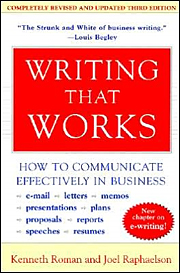
Writing that Works by Roman and Raphaelson

Writing That Works
By Kenneth Roman and Joel Raphaelson
2000

I don’t generally read books that I don’t like. Why bother?

As it turns out, the answer to that is, if they are assigned, then it matters to my grade and thus I had better go ahead and read them.

But really, this makes four for four for this one class, and I just want to read something that I unambiguously enjoy.* At least this book was relatively short and easy to speed read.

Writing That Works is a how-to book that is both extremely basic (know the meanings of the words you use and don’t confuse “its” and “it’s”) and highly dated (a lot of people are now using this crazy thing called “e-mail” to communicate with.)

The simplified nature of the rules it gives for writing means that they remain true. As important as it was to learn them in elementary school, it’s probably equally important to review them periodically. I just get irritated by being told rules that I already know AND that I would argue are often best demonstrated by their exceptions.

It is important to know the rules so that when you break them, you do so intentionally.

Oddly, Writing That Works acknowledges that some rules are meant to be broken but only in the chapter on political correctness, quoting Bernard Shaw’s definition of a gentleman as someone who “never insults a person unintentionally.” While admitting that you may occasionally want to insult someone, it fails to acknowledge that sometimes you don’t want to use the most common words in short sentences.

Sometimes it is useful to use rarer words and complex phrases. I quote Mark Twain: “The difference between the almost right work & the right word is really a large matter—it’s the difference between the lightning bug and the lightning.”

So overall, I would say that if you want to improve your writing, this is a somewhat useful book. But read it with the goal of thinking about what it says as if the statements were suggestions for you to consider rather than rules for you to follow.

* Although being able to grammatically write “four for four for” might well make it all worth it.** It’s not quite up there with “I, where you had had ‘had,’ had had ‘had had;’ ‘had had’ had had a better effect.” but it’s still fun.***

** Actually another thing that makes it worth reading is it introduced me to the story of David Ogilvy and his Russian matryoshka dolls. Ogilvy would give these dolls to his board members with notes saying: “If you hire people who are smaller than you are, we shall become a company of dwarfs. If you hire people who are bigger than you are, we shall become a company of giants.”

*** The fact that enjoy these examples of phrases which are grammatical but excruciatingly difficult to parse may have something to do with the fact that I didn’t enjoy a book about writing in a simple and straight-forward fashion.

Bargaining for Advantage by G. Richard Shell

Bargaining for Advantage: Negotiation Strategies for Reasonable People, 2nd Edition
By G. Richard Shell
2006

I’m going to start off by saying that I recommend this book: it’s well written and it’s useful.

That is not to say that I enjoyed it. But for now, I’m going to focus on the “useful” aspect.

Bargaining for Advantage did an amazing job of teaching me a topic that I really wanted to avoid and doing so in as enjoyable a manner as possible, which just wasn’t all that enjoyable. It was kind of like having a really nice, capable guy for a dentist. He’s a nice guy, it’s a necessary experience, and wow do I not want to deal with it.

As I mentioned in a previous review, I did not find Difficult Conversations particularly useful because the conversations that book dealt with were not the ones that I find difficult. What do I find difficult? Bargaining.

So, my first reaction is to shudder in horror at the title. I hate bargaining, I consider myself quite bad at it, and I avoid it whenever possible. I don’t even like thinking about bargaining. To me, paying a higher price for something is an irritating but acceptable price to pay for not having to bargain.

Despite this, once more and for the same class, I read a book that I found painful to force my way through. However, I’m willing to acknowledge that it’s my own idiosyncrasies that made it so, and the book itself is actually quite good. It’s both well written and provides useful information and good advice on implementation.

The book has two main parts: the first half discusses the foundations of any negotiation and it just made me cringe because I didn’t want to have to deal with any of them. The second half is about the negotiation process and that, while still painful, was also somewhat soothing to my poor introverted and avoidance-heavy sensibilities. It walked me through how to deal with the six foundations previously introduced. I still don’t want to deal with them and I’m not looking forward to any actual bargaining experiences, but I do think I have a much better handle on how to approach those situations when they’re necessary.

Also, the negotiation styles and techniques were all illustrated with a plethora of examples from around the world and throughout history. The stories were all fun, fascinating, and informative. They consisted of little anecdotes about modern and historical figures, familiar and foreign cultures, and successes and failures at the bargaining table. They were pretty much the saving grace of this book for my sanity, since every time I started to worry too much about having to (oh dear god) deal with some bargaining technique myself, there would be some bit of historical or cultural trivia coming my way.

So to sum up, I hated reading it, but it was still an excellent book and I learned a lot.

Cool, Calm & Contentious

By Merrill Markoe

Book Cover: Cool, Calm & ContentiousI did not know who Merrill Markoe was when I first saw her touting this book on The Daily Show with Jon Stewart, but she was so funny on the show and the excerpts from the book were so funny that I immediately put my name on the waiting list at the library. Apparently along with everyone else in Boulder, too, because it took several months for the book to come to me.

Then, I mentioned the book to my office-mate, and she caught me up that Markoe was a comedy writer for David Letterman and dated him for several years, which was good information to have for several of the essays which discuss her love life in satirically veiled terms.

I expected the book to be really funny; what I didn’t expect was for it to be so insightful. At least three different points she makes were directly applicable to my life, and at least one has already made an improvement in my life. How many books can you say that about? Especially ones that are already sidesplitting.

I have to warn that one of the essays, about two-thirds of the way through the book, starts funny like all the others, but then veers into pretty dark territory. After that, it is all comedy again, but it threw me for a bit of a loop.

—Anna

“Difficult Conversations” by Stone, Patton and Heen

Difficult Conversations, 10th Anniversary Edition
By Douglas Stone, Bruce Patton, and Sheila Heen
1999, 2010

There is a reason why I don’t tend to read self-help type books (or attend church services very often either), and that problem is separating the wheat from the chaff. I believe that no one is perfect but everyone has something of value; it’s the ratio of valuable insight to crap that can get annoying.

I rediscovered this as I was reading my next assigned text, Difficult Conversations.

There was a lot of chaff in the book and not much wheat.

I was not looking forward to reading this book anyway, because I hate difficult conversations and will attempt to avoid them if I reasonably can. I have had several situations over the years that maybe could have been improved by my being willing to confront a situation head on and a couple more situations where I was impressed with another person for their strength of will that allowed them to start a needed conversation. So, I started this book, not looking forward to the reading, but expecting it to be good for me.

Instead I discover that once more I am enough of an odd duck that when the authors talk about how I think X, Y, or Z, — and the author’s do write in the second person, “you do this”, “you do that” in order to make all of their pronouncements as personal as possible — I’m over here going, wait, but I almost always respond with G or H or J, rarely with X, and think Y and Z are idiotic. So why are the authors telling me that I always make a certain set of assumptions (which I don’t) and should instead soliciting the other person’s interpretations, when they (the authors) are making all sorts of assumptions about me and, by virtue of the medium being a book, not giving me the opportunity much less an invitation to clarify my side?

At which point I’m feeling all maligned like one of their example cases AND feeling like I’m unnatural in some way, AND feeling like an idiot for taking this personally.

When I brought up my problem with the book in class, though, expecting other students to have had similar thoughts, I discovered that apparently I really am that odd and no one else had a similar take. A lot of the other students thought it was an excellent book that helped a lot. A few of the other students didn’t care for the book for one reason or another (it was simplistic, it contained too many scenarios and not enough theory, the scenarios were all a bit too contrived, etc.), but none of them disliked it for the same reason that I did.

There were some good points. The book did offer some useful ideas about how to distinguish the real goal of several different types of difficult conversations, how to think about each type of confrontation, and how to prepare for each type. Plus, the actual writing is quite well done, and the book goes pretty fast (or it would if I didn’t have to put it down and walk away periodically.)

However, my big conclusion is that while everybody has some set of conversations that they find really unpleasant to participate in, we don’t all agree on what set of conversations those are — a conversation that I consider difficult may not be one that you do and vice versa. And this book really was not addressing my issues at all.

“In the Beginning… was the Command Line” by Neal Stephenson

In the Beginning… was the Command Line
Neal Stephenson
1999

As an opening caveat, I should say that this is the first in what is likely to be a series of reviews of assigned readings. I read this book because one of my professors said to, rather than through any choice of my own. Arguably, I did make a higher-level choice to take the course, but since I’m writing a review of a book rather than the course, the caveat is still important.

I will say that I was delighted at the assignment.

This is the same author as Snow Crash, Diamond Age, and Cryptonomicon, all of which I loved. Stephenson has also written a variety of other books that I have not read, and given that this book came out in 1999 and I’m only just now reading it because it’s assigned, it should be evident that while I like this author, I choose books that I think look interesting rather than reading just anything he’s written as I do for a couple of other authors.

My first reaction is that this is a really useful introduction to the history of the personal computer. Despite the speed at which computer development happens, or maybe because of it, it’s a useful to understand what computer operating systems are and how they’ve developed and what the competing market pressures have been regarding them.

On the other hand, I’m reminded of why I am wary of interacting with authors and actors as people rather than simply enjoying their work. There are often occasions when I like a book or movie or whatever and don’t want that enjoyment to be tainted by the fact that I don’t care for the author or actor. (Robert Heinlein, I’m thinking of you. And, oh, Tom Cruise. Tom, Tom, Tom. Why?)

Stephenson isn’t too bad though. He seems like an okay sort of guy even when he’s writing a nonfiction essay and not writing with the voice of characters developed specifically to be sympathetic. However, there were multiple times when I wanted to argue back at the book and explain that while I didn’t understand the details of computers that he obviously does, a couple of his metaphors were still poorly applied and had internal inconsistencies, and the motives that he projects onto the people who act more like me than like him are not the motives that I actually have for my actions.

So, over all, this is not the most perfect book ever that simply, clearly, and correctly explains the history of operating systems. If you know such a book, please let me know, but I’m guessing it’s a logical impossibility. Instead, it makes a good attempt, succeeds at a good portion of it, introduces some interesting ideas to think about even if I don’t agree with all of them and does so with a sprinkling of fun, geeky humor.

Incidentally, the book is only 150 pages long and while it can be purchased from Amazon (which I did) or various physical bookstores, it’s also available online for free. If you’re interested in understanding more about computers without reading a computer book, go and read In the Beginning… was the Command Line.