One Click

One_ClickOne Click: Jeff Bezos and the Rise of Amazon.com
By Richard L. Brandt
2012
read by Neil Shah

Curiously, this kind of reminded me of Mr. Penumbra’s 24-Hour Bookstore. It’s about a rather eccentric bookseller who isn’t actually interested in selling books so much as making a major impact on society. The fact that Amazon.com started by selling books is mostly a side effect of the fact that Bezos wanted to start a transformative online retail business.

Bezos seems like an interesting character. He’s presented as very analytical in his thoughts and emotions, as well as a visionary. I can’t help but compare him to Mark Zuckerberg of Facebook as presented in The Social Network (i.e., I haven’t actually read any nonfiction about Zuckerberg, but I’m still going to make this comparison.) They’re both very smart with a vision of using the Internet to revolutionize the world and somewhat out of step with other people socially. But where Zuckerberg comes across as trying a bit too hard to both fit in and to make other people fit to him and generally being an ass, Bezos comes across as being very comfortable with himself and honest about who he is and what he wants. He seems like a decent guy. Oddly, the author of the book strikes me as falling in between the two, trying rather desperately to model himself after Bezos (good for him) but still uncomfortable and nervous and trying too hard to casually use “nerd” as a descriptor rather than an insult.

In fact, Brandt come across in awkward in several says. First, he slants all the descriptions to show Bezos as being ultimately in the right, and all of Bezos’ questionable activities (standard CEO stuff: too demanding, too micro-micromanaging, too distant, too whatever) are presented in a lump in one of the later chapters rather than interspersed through the story.

Another oddity in Brandt’s writing is some of the rather lurid prose that occasionally pop up in a rather jarring fashion. I enjoy a certain level of purple prose: the grammar alone can add a pleasing complexity and richness to a description even beyond the subject itself. That said, “the stock prices fell like spit off a bridge,” “the stock was as sickly as a CEO with swine flu” and similar phrases gave me pause. The writing is generally fairly straightforward and even a bit pedantic, but it’d dotted with these WTF metaphors and similes that make me blink and go “huh.”

I’m really glad that I was listening to the audiobook version of this rather than trying to read it. There are long sections that strike me more like elaborated lists than any real narrative, and I’m fairly sure I would have bogged down in them if I’d been trying to read them. But with it read and simply playing out during my commute, I go at a steady pace and the information is fairly interesting.

Despite the rather lukewarm review, I enjoyed the book. I also found it a particularly timely read.

On Monday, I learned that Bezos is buying The Washington Post. He’s not even buying it as an Amazon.com acquisition, but rather through his personal wealth.

A while back, I watched Page One: Inside the New York Times, and despite it’s apparent intent to convince me that newspapers were still important, it mostly succeeded in convincing me of the opposite. Bezos has demonstrated a deep understanding of how online capabilities change retail. I very much look forward to seeing if he will demonstrate a similar understanding and sense of innovation regarding online capabilities in the information business.

Gulp: Adventures on the Alimentary Canal

gulpGulp: Adventures on the Alimentary Canal
By Mary Roach
2013
Read by Emily Woo Zeller

This was excellent, but…

That’s pretty much my review of this book. It was excellent—funny and informative—and yet, there are so many warnings necessary before I could possibly recommend this to anyone else.

I read Mary Roach’s Stiff: The Curious Lives of Human Cadavers some years back and enjoyed it a lot. It was funny and educational and oddball and also kind of gross but mostly that just made me get all picky about what I want to have done with my body after I die. I had not expected adventures in the alimentary canal to be significantly grosser than a recounting of the things that can and do happen to bodies after death. Oh, how wrong I was! Gulp got incredibly gross, and I am now hyper conscious of my bowels. I can only hope that awareness disperses after I move on to another book.

Second: I have to warn about animal harm. So. Much. Animal. Harm! You know how people have learned about the digestive track over the centuries? Largely by doing really unpleasant things to animals. Do you know what vivisection is? If you don’t, then count your blessings and don’t ask.* If you do, well, if you read this book, you’ll know a lot more about it. The people at the dog food factory loved their dog taste-testers and treated them extremely well. I cling to the fact that there are people here who love their animals. Because all the other animals mentioned in this book came to gruesome ends.

Moving on, I was surprised about how Roach didn’t spend much time on the intestines. She started at scent and taste and swallowing, moved on to the stomach, and then dealt with digestive juices, but then moved on to the colon (and stayed there for a really long time) but I didn’t really think the small and large intestines got their fair share of time. On the other hand, this isn’t exactly intended as a textbook. Maybe she just couldn’t find the same number of stories—horrifying and hilarious—for that particular section of anatomy as she could for the rest.

Finally, while I listened to this in audiobook format, I think it probably works better read in a traditional book format. There were a fair number of footnotes that discussed tangential issues and it was occasionally difficult to track the divergence and subsequent return to the regular text.

So, if my various warnings haven’t put you off too much, then I do recommend this book. It is hilarious and I have learned things that I never would have expected.

* I first learned of vivisection from a book in which the bad guys did it and the good guy was Jack the Ripper. Let that give you some perspective.

The Art of the Steal by Frank Abagnale

The-Art-of-the-Steal-Abagnale-Frank-W-9780786121373The Art of the Steal
How to Protect Yourself and Your Business from Fraud, America’s #1 Crime
By Frank W. Abagnale
2001
Read by Barrett Whitener

This book is enthralling and funny and useful. I definitely recommend it.

I just started a new job (yay!) which comes with an hour-long commute (hmm), so I’m starting to look at audiobook options. I started listening to this one when my hour-long commute (which would be half an hour if it weren’t for rush-hour traffic) turned into a two-hour-long commute due to construction. I give this audiobook full credit for saving my sanity. It’s not only well-read, but the reader is well-matched to the author. I have no idea what Abagnale actually sounds like, but in my head, he sounds just like Whitener and not much at all like Leonardo DiCaprio.

The DiCaprio reference is not as random as it might at first appear. The character of Frank Abagnale was played by DiCaprio in the movie based on Abignale’s autobiographical book, Catch Me If You Can. He was a con-artist for five years, from age 16 to 21, and then managed to grow up and started to understand consequences. Since being released from prison, he has made a career out of helping businesses avoid being conned in one way or another. Interestingly, this book is apparently his first effort to reach an audience of small-businesses and private individuals. The Art of the Steal goes over a lot of the major methods of fraud, how they are perpetrated and how they can be avoided or at least dealt with.

I think the part that I found funniest was Abagnale’s suggestion on what to do to embezzler’s. Since embezzlement is really difficult to prosecute, and often has more major consequences for the victim than the perpetrator, most companies just cut their losses and let the perpetrator go with no reprisal. Abagnale suggests filing an IRS form letting the IRS know that the company “paid” the perpetrator the amount that was embezzled. The criminal and civil court systems might not do much to embezzlers, but the IRS is not at all nice to tax dodgers. The thought of using the IRS as your personal attack dog just cracks me up.

There were also a lot of descriptions of awesome and interesting science projects and social science experiments that I would love to try out if only they weren’t both illegal and malicious. (Is it really that easy to set up an entirely new identity? I kind of want to try it and see! But I won’t. Because I am moral, I am lazy, and I don’t want to deal with potential consequences.) But there are all sorts of interesting ways to forge different types of documents and it’s fascinating to hear what they are and what their various strengths and weaknesses are.

The book contains eleven chapters, nine of which were excellent. The chapter on online and digital fraud was necessarily severely dated: this book was published twelve years ago and the digital/online landscape has changed a lot in the interim. The chapter on counterfeit objects too clearly highlighted the fact that Abagnale’s normal clients are big business: he conflates the issues of (a) getting high-quality goods without the expensive middleman with (b) getting low-quality goods with counterfeit expensive branding. These are different issues and should be treated differently.

Anyway, with those caveats, this was a fascinating book and kept me well entertained on my daily commutes. I definitely recommend it as being well-done, interesting and useful.

Parecomic and That Lovely Horrible Stuff

parecomicParecomic: The story of Michael Albert and Participatory Economics
Written by Sean Michael Wilson
Drawn by Carl Thompson
2013

Not liking the current economy very much, a book about an alternate way for an economy to run seemed like an excellent opportunity for me. Especially since it’s a graphic novel and thus likely to be at least slightly livelier than other books about the economy.

However, while it wasn’t a terrible book, it wasn’t a particularly good one either and I was really not impressed with participatory economics as it was described.

The first two-thirds of the book were more a biography/personal history of the civil rights era. I found this portion extremely interesting, even if it wasn’t saying much about participatory economics. The people and the times were interesting enough that it was okay that I didn’t find the main character (or any of the other characters) very sympathetic.

The later third of the book did discuss participatory economics, but did so very poorly. This is the closest I’ve ever come to feeling like I might understand why Ayn Rand was so down on liberals and socialists. Given that this book was written in Albert’s words, defending his ideals, presumably to the best of his ability, I have to admit that maybe Rand wasn’t entirely making up her annoying “liberal” characters as I’d assumed.

Albert wants to save the working class and the poor, but he sure doesn’t respect them. He argues that white-collar workers aren’t any better than blue-collar workers but assumes that it’s obvious that white-collar work is better and more empowering than blue-collar work. He assumes that everyone will like the same things and dislike the same things and generally have the same opinions if only they really understood. Thus, in his view, business meetings can reach consensus quickly and easily, and if you don’t agree with him, then you just don’t understand the situation.

It started out interesting, but ended up mostly irritating. On the other hand, it was well-illustrated, the first part was interesting, and the book as a whole wasn’t that long. So, faint praise, but still praise.

FinalCOmpsThat Lovely Horrible Stuff
By Eddie Campbell
2012

This was in the nonfiction new-release section at my library and it seemed to be a graphic novel about currency, which I thought would be interesting. Instead it was mostly some biographical ramblings of the author about his money troubles. It did have a section about the stone money of the island Yap, which was really interesting. I wish the whole book had been like that. Instead I mostly got annoyed at Campbell for being whiny. Like Parecomic, it was interesting and well-illustrated (and really quite short), but the main character was even more off-putting.

A Book About Design by Mark Gonyea

book about designA Book About Design: Complicated Doesn’t Make It Good
by Mark Gonyea
2005


another book about designAnother Book About Design: Complicated Doesn’t Make It Bad
by Mark Gonyea
2007


These are awesome! I love them both.

In theory, these are picture books about design, written and illustrated for young children. As such, they are about as long and have about as much text as you might expect from a picture book intended for to be read either by or to very young beginning readers.

In practice, they are design books that show some of the foundational concepts of design, and are a great introduction for adults as well. There is very little text, but it is all exactly on point and the illustrations do an excellent job of actually illustrating the concepts presented.

Plus, there’s a certain humor in the presentation of the concepts that I really enjoyed. I thought the books were useful, but I was also grinning the whole time I read them. I highly recommend them.

Stephen Hawking

I was reading a Cracked article the other day: 14 Photographs That Shatter Your Image of Famous People, and #13 was “A Young, Cool Stephen Hawking, Standing With His Bride.”

hawking_wedding

It actually looks quite a bit like the new Q from the most recent James Bond movie, Skyfall.

Q_fromJamesBond

It made me want to watch a Stephen Hawking biopic starring Ben Whishaw. (There’s already a biopic starring Benedict Cumberbatch that is apparently pretty good, but after watching Cumberbatch in both BBC’s Sherlock and Star Trek Into Darkness, I have trouble seeing him as young Stephen Hawking.)

Instead, I checked out a couple of biographies from my library:

Stephen HawkingStephen Hawking: Revolutionary Physicist
By Melissa McDaniel
1994

I got this book from the library because it was short and looked like a quick overview. Something like an Encyclopedia article: less detailed, less accurate, but somewhat more reliable than Wikipedia. I wasn’t even entirely sure if this book was supposed to be in the adult section rather than the young reader section. But, no, it was properly catalogued. It’s just that it’s kind of a book for people who don’t like reading.  Although it was frequently vague and/or confusing about the order of events, it was a useful overview in preparation for a more detailed biography.

Stephen Hawking 2Stephen Hawking: An Unfettered Mind
By Kitty Ferguson
2012

Alas, this book was a severe disappointment. I managed to force my way all the way through it, but I suggest avoiding it. Only in retrospect did I notice that of the five reviews on the back of the book, only one of them was for the book “Stephen Hawking”—the other four for person Stephen Hawking.

Ferguson has a serious case of hero worship for Hawking and it hamstrings this book. I imagine that one doesn’t write a biography of someone without feeling strongly for or against that person, but most biographers attempt to showcase their subjects in all their humanity. Ferguson, on the other hand, does more to obscure Hawking’s existence as a human being than she does to reveal it, presenting Hawking as a godly figure, without failing or flaw.

Ferguson’s own presence is also extremely present, as she highlights her connection to Stephen Hawking, talking about how her children went to the same school as the Hawking children did, how Hawking himself reviewed the manuscript for her first biography of him, and how she met with him at his office! I can see the stars in her eyes and little hearts floating around her head. In keeping with an overblown crush, Ferguson uses the passive voice in a pattern that I believe intentionally denies Hawking culpability in anything that Ferguson didn’t approve of and attributed to him actions and decisions that Ferguson did approve of. Hawking is presented as having perfect intuition for physics such that he requires no proof and his word should be accepted as gospel. Questionable events are either denied, skimmed over, or not mentioned at all. She presents Hawking as a messiah figure—awesome, majestic, unknowable and yet all-knowing—and Ferguson as his faithful disciple—a devoted lesser being who is brought greatness by proximity.

In addition, Ferguson attempts to explain a few actual physics issues that Hawking had worked on over the years, but learning new physics concepts requires a certain amount of trust in the teacher. After, 1, obscuring and contradicting biographical events, 2, describing students as working on incomprehensible and mysterious equations, and, 3, explaining that the Pythagorean Theorem changes when used in space-time*, Ferguson lost her credibility with me for any of her physics explanations.

By the end, this book was a pure slog to get through. I definitely do not recommend it to anyone.

In comparison, I was increasingly impressed by the earlier book which was short, to the point, and presented a factual and nuanced view of the actual person, Stephen Hawking.

* The Pythagorean Theorem is a relationship between the sides of a right triangle and the hypotenuse. It is most often summarized as A2 + B2 = C2. It would take a thorough explanation  from someone I trusted to know what they were talking about before I was willing to believe that when time is a dimension, the equation suddenly becomes A2 = B2 + C2.

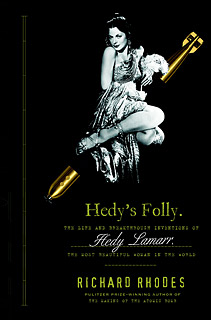
Hedy’s Folly by Richard Rhodes

Hedys-Folly_211x320Hedy’s Folly: The life and breakthrough inventions of Hedy Lamarr the most beautiful woman in the world
by Richard Rhodes
2011

Hedy Lamarr is best known for being “the most beautiful woman in the world.” She was a film actress from 1930 through 1958, and once said, “Any girl can be glamorous. All you have to do is stand still and look stupid.”

Hedy was anything but stupid, although it’s amazing (and depressing) how many people discounted her intelligence. She broke into the film industry in Austria when she was 16, married at 19, escaped her controlling husband at 22, moved to Hollywood ahead of WWII, broke into the film industry in Hollywood to become a movie star, married (and divorced) five more times, raised three children, and died in January 2000. She also maintained a significant hobby of invention.

However, while I learned a great deal about Hedy Lamarr from reading this book, the title is somewhat misleading. It’s not so much the story of Hedy Lamarr as it is the story of one of her inventions: the frequency-hopping secret communication system.

Frequency-hopping is now known as spread-spectrum and is the technology that allows wireless communications to happen without interference or jamming. It’s one of the foundational technologies for cell phones, Bluetooth, military drones.  And it was developed by Hedy Lamarr and George Antheil, the composer of Ballet Mecanique, in Hollywood during WWII as a bit of civilian support of the war effort.

This book tells the story of how this technology came about, starting with background on these two famous artists. While it is an interesting perspective on the two characters, it is not a comprehensive biography of either, and it was a bit disingenuous of the author to title and illustrate the book as if it were a biography of Hedy Lamarr alone.

For what it is, though, the book is well written (with the only a few wrong notes, where the author inserts a few generic homilies), quite interesting, and not that long. I recommend it.

Comic Book Glut

RurouniKenshinRurouni Kenshin: Restoration
By Nobuhiro Watsuki
2013

This was one of the free comic books that I picked up at Free Comic Book Day. It is a teaser for an AU (alternate universe) version of Rurouni Kenshin by the original author. It was fun, but mostly I enjoyed it because it reminded me how much I love this series. The actual teaser itself wasn’t all that great. It reintroduced the characters and held their first meeting at an arranged illegal fighting/gambling event, which just seemed like a bit of over-the-top, idiotic, self-indulgence.

While the reboot wasn’t so great, I definitely recommend the whole original series of Rurouni Kenshin, following Himura Kenshin, an amazing swordsman who, after a bloody past during the civil war, made an oath to never kill again but still manages to find and be found by a whole lot of trouble. The anime series based on the manga is also really good, and the recent live-action movie was excellent! (The animated movies, branded “Samurai X”, however, should be avoided.)

Anyway, seeing more of these characters written and drawn by the original author made me bounce around grinning with excitement. But the actual thing wasn’t all that good. It was a it of self-indulgent fluff, and while there’s nothing wrong with self-indulgent fluff, if you actually want to read a good AU take on this series, fandom (in the person of Vathara) has provided several better options, including the urban fantasy Blades of Blood and it’s sequel Witchy Woman, the Star Wars-crossover Shadows in Starlight, or the historical fantasy Gargoyles-crossover All I Need is a Miracle (which is a direct response to the awfulness of the animated movies).

So this series is awesome, and I highly recommend it, but this particular comic book is not the best example of it.


HawkeyeHawkeye: My Life as a Weapon
By Matt Fraction, David Aja, and Javier Pulido
2013

I’ve never really followed any of the Hawkeye comic books, but I enjoyed The Avengers movie a lot and the characters cameo in the Thor movie made me grin. So a new stand-alone comic book about Hawkeye at my library caught my eye. It was a whole lot of fun.

It’s a look at what Hawkeye, aka Clint Barton, is doing when he’s not out being a superhero Avenger… which is mostly getting into other types of trouble and going out being a secret agent for SHIELD. But it also involves hanging out with his neighbors at a rooftop barbeque/potluck.

Anna pointed out that the stories in this collection are all a bit grim, which I was going to argue with, except, okay, yes, they are a bit grim. But it left me happy. I liked it. Even though it does kind of imply that one of the main requirements of being a superhero is the ability to take a beating.


the-book-of-five-rings-a-graphic-novelThe Book of Five Rings
By Miyamoto Musashi, Sean Michael Wilson, Chie Kutsuwada, and William Scott Wilson
2012

I picked this book up because I have struggled to read The Book of Five Rings for a while now. It was highly recommended by a seventh-don black belt that I was training with. And yet, I found it super uninteresting and unhelpful. In some ways it read (to me) like The Art of War, except without the value. The graphic novel version makes up for some of that lack by being really well illustrated. And from everything I’ve read, Musashi himself was a fascinating character and I wouldn’t mind reading more about him, despite not caring for his writing.

Anyway, I actually highly recommend the graphic novel as a precursor to the plain unabridged text of The Book of Five Rings. It will give you a taste of the text while making subject more accessible. It’s readable in about an hour. Then, if you find the graphic novel appealing, maybe you should try reading the original text in its entirety.

Although, really, I mostly recommend Sun Tzu’s The Art of War instead.


Elektra_Lives_Again_00-1book_coverElektra Lives Again
By Frank Miller
2002

I read a couple of Daredevil series before and really enjoyed them (Frank Miller’s Daredevil: The Man Without Fear is excellent, as is David Mack’s Daredevil: Vision Quest although it largely focuses on a different character), but over all the quality of Daredevil comics varies wildly, so I also read a couple of Daredevil series before that I didn’t enjoy at all. Elektra is Daredevil (aka Matt Murdock)’s tragic girlfriend, a zombie-ninja-assassin who has her own spin-off series, but I had never read any of her comics that were any good at all… until now. This collection really brought her to life (haha!) as a character, despite her being a zombie ninja assassin. I liked the writing and the illustrations and just the whole feel for it. Well done.

Plus, there are two more Elektra graphic novels by Frank Miller for me to look forward to.

The Man Who Loved Only Numbers

the_man_who_loved_only_numbersThe Man Who Loved Only Numbers
by Paul Hoffman
1998

This is a wonderful book, but it also took me four tries over nearly a decade to get all the way through. It presents itself as a biography of the mathematician Paul Erdös (1913-1996). In reality, the book goes off on a lot of tangents, and there are a lot of natural breaks where it’s easy to set down. It talks about world history and about mathematics and is pretty obviously based on an oral history project. However many tangents it goes on, though, it does always return to Erdös.

Erdös, for those who don’t immediately recognize the name, is the zero point of Erdös numbers—where actors have degrees of Kevin Bacon, mathematicians have Erdös numbers, showing how close they are to having collaborated with Erdös.

Erdös is also one of the few mathematicians who made serious contributions to the field of mathematics after the age of 30, Mathematics generally being a young person’s field. Erdös remained a productive and innovative thinker until his death in his 80s. He was also a very peculiar man, thus a great focus for a biography.

He also seems like a good example of how there are people who are delightful to hear about and make the world a more wonderful place but I’m still glad I don’t have to deal with them personally. (Having read Surely You’re Joking, Mr. Feynman! several times and enjoyed it immensely, the physicist Richard Feynman is likely another of these individuals.) Among other things, Erdös spent most of his life couch surfing at his colleagues’ houses, demanding that they talk mathematics 18 hours a day. He made it work, though, and there was always someplace for him to stay.

Anyway, the problem with the book is that while it is excellent text about a fascinating character, it is also really dense, and not particularly well organized. In addition to Erdös himself, the book describes some of the more accessible and yet unusual mathematical proofs, the lives of various other mathematicians, and a good amount of political history–both that Erdös dealt with and that other mathematicians, both contemporary and historical, dealt with. The history and the mathematics are all related to Erdös’ life and experience, but it’s still a bit like reading multiple books, each of which requires a fair bit of concentration to properly appreciate. The book clearly shows its basis in oral history, and Hoffman doesn’t manage to give it any strong, overarching structure.

It is still well worth reading, but it does take effort.

Codex Seraphinianus

codexCodex Seraphinianus
By Franco Maria Ricci
1981

In honor of April Fool’s Day, I am reviewing the Codex Seraphinianus. No, this is not a prank or a lie, at least not on my part. The book exists. Just, well… it’s more like it’s a prank or a lie on the author’s part.

The Codex is an incredibly beautiful and extremely peculiar biology/sociology text in a foreign language. Yeah. Think on that for a bit.

Also, I recommend it.

Regardless of what languages you may be fluent in, this book is in a language foreign to you. It’s actually an alien language constructed as either a code or simply a very detailed doodle by the author, such that the written text is just as much an illustration as any of the actual color illustrations.

The color illustrations, of which there are many, are beautifully done, likely with oil pastels or some such.

codex03  codex7  codex_09

The subject of the book is the biology and sociology of an alien world… an extremely peculiar alien world, with a very complex biology. In some ways it reminds me of a steam-punk universe with cyborgs/implants/etc., except that such mechanical additions are intrinsic to the biology of the plants and animals rather than intentional additions later. (Sort of like WTF-Evolution’s even crazier, acid-tripping brother.)

In other ways it reminds me of the biology from Vernor Vinge’s A Fire Upon the Deep or Orson Scott Card’s Speaker for the Dead. Except more so than either Vinge or Card went.

It also reminds me a great deal of the Voynich Manuscript, a document that I have yet to actually see a good copy of, but which is another biology text written in an unknown language. But the Voynich Manuscript has had professional and amateur codebreakers trying to break it for nearly a century at this point and variously manage to “prove” is (a) a complex code that we just don’t have the key to yet, (b) a brand new language that would need to be translated rather than uncoded, or (c) complete gibberish that contains no meaning and can thus be neither uncoded nor translated. Its provenance is also deeply questionable. It has the potential to be (a) a secret alchemical manuscript from the 1200s, (b) a forgery created in the late 1500s and sold to Emperor Rudolf II as a secret alchemical manuscript from the 1200s, or (c) a forgery created in the early 1900s perpetrated either by or on the book dealer Wilfrid Voynich.

But back to the Codex Seraphinianus, it is vibrant and gorgeous and inspiring and confusing.

If you can get your hands on a copy, it’s a lot of fun.

Or, for a more easily accessible book, check out Chris Van Allsburg’s The Mysteries of Harris Burdick, and try to figure out what the plots are of those stories.