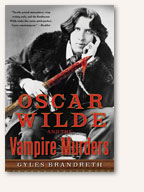
Oscar Wilde and the Vampire Murders

By Gyles Brandreth

I picked this book up from the library on a whim (despite the truly hideous cover*), without any foreknowledge, figuring I like historical mysteries and I like Oscar Wilde. After starting it, it occurred to me that I’m not entirely sure I like historical novels that fictionalize real-life characters however, and this proved no exception.

Actually, much like with The Hangman’s Daughter, I found it frustrating that I didn’t know the actual historical events better in order to judge what was true to the real-life characters and what the author was inventing for the story.

The basic premise of the story is that Oscar Wilde meets up with Arthur Conan Doyle in order to solve a high-society murder mystery with some assistance from Bram Stoker. It sounds kind of cool, right? Oscar Wilde is a really interesting historical figure, very witty and extensively quoted.

Here’s the thing, though: fictionalizing him by shoehorning his various well-known quotes into fictional conversations comes across as lazy writing and makes his character almost completely insufferable.

Oscar Wilde is the protagonist and central detective of this book, which is the fourth book of an on-going Oscar Wilde historical mysteries series. All the other characters describe him as irresistibly charming, but through the scenes of the book, he comes across as melodramatic, egotistical, and often inconsiderate of those around him.

Honestly, it wouldn’t surprise me if he was all of those things in real life, as well, but I found him almost unbearable in this novel, always spouting off some witticism, regardless of whether it is actually pertinent to the discussion. He seemed to be showing off his cleverness at all times and that gets to be a bore really quickly in real life.

Poor Conan Doyle is described as sort of doddering and hide-bound (apparently Oscar Wilde’s brilliant detection is the inspiration for Sherlock Holmes), and my sympathies were entirely with him throughout the entire book. Toward the middle of the book, when I had to really slog through it (it picked up a bit toward the end when the mystery itself stepped up), Conan Doyle writes to his wife, “And Oscar, I confess, I am beginning to find rather ‘too much.’” Amen, Conan Doyle. Amen.

— Anna
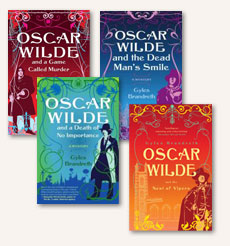
*Excuse my going off on a graphic-design tangent, but when pulling the image of the cover of this book, I saw the covers of the previous books in the series, and they are just really attractive and create a really nice set that I can’t figure out what happened with the design of this cover. [Ah! With a very little of research (reading the reviews on amazon), I found that this book was previously released under a different title (Oscar Wilde and the Nest of Vipers) and with a cover matching the others. I would say that the new cover design seems like a mistaken attempt to capitalize on the vampire craze right now, but I did pick it up myself, didn’t I?]

 

Devil-May-Care

By Elizabeth Peters

Elizabeth Peters’ novels were some of my first adult novels, and I couldn’t have had a better author for transition. Her books are almost all mysteries, though when I think back on them, I can’t think of a single one that features a murder—they usually deal with theft of artifacts. They are all funny, with likable characters and light romance, which makes them perfect for a young teen graduating out of young adult books.

Devil-May-Care is my favorite of all of her books. It was published in 1977 and features a young woman caretaking her aunt’s mansion, which turns out to be haunted. Sound familiar?

Well, the heroine is smart, capable and mostly unafraid, and the other characters are all engaging and humorous. The plot moves along quickly and interestingly, and with great humor. One warning: each scene leads seamlessly into the next action, so it can be quite difficult to find a stopping point for breaks, leading to too many late nights this week.

A line toward the end of The Shining brought this book to mind for me and inspired me to pick it up again (very mild spoiler):

Continue reading

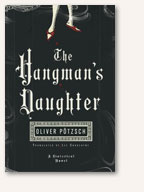
The Hangman’s Daughter

By Oliver Pötzsch

Before I got distracted by Isaac Marion’s zombies, I read The Hangman’s Daughter and was struggling with writing a review. It is difficult because the book has two very different themes. On the one hand it is a fairly run-of-the mill murder mystery, with somewhat slow plotting. On the other hand, it is a meticulously researched account of Bavaria in 1659 which is not a time or a place I am terribly familiar with. (The author actually is, though; he is writing about his own ancestors and used a lot of personal family papers in his research.)

I enjoyed it all-in-all, but it wasn’t an easy read. The mystery, for me, took second place to the historical aspects, which were fascinating but also disturbing. It turns out Bavaria in 1659 is not a terribly pleasant place to be, especially as a woman.

The accusation of witchcraft was still a prevalent and valid police matter and was dealt with quickly and brutally. Most shocking for me was how many of the characters didn’t actually believe in the charges of witchcraft, but still went along with it out of fear or convenience. The author makes a point of showing how accusations of witchcraft were used very deliberately to keep women in a subservient place, particularly those like midwives who had knowledge and careers of their own.

It was too historically realistic to be the fun murder mystery I was hoping for after The Shining, but it was undeniably interesting. Just know what you are getting into; the protagonist is the hangman (his daughter is disappointingly peripheral for being the title character, but I guess that fits in with the time period) and he does his job as both hangman and interrogator. Not exactly for the weak of stomach.

Addendum: as I was looking for a photo of the book cover, I ran across other reviews of The Hangman’s Daughter, which were all a lot more critical than mine but with which I generally agree. It makes me think that I’m just not a very critical person, which is a little unfortunate when writing for a book-reviewing blog.

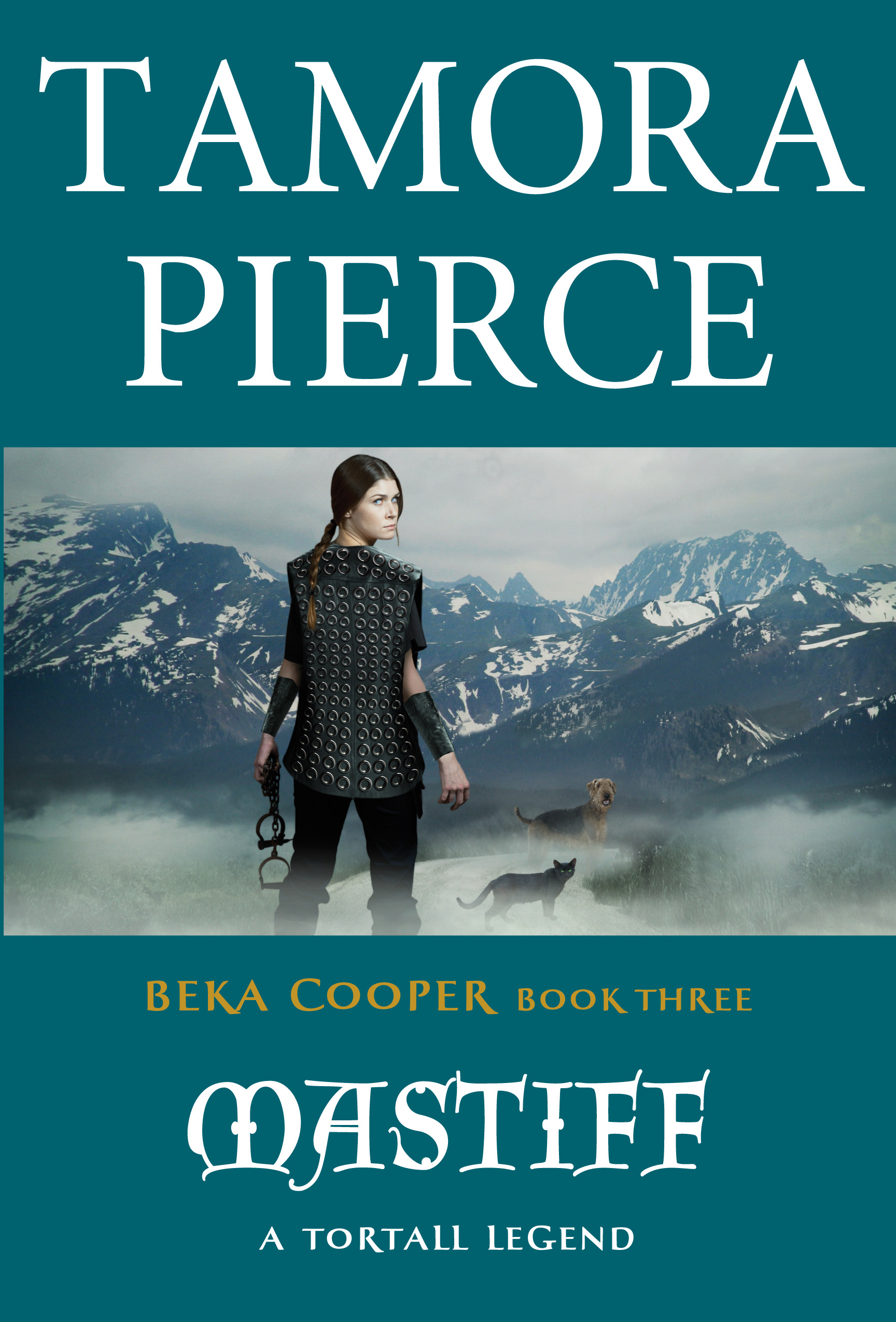
“Mastiff” by Tamora Pierce

Mastiff coverMastiff
Tamora Pierce
(2011)

Despite the many other things I should have been doing, I bought and read Tamora Pierce’s latest book as soon as it came out. I loved it, of course.

Given that I loved it, of course, you can see that I might just be a tad biased in my review. I grew up with this universe. I love these books, and I love this author. Her first book (Alanna: The First Adventure) was published in 1983, and since then she’s written 26 other novels, generally broken into quartets, and set in one of two universes.

Both of the universes she writes are magical fantasy: Tortall has knights and wars and a pantheon of gods; Emelan has mages and priests and pirates. Fun!

Each quartet of books stands alone, although there are often brief appearances of the characters from previous quartets for the delight of those readers who have recognize them.  And while the characters develop through their quartets, the plots of each individual book also stand alone for the most part.

Mastiff, her most recent book, is set in Tortall and is the third book in a rare trilogy rather than a quartet. In Terrier, Becca Cooper was in training to be a city guard; in Bloodhound, she was finally an official city guard.

In Mastiff, Becca Cooper is one of the best of the city guards and thus given the hardest tasks. I think that’s why Mastiff struck me as slightly more mature than other of Pierce’s books. While she’s not formulaic, per se—each plot is different and each character is unique—she writes coming-of-age stories, generally of young girls. There are multiple stages of coming of age, and each quartet will follow a character through some of them.

Becca had her coming of age experiences in the first two books and had, in fact, come completely of age. In this, the character development was very much that of an adult in an adult’s world. Good and evil are not necessarily clearly delineated and sometimes even when they are, you wish they weren’t. The book starts with the funeral of Becca’s fiancé whom she had been intending to break up with and is then immediately sent on a mission to stop a traitor to the crown intent on civil war. There’s guilt and betrayal mixed in with adventure and mystery.

There’s also a sense of foreshadowing throughout this entire series. It’s set a hundred years prior to her first book, and for those of us who have read the Alanna series, we can see developing the social changes that Alanna will have to fight against.

I enjoyed the book immensely, I enjoyed the series immensely, and I enjoy this universe immensely. I definitely recommend them all. But if this is an entirely new universe to you, I recommend that you start with the first book in any of the quartets (or trilogy):
Alanna: The first adventure
Wild Mage
First Test
Terrier

The Peter Grant Books

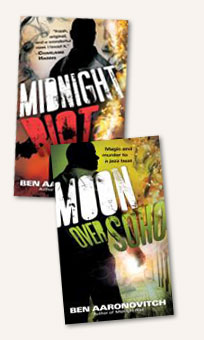
Midnight Riot and Moon Over Soho
by Ben Aaronovitch

The cover of Midnight Riot, Ben Aaronovitch’s debut novel (he has previously written episodes of Doctor Who), has a praise blurb from Charlaine Harris. I get that Charlaine Harris is a popular bestseller, and I sincerely hope that her quote helped Aaronovitch sell more books, but it inspired in me similar outrage as Roger Ebert giving Nicholas Sparks my current favorite author burn:

“I resent the sacrilege Nicholas Sparks commits by even mentioning himself in the same sentence as Cormac McCarthy. I would not even allow him to say “Hello, bookstore? This is Nicholas Sparks. Could you send over the new Cormac McCarthy novel?” He should show respect by ordering anonymously.”

Now, I’m not daring to say that Ben Aaronovitch compares to Cormac McCarthy, but he is a significantly better author than Charlaine Harris.

The praise blurb on the back of the book says, “Midnight Riot is what would happen if Harry Potter grew up and joined the Fuzz.” (Diana Gabaldon) I would say rather it is like if The X Files was British and funny. I’m not entirely clear on what the difference between those two is, maybe that the magic elements are addressed in a practical, scientific manner.

Here’s the highest praise I can give a book: the protagonist, Peter Grant (“rookie cop and magical apprentice”) catches onto plot twists as quickly as I do as the reader. Pretty much as soon as I start to think, “hmm, that other character seems kind of suspicious,” Peter Grant thinks the same thing and acts on it. It is extremely satisfying as a reader.

The third book in the series, Whispers Under Ground, is due out in May 2012, and I can hardly wait!

The Lady Julia Grey Novels

Silent in the Grave, Silent in the Sanctuary,
and Silent on the Moor
by Deanna Raybourn

Silent on the Moor book coverI am currently halfway through the third book in this series of murder mysteries set in Victorian England, and it looks like there are at least three or four more books already published in the series. They were recommended by my friend Kinsey, and I’m really enjoying them; the books are well-written and the heroine is very likeable, which are pretty much the most important qualities for me.

In fact, for me, the heroine and the romantic hero reminded me of what Gail Carriger was trying to go for with her supernatural heroine and werewolf hero in her very poorly written Parasol Protectorate Series. A strong, independent woman raised solely by her father with unusual freedom in the Victorian Era and a detective with rough edges on the fringe of society. Only, Carriger’s are even less than one-dimensional, if that’s possible, while Raybourn’s are relatable and engaging. (I’m hoping to get a friend who enjoys Carriger’s books to write a review on them later.)

Continue reading