In a ridiculously extended simile/metaphor, books are like food—good literature is a hearty meat-and-potatoes kind of meal; fluff novels are something delicious and comforting like baked mac-n-cheese; nonfiction is a nice big salad, healthy and perhaps a little goes a long way.
All of this is to describe how I feel about comic books—they are the candy of my book meal. I love them, but once I start reading them, I always crave more, and finally after hours of reading them, I feel a little off, in a kind of empty and stale way. So, I try to indulge in comic books in moderation.
However, this afternoon, it was a beautiful day, and my work let me out early. I went to the library to check out a nice, healthy salad of a nonfiction book, but for some peculiar reason, my local library organizes the graphic novels in the nonfiction section, so I also walked out with five graphic novels, and then proceeded to glut myself on literary candy.
1) The League of Extraordinary Gentlemen, Century: 1910
 I loved The League of Extraordinary Gentlemen, Volume 1 (I even enjoy the movie in a very guilty-pleasure kind of way). The premise of having characters from famous literature join a crime-fighting group, lead primarily by a strong female character, sold me within the first few pages. That it was a period piece, set in the 1800s was an additional bonus. The character dynamics were engaging and the plotting was clever.
Then, Volume 2 got a little more outlandish in plot, made the female lead weaker and more traditionally “feminine,” and added some jarring sex scenes. I not only began to feel like I wasn’t the target audience, but that perhaps they were actively discouraging female readers. The League of Extraordinary Gentlemen, Century: 1910 goes even further. It is maybe a third of the length of the previous two volumes, and feels more like an introduction of new characters than a complete story, but it still manages to squeeze in seven illustrations of topless women, three illustrations of full frontal female nudity, and two rapes. There’s shock value, and then there’s just being disagreeable.
2) American Vampire, Volumes 1 and 2
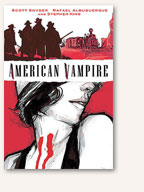 I really wanted to like these, and I did enjoy parts of them. The premise is interesting and had some good possibilities: a group of traditional European vampires come to America during the expansion of the railroads in the Wild West. One of them unintentionally “converts” a train robber, and the American vampire is a new breed—he draws strength from the sun. The two volumes follow him to the 1920s, where he “converts” a young starlet, and then the story follows them both (in separate plotlines) through the 30s as they battle both the clan of original European vampires and a secret society of vampire hunters.
I love both vampires and historical fiction, and like I said, it had great potential. It’s hard to pinpoint exactly what was missing because it wasn’t terrible, it just wasn’t as good as I had hoped or thought it could be. The writing was a bit clichéd, the characters were two-dimensional and not very sympathetic, and the plot eventually devolved into little but violence. The art itself had a rough, sketchy quality that I liked on first view, but began to just look increasingly muddy and almost blurred to me. It is clearly an ongoing series, but not one I’ll be continuing with.
3) Baltimore: The Plague Ships
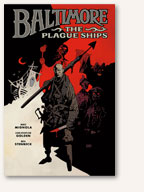 Another historical vampire comic, but this one was everything and more I was hoping for with American Vampire. The author is the same as for Hellboy, but this one has a darker atmosphere that I really appreciate. The book jumps right into the action with our hero, Lord Baltimore, hunting down vampires in a small village off the coast of France in 1916. His background and the history of this world unfold throughout the story, along with some nicely paced plotting.
The art is a really nice screen-printing style, with minimalist, flat color fields, with a muted palette that gives the illustrations a really nice atmosphere. It is fairly clearly the beginning of a series, though Volume 2 doesn’t come out until June. In the meantime, the introduction mentions that this comic book is a companion piece to the illustrated novel, Baltimore or, The Steadfast Tin Soldier and the Vampire. I’m not entirely sure what an illustrated novel is, but I definitely plan on finding out.
4) Blacksad
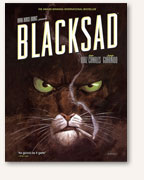 This was the one I was the most excited about (I may have even done a little jump in the library aisle), so I saved it for last. I already knew that I was going to love it because I own it, sort of. First, a quick story: my dad travels a lot for work and he would bring all of us kids souvenirs from everywhere he travelled. He brought us each anime comics from Japan when I was a young teen, and that hooked me (even though after very careful perusal of the illustrations, I finally discovered that my dad had accidentally bought me a schoolboy romance story). Subsequently, I asked for a comic book from every country he went to, so I now have comics from Germany, Sweden, Holland, China, Ireland, Croatia (from my wonderful friend, Hannah), and France.
One of my two French comic books is Blacksad, and it is brilliant! From what I could piece together from the illustrations, it is a gritty noir mystery, which you already know I love, with anthropomorphized animal characters, drawn more beautifully than any other comic I have seen. Blacksad is John Blacksad, a black-and-white cat and private detective. I was so, so excited to actually be able to read it, instead of poring over the pictures and trying to read a word or two of the French with my high school Spanish learning. It turns out the writing is almost as lovely as the pictures, and I can’t recommend the whole package enough.


 Biblio-therapy