The Ocean at The End of the Lane

By Neil Gaiman

Book Cover: Ocean at the End of the LaneI have a bit of a love–hate relationship with Neil Gaiman. I loved the Sandman series, of course, and American Gods, and I hated his short story collection Smoke and Mirrors. All of his other stuff sort of falls between those two extremes, and The Ocean at The End of the Lane is pretty smack dab in the middle.

It is quite short, less than 200 pages; really more of a novella, despite “A Novel” being printed on the cover right under the title. And to go off on a side rant: I hate novellas! Somehow they are always both too long and too short. Like, authors write short stories to be compact and novels to be all-encompassing, but novellas pretty much always fail at both, and seem like initial outlines for a full novel. I almost always end up feeling like I’m reading an incomplete work and it has been a waste of my time. I then get sulky about the author being lazy, and bitter about the state of publishing, and it all cycles down from there, so novellas are not my thing.

So, I wasn’t too enthusiastic about this one, but I follow Neil Gaiman on twitter, and lots of people were raving about it. When I ran across it in the library, I figured I’d give it a shot, since I really did like American Gods and this seemed all fantastical, too.

It was okay. It starts off pretty slow, with the narrator reflecting back on the summer when he was seven, when a boarder in his house dies, kicking off a string of supernatural events. He meets his mysterious neighbors, a family of three-generational women including a girl just a few years older than him, and helps them try to contain the odd happenings. It all takes some time to get rolling, but by the middle, the story is quite engaging, though at times I felt it followed a very standard “yellow brick road” narrating style, as the two children walk a path into another reality, and must deal with one strange thing after another.

Gaiman does introduce some quite intriguing characters and imagery that simply don’t have the space to really grow to their full potential in such a short book. It ends up feeling a bit like Chis Van Allsburg’s The Mysteries of Harris Burdick, in which the readers must flesh out the story on their own, and it makes me bitter, having to put all this unexpected work into a story. I just told Tom that this review was circling the drain, and he commented that while I often talk about how much I like Gaiman, I don’t really like the majority of his work, so I guess maybe I’m not really a fan at all. Oh, well.

—Anna
The Coldest Girl in Coldtown

About this time last year, Anna reviewed a series of YA fantasy books by Holly Black that started out with White Cat. We both finished that trilogy this year, and really enjoyed them. So imagine how happy I was to see that Black released a new book this fall! It’s a YA book about a teenage girl who gets swept up into a whole adventure with vampires. Yes, another one of those. But this one is awesome, and rather than try to explain why by describing the plot, I’m going to list just a few of the ways this book is better than Twilight:

1) First and foremost, the main character, Tana, is the totally kickass opposite of Bella Swan. She takes care of herself and others and doesn’t particularly need saving. And it’s not that she’s a superhero–she’s terrified most of the time–but she sees things that need doing, so she just does them.

2) There is a bit of romance, which I like in my books, but it not the main point of the story. Also, it isn’t a love triangle. Why do books and movies so often involve love triangles, when my experience is that they are just not that common in real life?3) In this book, the public is aware of vampires, because although the old vampires had managed to keep themselves secret for years, they eventually lost control and it all came out and vampires ended up being celebrities. You know that if vampires were real they would be all over YouTube and People.

4) Being a vampire isn’t particularly romanticized here. There are characters that do glamorize it, but it’s actually presented a lot like fame: it might seem exciting, but the reality is not that much fun. The main character spends most of her time trying very hard to not become a vampire, which I found refreshing.

So, overall, a little gory, but very entertaining and way way way better than a lot of vampire stuff out there.

Kinsey’s (Approximately) Three Word Review: A fun, dark ride.

You might also like: Sunshine by Robin McKinley, which Anna already told you to read.

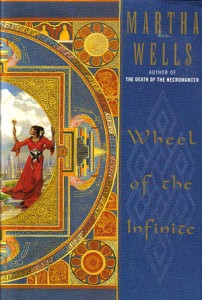
Wheel of the Infinite

Wheel-of-the-InfiniteWheel of the Infinite
by Martha Wells
2000

Having thoroughly enjoyed The Books of the Raksura by Martha Wells, and going through a bit of withdrawal from reaching the end of the series, I checked out an older book of hers and am extremely glad I did so.

I love stories that involve gods and godlike powers and the difficulties faced by both the people who struggle against those powers with just human strength and the gods who struggle to avoid unintended consequences. (Some of my all-time favorite books deal with these issues:  Isle of the Dead by Roger Zelazny, Curse of Chalion by Lois McMaster Bujold, Nameless Magery by Delia Marshall Turner.)

The world-building here is amazing particularly as it comes to the rules of magic and religion, and we get it from two perspectives:

Maskelle is The Voice of the Adversary, a highly ranked priestess, but she was exiled (rightly so) for murder and treason some years back. She has been summoned back to the Imperial and religious center of the land by the request of the Celestial One to help regarding a problem with the Hundred Year Rite, in which the Wheel of the Infinite recreates the world. (A problem with the re-creation of the world is, rather obviously, quite a problem.) But she approaches the people and the magic with deep familiarity and deep discomfort given her past.

Rian is a bodyguard from a far distant land who ran away from an unpleasant situation, and manages to fall in with Maskelle on her return trip, and sees the political and religious situation with fresh eyes.

And that is the premise. From there, stuff happens: after all, there’s a problem with the ritual that recreates the world. Stuff. Happens. I love the exploration of the world that is inherent in our main characters’ investigation of what has happened.

In addition to the amazing world-building, I also just love the characters. Rian’s culture shock is somewhat hilarious (especially as it mirrors the reader’s own shock at this culture). And Maskelle’s deadpan practicality, even as she struggles with her own issues, is a delight.

Another thing I appreciated about this book was that Maskelle was middle-aged and black. The book is high fantasy, in an entirely different world, so clearly she’s not African or African-American, but she and her whole culture are dark-skinned and her hair is in braids.  Scifi and fantasy, for all their alien species, tends toward the homogenous white humans, in both writers and characters. (The one exception to this that I can think of off hand is Octavia Butler, but her books tend to be both excellent and extremely hard hitting. Wheel of the Infinite is readable purely for fun.)

The first chapter of Wheel of the Infinite is available online, so you can get a taste. I highly recommend this book.

Melting Stone

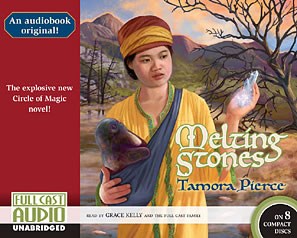
Melting-Stones-Tamora-Pierce-unabridged-compact-discs-Full-Cast-Audio-books-MMelting Stone
By Tamora Pierce
Full cast audio
2007

This was interesting.

Tamora Pierce was a guest speaker at the National Book Festival this year and I was delighted. I was also somewhat shocked that the line to get a book signed by her started forming in front of the signing tent at least an hour before she gave her talk at a completely different tent, and several hours before she would start signing anything.

I’m pleased that she’s popular, but I think the kids in that line made a mistake in going for a signature rather than listening to her speak. She’s a wonderful and witty speaker, with a certain acerbic quality that I enjoy. Seeing her at the festival was also my first notice that her next book has come out: Battle Magic.

I put a hold on it at my local library and checked out Melting Stone.

I grew up reading Tamora Pierce and I still love her books, but I hadn’t gotten around to reading Melting Stone, in large part because it was a born-audio book. While it also came out in traditional book format, that was only after it was published as a full-cast audio-book: meaning each character was voiced by a different voice actor and some sound effects were included, too.

This is not the only thing that’s unusual about this book.  The main character, Evvy, was first introduced in a different book, Street Magic. Street Magic, in turn, in the second book that focuses on the character of Briar Moss. Both of those books focused on Briar Moss are single parts in four-book series. Melting Stone also references a lot of events that happen in Battle Magic, a book that was only just published recently in 2013, some six years later. It’s hard for me to tell exactly, given that I know this book series quite well and for some time, but I think this book was intended to be able to stand alone and even introduce the universe to a new generation of readers, who can then go back, if they’d like, and read the backstory of the original books, but don’t have to if they don’t want to, and can continue to read future books as they come out.

Anyway, it was fun, even though it was also intended for a younger audience even than most of Pierce’s books. As Kinsey noted in her last post, we all like reading YA fiction, but generally the audience of those books are teens or the particularly precocious, and the intended audience for this book was more elementary school.

One of the things I love about well-written fiction is that it’s often also well-researched and you can learn a fair bit of non-fiction facts along with enjoying a story with characters and plot-arch. This book, in particular, I thought did a good job of including some basic geology for kids.

So while I enjoyed the story and the characters, I was mostly interested in my own meta analysis of this book. Are audiobooks really becoming more mainstream and standard? Regardless of format, it’s rather brilliant of Pierce to break up the continuity a bit in order to bring in a new generation of kids. I wonder: are there people out there who grew up reading her books who are now introducing them to their own kids?

The Books of the Raksura

The Books of the Raksura
By Martha Wells

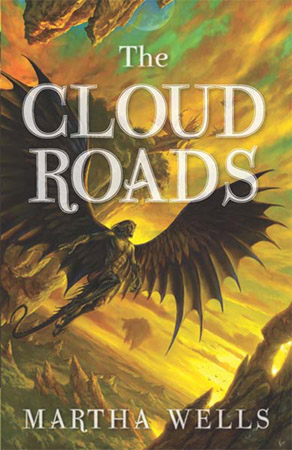
Raksura_TheCloudRoadsThe Cloud Roads
Feb. 2011

Raksura_TheSerpentSeaThe Serpent Sea
Jan. 2012

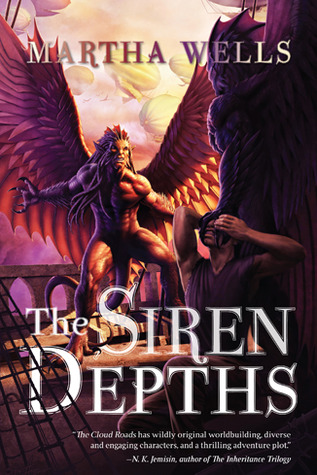
Raksura_theSirenDepthsThe Siren Depths
Dec. 2012

Please, please, let there be more coming soon!

So I started reading The Cloud Roads on the recommendation of an online friend and thought it was decent but not fabulous. My ambivalence was mostly due to the fact that most of what should have been unique about the world building, I’d seen before in either George Lucas’ Star Wars or in Bujold’s Sharing Knife series.  The characters seemed a trifle flat, although nothing out of the ordinary when the focus is on world building. The plot and character interactions were still fun, and I enjoyed it enough to check out the second book.

Half way through the second book, I put a request in at my library for book three. Then I finished book two, which ended perfectly satisfyingly with no cliff-hanger in sight, and yet I still desperately wanted to see more of these characters and this world, both (all?) of which had finally come into their own.

And then the third book was just as awesome as expected. Awesome!

And now I want more, more, more!

Anyway: the world Wells created is a complex one with an unknown number of sentient species all living in their own communities and groups, but also very much interacting. The bar in Star Wars, where Luke and Kenobi meet Han Solo would not be out of place in one of this world’s cities.

Our main character, Moon, is introduced while living with yet another group of people, trying to fit in with a species not his own. The trouble is that Moon doesn’t know what species he is. He lived with only his mother and siblings before he was able to care for himself, and they all died when he was still quite young.

In The Cloud Roads, the first book, Moon discovers his own people. Or rather, he is discovered by his own people. In The Serpent Sea, Moon settles in and finds his place among his own kind. And in The Siren Depths the comfort that he has found is challenged.

One of the things that particularly impresses me with Wells is the way she introducing the reader to a person and a culture who are decidedly not human and yet are completely sympathetic. Each book adds more layers of complexity and subtlety over the cultures and individuals, making them increasingly enthralling. I also love the way Wells plays with gender roles and how societal expectations vary from society to society and how even societies with established hierarchies always have to deal with a few exceptions. And Moon, as both our main character and an outsider to all societies, gives the reader a wonderfully bemused perspective on it all.

If you want a taste of these books, the first chapter of each book is available online. In addition, Wells has posted a short story, The Forest Boy, which shows Moon as a kid, before the start of the books.  (She also has other short stories and missing scenes posted, but the others should wait until you’ve caught up to those events in the books.)

Overall, they’re just kind of adorable books with wonderfully nuanced takes on some standard tropes. And I really hope there’s more soon.

The Raven Boys

First of all, let me say that the people I write this blog with are very, very smart. I haven’t been writing many reviews lately because I’ve been too busy with things that they’ve already told you about. But just in case you missed any of Anna and Rebecca’s previous recommendations, I add my full endorsement to :

The Lizzie Bennett Diaries–these are so good, I now own merchandise.

White Cat–as I said in a comment on Anna’s review, this whole series was like Harry Potter meets the Sopranos.

The Tightrope Walker-very 70s and fun.

Frost Burned–one of the more enjoyable of the recent Patricia Briggs books.

But I finally got around around to reading something new. The first Maggie Stiefvater I read was her teenage werewolf trilogy that starts with Shiver. The story was fine, if maybe a little weighted down with teenage romance, and maybe sharing a little too much DNA with the Twilight books. But The Raven Boys, the first book in her new Raven Cycle, felt much more original and confident.

The boys of the title are teenagers attending a fancy school in Virginia, and Blue is a local girl who gets caught up with their efforts to solve a supernatural mystery. Magic is treated very calmly here–Blue is from a family of psychics, and ghosts and time travel and Arthurian legend are all just common currency–so don’t expect a lot of explanation for how anything works. And since this is clearly intended to be the start of a series, a whole lot of guns are introduced in this first act that have yet to go off. But I liked the characters and, even more, liked the tone of the book. This isn’t a bleak story, but it is creepy and ominous, and it gave me the shivers reading it at night. The second book in the cycle, The Dream Thieves, just came out on Monday, and I have that squiggly sort of feeling about reading it–I can’t wait to find out what happens, but I’m not sure I can bear to find out, since I know things can’t possibly end well for everyone. It’s going to be an excellent thing to read as the year races towards Halloween.

Kinsey’s Three Word Review: Eerie, magical mystery

You might also like:  White Cat, or Grave Mercy, or Beautiful Creatures, or any of those young adult magic/fantasy series. But let me also recommend another YA book about a boarding school that has a similar melancholy, atmospheric tone, minus the magic: Jellicoe Road by Melinda Marchetta.

Magic Rises

By Ilona Andrews

Book Cover: Magic RisesThis is the sixth book in Ilona Andrew’s Kate Daniels series, and Rebecca has previously introduced the series here.* It is my favorite in the over-abundance of series about spunky women in a werewolf- and vampire-populated world, but to my mind the series peaked at book 3 and went downhill from there. (As an aside, Rebecca and I had a lengthy discussion about whether this is a common phenomena; are trilogies so standard because authors tend to lose steam after the third book? There are a lot of series that support that thesis, and only a few that belie it.)

Maggie Q as Nikita

As an aside on first impressions, when I first got the book, I was somewhat taken aback by the cover. The featured woman looks somewhat different than previous illustrations of Kate Daniels, which is fine, artists change visions, etc., etc. But, doesn’t she look strikingly similar to someone else instead? I feel like, as an artist, you should take your inspiration from wherever you like, but maybe don’t make it so blatant.

A very mild spoiler for the series: book 3 settled a romantic tension that had run through all three initial books, and all the subsequent books have had relationship drama that I don’t care for, and increased violence, possibly to counter-balance the relationship drama, now that I think about it. A lot of the violence, too, was starting to be directed toward various magical (and deadly) creatures that populate the world, and I have a big problem with violence against animals, even fictional ones. A true hypocrite, I don’t have nearly the same problem with violence against people, which is why I was fine with the earlier books. I was still committed to the series, but was not anticipating this book with the eagerness I had earlier in the series.

In fact, this book way exceeded my expectations, and I believe rejuvenated the series a bit in a very clever way. Andrews changes the setting from Atlanta, Georgia, where all previous books are set, all the way to Europe, so there is a freshness just in the change of scene. With the new setting, she also constrains the number of characters, which had been expanding exponentially with each book, until the action started to get muddled with so many players. Magic Rises is pared down to just a cleanly written and plotted, extraordinarily fun supernatural adventure, and I am just so, so happy to have my favorite fluff series back.

One caveat to all of my praises: I went back to the earlier books to double-check a minor character’s name, and it reminded me of the casual humor and one-liners that made the early books such a pleasure. As the books have ratcheted up the drama and tension, that humor has mostly disappeared and I miss it. I almost feel like that as the authors have become more accomplished, they perhaps have edited out those parts as being less polished, and that makes me sad.

* There has been some update in information from this original review. The series has been expanded to ten books instead of the previously planned seven, when the authors realized that they would not be able to wrap it up conclusively in just two more books.

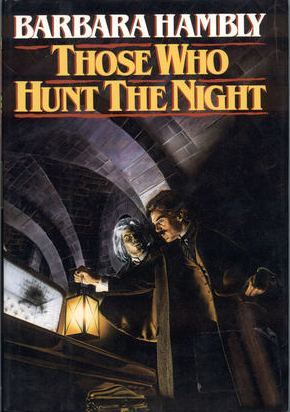
Those Who Hunt the Night

Those_who_hunt_the_nightThose Who Hunt the Night
By Barbara Hambly
1988

This is an excellent vampire book. There are a lot of fun vampire books, but this one is actually good. I love the characters, I love the way they interact, and I especially love the way that the author presents the vampire characters.

The book is set in Edwardian England and our main character is Oxford professor James Asher. He’s living a calm quite life, but has a rather gritty past as a secret agent for the British government. At the start of this book, the vampire Don Simon Ysidro approaches Asher, informs him that (1) vampires exist, (2) someone has been hunting the vampires of London, and (3) Asher is going to be Ysidro’s agent in tracking down the hunter or Ysidro is going to kill Asher’s wife Lydia. The plot progresses from there.

The problem with vampires (as it were) is that they eat people. Humans are their prey. There just can’t be any sort of natural alliances between predator and prey. Most vampire stories hand wave this away: the vampire just feels terrible about it, or refrains from following his natural urges, or some such. This book, though, directly confronts the fact that these vampires kill people; both ‘good’ and ‘bad’ vampires kill people.  The alliance between Asher and Ysidro is necessarily deeply coercive and fraught.

Very much related to the previous point, I like a certain amount of ruthlessness in my characters. I don’t want them to be mean or cruel, but I like characters who are smart and determined and accept personal responsibility for their actions and the repercussions of those actions. Asher, Ysidro, and Lydia are all like this. They have goals and they do what they need to do in order to achieve those goals. They know what risks they take with their actions and they are very careful in how and what they do.

Another wonderful thing about this book and these characters is that Lydia, Asher’s wife, is an excellent character in her own right and the marriage between her and Asher is equitable. They not only love each other but they also respect and support each other. They are honest and forthright with each other. They trust each other, not just to be faithful, but to be capable.

Anyway, the investigation that makes up the actual plot itself was good, but what makes this book shine are the characters and their interactions with each other. I definitely recommend it.

Among Others

By Jo Walton

Book Cover: Among OthersKinsey introduced me to Jo Walton through her Small Change series, which is actually pretty brilliantly titled, now that I think about it. The three books, titled Farthing, Ha’penny, and Half a Crown, are solidly written English murder mysteries with the added brilliance of being set in an alternate history in the 1930s and 40s in which England supported the German Nazi Party (which is not all that improbable: if not for Wallis Simpson, Edward, a known nazi sympathizer, might have stayed on the throne). Anyway, the mysteries themselves are intriguing, but it is the setting and characters that really make those books shine.

When I ran across several (very favorable) reviews for her new book, Among Others, I added it to my to-read list immediately. It was described in the reviews as a coming-of-age story set in a world of magic and fairies, and I was so there! It…isn’t exactly that. I still really, really liked it, but the magic is very much in the background, an alternate setting like in the Small Change series. It follows a teenage girl from Wales recovering from personal tragedy while attending a very British preparatory school, and on occasion she confers with local fairies for advice. The magic of the world is utilized very effectively as a way to look at the world around you and make decisions for the direction of your life. I quickly got over any disappointment in the marginalized fantasy because once again, the characters and settings were completely engaging.

I’ve insisted that Rebecca read it next because I think she’ll appreciate the one aspect of the book that I found a bit alienating. Very minor spoiler: Mori, the heroine, finds comfort and friendship in a SF book club held at her local library. Much of Among Others is a love letter to the genre of science fiction and all the great authors that founded the genre. I’m not much of a SF reader, though; I had only read a few books by the authors mentioned, and I had liked even less. (The book is set in 1979, so I kept having to bite my tongue against criticism over the omission of more recent authors.) The heroine and the club are very sniffy about people who don’t like science fiction, and the book does such a good job of carrying that feeling through in the writing that I felt the alienation a bit as a reader.

—Anna

Good Omens

By Neil Gaiman and Terry Pratchett

Book Cover: Good OmensThis is less of a book review, since I’ve read Good Omens at least half a dozen times, and more of a PSA:

GO READ THIS BOOK!

Seriously, it is awesome! The basic premise is inspired by Antichrist-genre movies, such as “The Omen” (which I also love, but you don’t need to in order to love this book), but with a twist: what if the Satanic nuns, who were supposed to switch the infant Antichrist with the newborn of the American consulate, accidentally misplaced him instead, and he ended up being raised by perfectly normal and very British middle-class parents in a small English country town?

After introducing the premise, settings, and characters within the first 60 pages, the majority of the book takes place over the four very busy days before The End Of The World. High-jinx ensue, of course, and there is a surprisingly wide array of players, including angels, demons, nuns, witches and fortune-tellers, witch hunters, nosy neighbors, and, of course, the Four Horsemen of the Apocalypse.

Both Neil Gaiman and Terry Pratchett excel at creating literary screwball comedies with dozens of characters all running around at cross-purposes. To my mind, though, the two authors are so perfectly matched because each balances the other’s weaknesses as well. Gaiman can get a bit melodramatic, while Pratchett is often too silly for me, so the two of them together create a fast-paced story with a light touch that doesn’t get bogged down in either symbolism or puns.

—Anna