Manhood: How to Be a Better Man – Or Just Live with One

By Terry Crews

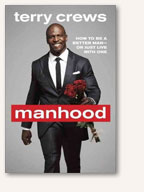
Book CoverI’ve been a fan of Terry Crews since I first saw him as the dad on “Everybody Hates Chris.” In fact, he did such a good job of inhabiting the overworked and often exhausted character that I was surprised to learn later that he is a body builder and ex football player. When I heard him interviewed on NPR in promotion of his autobiography/guidance book, he was just so charming that I was immediately interested in the book.

His writing is as humorous as his acting, but what really surprised me was his complete openness and honesty. He is upfront and unflinching when examining truly vulnerable things in his life, like what caused him to wet the bed until he was fourteen, and what led to a decades-long addiction to pornography that he only recently got help for. The real eye-opener for me, as a woman, was his discussion of the stresses that our culture puts on men. Because being scared or sad is considered weak in a man, he felt like his only outlets for these emotions were anger and aggression.

Crews writes with a sincerity that occasionally came across as oddly childish to me, and then he’d catch me off guard with something really funny in exactly the same tone, and I’d wonder, “does he even realize that he’s being funny?” But, of course he does; he’s a master comedian.

Some additional take-aways:

  • The NFL is crazy dysfunctional. Like, take every horrible work story you’ve ever heard and bundle them all up into one entity, and it would be the NFL.
  • Terry Crews has had to pull himself up by his bootstraps a shocking number of times. Every time I thought “oh, this is where his success began,” it would all crumble and he would have to start over again from scratch.
  • The person who most deserves to reap the rewards of Crews’ current success is his unbelievably patient and supportive wife of over 20 years.

To end this review on a more superficial note, I think the cover designer did Crews a real disservice. I was a bit embarrassed carrying it around in public, so I can’t imagine that the young men who could really benefit from his advice would love to be seen with it.

—Anna

Love, Nina

Some of my favorite people on Twitter are a group of British authors that includes Bim Adewunmi (@bimadew), India Knight (@indiaknight), Jojo Moyes (@jojomoyes), and Emma Beddington (@Belgianwaffling). In addition to being generally hilarious, they often have conversations amongst themselves about what they’ve been reading, and paying attention to those back-and-forths is a fabulous way of staying on top of what the cool (but non-pretentious) kids in publishing are reading and enjoying. The problem is that not everything they talk about is available in the U.S. I spent months watching them rave over a memoir that I couldn’t get, but just when I was about to cave and pay the insane shipping on amazon.co.uk, Love, Nina: A Nanny Writes Home by Nina Stibbe came out in the U.S. And it is just as great as they said it was.

Now, if I had just read a description of the book, I’m not sure if it would have caught my eye: in the 1980s, a young woman takes a job working as a nanny for two boys whose parents run in London’s fancy literary/artsy circles, and this is a collection of the letters she wrote home to her sister. I don’t know, it sounds very, innocent-country-girl-in-the-city? Or like a pre-Internet mommyblog? I’m just not sure I would expect much. But it is so much more sharp and thoughtful and, friendly than it sounds.

First of all, Nina and the family she works for are all hilarious. It’s clear that MK (the mom) was far more interested in a nanny who was clever and could keep up with the jokes and get along with the kids than in someone who could cook, clean, or successfully park a car. So there’s no employee-employer feel here, but rather it seems like you’re reading about the daily lives of a snarky bunch of friends. In the letters themselves, Nina often entertains her sister with retellings of conversations she has with the kids or MK, which are awesome. And presumably because these were going to a sister she was close to, Nina doesn’t try to make herself look good in the letters (there is kind of an on-going joke about Nina lying when she gets stuck in unpleasant situations). But that just make her seem even more relatable, and like someone you’d very much like to hang out with. In fact, the whole books feels like you’re getting to be in on all the jokes and secrets of some very cool people—there is one bit when Nina is evaluating a number of people on whether she is going to try to make friends with them, and I found myself thinking, “I really hope she’d have thought I looked worth the effort.” There’s no huge dramatic arc here, or any big tragedy, it’s just a lot of smart people who like each other chatting and having tea and reading things. It’s the perfect life, really.

I should say that this is an incredibly English book. There is a lot of discussion of English foods and dish soap and lots of slang, and lots of references to people that I suspect are more household names in the U.K. than they are here. The book opens with a list of main characters, and I did have to refer back to it and to Google occasionally to make sure I understood all the references. But you wouldn’t have to do this—the point here is not the celebrity gossip, and I think you could skim over every odd English reference and still enjoy this immensely.

Kinsey’s Three Word Review: Cool, charming, and funny.

You might also like: This is not at all original, because a number of other reviewers have mentioned this, but Love, Nina feels a lot like 84 Charing Cross Road, another sweet English book of letters. And Nancy Mitford’s books are from a different generation, but I think they also have a similar chatty, inside-joke sensibility (with just a tiny little bit of added Nazis).

Leftover Life to Kill

By Caitlin Thomas

Book CoverJoan Didion mentioned this book in The Year of Magical Thinking, saying that when she read it in her 20s, she was exasperated with what she felt was Caitlin, Dylan Thomas’ widow, wallowing in self-pity, but that she could relate better now.

I was immediately struck by the name, because at times it describes my own feelings perfectly: how on earth am I going to get through the potential decades I have left when all of my plans for the future involved Thomas?

Unfortunately, Caitlin Thomas’ own strategy of alcohol, drugs, and shallow affairs while living off others’ charity in a small Italian villa is not the most helpful, and I have to admit to agreeing with 20-something Didion, that Caitlin’s raging against the world gets to be a bit much, even while I often feel similar myself. I would say that the entire book reflects my state of mind at the very worst 10% of the time, an emotional state of impotent rage and self-pity and self-destructiveness that I spend the rest of the time fighting against.

The most important piece of awareness this book did bring to me, though, was gratitude for the job that I often have to drag myself to with a combination of internal threats and bribery. I was occasionally resentful of Didion’s freedom from the need to work and juggle finances during her own recovery, but Caitlin (I’m avoiding calling her Thomas for obvious reasons) describes the emptiness of her days and her need for any sort of task to fill them (though she also refuses to find one), and I recognized that my work has kept me on a more structured path than I would have been able to create for myself during this time, and I am (grudgingly) grateful for that.

So, while the book was eventually worth while reading if only for that, I wouldn’t recommend it to anyone not particularly interested in the subject matter for one reason or another. Caitlin most often comes across as the stereotype that shows up in Austen novels and other period pieces of that time, always complaining of the ill treatment she gets from everyone around her, from no possible cause, since she herself is nothing but kindness, and would be more than happy to be of assistance to others if only she were in a better condition to do so.

I also had some doubts that I would even be able to finish the book, since Caitlin has an incredibly difficult writing style, which uses punctuation marks in very strange ways that actively block comprehension. Semi-colons are often used where comas should be, and comas are just sort of haphazardly thrown in wherever, along with the random colon and hyphen, as well. I eventually decided that I wasn’t going to get so hung up on reading comprehension, and instead was simply going to charge through the book at 50 pages a day and I would simply settle for taking in whatever I was able to at that pace, and that ended up working fairly well.

—Anna

The Year of Magical Thinking

By Joan Didion

Book CoverOn Wednesday, March 19, I sat in the living room and wrote my last post on this site, while Thomas, my partner for almost eight years, lay down for an afternoon nap that he wouldn’t wake up from. Thomas had been quite ill for several months, and I thought I had to some degree prepared myself for any possible outcome, but the immediate implosion of one’s life is literally unimaginable. There is no way to prepare for this, and no way to understand it without going through it. I don’t have the words for what the past couple of months have been like; everything seems insufficient.

A couple of weeks later I ran across a copy of Joan Didion’s The Year of Magical Thinking. I went back and forth on whether to read it; I wasn’t sure I was ready, but a phrase on inside blurb resonated with me: “This powerful book is Didion’s attempt to make sense of the ‘weeks and then months that cut loose any fixed idea I ever had about death, about illness…about the shallowness of sanity, about life itself.’” I felt so cut loose myself that even reading those words felt like a stabilizing force.

The Year of Magical Thinking describes the year in which Didion’s adult daughter almost died of a sudden blood infection and her husband did die of heart failure. She describes her various emotional states, along with research she did around the psychology of grief. I could read this book when I rejected more direct help books because I could experience her story at a little bit of a distance, even while I felt “yes, this is exactly how it is” at the same time.

It wasn’t always the same, of course; it couldn’t be since grief is so personal. I also had to remind myself that Didion writes from a world of great privilege: both she and her husband are renowned authors, very comfortably off in both finances and independence. They had top-quality medical care, and Didion was able to spend all her time and resources with her slowly recovering daughter and her own slow emotional recovery. Several times I had to decide not to get resentful of what she had, but instead to take advantage of what she was giving—a thoughtfully written account that kept me from feeling quite so isolated.

Several people expressed concern about reading this book right now, since it is not an uplifting or inspirational story. However, the reality is so much worse that her words were soothing and comforting. She doesn’t have any answers because there aren’t any. Didion simply gave me a way to define, and then begin to accept, something that still often seems indefinable and unacceptable in a very literal sense.

—Anna

Coal to Diamonds

By Beth Ditto with Michelle Tea

Book CoverSigh. One would think that I would eventually learn my lesson, and not go off completely half-cocked, but I never do learn and I actually do this far more often than one would think.

So, when I first saw the Dior perfume commercial with Charlize Theron juxtaposed with Marlene Dietrich, Grace Kelly, and Marilyn Monroe, I was promptly hugely offended because I vaguely remembered that Theron had once said something derogatory about Monroe’s size years ago, and didn’t think that she should then profit by the juxtaposition. But, of course, once I actually double-checked before writing this review (at the very least, I have learned to do that, on occasion), it was actually Elizabeth Hurley who said that (in my defense, I had forgotten that Elizabeth Hurley was even a thing).

Anyway, in this one case, my own misinformation actually worked in my favor, because it made me pay more attention to the commercial, which made me realize how very catchy the song is. I downloaded* the song and added it to my current mix of music, and then didn’t think much more about it.

A couple months later, I read Buzzfeed’s Best YA Books of 2013, and decided that I wanted to read Mermaid in Chelsea Creek by Michelle Tea. My library system doesn’t have that book (I requested that they buy it), but they did have a memoir she helped Ditto write. I wasn’t sold right away because I don’t really like memoirs to begin with, and Ditto seems awfully young to have one anyway, but my curiosity got the best of me.

It is quite short, only about 150 pages, which makes sense given that Ditto is only now in her early 30s. But, what I was kind of banking on, her life has been chock full of crazy. Her childhood in rural Arkansas is so retrograde that I have trouble wrapping my mind around it. It was a truly terrible place to grow up and truly terrible things happened to her, but Ditto (and Tea) has such an incorrigibly upbeat voice that the story never gets bogged down in the grimness.

So, that was pretty much the first half, and I was quite pleased with both Ditto and Tea as authors, feeling that this was a surprisingly lighthearted memoir about an upbringing of poverty, neglect and abuse. However, the second half surprised me by being quite educational. I like listening to music a lot, but I don’t really know anything about it, and I don’t really like punk music at all. I have always been a little in awe of the punk movement, though: I would have loved to be a punk sort of person, but I’m really not, and I don’t even really understand the movement. Ditto does understand it, however, or at the very least, has her own strong interpretation of what punk means. She does an excellent job of describing what drew her to the late-90s punk scene coming out of Washington in the aftermath of the grunge movement.

I was fascinated and also a little embarrassed at my ignorance. Ditto and the band Gossip had a fairly meteoric rise for an indie punk group, and I only hear about them from a television commercial. One doesn’t get much less punk than that, I think. They even toured with Sleater-Kinney, which I had heard of, but only through an interview with Carrie Brownstein about Portlandia.

The vast majority of the short book takes place before Ditto’s big success, with the last few pages zipping through her gold, and then platinum, records, her television appearances, and her clothing line. The pacing seems to reflect her own experience of everything suddenly coming together at once, but after reading so much about the titular “coal,” I would have liked to spend some more time on the “diamonds.”

—Anna

* Downloaded legally, though I also didn’t pay anything. Rebecca introduced me to Freegal Music, a music downloading service through a network of libraries. They have a kind of random selection of music, but someone there is a apparently a big Gossip fan.

Hyperbole and a Half

By Allie Brosh

Book Cover: Hyperbole and a HalfI received the Hyperbole and a Half book for Christmas and it was awesome! I tried to portion it out so it would last longer, but was only able to stretch it out over four days. A lot of her fans say this, but author Allie Brosh seems to live, at least part of the time, inside my head.

If you’ve never heard of Allie Brosh or Hyperbole and a Half, the book is a selection of stories, both new and from her blog by the same name, which you have to go visit right now. You should read my two favorite stories, which are also in the book, “The Simple Dog” and “The Party.” And read Wolves, too, because that one is also really funny. Oh, and Sneaky Hate Spriral is great. Basically, just start at the top and read until you hit the end. And buy the book, especially to read “Motivation,” one of the new stories, because I’ve been quoting it all week: “I don’t want to do anything more than I don’t want to hate myself.”

It was actually a perfect gift for me because although I’m a big fan of hers, I’d mostly stopped reading her blog for the last year, for a reason that shames me a little. She stopped posting for several months, during which I checked back regularly, but when she came back, she discussed how she was recovering from a serious bout of depression, and I couldn’t bring myself to read about that, and I got too anxious to check back in afterwards. So, basically, I’m pretty much as unsupportive as can be, and was seriously ashamed of myself, but luckily her book actually addressed her own coming-to-terms with her selfishness and egotism, so once again, I felt very like she was talking from my own head.

—Anna

Marching Powder

marching-powderMarching Powder
By Rusty Young
Read by Adrian Mulraney
2003

This was a fascinating book, but, once more, this was a book that I would not have managed to get through in anyway other than an audiobook. Even as an audio book, I almost quit it multiple times.

It’s essentially the memoirs of Thomas McFadden, a young British drug smuggler, about his years in Bolivia’s San Pedro Prison. I say “essentially” because I’m a bit unclear on why this book isn’t listed with two authors: it’s written in the first person and there are direct descriptions of how Rusty came to the prison and recorded McFadden’s story on audio cassettes.

The hardest part of getting through this book is that there was no one in the book that I liked. There were better and worse people. And there were definitely situations that no one should have to live through, no matter how nice or not they are, but being a victim doesn’t always make a person innocent. I went into this book knowing it was about a prison and a drug smuggler, but he’s described as being very personable, and I guess he is? But it came across to me as a highly manipulative, almost psychopathic type of personability where I couldn’t actually feel a connection and, through his recounting, couldn’t feel a connection to anyone else, either. As the book described actions, reactions, and motivations, I found myself just generally disliking both Thomas (the narrator) and Rusty (the author) and most of the other people too, regardless of whether Thomas was trying to present them in a good or bad light.

Surprisingly, while the people made the book difficult to get through, the events recounted were not as difficult. I’d gone into this book prepared by Hollywood and stereotypes to hear the conditions of a third-world drug prison (ie, awful, awful, awful conditions). I was surprised that while, yes, at some points in time and in some circumstances, it did live up to those expectations, at other times and in other situations, the prison as a whole acted more like a small city-state with strict immigration laws: ie, you couldn’t leave, but it wasn’t a half-bad place to settle down, start a business, and raise a family.

The corruption described is so prevalent that the it struck me that this wasn’t a corrupt justice/prison system at all, but was something entirely different, merely masking itself to the outside eye as a justice/prison system. It seemed like more of a state-run hostage business or some other money-making scheme that I don’t quite understand, but certainly wasn’t interested in either justice, rehabilitation, or even punishment. This is not is a justice/prison system marred by corruption, because the corruption has taken over. The corruption is so prevalent that it creates it’s own structure, completely replacing the structure that might otherwise have been there.

I’ve been trying to think of a good simile and the best I can come up with is that calling this part of a justice system with some corruption would be like calling a fishing net a sailboat sail with some holes. They can’t really be compared.

To sum up, I’ll steal Kinsey’s three-word review style and say, this book was: informative, interesting, off-putting.

Nonfiction Graphic Novels

I previously read Pyongyang and Shenzhen by Guy Delisle, and really enjoyed them, and when I saw that he also had books on Jerusalem and Burma, I was very interested in reading those, as well. I was living in Boulder at the time, though, and the local library didn’t have copies, so I backburnered it and of course forgot about it until a couple of weeks ago, when I thought to try my new library system, which happily had both! Jerusalem was available first, and when I went to go pick it up, I browsed the other offerings in the adult travel graphic novel section (a small section, certainly). I picked up Joe Sacco’s Palestine and Waltz with Bashir: A Lebanon War Story as well.

Being your typical clueless American, I hadn’t quite put together that all three books were pretty much talking about the exact same region. I had just figured that I am generally sort of confused over issues in the Middle East, and perhaps a graphic novel or three would be able to break some of the issues down in a way that I could understand. If libraries weren’t stringently against keeping rental records (for exactly this reason), I’m sure I’d be on some list somewhere.

Jerusalem

By Guy Delisle

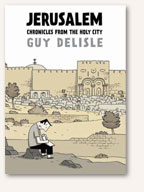
Book cover: JerusalemJerusalem is about twice as long as Delisle’s previous books, which is explained toward the beginning when he describes how he and his family are moving to Jerusalem for an entire year for his wife’s work for Doctors Without Borders. By this point, he has made enough of a name for himself as an author that he is spending the year solely working on this graphic novel, while also taking care of the children and doing the occasional lecture.

Delisle’s style is quiet and nonjudgmental. His strength as an author and illustrator comes from showing the reader these foreign cultures through his eyes as a traveling Westerner (he’s French Canadian), so it feels very personal. Several times, I laughed out loud, which is somewhat unusual in a visual media such as graphic novels, and two specific pages related to the other two authors of this blog: 1) Kinsey, apparently you are not alone in playing the game “Hipster or Priest”, and 2) Rebecca, I believe you, too, own some of the Helsing manga?

Like his previous books, this one focuses primarily on his own small, daily experiences trying to navigate a new culture, only referring to more global politics when it touches on him directly. For instance, a recurring theme throughout the book is him attempting and failing to get permission to travel into Gaza to lecture at a university there. In fact, after his fourth and final failure, he wonders if perhaps he is being mistaken for Joe Sacco, a reference that pleased me since I was reading his book next.

Palestine

By Joe Sacco

Book Cover: PalestineI have to admit that after Guy Delisle, Joe Sacco came as a bit of a shock and I was initially quite turned off. Like Delisle, Palestine is an autobiographic account of Sacco’s experience in Palestine, but where Delisle is quiet and personable, Sacco is loud, crude, and in-your-face. He is very clearly influenced by the R. Crumb school, which is not my favorite either, and I found his bold lines and clustered text boxes aggressive and claustrophobic. Sacco portrays himself as a bit of an asshole, self-centered and cowardly, and I initially took his word for it, but slowly began to think it is defense mechanism on his part, protecting himself emotionally from so many needy people that he is not in a position to help.

What finally sold me on the book is the sheer amount of information he has managed to pack into it. While I enjoyed Jerusalem more, Palestine gave me a much better understanding of the current situation, and the history that brought about it. As the title might reveal, the book is very much in support of an internationally recognized Palestine, which is not a perspective we hear much here in the United States, and it seems to me that it is an important perspective to hear.

Once I got over my initial bias, too, I started to notice that Sacco is a beautiful illustrator when he wants to be, drawing very detailed and delicately inked vistas depicting the scope of the conditions in the settlements.

Waltz with Bashir: A Lebanon War Story

By Ari Folman

Book Cover: Waltz with BashirI had initially picked this one up because the illustrations are beautiful, like little paintings in each panel. I was not real clear on where Lebanon is (I may or may not have thought it was in South America, the Texas public school system at work.) I had certainly never heard of Bashir before.

It turns out Waltz with Bashir was actually an animated film first (you can see the trailer here) and the graphic novel is made up of frames from the film. It also turns out that Lebanon is just above Israel, and Waltz with Bashir centers around the Israel Defence Force’s invasion of Lebanon. I figured that after the previous two pro-Palestine books, this would be my Israeli perspective.

The book (and film) is an autobiographical account of Folman attempting to recreate memories of his experience as a young soldier in the Israel Defense Forces during the 1982 Lebanon War, when Israel invaded Lebanon in order to install a pro-Israeli Christian government headed by the titular Bashir Gemayel. Folman knew that he had been stationed near the horrific Safra and Shatila Massacre (Christian soldiers under Israeli protection slaughtered between 762 and 3,500 Palestinian and Lebanese civilians), but had no memories at all of that time or place.

A friend of Folman’s, also stationed nearby, began having nightmares 20 years later, which inspires Folman to begin to dig into his own past. Clearly, it is not a happy book, and it, too, is quite critical of the Israeli military, so I am three-for-three on the pro-Palestine front. (If anyone wants to recommend a solid pro-Israel book on the subject, I’d be happy to check it out, though I’d prefer a graphic novel, clearly.)

Which brings me to my conclusion: while nonfiction graphic novels seem a little odd at first, they are palatable media for communicating very complex and charged information. There is no way that I would read a multi-hundred-page book, or even a dozen-page article, on the Israel/Palestine issue, but I happily and quickly ran through several hundred pages of these three comic books combined. They only made me marginally more informed, but they made me a lot less ignorant, if that makes sense. I don’t think that I could instruct someone else on the nuances of the various issues, but I know enough now not make pat judgments, either.

Burma Chronicles

By Guy Delisle
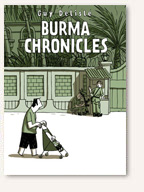
Book Cover: Burma ChroniclesDelisle’s Burma Chronicles came as a welcome relief after the building heaviness of the Israel/Palestine books above, though it is also Delisle’s most political book. He still writes very much in his first-person perspective, but Burma (or Myanmar, depending on your politics) has such a restrictive government that it interfered quite a bit in his daily life. Burma Chronicles takes place after Pyongyang and Shenzhen, but before Jerusalem; Delisle, his wife, and their infant son travel to Burma for his wife’s work in Doctors Without Borders. For the nine months that they are there, Doctors Without Borders attempts to reach outlying minority groups, with the government blocking their efforts until they eventually pull out altogether. This book highlights Delisle’s main charm for me: at the same time as he lightly touches on global politics, he shows us individuals in a very real light, so it becomes easy to look past the cultural differences and see the basic humanity underneath it all.

—Anna

Rather Outspoken: My Life in the News

Rather_OutspokenRather Outspoken: My Life in the News
By Dan Rather and Digby Diehl
2012
read by Dan Rather

I almost quit this book several times, as I struggled to make it through the first three CDs of the ten-CD audiobook. Not because it was bad (I wouldn’t have had a problem quitting if it were just bad), but because it was very well done recounting of a couple of very hard stories. In the first two chapters, Rather recounts breaking the Abu Ghraib scandal and the Bush National Guard scandal, and having to deal with the push backs and the attempts both external and internal to CBS to squash those stories.

In my imagination, the news business is run by the type of irascible fictional news editors like J. Jonah Jameson of the Daily Bugle (from Spiderman) and Perry White of the Daily Planet (from Superman). They’re gritty and obnoxious abut are all about getting the news out there and aren’t going to put up with anyone trying to quash a story:

 “I’ve got a story,” I said. “My source has leaked a lot of highly classified information, and the paper could get in a lot of trouble if we run it. But if we don’t, my source is going to keep trying until he finds someone who’ll print it.”

Jameson’s face lit up like Christmas. “That’s just about my favorite thing in the world to hear,” he said, and chomped on his cigar for emphasis. “What’s the story?”

The Scoop (an Avengers fan fiction) by Hollimichele

And yes, I realize that’s a highly romanticized notion of how investigative reporting works, and yet, it is the image I have in my head. From Rather Outspoken, I got the impression that Dan Rather has a similar idea of how the news should run. News, by it’s very nature, is something new and the people who are currently in power, happy with their power, and happy with the status quo, are not going to want told. If no one is offended or angry about the news, then it’s probably not very useful news. A news organization, then, should know that it’s setting itself up to fight a series of battles, and those organizations who ignore stories and refuse to fight are failing at their jobs.*

With this vision in mind, for Rather, seeing CBS cave in to political pressure is a personal betrayal as well as a professional one and just… hard. For me, it’s painful to see that betrayal and to realize that, as a member of a very different generation, it doesn’t really surprise me at all. I have an idealized vision of news reporters, but I don’t actually believe it’s real.

Luckily, after that, Rather turns to looking with a more large-scale perspective on his life and career and goes back over events of the past. I do wonder though, if it becomes easier for me because he begins to discuss events that happened before I was born and if they would remain difficult to hear for people who had lived through them and could feel those traumas again in the recounting, of the Kennedy assassination, the civil rights movement, the Watergate scandal…

Anyway, it was a very good book, and while I didn’t always agree with Rather on his politics or his interpretations, I do whole heartedly agree with him on the importance of an informed public and the dangers of a progressively more corrupt news industry.

* Speaking of people who are failing at their jobs: I’m going to take a moment to call out the U.S. Congress: if they can’t keep the government running, then maybe we need to get a new Congress. Is there a way to make a vote of not confidence? This is the type of dirty politics that Rather managed to immerse himself in so he could report on it, but that I find so distasteful that I can barely stand to listen to.

She Left Me the Gun

I love memoirs–I’ve said this before–and can read one after another, but even I get a little tired of the endless string of “Here’s The Unique Way that My Parents Messed Me Up” stories. I certainly understand how a traumatic childhood can allow for the kind of narrative arc that works well in memoirs, but they are such a drag to read. Which is one reason that She Left Me the Gun: My Mother’s Life Before Me by Emma Brockes was a such a refreshing change from the usual memoir.

Though told from Emma’s point of view, the book is really about her mother Paula, who was born and raised in South Africa but emigrated to England as an adult. After arriving in London, she got married, had her daughter, moved to the country, and lived out a normal, sedate village life. It was only after her mother died that Emma started looking into some of the vague things that her mother had said about her past. It takes Emma a fair amount of research, including multiple trips to South Africa and visits with extended family, to piece together exactly what happened to her mother before she got to England, and I’ll just say that very little of it was good.

The book goes into some detail about what happened to Paula, and offers an intriguing glimpse into everyday life in modern South Africa, as Emma ends up spending a great deal of time there meeting family and doing research. But the real heart of the book seems to be Emma trying to get her head around both who her mother was, and how much of the past she has the right and/or responsibility to know. Her mother kept this information from Emma for her whole life, and clearly wanted her to be as protected as possible; by discovering the truth, does Emma undo her mother’s work? Did Emma really know her mother, if she knows nothing of the first 30 years of her life and the momentous events that shaped her? (Emma does a great job of explaining that kid feeling of, “My mom was born, and then she had me. The end.”) And after her mother has died, does Emma have an obligation to learn what happened, so that SOMEONE knows exactly what her mother had to overcome?

The biggest question asked here, though, is just how does someone start over again? No matter the specifics of what happened to Paula, the upshot is that at 30 years old she walked away from a troubled life in South Africa and started all over again in London. She got married, had a child, and remained, as her daughter describes her, a vibrant, funny, functional person. How does someone do that? How could Paula do it when so many others couldn’t? The book doesn’t really answer that, of course. It’s a bigger mystery than one book can solve and Paula herself isn’t around to offer her thoughts. I wish she were, because she sounds like she would have been a riot, even if she couldn’t tell you how she did this magic act of creating a new life.

Kinsey’s Three Word Review: Inconclusive, but satisfying.

You might also like: The Glass Castle by Jeannette Walls, another memoir by a daughter that is (largely) about her mother. In this case, the unknowable part seems to be how Walls ended up so functional when her mother was so dysfunctional, but it addresses some of the same key questions about how you construct a life.