A Perfect Union of Contrary Things

By Sarah Jensen with Maynard James Keenan

A_Perfect_UnionRebecca referred obliquely to this book in her comment to my previous review, saying that she guessed I had lost all perspective of writing quality while in the middle of this book. We all have books that we are too embarrassed to review on this site, and thus admit to reading. I was torn about this one, but I think it is time for me to admit my love for Tool. I am a 40-year-old, mild-mannered woman, and yet I just love Tool’s music. I try to ignore the general Tool fanbase as much as possible, and honestly I’m super conflicted about frontman Maynard James Keenan – I have so much admiration for his music, but every time he stops singing and starts talking, my admiration steadily falls.

Still, when Keenan partnered his long-time friend Sarah Jensen on an official biography, I was certainly interested (though still a bit embarrassed).

The Forward opens with “Maynard James Keenan is a mysterious fountain of constant creation. From his soul-searching lyrics, and extraordinary music in multiple bands to his astoundingly delicious wine, he has permeated our culture like no other artist. He straddles guises and genres and makes us wonder what could fuel such original superhuman output.”

Uh oh, I thought.

Skipped the rest of the Forward to the Prologue: “He sings of the fire’s spirit, of the taste of ashes on the tongue, of the truth on the other side of the mirror. He sings of the desert that is no desert place but a land breathing, flying, crawling, dying—alive with spirits of ancestors and the untold tales of children to come.”

Oh, nooo.

Continue reading

Between the World and Me by Ta-Nehisi Coates

61unm4weinl-_aa300_Between the World and Me
by Ta-Nehisi Coates
2015

So 2016 proved to be a bit of a wake-up call for me in terms of politics and social justice. We have some serious problems in the US, regarding unjust inequality of human respect and public safety in addition to inequalities of income, access to education, access to healthcare, and access to overall opportunities.

I’ve come to the realization that it’s a sign of just how sheltered I’ve been that 2016 was a wake-up call rather than just another demonstration of what the world can be like. It was time and past for me to expand my horizons and get out of my comfort zone.

Ta-Nehisi Coates is only a couple of years older than me and this book is about his experience with being black in a white society. I’m white in a white society and thus a lot of racial issues are nearly invisible to me. I am not at all the intended audience for this book: he writes it as a black man to his black son about his experience with the way their blackness is seen by society. It is beautifully written and it’s an honor to be be allowed to read this somewhat intimate letter from a father to his son about his fears and hurts and anger.

It reminded me of Why Are They Angry With Us?, another book I highly recommend, but while that book was academic and intended for a general audience, Between the World and Me is very personal and intended for a specific audience of one, possibly expanded to include all young black men.

I’m glad I listened to it as an audio book rather than trying to read it as text. Coates reads it himself, which I always appreciate in audio books. But the real benefit of audio books is that they don’t stop unless you actively push the pause button. I found it a difficult book to hear but that very difficulty is what makes it all the more important that I listen.


How to Build a Girl

moranWay back in late 2012, in a wrap-up of my favorite books of the year, I mentioned how much a I liked a book of essays by Caitlin Moran. She remains fabulous to follow on Twitter and I read her essays any time I get the chance (her weekly column is behind a paywall, and I can’t quite justify subscribing to a British newspaper just for one column, but things do show up from time to time). But for some reason I had been avoiding her debut novel. I’m not sure why exactly, maybe because I knew it was a coming-of-age story and I was worried that it would be horribly embarrassing and awkward to read about a teenage girl struggling through puberty? But I finally got around to reading it and I loooved it.

How To Build a Girl is fiction, but is obviously largely autobiographical. Moran, like the main character Johanna, was part of a large family growing up poor in 1990s Britain. And she also stumbled into a career as a music writer as a teenager, which is the story the book largely tells. Johanna is a poor, geeky, too-smart-for-her-own-good unpopular kid who decides to reinvent herself and ends up on the edges of the British music scene working as a magazine writer. As you can imagine, sometimes this goes swimmingly and sometimes it doesn’t, but it’s fascinating to watch Johanna work out how to present herself, how to talk to people, how to construct a persona for herself–essentially how to be an adult. Which, you know, being an adult is hard and I think most of us are still trying to figure out how to do it. I haven’t seen many books that talk about this process as explicitly as this one does. But it manages to not be at all preachy or new-agey, but entirely practical.

I’m not sure how many of the details come directly from Moran’s life, but all of it feels very true–the family interactions, the fashion and makeup conversations, the music reviews. She and I are roughly the same age and I recognized a lot of the musicians and cultural references of the era, which was fun for me but was definitely an extra and not required to enjoy the book. And I should note that while this may sound like a YA novel, it’s not appropriate in any way. Moran does not shy away from talking about sex and drugs and bodies and crime and all the things that a teenager might encounter, and it’s pretty gritty from the very first page. And yet it didn’t feel exploitative or like Moran is grabbing for attention–it just felt real.

Kinsey’s Three Word Review: Snarky but touching

You might also like: Anything by Caitlin Moran is awesome. And if you haven’t read Tina Fey or Amy Poehler’s books, their stories of teenage adventure match up with Johanna’s very well. Someday, Someday, Maybe by Lauren Graham (AKA Lorelai Gilmore) is also a clearly-largely-autobiographical-novel about a young woman becoming who she wants to be, and is lovely.

Also, let me take this opportunity to shout out a couple of things that I read on my fellow blog author’s recommendations and thoroughly enjoyed. First, back in July Rebecca raved about Uprooted by Naomi Novik and she was totally right. It was a completely fabulous modern fairy tale. And Anna recently talked about The Rest of Us Just Live Here by Patrick Ness, which I liked as well. Ness has another recent release called A Monster Calls, which was also great. Different from The Rest of Us–while that one reminded me of an episode of Buffy the Vampire SlayerA Monster Calls was more like Neil Gaiman’s The Graveyard Game–but also great.

Homeschool Sex Machine

By Matthew Pierce

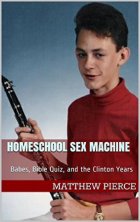
Book Cover: Homeschool Sex MachineI don’t even remember what internet rabbit hole led me to Matthew Pierce’s blog, but the entries I read were funny enough that I decided it was worth $2.99 to get them compiled in his kindle book. The author was primarily homeschooled up to 10th grade, and he describes the experience, and that niche community, hilariously and self-deprecatingly. I kept expecting some anger or bitterness, but he writes respectfully, if briefly, about his religiously conservative parents, and ultimately affectionately about his upbringing.

I got a little grumpy about it, actually, and ended up having to face some personal bias against religious conservatism that I would have preferred to ignore in myself. Personal issues aside, though, it was a really interesting and entertaining look a childhood much, much different from my own. He has a sequel about attending a Christian college, which I look forward to reading just as soon as I work up some acceptance for Christian colleges.

In case this review has not already made my religious lack clear, I have tested as being damned to an inner circle of Dantes’ Hell. Rebecca found an online quiz that tells you where you belong in the 9 circles, and it was all fun and games as every other member of my family headed off to limbo to hang out with famous philosophers, and then I was consigned to burn in sepulchers with all the other heretics.

—Anna

The Dante’s Inferno Test has banished you to the Sixth Level of Hell – The City of Dis!
Here is how you matched up against all the levels:

Level Score
Purgatory (Repending Believers) Very Low
Level 1 – Limbo (Virtuous Non-Believers) Moderate
Level 2 (Lustful) Low
Level 3 (Gluttonous) High
Level 4 (Prodigal and Avaricious) Low
Level 5 (Wrathful and Gloomy) Moderate
Level 6 – The City of Dis (Heretics) Very High
Level 7 (Violent) High
Level 8 – The Malebolge (Fraudulent, Malicious, Panderers) Moderate
Level 9 – Cocytus (Treacherous) Moderate

Take the Dante’s Inferno Hell Test

I’m Not A Terrorist, But I’ve Played One On TV

By Maz Jobrani

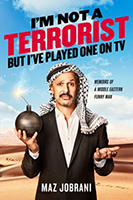
Book Cover: I'm Not A Terrorist, But I've Played One on TVI first read an article in GQ by Jon Ronson (who I love) about Maz Jobrani and other actors of Middle Eastern descent, and about how they are only offered roles as terrorists. The actors describe all the different ways they are killed by the heroes, over and and over again, and how frustrating it is to get no other roles, not to mention feeding into negative stereotypes of your culture in order to make a living. Because it is Jon Ronson, too, it is depressing, but also a bit funny.

I thought it was a really interesting piece on something I had literally given zero thought to before, so when the article mentioned Jobrani’s memoir, I checked it out from the library that day. Jobrani, an Iranian-American, started as an actor, but turned to stand-up comedy when he decided that he didn’t want to play terrorists any more, which I think was a good move since his book made me laugh out loud several times.

Jobrani is an extremely positive person, disappointed by the anti-Middle-East sentiment in the US, but focused on creating a more positive presence. For my own part, I like humor that is a bit angrier and more biting, especially when it comes to social justice issues. However, even his light-hearted jokes revealed how little I know about Iran and the rest of the Middle East and this is a very easy way to learn some very basic truths about Middle Eastern culture. Jobrani has a lot of videos up on YouTube and is a semi-regular on Wait, Wait, Don’t Tell Me, so check him out!

—Anna

Service Included by Phoebe Damrosch

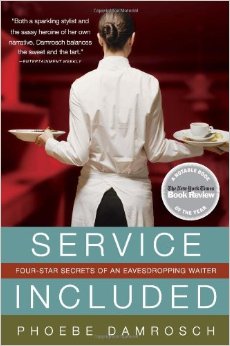
ServiceIncludedService Included: Four-Star Secrets of an Eavesdropping Waiter
by Phoebe Damrosch
2007

The subtitle is misleading: while there was one chapter that told some stories about some of the wacky customers, the focus was really on the professional (and sometimes personal) life of a high-end waiter. It’s fascinating. It’s eye-opening, nonfiction, and really makes me reassess my experiences at various restaurants. I don’t tend to go to the high-end restaurants like Per Se, where Damrosch worked, but I imagine much of the same structure is true in a watered-down fashion in other restaurants.

Also, the food descriptions are mouth-watering. Even when the descriptions were of food that I don’t generally care for, wow, I wanted to try them out because it sure sounds like this place would be doing them in a way that all people would like. I want to try these dishes! And I really want to visit Per Se to experience them.

I could have done without the sections focused on Damrosch’s adventures in dating, but it was still well written with humor and humility. I just found it somewhat soap-opera-like and an unwanted break from the intricacies of the high-end service industry. It’s possible and even likely that other readers will enjoy those sections, though.

I still don’t understand the interconnected budgets of the restaurant, the service staff, and New York living, but I assume it’s all based on the incomes of the regular clientele who apparently might spent $20,000 on dinner. (After reading this book, I looked up the Per Se website and confirmed that a regular dinner without wine is a fixed price of $310, which is within the realm of possibility if I save, in contrast to the $20K that is just not.)

Damrosch also includes tips on how to interact with service staff, most of which I already knew, and some of which I (rather embarrassingly) did not.

Anyway, this is a fabulous book and I definitely recommend it.

Fresh Off The Boat

By Eddie Huang

Book Cover: Fresh Off The BoatEddie Huang is funny and smart and has a really interesting story and perspective on life, but he’s also kind of an asshole.

He wrote his memoirs a couple years ago, which inspired a new sitcom just this season. Reading a review of the sitcom, I figured the book would be an interesting account of a first generation American’s experience. And it is. What it doesn’t really seem to be is material for a sitcom. As I got further in the book, I was more and more confused about how on earth they were going to make this family-friendly. Like, Huang’s family is all sorts of crazy, with some serious abuse problems to boot, and Huang has more than a few thug tendencies.

A lot of the story has been left out of the sitcom, naturally, but some has just been cleaned up. In one episode, the grandma teaches Eddie’s little brothers to play poker and promptly fleeces them of all their toys. It is a cute scene (my favorite part is when they appeal to their mom to get their toys back, she solemnly tells them that their grandma won them fair and square), but the reality is that Huang’s grandma had a gambling addiction that impoverished her husband and son.

Huang talks a lot about how meaningful he finds hip hop and the hip hop culture. I hadn’t ever thought about it like this, but he says that growing up in a chaotic and abusive household (his parents went far past the point of just being traditionalist; the children’s school reported the family to child protective services), the rhetoric used in hip hop about hard living on the streets gave him a frame of reference for his abuse at home. So, I found that to be a very interesting perspective, if not one that I could always understand.

Sports, basketball in particular, are also an important part of his life, and he discusses that at length, as well. Again, interesting, but not much relevance to my own experience.

What I could really relate to, though, was when he starts talking about food. He describes wanting to make a traditional American Thanksgiving (amusingly, his mother turned her nose up at most American food, but became a fan of green bean casserole), and watching a bunch of Food Network for research before settling on a combination of brining and infused herb butter under the turkey skin, which almost exactly replicates one of my first Thanksgivings on my own.

It is also through cooking that he was able to create his own identity and find a place in society that he was comfortable with, after many, many years of acting out. Similar to other memoires I’ve read by people in their 30s, relating their road to eventual success, the vast majority of the book is spent on the early struggles, with the success sort of just coming together at the end. I guess I’d prefer a somewhat later memoir that gives a little more attention to maintaining the point of success once it has been achieved.

—Anna

How To Be Black

By Baratunde Thurston

Clearly I’m not so much the intended audience for this book, though author Baratunde Thurston was very kind of include a welcome to non-black readers in his introduction:

Book Cover: How To Be BlackIf you are not black, there is probably even more to be gained from the words that follow. They may help answer the questions that you’d rather not ask aloud or they may introduce a concept you never considered. You will get an insider perspective, not only on “how to be black” but also on “how to be American,” and, most important, how to be yourself. This book is yours as well.

He does provide a caveat though:

If you purchased the book with the intention of changing your race, I thank you for your money, but there will be no refunds. None.

This made me laugh and also feel better about reading about it, though not enough to read it in public. (In fact, Rebecca told me that it made a list of poorly-chosen books to read in public.) Then, I felt worse when I realized when I was reading it. Another excerpt:

Now, more to the heart of the matter, the odds are high that you acquired this book during the nationally sanctioned season for purchasing black cultural objects, also known as Black History Month. That’s part of the reason I chose February as the publication date. If you’re like most people, you buy one piece of black culture per year during this month, and I’m banking on this book jumping out at you from the bookshelf or screen. Even if you’re reading this book years after its original publication, it’s probably February-ish on your calendar.

And so I am. Sigh. I actually heard about the book through Samantha Irby on her blog bitches gotta eat, (which I’m slowly reading all entries backwards in order to catch up) in which she talks about getting to open for Thurston at his Chicago show.

Anyway, the book is a combination of his personal memoirs, thoughts on the black culture in the United States, and interviews with a group of other writers and artists. It is just really funny (as it should be—Thurston works for The Onion), and really informative.

This is making me very uncomfortable to write, but I think it is important. It is very easy to fall into the liberal trap of ‘black people aren’t scary, just culturally different’ while still keeping them very much grouped as one solid entity and separate from yourself. I was continually surprised at how many similarities there were between my childhood and Thurston’s.

First off, my mom and his mom would have gotten along like gangbusters, both outspoken and often radical feminist professionals in large urban areas (Boston and DC, respectively) with long-standing hippy tendencies. We were both the first ones in our peer group to know what tofu was and to have eaten, if not enjoyed, it regularly for dinner. Both of our parents struggled with the idea of sending us to underfunded public schools, before deciding to send us to the local private Quaker schools (of course, his turned out to be Sidwell, so he won this round).

The funny thing is that some real disconnect for me happened around college, when Thurston describes going to Harvard, and while he mentions certainly having to deal with entrenched racism, the experience was overwhelmingly positive and his main take-away was that anything was possible for him and his fellow Harvard grads. At which point, the grubby little communist in me rose up to bitch about how these rich college boys think they can just have whatever they want whenever they want, which was certainly not a response I thought I would have to this book.

Honestly, though, the biggest take-away for me, the thing that was the most important lesson and revealed some hidden racism on my part, was just how funny I found the book to be. Because a lot of humor is shared experiences and personality, and I guess I’d figured that Irby and I are both women, so I relate to her humor in that way, but I just hadn’t expected to relate to Thurston so much. I’m glad I did, of course, and more than a little ashamed that I assumed I wouldn’t.

—Anna
Maya Angelou

I read I Know Why the Caged Bird Sing in high school after my particularly awesome English teacher won her stare-down with the school board. Unfortunately, I don’t actually remember it all that well and didn’t remember much about the author either, for all her name recognition. Clearly that needed to change.

So for my Christmas road trip, I picked up (thank you public libraries!) three of Maya Angelou’s audio books, each of which she read herself. I like audio books that have been read by their authors. All readers add their own nuances to texts and when the authors read them you know it’s the intended nuance. Maya Angelou has the added benefit of actually being a professional performer and reciter.

Curiously, her speech pattern reminded me of William Shatner’s, and I wonder if he modeled his after hers. Very well enunciated, and with frequent, intentional pauses. She carries the style off better, though.


asongflunguptoheavenA Song Flung Up To Heaven
2002

Maya Angelou had a pretty amazing life with many ups and downs. Where before my impression of her was as this iconic individual almost out of sight on a pedestal, this autobiography shows her as fully human with all the attending strengths and weaknesses. One of her many strength is surely her willingness to show the world her weaknesses.

Rather than a single long book, this felt like a themed collection of short stories. Rather than telling the story of her life, she’s telling stories from her life, giving the reader a look at different times and events. Each chapter could potentially stand alone and be well worth reading.


momandmeandmom2Mom & Me & Mom
2013

Wow. Maya Angelou’s mother, Vivian Baxter, sounds like a truly amazing woman who lived her life to the fullest. As tumultuous as Maya Angelou’s life has been, her mother’s seems to have been that much more so. This book focuses on Maya’s relationship with her mother, which was excellent, but I also wish there was a full biography of Vivian Baxter, because just the glimpses we see into her life as it intersected with her daughter are pretty amazing. She was strong and determined and opinionated and just an amazing woman but she was not necessarily a comfortable woman to be around. She seems to have been utterly and completely herself and lived out loud.


lettertomydaughterLetter To My Daughter
2009

This struck me as pretty much a perfect graduation gift (highschool? college? some other major life transition where you’re not sure what you’re going to be doing next?). Many of the chapters are slightly edited versions of chapters from her other books, but they’re collected here for a reason. The overall message of this book is that life is going to throw a lot of different things your way, some wonderful opportunities and some awful experiences, so stay strong and try your best to take advantage of the first and get through the second.


I recommend all of these.

The Best of the Rest of 2014

I’ve said here before that when I read a really great book, I am so excited to share it with people that I immediately write a blog review. Hence, my short list of the best things I read this year would be The Goldfinch, The Signature of All Things, Love, Nina, and Americanah. (I was looking at the list of the books I read this year and wondering why it was so much shorter than last year–I read about 45 books this year, rather than my typical 80-100. Maybe it’s because I spent half the year reading giant doorstop literary novels that took forever? At least most of them were good; let’s just not talk about The Luminaries.)
But  I did read a few other things in 2014 that I loved but that never made an appearance here. So before this year runs away from us entirely, let me put in my vote for a few more things:

1) Bridget Jones: Mad About the Boy

I have a love for the first Bridget Jones book that I cannot explain. I just think it’s brilliant and is working on about four different levels and I still reread it once a year. Even Helen Fielding would probably admit that the second one went off the rails a bit, but I really, really enjoyed this third Bridget installment. Rather than picking up where things left off, the book ages Bridget and puts her in an entirely different situation. Bridget is still recognizable, but she’s gown up a little, and as predictable as the book was, I found it charming and surprisingly touching.

2) Mastering the Art of Soviet Cooking

I am kind of obsessed with the Soviet Union, but I find it really difficult to find things to read about it. Nonfiction books tend to be incredibly dense, academic tomes along the lines of “and then that other diplomat issued a statement that countered the previous statement  . . . ” And fiction tends to be unbearably dark, which is understandable but difficult to read (Child 44, you still give me nightmares). This memoir uses food–from pre-revolutionary excess to the siege of Leningrad to Soviet institutional cafeterias–to show how the Soviet state affected the everyday life of it’s citizens. And it shows how one family rebelled against that state, at least partly through food. Really charming, although I’m not likely to cook any of the recipes provided.

If you are not already reading the website Bitches Gotta Eat, you should go do so immediately, because it is one of the funniest things on the Internet (assuming you’re over 18–if you’re not, please go look in our YA tag for something more appropriate, because this sure isn’t). Meaty is a collection of essays by Samantha Irby, who writes the site, and it is equally funny. However, I should warn you that she uses the essay format to also tell some less funny stories about her life, including one about her mother that was so sad it made me put the book away in a drawer for several months so I could recover. But the funny stories are really funny, the sad stories are stunning, and Irby definitely deserves a bigger outlet than she’s gotten so far.