Predictably Irrational

Predictably IrrationalPredictably Irrational: The Hidden Forces that Shape Our Decisions
by Dan Ariely
2008
read by Simon Jones

I took a couple of courses in grad school about the information business, which is a growing industry that deals with the interesting paradox of having to use information as both a marketing tool and a product. It’s fascinating and complex, but was also my first introduction as an adult to standard economic theory.

Both my immediate and ongoing reaction is: standard economic theory is idiotic. It’s just blatantly false, based on two assumptions: 1. All decisions made by individuals are rational. 2. All those rational decisions are made with the primary goal of increasing that individual’s personal financial wealth.

Standard economic theory has a real hard time trying to explain nonprofits. Or, you know, families and friends.

Ariely is one of the active researchers opening up a new field of study: Behavioral economics. This is a field that comes out of psychology more than economics, and it looks at how people actually make decisions. (And is something of a balm to my soul after trying to comprehend what regular economics think.)

How do biases work, or habits form? How do our decisions change when we have an audience or not? Rather than always acting rationally, how do we rationalize some of our less acceptable behaviors?

He studies this, and he does so through a series of small experiments. (His students at MIT should really have started to be suspicious of some of his odder requests.  And I imagine the neighborhood kids roll their eyes at this point.)

It’s an excellent book, with a great deal of humor to it, but also caused a certain amount of introspection as I thought about how I make my own decisions, and a certain amount of horror, given the current political state of my country, in regards to how politicians make their decisions.

I highly recommend this book. My three word review: funny, fascinating, and important.

Rather Outspoken: My Life in the News

Rather_OutspokenRather Outspoken: My Life in the News
By Dan Rather and Digby Diehl
2012
read by Dan Rather

I almost quit this book several times, as I struggled to make it through the first three CDs of the ten-CD audiobook. Not because it was bad (I wouldn’t have had a problem quitting if it were just bad), but because it was very well done recounting of a couple of very hard stories. In the first two chapters, Rather recounts breaking the Abu Ghraib scandal and the Bush National Guard scandal, and having to deal with the push backs and the attempts both external and internal to CBS to squash those stories.

In my imagination, the news business is run by the type of irascible fictional news editors like J. Jonah Jameson of the Daily Bugle (from Spiderman) and Perry White of the Daily Planet (from Superman). They’re gritty and obnoxious abut are all about getting the news out there and aren’t going to put up with anyone trying to quash a story:

 “I’ve got a story,” I said. “My source has leaked a lot of highly classified information, and the paper could get in a lot of trouble if we run it. But if we don’t, my source is going to keep trying until he finds someone who’ll print it.”

Jameson’s face lit up like Christmas. “That’s just about my favorite thing in the world to hear,” he said, and chomped on his cigar for emphasis. “What’s the story?”

The Scoop (an Avengers fan fiction) by Hollimichele

And yes, I realize that’s a highly romanticized notion of how investigative reporting works, and yet, it is the image I have in my head. From Rather Outspoken, I got the impression that Dan Rather has a similar idea of how the news should run. News, by it’s very nature, is something new and the people who are currently in power, happy with their power, and happy with the status quo, are not going to want told. If no one is offended or angry about the news, then it’s probably not very useful news. A news organization, then, should know that it’s setting itself up to fight a series of battles, and those organizations who ignore stories and refuse to fight are failing at their jobs.*

With this vision in mind, for Rather, seeing CBS cave in to political pressure is a personal betrayal as well as a professional one and just… hard. For me, it’s painful to see that betrayal and to realize that, as a member of a very different generation, it doesn’t really surprise me at all. I have an idealized vision of news reporters, but I don’t actually believe it’s real.

Luckily, after that, Rather turns to looking with a more large-scale perspective on his life and career and goes back over events of the past. I do wonder though, if it becomes easier for me because he begins to discuss events that happened before I was born and if they would remain difficult to hear for people who had lived through them and could feel those traumas again in the recounting, of the Kennedy assassination, the civil rights movement, the Watergate scandal…

Anyway, it was a very good book, and while I didn’t always agree with Rather on his politics or his interpretations, I do whole heartedly agree with him on the importance of an informed public and the dangers of a progressively more corrupt news industry.

* Speaking of people who are failing at their jobs: I’m going to take a moment to call out the U.S. Congress: if they can’t keep the government running, then maybe we need to get a new Congress. Is there a way to make a vote of not confidence? This is the type of dirty politics that Rather managed to immerse himself in so he could report on it, but that I find so distasteful that I can barely stand to listen to.

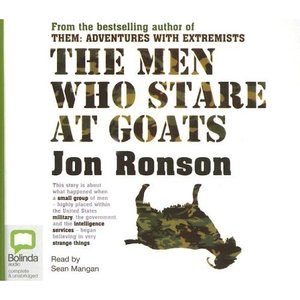
The Men Who Stare at Goats

men-who-stare-at-goatsThe Men Who Stare at Goats
by Jon Ronson
2004
read by Sean Mangan

This book is awesomely hilarious. Hilarious, if, you know, you can get past the very real horror that is mixed in with the craziness. Apparently, I can. In many ways, the book as a whole reminded me of Keller’s Catch-22, an awesomely hilarious comedy all about the inhumanity of war.

And unfortunately, I once more have to warn for animal harm. Given the intent (by the men who stare at goats) of doing harm, I shouldn’t be surprised, but given the proposed method (i.e., staring), I found I was surprised after all. (It hadn’t occurred to me to ask: where are these goats coming from?) Plus, once we’re past the animal harm, we then move on to torture of prisoners.

Somehow it still manages to be super funny.

Jon Stewart on the Daily Show called Jon Ronson’s writing “investigative satire” and that’s pretty much what it is. This book is also an illustration of the phrase: “Truth is stranger than fiction, (because fiction has to make sense.)” In the final chapter of this book, Ronson sums it up by explaining that this is the story of how, in the aftermath of the Vietnam War, the discouraged and demoralized U.S. army attempted to incorporate some of the “New Age” culture that was developing, but in true military style, rather than seeking new ways to find peace, they looked for new ways to make war.

Ronson himself is also quite the character: a soft-spoken, somewhat nebbish guy. He’s gone on The Daily Show with Jon Stewart, twice, so you can see him for yourself. It’s worth seeing him for yourself, especially if you’re planning on listening to the audiobook version of this book, because, in stark contrast to Ronson, Sean Mangan reads the text with a deep intent and melodrama that just adds an extra layer of hilarity to it all.

There are a lot of conversations in which the various interviewees are saying something either crazy or horrifying or both, and Ronson is recounting the conversation:

So-and-so said: some crazy and/or horrifying thing

I said, “hmm.”

Now imagine that spoken in a deeply melodramatic fashion.

“I said,” Mangan intones, “hmm.”

I, the listener, can’t help but giggle.

To use Kinsey’s practice of a Three Word Review: funny, informative, disturbing

Simplexity

SimplexitySimplexity:
Why Simple Things Become Complex (and How Complex Things Can Be Made Simple)
By Jeffrey Klugger
2009
Read by Holter Graham

This was a fascinating book, although it wasn’t quite what I had expected. The subtitle is a bit of a misnomer as the book doesn’t really address why things become complex or how they can be made simple. Instead, it shows that many simple things actually are quite complex and many apparently complex things actually are quite simple. So I suppose it does tell you how, if only by showing you how to shift your perspective.

The book is essentially composed of a series of case studies. The studies range from the evacuation of the Twin Towers on 9/11 to regular New York traffic patterns, from stock market fluctuations to cholera outbreaks to Jackson Pollok paintings. All of these are used as examples of the simplicity-complexity continuum, in which both extreme regimentation and extreme chaos are conceptually simple, while in between these two extremes is the place where some extremely complex patterns form.

As is, perhaps, appropriate for a book on this topic, I’m not quite sure what else to say about it. It would be easy to recount some of the interesting details, of which there were many, but the premise itself was quite simple: some things are simple, other things are complex, but it is not always obvious which is which.

Kluger presents a different way to examining the world, and I enjoyed it a great deal.

Yes, Chef by Marcus Samuellson

Yes-Chef-Marcus-Samuelsson-Random-House-Audio-booksYes, Chef
By Marcus Samuellson
2012
read by Marcus Samuellson

Now, Marcus Samuellson is a successful celebrity chef. Way back when, he was a toddler in Ethiopia dying of tuberculosis, and then a kid in Sweden determined to become a professional soccer player, and then a young man in Europe and America trying to get a job and work his way up the career path. This is the story of how he got from there to here, and it’s an excellent story.

One thing that really impresses me with this book is how he manages to not only tell about his actions and experiences in the past, but also to portray his perspective and thought process in the past. When he was writing about his childhood, he wrote as an adult recounting his childhood, but as he was writing about his experiences as a young adult growing into a mature adult, his writing also changed to reflect the change from being driven young man with an overriding ambition to being a much more socially aware adult who didn’t take family for granted.

I was really glad that I experienced this as an audiobook, not because it would have been at all bad as a standard book, but because the audio version is read by Samuellson himself. He doesn’t have the perfect elocution of a professional audiobook reader, but he does have real emotional connection to the story he’s telling. As an autobiography, it gains even more power by being told, literally, in his own voice.

Also, his descriptions of food make me wish that I was more of a foodie. I like food, but I also like simple flavors. Samuellson’s descriptions of the rich and complex flavors that he loves are tantalizing.

The one problem I had with the book is that some of the transitions are pretty abrupt, and a couple of times abrupt enough to be confusing, where I wasn’t quite sure what happened. Also, I got the distinct impression that he was living by the same parental advice I got, that “if you can’t say something nice, don’t say anything at all.” Not that all of his experiences were good by any means, or even that all the people were nice (not at all!) but no one and nothing is presented as unmitigated badness, and that is something I appreciate. Sometimes that might mean skipping over a period of his life, maybe, but for the most part Samuellson seems to genuinely like and respect people. Even the most difficult people (and there are apparently a lot of difficult people in the cooking community, good grief – I’m extremely glad that I don’t have to put up with that) have something good about them and Samuellson sees that.

Anyway, I enjoyed this book a great deal and I definitely recommend it so that you can enjoy it, too.

RIP Elizabeth Peters

Elizabeth_Peters
RIP Elizabeth Peters
(Sept. 29, 1927 – Aug. 8, 2013)

I just learned that Elizabeth Peters recently died. Her actual name was Barbara Mertz, but I knew her as Elizabeth Peters when I grew up reading her books.

She was a prolific mystery writer, her characters are a delight, and her writing easily mixed suspense and humor. I particularly loved her sense of character though. Her heroines were all very real, with very definite personalities and perspectives. They were all people that I would have loved meeting, but also that I could have imagined meeting. They were real people and they continue to delight me. The love interests were also all strong personalities that could hold their own against the main characters, and the large casts of secondary characters were always zany and delightful.

I think growing up reading these books provided a wonderful salve to also growing up reading classic science fiction, which tended to skimp on the character side of things, especially when it came to females. Peters’ characters more than made up for the lack in any other books, though. Her were a delight and a wonder.

crocodile-on-the-sandbank   The first book of hers that I read was Crocodile on the Sandbank, which introduced me to Amelia Peabody, Peters’ most well-known character. Peabody is a British female Egyptologist in 1884. As you might guess from that, she is quite opinionated and strong-willed. Watching her butt heads with pretty much everyone is a delight. Amelia along with her eventual husband and eventual son are the focus of 19 books.

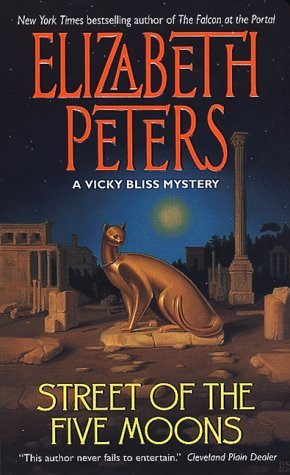
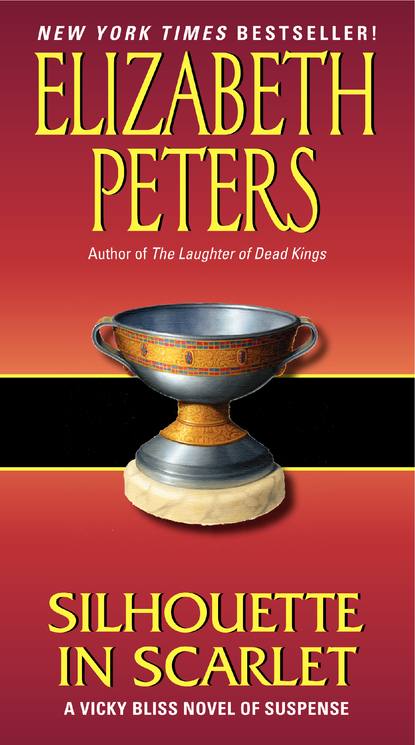
borrower-of-the-night-a-vicky-bliss-murder-mystery-by-elizabeth-peters     streetoffivemoons    silhouette

My favorite series of hers though is the one that follows Dr. Victoria Bliss, a medieval arts scholar who works at the National Museum in Munich. Vicky is Barbie-doll-esque enough in appearance that most people don’t take her seriously as a scholar. Her boss Herr Professor Anton Schmidt is Santa-Claus-esque enough in appearance that no one takes him seriously as an adventurer. John Tregarth is a master criminal who tries valiantly to not be taken too seriously. Together they find and/or get drawn into all sorts of historical and criminal adventures.

summer_of_the_dragon     devilmaycare     lovetalker

Some of my favorite books of Peters, though, are her stand alone novels, introducing whole new casts of characters and a single mystery to be resolved. Of her many such books, Summer of the Dragon is probably my favorite, closely followed by Devil-May-Care and The Love Talker.

This is an author well worth reading and who has had a major impact on my youth, reading, and writing. She set a high bar for others to follow.

Rest in peace, Elizabeth Peters.

One Click

One_ClickOne Click: Jeff Bezos and the Rise of Amazon.com
By Richard L. Brandt
2012
read by Neil Shah

Curiously, this kind of reminded me of Mr. Penumbra’s 24-Hour Bookstore. It’s about a rather eccentric bookseller who isn’t actually interested in selling books so much as making a major impact on society. The fact that Amazon.com started by selling books is mostly a side effect of the fact that Bezos wanted to start a transformative online retail business.

Bezos seems like an interesting character. He’s presented as very analytical in his thoughts and emotions, as well as a visionary. I can’t help but compare him to Mark Zuckerberg of Facebook as presented in The Social Network (i.e., I haven’t actually read any nonfiction about Zuckerberg, but I’m still going to make this comparison.) They’re both very smart with a vision of using the Internet to revolutionize the world and somewhat out of step with other people socially. But where Zuckerberg comes across as trying a bit too hard to both fit in and to make other people fit to him and generally being an ass, Bezos comes across as being very comfortable with himself and honest about who he is and what he wants. He seems like a decent guy. Oddly, the author of the book strikes me as falling in between the two, trying rather desperately to model himself after Bezos (good for him) but still uncomfortable and nervous and trying too hard to casually use “nerd” as a descriptor rather than an insult.

In fact, Brandt come across in awkward in several says. First, he slants all the descriptions to show Bezos as being ultimately in the right, and all of Bezos’ questionable activities (standard CEO stuff: too demanding, too micro-micromanaging, too distant, too whatever) are presented in a lump in one of the later chapters rather than interspersed through the story.

Another oddity in Brandt’s writing is some of the rather lurid prose that occasionally pop up in a rather jarring fashion. I enjoy a certain level of purple prose: the grammar alone can add a pleasing complexity and richness to a description even beyond the subject itself. That said, “the stock prices fell like spit off a bridge,” “the stock was as sickly as a CEO with swine flu” and similar phrases gave me pause. The writing is generally fairly straightforward and even a bit pedantic, but it’d dotted with these WTF metaphors and similes that make me blink and go “huh.”

I’m really glad that I was listening to the audiobook version of this rather than trying to read it. There are long sections that strike me more like elaborated lists than any real narrative, and I’m fairly sure I would have bogged down in them if I’d been trying to read them. But with it read and simply playing out during my commute, I go at a steady pace and the information is fairly interesting.

Despite the rather lukewarm review, I enjoyed the book. I also found it a particularly timely read.

On Monday, I learned that Bezos is buying The Washington Post. He’s not even buying it as an Amazon.com acquisition, but rather through his personal wealth.

A while back, I watched Page One: Inside the New York Times, and despite it’s apparent intent to convince me that newspapers were still important, it mostly succeeded in convincing me of the opposite. Bezos has demonstrated a deep understanding of how online capabilities change retail. I very much look forward to seeing if he will demonstrate a similar understanding and sense of innovation regarding online capabilities in the information business.

Gulp: Adventures on the Alimentary Canal

gulpGulp: Adventures on the Alimentary Canal
By Mary Roach
2013
Read by Emily Woo Zeller

This was excellent, but…

That’s pretty much my review of this book. It was excellent—funny and informative—and yet, there are so many warnings necessary before I could possibly recommend this to anyone else.

I read Mary Roach’s Stiff: The Curious Lives of Human Cadavers some years back and enjoyed it a lot. It was funny and educational and oddball and also kind of gross but mostly that just made me get all picky about what I want to have done with my body after I die. I had not expected adventures in the alimentary canal to be significantly grosser than a recounting of the things that can and do happen to bodies after death. Oh, how wrong I was! Gulp got incredibly gross, and I am now hyper conscious of my bowels. I can only hope that awareness disperses after I move on to another book.

Second: I have to warn about animal harm. So. Much. Animal. Harm! You know how people have learned about the digestive track over the centuries? Largely by doing really unpleasant things to animals. Do you know what vivisection is? If you don’t, then count your blessings and don’t ask.* If you do, well, if you read this book, you’ll know a lot more about it. The people at the dog food factory loved their dog taste-testers and treated them extremely well. I cling to the fact that there are people here who love their animals. Because all the other animals mentioned in this book came to gruesome ends.

Moving on, I was surprised about how Roach didn’t spend much time on the intestines. She started at scent and taste and swallowing, moved on to the stomach, and then dealt with digestive juices, but then moved on to the colon (and stayed there for a really long time) but I didn’t really think the small and large intestines got their fair share of time. On the other hand, this isn’t exactly intended as a textbook. Maybe she just couldn’t find the same number of stories—horrifying and hilarious—for that particular section of anatomy as she could for the rest.

Finally, while I listened to this in audiobook format, I think it probably works better read in a traditional book format. There were a fair number of footnotes that discussed tangential issues and it was occasionally difficult to track the divergence and subsequent return to the regular text.

So, if my various warnings haven’t put you off too much, then I do recommend this book. It is hilarious and I have learned things that I never would have expected.

* I first learned of vivisection from a book in which the bad guys did it and the good guy was Jack the Ripper. Let that give you some perspective.

The Art of the Steal by Frank Abagnale

The-Art-of-the-Steal-Abagnale-Frank-W-9780786121373The Art of the Steal
How to Protect Yourself and Your Business from Fraud, America’s #1 Crime
By Frank W. Abagnale
2001
Read by Barrett Whitener

This book is enthralling and funny and useful. I definitely recommend it.

I just started a new job (yay!) which comes with an hour-long commute (hmm), so I’m starting to look at audiobook options. I started listening to this one when my hour-long commute (which would be half an hour if it weren’t for rush-hour traffic) turned into a two-hour-long commute due to construction. I give this audiobook full credit for saving my sanity. It’s not only well-read, but the reader is well-matched to the author. I have no idea what Abagnale actually sounds like, but in my head, he sounds just like Whitener and not much at all like Leonardo DiCaprio.

The DiCaprio reference is not as random as it might at first appear. The character of Frank Abagnale was played by DiCaprio in the movie based on Abignale’s autobiographical book, Catch Me If You Can. He was a con-artist for five years, from age 16 to 21, and then managed to grow up and started to understand consequences. Since being released from prison, he has made a career out of helping businesses avoid being conned in one way or another. Interestingly, this book is apparently his first effort to reach an audience of small-businesses and private individuals. The Art of the Steal goes over a lot of the major methods of fraud, how they are perpetrated and how they can be avoided or at least dealt with.

I think the part that I found funniest was Abagnale’s suggestion on what to do to embezzler’s. Since embezzlement is really difficult to prosecute, and often has more major consequences for the victim than the perpetrator, most companies just cut their losses and let the perpetrator go with no reprisal. Abagnale suggests filing an IRS form letting the IRS know that the company “paid” the perpetrator the amount that was embezzled. The criminal and civil court systems might not do much to embezzlers, but the IRS is not at all nice to tax dodgers. The thought of using the IRS as your personal attack dog just cracks me up.

There were also a lot of descriptions of awesome and interesting science projects and social science experiments that I would love to try out if only they weren’t both illegal and malicious. (Is it really that easy to set up an entirely new identity? I kind of want to try it and see! But I won’t. Because I am moral, I am lazy, and I don’t want to deal with potential consequences.) But there are all sorts of interesting ways to forge different types of documents and it’s fascinating to hear what they are and what their various strengths and weaknesses are.

The book contains eleven chapters, nine of which were excellent. The chapter on online and digital fraud was necessarily severely dated: this book was published twelve years ago and the digital/online landscape has changed a lot in the interim. The chapter on counterfeit objects too clearly highlighted the fact that Abagnale’s normal clients are big business: he conflates the issues of (a) getting high-quality goods without the expensive middleman with (b) getting low-quality goods with counterfeit expensive branding. These are different issues and should be treated differently.

Anyway, with those caveats, this was a fascinating book and kept me well entertained on my daily commutes. I definitely recommend it as being well-done, interesting and useful.

Parecomic and That Lovely Horrible Stuff

parecomicParecomic: The story of Michael Albert and Participatory Economics
Written by Sean Michael Wilson
Drawn by Carl Thompson
2013

Not liking the current economy very much, a book about an alternate way for an economy to run seemed like an excellent opportunity for me. Especially since it’s a graphic novel and thus likely to be at least slightly livelier than other books about the economy.

However, while it wasn’t a terrible book, it wasn’t a particularly good one either and I was really not impressed with participatory economics as it was described.

The first two-thirds of the book were more a biography/personal history of the civil rights era. I found this portion extremely interesting, even if it wasn’t saying much about participatory economics. The people and the times were interesting enough that it was okay that I didn’t find the main character (or any of the other characters) very sympathetic.

The later third of the book did discuss participatory economics, but did so very poorly. This is the closest I’ve ever come to feeling like I might understand why Ayn Rand was so down on liberals and socialists. Given that this book was written in Albert’s words, defending his ideals, presumably to the best of his ability, I have to admit that maybe Rand wasn’t entirely making up her annoying “liberal” characters as I’d assumed.

Albert wants to save the working class and the poor, but he sure doesn’t respect them. He argues that white-collar workers aren’t any better than blue-collar workers but assumes that it’s obvious that white-collar work is better and more empowering than blue-collar work. He assumes that everyone will like the same things and dislike the same things and generally have the same opinions if only they really understood. Thus, in his view, business meetings can reach consensus quickly and easily, and if you don’t agree with him, then you just don’t understand the situation.

It started out interesting, but ended up mostly irritating. On the other hand, it was well-illustrated, the first part was interesting, and the book as a whole wasn’t that long. So, faint praise, but still praise.

FinalCOmpsThat Lovely Horrible Stuff
By Eddie Campbell
2012

This was in the nonfiction new-release section at my library and it seemed to be a graphic novel about currency, which I thought would be interesting. Instead it was mostly some biographical ramblings of the author about his money troubles. It did have a section about the stone money of the island Yap, which was really interesting. I wish the whole book had been like that. Instead I mostly got annoyed at Campbell for being whiny. Like Parecomic, it was interesting and well-illustrated (and really quite short), but the main character was even more off-putting.