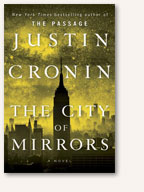
The City of Mirrors

By Justin Cronin

city_of_mirrorsI wasn’t going to review this book because it is the third in a trilogy in which I’ve already discussed the first two. However, the third book pissed me off so much that I had to rant. I am also about to spoil the hell of this book, starting right now, though I’ll throw a page break in before the more specific spoilers.

The City of Mirrors has a problem, and that problem is Timothy Fanning. The character Fanning is also known as “Zero,” as in Patient Zero, the original vampire. He is the main villain of the whole series, having orchestrated the spread of the vampire virus purposefully, though he has stayed mostly behind the scenes in the first two books.

Unfortunately, in the third book we get a much more in-depth look, via a 100-PAGE MONOLOGUE in which he gives his entire history, starting almost from birth, and it is just the most undiluted example of white male entitlement that I think I have ever read. I really wanted to believe that this was on purpose, to make a commentary on how dangerous this kind of unacknowledged privilege can be, but I had increasing suspicions that Cronin intended it to create a more complex villain with a sympathetic backstory. The monologue itself was insufferable, but the recipient of it, a previously strong woman, appears to receive it with sympathy and understanding.

Here’s where I’m about the spoil the hell of this book, by sharing a breakdown of his backstory.  Continue reading

Aristotle and Dante Discover the Secrets of the Universe

I’ve said before that I sometimes find teenage boys to be an entirely different species, and in books they so often come off sounding like the teenage dirtbags that the late, lamented Toast described so well. So I love it when I find a book that makes me feel like I completely understand its teenage narrator–a book that makes a teenage boy into a real person and not some Holden Caulfield stereotype. Aristotle and Dante Discover the Secrets of the Universe, by Benjamin Alire Saenz, is SUCH as good example of this kind of book, and is a YA book that just made me happy to read.

It’s a basic story in a lot of ways–during a hot summer in the late 1980s Ari, who is sort of a loner, becomes friends with Dante. Ari’s a smart kid with a family that is loving, but has its troubles. Dante has a nice family as well, and is dealing with his own stuff. So, you know, they’re kids trying to live their lives and do the best they can. Various plot things happen over a couple of years, some of them pretty dramatic, but they book never feels like an Afterschool Special, mostly because Ari’s narration is so calm as he tries to just go along with life and figure things out. While you could say that this is a book that deals with identity issues, and trauma, and PTSD, and showing diverse communities in books, you could also say that it’s a sweet story about friendship and family and love. I don’t want to give away too much more, but I just thought it was lovely.

Also, I read the paper book rather than listening to the audio book, but apparently the audio version is narrated by Lin-Manuel Miranda, which just seems perfect. I actually pictured him saying some of Ari’s lines as I was reading and it really worked. So if you’re an audiobook person, this books gets a little extra recommendation.

Kinsey’s Three(ish) Word Review: Sweet coming-of-age tale

You might also like:
Simon vs. the Homo Sapiens Agenda, The Beginning of Everything, Nick and Nora’s Infinite Playlist, and Maggie Stiefvater’s Raven Boys cycle are other teen boy-narrated books that I have enjoyed quite a bit.