Apple Tree Yard

First of all, if anyone reading this hasn’t seen Anna’s post from May 26, stop right here and go read that immediately, because Anna is amazing. I know that this blog is usually all about YA fiction and torturing ourselves with Atlas Shrugged, but Anna’s post is a good reminder of why we chose the name for this blog, and how important books have been and continue to be for all of us.

And now for a book review that is neither YA or Ayn Rand.

I’ve already raved here about how much I loved Gone Girl, and Anna has written about enjoying another Gillian Flynn book. For the past couple of years I’ve seen a great deal of discussion about what would be “the next Gone Girl,” and one of the suggestions that came up was the English book Apple Tree Yard.  Apple tree yard–doesn’t that sound pretty and pastoral, peaceful almost? Yeah, that not what this book is at all. But if you’ve liked any of Gillian Flynn’s creepy mysteries, I bet that you’ll enjoy this one as well.

I don’t want to give away too much of the plot, but from the beginning you understand that the main character, a British woman in her 50s, is on trial for something bad that went down when she was having an affair with a mysterious man who isn’t names until late in the book. The real story is the process, the downward spiral of exactly how the affair happened and what went so terribly wrong. The whole thing is very grim, and everything in the main character’s life–marriage, work, children–seems to have a dark cloud hanging over it. In fact, each time I closed the book I found myself feeling a bit disappointed in people and in life. Here was this woman who seemed to have made such good decisions and have such a nice life, and yet things were just rotten underneath it all and everyone and everything was sort of horrible. Much like the Gillian Flynn books, I sort of wanted to take a shower after reading.

Although there’s not a single huge twist as in Gone Girl, I found myself frantically turning pages to learn how things all went so wrong. The book also offered a nice look into the English justice system, which is a bit different than we’re used to seeing on American TV. And for the record, Apple Tree Yard is the name of a tiny London side-street where something unseemly happens. So, definitely not pastoral, but very gripping.

Kinsey’s Three Word Review: Dark courtroom drama

You might also like: Lionel Shriver’s books, which also tend to be grim, women-centered books about the tragedy of everyday life in modern England. The Post-Birthday World has been my favorite of hers so far.

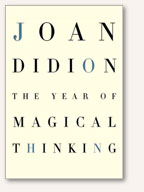
The Year of Magical Thinking

By Joan Didion

Book CoverOn Wednesday, March 19, I sat in the living room and wrote my last post on this site, while Thomas, my partner for almost eight years, lay down for an afternoon nap that he wouldn’t wake up from. Thomas had been quite ill for several months, and I thought I had to some degree prepared myself for any possible outcome, but the immediate implosion of one’s life is literally unimaginable. There is no way to prepare for this, and no way to understand it without going through it. I don’t have the words for what the past couple of months have been like; everything seems insufficient.

A couple of weeks later I ran across a copy of Joan Didion’s The Year of Magical Thinking. I went back and forth on whether to read it; I wasn’t sure I was ready, but a phrase on inside blurb resonated with me: “This powerful book is Didion’s attempt to make sense of the ‘weeks and then months that cut loose any fixed idea I ever had about death, about illness…about the shallowness of sanity, about life itself.’” I felt so cut loose myself that even reading those words felt like a stabilizing force.

The Year of Magical Thinking describes the year in which Didion’s adult daughter almost died of a sudden blood infection and her husband did die of heart failure. She describes her various emotional states, along with research she did around the psychology of grief. I could read this book when I rejected more direct help books because I could experience her story at a little bit of a distance, even while I felt “yes, this is exactly how it is” at the same time.

It wasn’t always the same, of course; it couldn’t be since grief is so personal. I also had to remind myself that Didion writes from a world of great privilege: both she and her husband are renowned authors, very comfortably off in both finances and independence. They had top-quality medical care, and Didion was able to spend all her time and resources with her slowly recovering daughter and her own slow emotional recovery. Several times I had to decide not to get resentful of what she had, but instead to take advantage of what she was giving—a thoughtfully written account that kept me from feeling quite so isolated.

Several people expressed concern about reading this book right now, since it is not an uplifting or inspirational story. However, the reality is so much worse that her words were soothing and comforting. She doesn’t have any answers because there aren’t any. Didion simply gave me a way to define, and then begin to accept, something that still often seems indefinable and unacceptable in a very literal sense.

—Anna

The Bible: Genesis 12 – 50

Okay, this is going to be broken into two sections: Genesis 12 – 36, and 38 which cover a whole lot of time and people, and Genesis 37, 39 – 50, which focuses on Joseph son of Jacob (AKA Israel) son of Isaac, son of Abraham.

Genesis 12 – 36, and 38

So, this is really difficult to summarize because it read a bit like a summary already. And not just any summary, but like the TV guide version of a really fraught soap opera. Or, given the amount of incest, prostitution, making and breaking of alliances, and the one notable wedding massacre, possibly a summary of Game of Thrones. (Although very little violent rape, which is good. Kind of. Trickery and drugged non-consensual sex: sure; Violent rape: only once and definitely shown as being bad.)

It would be difficult to track who the protagonists are, if this were any other book (my impression from getting regular summaries of Game of Thrones, it’s a bit hard to keep track of who the good guys are there, too.) The way this book is written, though, the good guys are the winners and the winners are the good guys, pretty much by fiat. It’s the opposite of the moral from the Book of Job. If you win, then God must have been on your side. And the God of Genesis is not above being the heavy in a protection racket or supporting some pretty shady characters.

While it is tricky to find a moral here, it is not bad as an entertaining soap opera, and covers a lot of different sexual and political scenarios.

I’m increasingly unimpressed with people who try to use the bible to argue for chastity. Maybe that will come later. But in Genesis, people have sex because they want a child, but they also have sex because they feel like it, or because they want to get something from it, or they’ve been given to the person so that someone else can get something from it. And while there is a sense of sanctity in marriage, it is oddly something that foreigners are expected to respect rather than the protagonists. (Abraham and Isaac both pimped out their respective wives Sarah and Rachel, and then blackmailed the men who took them up on it. And in case a reader develops too much sympathy goes to the wives: Sarah and Rachel, in turn, pimped out their servants as surrogate brood mares to their husbands. At one point, Isaac was doing stud service to four women who traded his nights between them: ah, the fraught soap opera of the women’s quarters.)

Just, wowza.

Anyway, the plot does slow down a bit later, stops skipping through generations, and focuses on a single individual: Joseph.

Genesis 37, 39 – 50

This is not to say that Joseph’s life isn’t a soap opera all on it’s own. So Joseph, the youngest but one of twelve brothers*, gets uppity with his brothers about some dreams he’s having, and how he’s going to be the greatest of them all. So, they decide that rather than killing him, they’ll sell him into slavery and tell Jacob (AKA Israel) that he was mauled to death by a wild animal.

But Joseph succeeds in life and rises in the ranks of his new master’s servants until he’s running the whole estate. Then his master’s wife tries to seduce him and when he refuses, she accuses him of rape and he gets sent to prison. From prison, he gets noticed by the Pharaoh , who elevates him to a position where he rules all of Egypt, second in power only to Pharaoh who doesn’t appear to do much at all.

Then there’s a great famine and Joseph’s brothers come to buy food from Egypt, and Joseph provides very mixed messages regarding his thoughts on his brothers. There is much trickery and lying and wailing and weeping, and eventually it all works out because all the brothers plus father Jacob and their household of 70 all move to Egypt to live with Joseph and his wife and two kids.**

You might think this is more than enough plot to keep the writing pretty adventurous, but there is still a whole lot of repetition. There will literally be a conversation that happens between two characters and then one of those characters will recount the whole of that conversation to a third character, so the reader gets to read the exact same words twice. It’s makes it a bit difficult to keep track of my place in the text.

But anyway, there’s a lot of weeping on the neck and kissing on the face in this section.

Summary: This is a soap opera.***

Moral: I’m really not noticing any type of moral in here. If there’s a moral, it’s like that of Scheherazade’s 1001 Nights: people are people and you shouldn’t believe in stereotypes because each person is an individual who may be good or evil, clever or dumb, violent or peaceful.****

* The begats continue to get to me. Not only have there been many generations, but each generation contains many siblings and a lot of them get named. And they’re so tedious that I hadn’t even noticed before that there are repetitions even in the begat sections. Names aren’t re-used for other people, no, the exact same people get listed multiple times! “Person X’s son are A, B, C, D, E, and F. The sons of person X are A, B, C, D, E, and F. The first born son of person X was A, who fathered G, H, I, J, and K. The second born son of person X was B, who fathered L, M, and N. Thus the sons of person X were A, B, C, D, E, and F.” Yes, I know, I get it already!


** Oh the begats for those 70 people.


*** I’m reminded of a Stargate/NCIS fanfiction, Stardust, in which Daniel Jackson gets amnesia (again) and discovers a bible in the hotel room he’s staying in. Without any of the cultural weight behind it, the book is actually a pretty fascinating story, and all the rest of the characters kind of grin about how enthralled he is by the story.


**** Scheherazade spent some three years telling entertaining stories to her husband, in part to convince him that people were people, some good and some evil, some honorable and some dishonorable, and knowing one honorable man and one dishonorable woman does not mean that all men are honorable or all women dishonorable. The other part of the reason was the more immediate goal of: don’t kill me before I finish the story. Who wants a show canceled on a cliff-hanger?


Up Next: Exodus

More fanfiction!

So I recently discovered that Naomi Novik (author of the Temeraire series) presented to congress about the importance of the fair use exemption, to foster creativity. Go her!

Since I was at work when I discovered this, I read the written testimony rather than watched the video, and narrowly avoided bouncing around like a crazy woman.

Anyway… it made me want to post another set of fanfic recommendations.

After my last fanfic post of massively-long stories, I’m back to recommending some short fun fics:


Infinite Use
by Elizabeth Hoot

Fandom: Pride and Prejudice by Jane Austen

Summary: I’ve always wondered what exactly went on when Lady Catherine told Darcy about her meeting with Elizabeth. There are a lot of versions of that scene, but none hit quite right. Mostly, they took a serious approach to a scene I’d always imagined as absolutely hysterical. So, with no further ado…

Why I like it: It cracks me up. Just, she really highlights the ludicrous nature of the situation. In a romance with all the serious emotional development and fraught revelations of Pride & Prejudice, this story looks at one of the off-screen scenes and shows just how hilarious it must have been. Hee.


Beautiful Ideas
by metisket

Fandom: BBC’s Sherlock.

Summary: Mike knew what would happen if he introduced John Watson to Sherlock Holmes. He knew exactly what would happen, and he did it anyway.

Why I like it: First, because it’s wonderful. More specifically, though, it takes a minor character who essentially fulfills a plot point and then never appears again and makes him a full character. That is always a wonderful thing. Even more wonderful, though, is the character, who is shown to be wickedly funny and well aware of what he’s doing.


Because Superman Is Not Evil
by Brown Betty

Fandom: Superman with a bit of Batman

No summary, but the first line is: Clark spent, perhaps, seventeen minutes when he was fourteen thinking super hearing was a cool power.

Why I like it: For those of us who are not big Superman fans, one of the primary reasons is that Superman comes across as just too perfect and good and serious in his virtue and it just not particularly sympathetic. This take on Superman, though, makes me grin. He’s still a good and virtuous person, but he’s still a person. And possibly he has his own issues with his reputation for virtue.


A Good Fight
by togina

Fandom: Marvel movies/comic books. Mostly Captain America and Avengers.

Summary: “You remember that pub in London?” Steve went on, and Tony thought that someone should have made a note in the SSR records on Captain America. Something like, ‘Subject is a brawler. Do not, under any circumstances, take him to a bar unless you’re carrying brass knuckles and possibly an RPG.’

Why I like it: This highlights a side of Captain America that is often ignored. He tends to be shown as straight-laced and obedient to authority, with a side order of naive farmboy thrown in, even though his actual backstory has him growing up poor but scrappy, in very urban Brooklyn, during the Great Depression and Prohibition. His first military action (to save Bucky) was completely rogue action on his part. He was (and is) scrappy as anything. Sure, he has a strong moral compass, but that just meant he got into more fights than he might otherwise. This is a celebration of the good guy, Steve Rogers, who also just likes to brawl sometimes.

Warning: It’s a sad state of affairs that I need to warn about a homosexual relationship, but such it is. While there’s nothing too graphic in this story, Steve Rogers and Bucky Barnes are most definitely in a relationship. (In addition, while being gay was illegal at the time of their youth, it wasn’t exactly uncommon, and they actually grew up in pretty much the center of gay Brooklyn. I would say it’s extremely unlikely that wasn’t intentional by the original creators.)

The Bible: Book of Job

I had actually read the Book of Job before, as a reading assignment in my high school English class.* Reading it again as an adult was a much different experience though. I’m all the more certain that people should not rely on their childhood studies.

I remember being really angry at the story, because God is so incredibly unfair to Job. While the text remains the same, my perspective on both the events and the dialogues gives me a very different interpretation.

The overarching structure of the story is a challenge offered by Satan and accepted by God, to test Job’s faith, but the majority of the text is a series of Plato-esque dialogues between Job and the various people who come to remonstrate with him. While the arguments are long and repetitive, I think the combination of the arguments and Job’s replies offer some seriously important lessons.

First: I’m fairly sure that Job’s wife was suggesting that Job go the Hamlet route, and avoid the slings and arrows of outrageous fortune by killing himself. To which Job replies that good and bad both come from God, and you can’t choose to just get one.

This bit reminded me of Kahlil Gibran’s The Prophet, where he writes:

But if in your fear you would seek only love’s peace and love’s pleasure,
Then it is better for you that you cover your nakedness and pass out of love’s threshing-floor,
Into the seasonless world where you shall laugh, but not all of your laughter, and weep, but not all of your tears.

Second: Job’s three friends come to tell him that since he’s being punished by God, then he must have done some pretty awful things to deserve that punishment, and maybe it’s time for him to repent and beg forgiveness. To which Job replies that, no, he doesn’t understand why he’s being punished, but he knows that he has only ever acted righteously, and has done nothing to deserve the punishment. The friends get progressively more vicious in their anger at Job’s refusal to admit to culpability. I think the moral of these three arguments and three rebuttals is to not blame the victim.

I think this is an incredibly important lesson. It’s also kind of in direct contradiction to what I’d previously recalled from Bible studies, which tend to be heavily weighed towards the lesson of the good being rewarded and the evil punished. But, no, this book acknowledges that sometimes bad things happen to good people, and that doesn’t mean they deserved it.

Third: God comes in a whirlwind to remonstrate with Job directly, but it’s interesting how the remonstration is focused. God essentially lists a long series of challenges to Job’s understanding and abilities regarding the world. Does Job know about the wild horses or the eagles or the ostriches? Did he make them in all their wildness and does he understand them? They’re all clearly rhetorical questions, and at first I thought that it was just God being something of a bully: I’m powerful, you’re not, so don’t question me. But the more I read and the more thought I gave it, I think instead, it’s more a demonstration that the world is complex, and Job is not the center of it.**

The lesson here is that Job’s punishments are not because of him at all, but part of something greater. We don’t know the full story behind Satan’s challenge to God, and all we see is Job’s part of it, and we can only take on faith that there is a purpose.***

Fourth: After Job apologizes to God about questioning his actions, God then turns to remonstrate the friends for victim-blaming. God lets them know that they’re only going to be forgiven for their sins if Job asks for forgiveness on their behalf.

Keeping in mind that this is the Old Testament, it’s still interesting to see that God’s forgiveness is not all-encompassing. In this case, the friends have been castigating a righteous man and their sin is not going to be forgiven with simple repentance. They need the forgiveness of their victim before God will grant them forgiveness.

And final thing of note: In the beginning, Job had ten children, seven sons and three daughters, who were all massacred along with their families as part of the test of Job’s faith. In the end, Job has ten more children, seven sons and three daughters, who live and prosper. Of his twenty children, only three are named, his three surviving daughters: Jemimah, Keziah, and Keren-happuch, to each of whom Job gives an inheritance to match their brothers’.

One of the things I’m increasingly aware of sexism in the modern era is the way it projects into the past. There was certainly plenty of sexism in the past, but it wasn’t nearly as pervasive as it’s generally thought. Women did many of the same things as men did, they just don’t tend to be described in the history books, and when they are described, they aren’t widely studied. Case in point: the book of Job names three of his daughters even though I had always had the impression that, like in the various begat sections, only the males get named.

I am reminded yet again, of how important it is to read this for myself rather than relying on the generalized sense of the book coming from no particular source.

Anyway, instead of concluding with a recommendation****, I’m going to end with a summation of what I think the moral is (if you disagree, feel free to comment.) The overall moral: Don’t victim-blame. Don’t assume that a victim deserves their suffering or did anything to warrant it.


* We also read the Mahabharata and Maya Angelou’s I Know Why the Caged Bird Sings. Mrs. Fort was going to teach great literature and if the school board disagreed, then they could fire her. They didn’t fire her. She was awesome!

** In addition to the long series of challenging questions about the goat and the ox and the donkey, there’s also long descriptions of the powerful might of the Behemoth and the Leviathan, that mostly left me confused. Okay, God, you created some really tough creatures. Is there a point to this description? If yes, I’m missing it.

*** I’m still not happy with the argument that you shouldn’t question the actions of God. I prefer the relationship that Raprasad Sen has with the divine, demonstrated through his poetry in honor of the Hindu goddess Kali. (Grace and Mercy in Her Wild Hair: Selected Poems to the Mother Goddess, by Ramprasad Sen, Translated by Leonard Nathan and Clinton Seely.) In his case, worship doesn’t mean blindness to faults, nor does devotion mean constant happiness. Like any other love, the pious love can include times when you’re not very pleased with the other person.

**** My overall recommendation is: If you’re a member of one of the religions that sees the Bible as holy script, then read it yourself so you know what it says, rather than relying on anyone else to tell you–if these are God’s words, then let them speak to you, rather than play telephone via someone else. If you live in a society that uses the Bible as a guide, then read it so that you know what’s truly in there and what’s not, and allows you to both understand where arguments are coming from and when they’re wrong. If you’re neither, then it’s probably still a good book to be familiar with, although maybe focus on the religious texts of your own religion and region first.


Next up: The remaining three quarters of Genesis.
The Goldfinch

Yet again, Kinsey is here to tell you to read a book that everyone on earth already knows about! This time, I’d like to refer you to the novel that just won the Pulitzer Prize, Donna Tartt’s new book The Goldfinch.

Actually, I am not here to tell everyone to read this. I ultimately thought it was great, but it also took me a month to read and was long and weird and I completely understand the people who didn’t like it and why the reviews were sort of all over the place. It’s an odd book–better, and more focused I think, than The Little Friend but not as streamlined or hard-hitting as The Secret History. I think you SHOULD read this book if:

1) You like long, rambling epics. This book is something like 800 pages long. (I read it on my Kindle so I didn’t see a page count, but man did those percentages go by slowly.) And it feels long–and like several different books, actually. It starts off in New York City as an urban, city kid story, but there’s a long stretch in the middle where the main character (Theo) is in high school in Las Vegas, and then another looong stretch as him as an adult. It was as if different stories with very different atmospheres all mushed together into one superlong story. So be prepared to make an investment.

2) You’re okay with a sense of dark foreboding. It wasn’t just the page length that made this book go so slowly for me. I kept setting the book down for days at a time because while I was desperate to find out what happened, it was so tense and all seemed so destined to end badly for Theo and the other characters that I couldn’t stand to keep reading. At one point, I was on an international flight, trapped in an seat for hours with plenty of time to finish the novel, and I was so dreading what might happen that I chose to watch a bunch of episodes of Two and A Half Men instead. I KNOW.

3) You like art (specifically Old Masters kind of art). For the two people who don’t know, the book centers around a painting that Theo accidentally takes from the Met when he end up in the middle of a terrorist attack on the museum (this sounds preposterous when I say it, but it makes sense in the book). There is A LOT of description of this painting, and other paintings that Theo ends up coming into contact with. And further, there is a lot of discussion of “art,” and of what art, and paintings, and this painting in particular mean to people’s lives and to their souls. I didn’t find this until I after I finished the book, but someone put together a genius Pinterest board that shows all of the various art work mentioned in the book–it’s a huge help to be able to actually see what Tartt is describing.

4) You don’t mind a useless/immoral main character. I certainly had sympathy for Theo  after spending so much time with him, but he’s frustrating and (especially as an adult) not a particularly admirable character. There were any number of points when I just wanted to throw my hands up and tell him that if he didn’t stop making such bad decisions I was going to have to give up on him.

So, don’t go into this book expecting a beach read, is what I’m saying. But I did like the book, and a number of the supporting characters were so great that I wish I could read 800 more pages about them (Boris!). Also, I will give away the tiniest spoiler, just because know my audience: nothing bad happens to the dog.

Kinsey’s Three Word Review: Sprawling modern saga

You might also like: Three Junes or The Whole World Over by Julia Glass, which are also dense, chewy books with New York City settings.