Swordheart by T. Kingfisher

Swordheart
by T. Kingfisher
2018

This is delightful and hilarious and a surprisingly quick read despite being fairly long. The story pulled me along as the plot goes on wild side-quests and the main character goes on wild tangents. I adore the main character, Halla, a housekeeper who had come into an unexpected inheritance that involves some really angry dis-inherited relatives that she has to avoid. She was happily living her life, more or less, and would have continued to do so if not for the need to avoid the awful relatives which has led to acquiring a magically haunted sword, running away from home, meeting bandits on the road and having to escape them, meeting police chasing the bandits on the road and having to escape them, and increasing number of hijinks that domino ever onwards.

The second main character, Sarkis, is the magically haunted sword and also a barbarian from a distant land, who is used to being used as a warrior by other warriors, and is now a companion for an escaping housekeeper and isn’t quite sure what to make of the situation. We slowly get more of his backstory over the course of the book, but (in my opinion) his true delight is to be the outside perspective on Halla and her situation. It’s hilarious!

I was also pleased to see confirmation in the afterward that this was going to be a trilogy. Since it was published in 2018, I assumed the other two would already be available. Alas! Book 2 of the trilogy is due to be published in August 2026. Hmph. I will wait.

I also realized about a quarter of the way in that Swordheart is set in the same universe as the author’s Saint of Steel series, of which I have read the first three of four:

Paladin’s Grace (Saint of Steel, Book 1)
2020

It’s actually only as I was putting together this review that I realize from the publication dates involved that these books were written after Swordheart, and thus these are in the Swordheart universe rather than vice versa. I had read a great essay about the social history of perfume and how closely perfumers were tied to alchemists and to poisoners and someone had recommend this book in the comments and it really is fabulous. Set in a generic historic fantasy setting with gods and demons and paladins, our main character Grace is a perfumer trying to make a living, but having to fight systemic sexism every step of the way. And also accusations of being a poisoner. Meanwhile, the main male character is a paladin’s who’s god has since died and thus his own status is deeply in question. I really enjoyed the deep dive into the perfuming business as well as the interesting theological perspective. After I read it, I immediately put a hold on the remaining books in the series:

Paladin’s Strength (Saint of Steel, Book 2)
2021

Paladin’s Grace had introduced four paladin’s who had survived the death of their god, and there was a book for each of them to figure out how to continue living when the religion they had devoted themselves to was so thoroughly disbanded. This is the second book and continues to do some amazing world-building on what religions there are and how they interact with one another and with their gods and I do love a deep dive into fantasy theology.

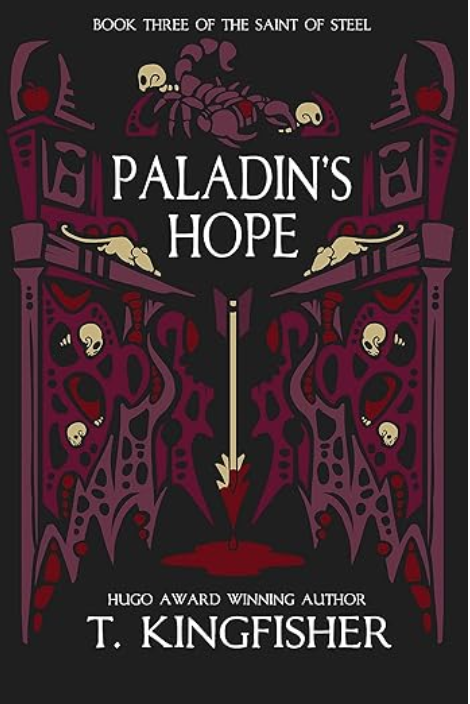
Paladin’s Hope (Saint of Steel, Book 3)
2021

This is the third book in the series and I probably should have taken a break rather than reading one book after another because I remember liking it well enough, but just loosing some steam in reading them back-to-back-to-back. I really love Kingfisher’s characters and world-building, but this book focused more on the overarching series plot of a massive villain in the background who must be routed out before they destroyed all of society or something like that and I just didn’t find it as interesting.

I’m pretty sure the reason I didn’t review these here before was because I’d been planning to review the whole series in one go but then didn’t get around to reading the final book: Paladin’s Faith. However, I’ve gone ahead and put a hold on that at my local library and plan to read it in preparation for Daggerbound being published in August 2026.

Sworn Soldier series by T. Kingfisher

I have started the spooky season off right with a pair of eerie fantasy horror novellas that I highly recommend (although admittedly not to my 6-year-old cousin for whom I had to do some quick page flipping to find a section I could read aloud without introducing any concerning concepts.)

What Moves the Dead
by T. Kingfisher (aka Ursula Vernon)
2022

This first novella is a retelling of Edgar Allen Poe’s The Fall of the House of Usher, which I actually only read in full afterwards, although I vaguely knew the gist of it through literary osmosis. The original is a bit of a slog with a lot of words about not much happening. In contrast, Kingfisher goes above and beyond in developing some of those details into full plot arcs and monster development, creating a cozy horror story that is deeply unnerving, with a wonderfully unique character to be the narrator.

Also, not to get into spoilers beyond what the cover already shows, but I feel like this book could be part of a triptych with Entangle Life and Little Mushroom to really cover the full expanse of literary discourse on fungi.

The narrator is Alex Easton, a retired soldier from Ruritania, a fictional eastern European country that apparently has a long history of being a fictional setting, and has — in this story at least — a running gag about how miserable the country is in pretty much every way, but it’s still home. An interesting twist that reminds me of the Cleric Chih series is that in the Ruritanian language, soldiers have their own dedicated pronouns, and thus anyone who doesn’t like their born pronouns can swear in as a soldier and get a soldier’s pronouns as part of the deal along with PTSD and various other injuries.

Easton is fascinating enough, that it’s no wonder that the one-off story became a series, and thus the second book is:

What Feasts at Night
by T. Kingfisher (aka Ursula Vernon)
2024

This is another cozy horror novella set in the 1880s, that follows pretty soon after the prior one where Easton is hoping to recover from the events at the House of Usher, although would have preferred to do so in an apartment in Paris rather than in an old hunting lodge in Ruritania, but events conspire to bring Easton to rural Ruritania, an unexpected death, and some deeply superstitious villagers. The characters are a delightful as they try to get along, despite having distinctly different perspectives, and the world-building perfectly creepy in the way it presents the world as dangerously uncertain about what is happening and even more uncertain about what to do about whatever is happening.

Kingfisher does an excellent job of both taking advantage of and subverting some of the standard writing tropes to keep both the reader and the characters uncertain. The supernatural elements are introduced into the world building in a way that feels all too natural and realistic.

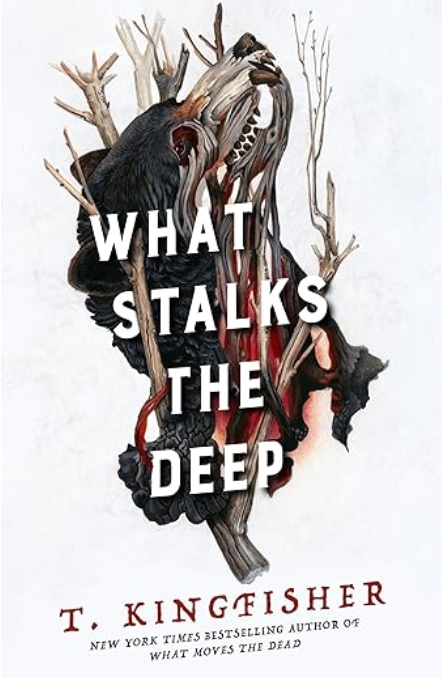
The third book in this series, What Stalks the Deep, just got published last week and I’m on the list for it as soon as it hits my library, but wanted to give it a call out here as well. It’s coming soon!