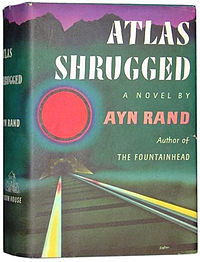
 Part 3, chapter 2: The Utopia of Greed
There’s a weird dichotomy in this whole book between what the characters are actually doing and what they (and Rand) describe them as doing.
The level of hypocrisy is pretty much on par between the good guys and the bad guys, it’s just that Ayn Rand castigates the bad guys for their hypocrisy while joining the good guys in theirs. The good guys are also happier with their hypocrisy, which makes me happy. While I sure would appreciate a few sincere people, I definitely prefer happy hypocrites to unhappy hypocrites.
Plus, I also prefer people who act in a way I can support, even if they mouth words I disagree with, to people who mouth words I agree with while acting in a way I dislike. Thus, even though Ayn Rand is saying “Greed is Good,” what she’s actually showing is closer to Marianne Williamson’s quote:
“Our deepest fear is not that we are inadequate. Our deepest fear is that we are powerful beyond measure. It is our light, not our darkness that most frightens us. We ask ourselves, Who am I to be brilliant, gorgeous, talented, fabulous? Actually, who are you not to be? You are a child of God. Your playing small does not serve the world. There is nothing enlightened about shrinking so that other people won’t feel insecure around you. We are all meant to shine, as children do. We were born to make manifest the glory of God that is within us. It’s not just in some of us; it’s in everyone. And as we let our own light shine, we unconsciously give other people permission to do the same. As we are liberated from our own fear, our presence automatically liberates others.”
— Marianne Williamson, A Return to Love: Reflections on the Principles of a Course in Miracles
This, I can agree with whole-heartedly.
Be successful, not by dragging other people down but by building yourself up. Yes!
Anyway, the summary is going to be vague because it’s less a series of events and more a lot of description and philosophy. After that, I’ll have a few comments and a small rant.


 Biblio-therapy