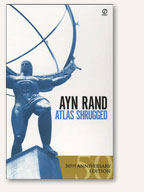
Atlas Shrugged, part 3, chapter 1

Part 3, Chapter 1

Ha-ha-ha!

Just… I can’t even…

Ha-ha-ha! Ha! Ha-ha-ha! Ha-ha-ha!

This is awesome. It is so incredibly ludicrous. This is John Galt’s solution? Ha-ha-ha! Ha-ha-ha!

Hee!

It’s just, okay, the internal contradictions are pretty extreme, ranging from specifics to whole societal structures.

For some non-spoilery specific examples:

“There were no superfluous objects, but she noticed a small canvas by a great master of the Renaissance, worth a fortune, she noticed an Oriental rug of a texture and color that belonged under glass in a museum.” (I don’t think “superfluous” means what she thinks it means. Plus, it’s a run-on sentence.)

“The streets were empty when I left that theater, I was the last one to leave—and I saw a man whom I had never seen before, waiting for me in the light of a lamppost.” (How many people does it take to have a street not be empty?)

Anyway, first a summary of events, short and sweet:

Continue reading

Atlas Shrugged, part 2, chapter 10

AtlasShruggedIn many ways, this book reminds me of reading Edith Wharton’s The House of Mirth. I read that book as assigned reading in college and it was just painful. It was well written, but that actually made the pain worse, because I spent several hours reading about this one character making bad decision after bad decision. Up until the very end, there was always a chance for her to change directions, to fix her problems, or at least mitigate them.  She just never managed to act on those chances.

I see Dagny in much the same way. She has these opportunities to turn things around. She has the connections and the opportunities to force people—in industry, in government, and in the general population—to listen to her.  These opportunities keep on coming up and she wastes them, time and time again. It’s painful to read.

The one time that she actually deigns to explain herself, back when she was introducing the John Galt line to the press, she explains herself in the most useless way possible.  (A hint: if you’re trying to convince either a person or a large group of people to side with you, explain why it is to their benefit to do so rather than to your own. For instance, don’t write a job application saying why you need a job, write a job application saying why the company needs you.) For all that Dagny and Rearden look downs at the idiot masses in this book who beg for money and goods, they don’t do anything different themselves when they talk about money and profit.

Anyway, I think this may all be over! This is the last chapter of the second section and not only does it contain my second favorite scene so far (right after Dagny’s ride on the first train on the John Galt line), it sets up the next section to be quite different. I am very excited.

First a summary of events:

Continue reading

The Age of Miracles and Where’d You Go, Bernadette

Okay, who could use a little break from all the Atlas Shrugged? Anna and Rebecca are both heroes, as far as I’m concerned, both for plowing through all those pages and for writing it all up so as to spare the rest of us from reading it. But I have to say that each time I read one of those entries, I am reminded how thankful I am to be reading enjoyable, non-creepy, non-propaganda books. So let’s talk about two of them: The Age of Miracles by Karen Thompson Walker and Where’d You Go, Bernadette by Maria Semple.

As a general rule, I don’t like books that feature children as the main characters. I’m not talking about young adult books here–those are almost always told from the perspective of a kid or teenager and those are great. I’m talking about “literature” by adult for adults that uses a child as a narrator. I find that way too often this is clever trick writers use to show off, and I find that it often comes off treacly and condescending. However, both of these books feature pre-teen young girls as main characters and although the stories are very different, they both work really well.

Walker’s book might actually be a YA book, but it reads to me very grown-up, and almost like a lengthy short story. It’s got a fascinating premise: one day the rotation of the earth starts slowing down, lengthening the days and nights and fundamentally changing life on the planet. The main character is a twelve-year-old girl who is trying to deal with typical middle-school friend/boy/parent issues, while everything we understand about time and the planet changes around here. It’s written as if the character is looking back from a much later perspective, but the story is not about what ultimately happens to the planet, it’s about how this girl experiences the changes. It’s sad and beautiful and disturbing–I couldn’t put it down.

Kinsey’s Three Word Review for The Age of Miracles: Sparse, elegiac memories.

You might also like: Susan Beth Pfeffer’s The Last Survivors series.

Where’d You Go, Bernadette has been getting rave reviews all over the place and with good cause–it is absolutely charming. The main character in this book is also a middle-school girl, who is trying to figure out what has happened to her mother, who has disappeared. That description doesn’t sound charming, does it? But it is, I promise! It’s told primarily through emails, news stories, interviews, and other “primary” materials that Bee (the main character) uses to try to piece together what happened to her mother. Most of the action takes place in Seattle and the portrayal of the culture of the Northwest is pretty scathing, but each character, even those that start off as caricatures, end of being really interesting, complete people. I just loved the whole thing.

Kinsey’s Three Word Review for Where’d You Go Bernadette: Delightful, funny, wistful.

You might also like: The Family Fang by Kevin Wilson
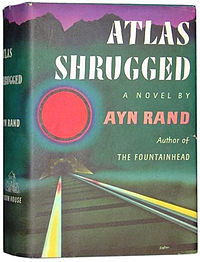
Atlas Shrugged (random musings at the half-way point)

By Ayn Rand

Cover: Atlas ShruggedOkay, so I lied about the previous post being my last for the week, but I have to celebrate making it to the halfway point somehow. It is all coasting downhill from here on out, right?

I’m working (sort of) at trying to understand the philosophy behind this book.* The idea of the poor little rich guys being forced by an equalitarian government into supplying their innovations to unappreciative consumers who believe it is their right to get any new product, not a privilege for which they have to work, is hard for me to wrap my mind around – not because I believe that her argument against such a thing is wrong, per se, but because it doesn’t bear any resemblance to the world around me at all.

It is the rare CEO nowadays that actually has direct involvement in the production of his or her company, which leads to more and more of them looting their own companies. In fact, today’s CEOs and Presidents more closely resemble Rand’s despised Washington men than any Hank Rearden or Dagny Taggert. (As an aside, even Rand’s protagonists seem to want their cake and to eat it, too: they complain of the inefficient officials who are always blaming their ineptitude on “unforeseen” and “unpreventable” circumstances, but whenever something interferes with the protagonists’ efficiency, it always turns out to be unforeseen and unpreventable, as well.)

However, as I was mulling this over, a Metallica song came on, and I started thinking about their history. They were on the forefront of the battle against illegal downloading of music, and got a ton of flack for basically being selfish and money-grubbing. Musicians in general are creators and innovators who are caught between unfavorable contracts to corrupt studios and consumers who are trying to fight back against the price inflation of the studios. Honestly, Lars Ulrich is this generation’s Hank Reardon!

Several days later, though, another thing occurred to me, though: when trying to get paid for his work, Lars Ulrich was asking for government regulations to stifle a new technology, which is what the bureaucrats do in Atlas Shrugged. So, he is actually both sides of the coin, really, which is a bit of a gray area that exists a lot in the real world and not at all in this novel.

—Anna

*Tom and I had a short discussion on whether you can call yourself “trying to understand” something when you are simultaneously unwilling to let go of your disdain for it, and I was arguing that you cannot, which seems to have come back to bite me in the ass for Atlas Shrugged.

Atlas Shrugged (Section 2, Chapters 8 and 9)

By Ayn Rand

Cover: Atlas ShruggedA double shot for my last recap of the week!

Have we already mentioned how we are getting through this book? Rebecca and I have both found that the best place to read is at the gym because it combines two very unpleasant activities. Whenever Atlas Shrugged gets too much for me, I put it down for a bit, but then I don’t have anything to distract me from the stationary bike, so I just pick it up again. I did a lot of bicycling for these two chapters.

Continue reading

Atlas Shrugged (Section 2, Chapter 6)

By Ayn Rand

Cover: Atlas ShruggedHappy Valentine’s Day, ya’ll! Here’s some more Atlas Shrugged for you.

In previous chapters, Rand dismissively called characters “college boys,” which I had figured was her shorthand for young adults who were long on theory and short on practice. This chapter, however, really brings out all the anti-intellectualism in force with quotes like:

“Walter Mouch came from a family that had known neither poverty nor wealth nor distinction for many generations; it had clung, however, to a tradition of its own: that of being college-bread and, therefore, despising men who were in business.”

and, “I know what I’m talking about. That’s because I never went to college.”

Continue reading

Atlas Shrugged (Section 2, Chapter 5)

By Ayn Rand

Cover: Atlas ShruggedSo, all hell’s breaking loose now, and I don’t know what’s wrong with me, but I’m kind of enjoying reading about it. Since the Ellis’ oil fields literally went up in flames, the coal industry has been overdrawn, and the trains can’t get their coal orders in a timely fashion. The trains then fail to deliver necessary parts to the various factories, and they promptly all go out of business. It’s kind of a satisfying domino effect, and at least things are happening. Continue reading

Greek Mythology

DaulairesBookOfGreekMythsIt has been a while since I’ve read any Greek Mythology, but I grew up with D’Aulaires’ Book of Greek Myths. One of my friends in college was a Classics major. If you’re interested, you can read about these myths online:

Theoi Greek Mythology: Exploring Mythology in Classical Literature & Art

Greek Mythology

Greek Mythology on Wikipedia

In particular, you can read about both Atlas and Prometheus. And you should, because it really pisses me off that Francisco definitely and Rand probably, in Atlas Shrugged, are getting their myths so horribly wrong.

Prometheus delivered fire/intelligence to the people. Then Zeus, being mad that the people are now slightly more godlike, punishes Prometheus by chaining him to a rock and sending vultures to eat his liver on a daily basis. Prometheus refuses to recant his beliefs or apologize for his actions and thus the punishment continues.

Saying that John Galt is like Prometheus except that he broke his chains, and took the fire back until the people took back their vultures is like saying that John Galt was a man who stood up to bullies, but when the bullies attack him instead, Galt decided it was too much so he left until the bullies returned to their original targets.

And this is supposed to be the person that Francisco thinks is honest and worthy and good? It makes me think Galt is a wimp who can’t stand by his own convictions and will go running home whenever the going gets tough.

I can only assume that Francisco got his mythology wrong. The misapplication of the Prometheus myth in chapter 5, made me double check the Atlas mythology, which is a good thing because Francisco got that one wrong, too, way back in some previous chapter.

First of all, Atlas is not holding up the world, he’s holding up the heavens, preventing the two from mixing back into primordial goop.  Second, holding it up is a punishment. Atlas was a Titan who fought against Zeus and lost. Holding up the heavens is not a choice or anything done for altruistic reasons. He can’t set it down. He can’t shrug.  Francisco saying that if he were Atlas, then he would just shrug, is a bit like him saying that if he were in prison, he would just leave. It’s not exactly an option!

Go read the actual mythology, people!

Atlas Shrugged (“Who is John Galt?”)

By Ayn Rand

Here’s where the live blogging gets a bit messy: by recapping as we go through it, we often decide to either not mention or put off mentioning something until it proves itself important. But the whole John Galt thing is sort of gradually gaining in importance, so there hasn’t been a good time to really address it head-on (yet) and we probably should have mentioned it beforehand. So, to catch up, here’s a quick run-down of John Galt: Continue reading