The Bible: Numbers

While not neatly divided into sections, there are really two themes in the book of Numbers*: ledgers and travelogues. Plus a really disturbingly positive view on genocide.

First: Ledgers

This book is appropriately named Numbers because it’s chock full of them. We have the results of two census, instructions on camp layout, a donation ledger, descriptions of a bunch of maps, plus a lot of additional instructions for how to make sacrifices.

The camp layout and census information was long and detailed enough that I thought it would be useful to create an info graphic, to get a sense of what all the numbers mean. You can see the results below:


Numbers

The donations ledger was both detailed and incredibly repetitive. Each day for twelve days, the exact same offerings/sacrifices were made, in the same order and for the same amounts. And over the course of 77 verses, those offerings/sacrifices were listed twelve times. I decided that this needed an infographic too, so I’ve included one below:
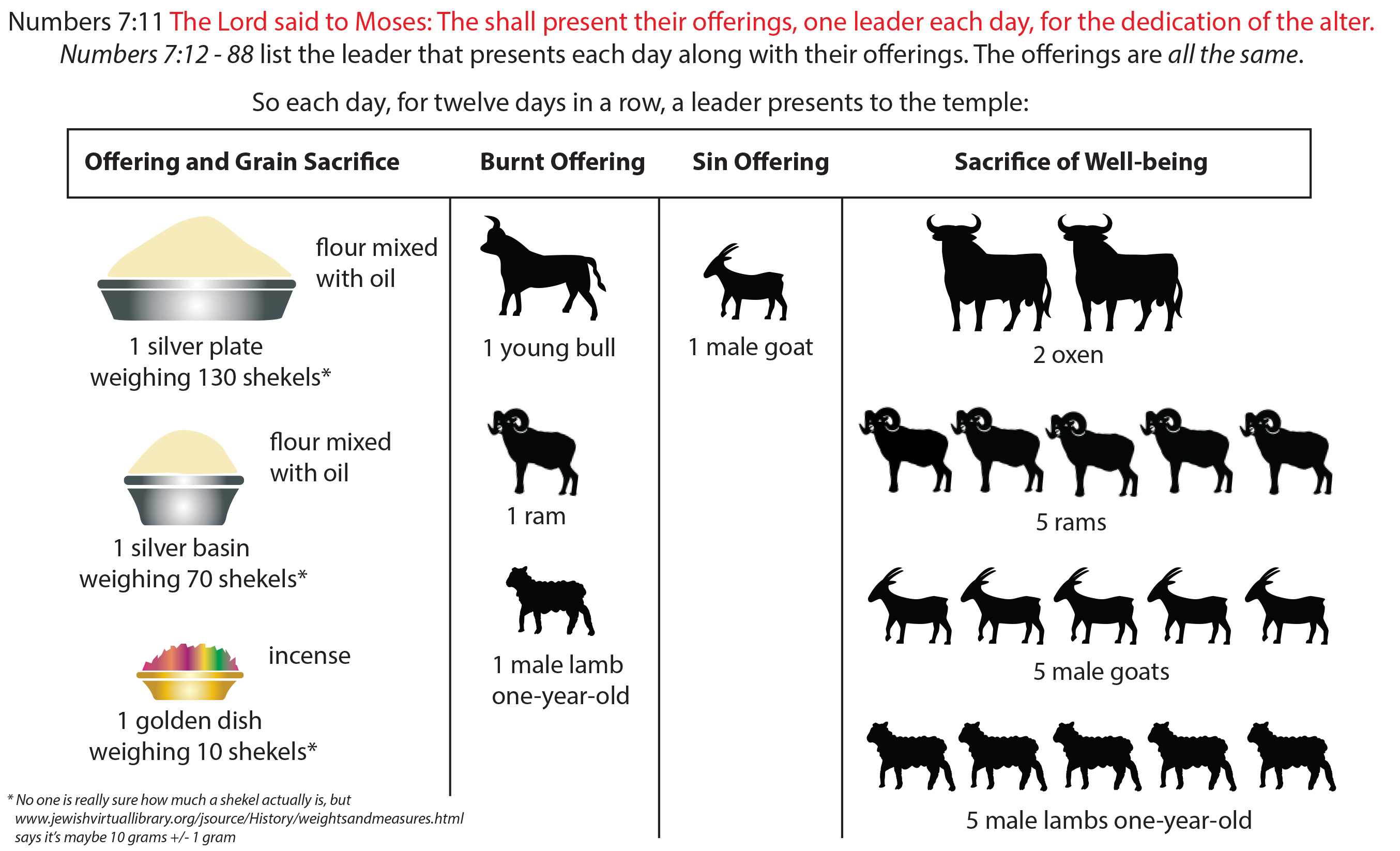
Numbers 7

Second: Travelogues

There are also a bunch of stories about different characters. These stories are each so complex and yet so concise that there’s not much point in summarizing them. They include several failed rebellions against Moses’ leadership, several stopped (or at least restricted) massacres by God of the Israelites**, and a foreign magician who is repeatedly hired to curse the Israelites but blesses them each time instead.

The one story that really stood out to me*** was in Numbers 20:14-21. This is the first time I felt any real sense of apprehension about the events. Moses sends a message to the King of Edom requesting permission to pass through the lands of Edom. The message is all nice and sweet, asking for permission and promising to do no harm, and I just thought to myself: say ‘no’, something terrible will happen to you if you say ‘yes’. And luckily Edom said ‘no’—politely, firmly, and without insult or excuse—and the Israelites traveled a different way and I felt so much relief for Edom managing the avoid so many travesties.

Not many other people were able to avoid the repercussions of coming into contact with them.

Keep in mind that at this point the Israelites are a landless, traveling army-nation of between 603,550 and 601,730 warriors along with their families and their herds of cattle, sheep, and goats. God is appearing to them as a fire at night and a dark cloud during the day. When the dark cloud moves, the whole army nation packs up and moves too, settling down only when the dark cloud stops and they can settle the temple around/under God.

And this God has given them many rules to live by but also promised them a land of milk and honey that already belongs to other people, with the instructions that they will simply take that land from those other people.

Which brings us to the prevalence of genocide.

While there’s many examples of genocide in this book, Numbers 21:3**** and Numbers 21:34-35***** are good examples of casual slaughters, Numbers 31 contains the one I find the most horrific because it’s the most specific.

Back in Numbers 25, we discover that some of the men of Israel had started to date some of the women of Moab and been invited into Moab homes and temples. God was infuriated and started a plague that killed 24,000 Israelites and only ended when one of the Israelite priests skewered an Israelite man and a Moabite woman on a spear in the man’s tent.

Well, in Numbers 31, God demands “revenge” on Moab, apparently for their women dating the men of Israel. So Moses calls together a war party of 12,000. These soldiers go into Moab kill every last man and burn to the ground every last town, but took back with them all the treasure they could carry, all the herds of animals, and all the women and children.

When the war party returns to the Israelite encampment, Moses is enraged because the soldiers hadn’t killed enough people. They weren’t supposed to take the women and children captive, they are only allowed to take the female children captive.

Numbers 31:17-18: Now therefore, kill every male among the little ones, and kill every woman who has known a man by sleeping with him. But all the young girls who have not known a man by sleeping with him, keep alive for yourselves.

And because this is the Book of Numbers, we know the numbers: once the soldiers were done slaughtering their prisoners, there were still 32,000 virgin girls as prisoners to distribute to the various tribes. Making the (somewhat dubious) assumption that the Moab population consisted of equal numbers of adult men, adult women, male children, and female children, this means that the soldiers invaded and killed 32,000 Moab men in the land of Moab, and then killed an additional 64,000 of their prisoners (adult women and male children) at the border of the Israelite camp.

I’ve actually been researching various genocides of the 20th century for my day job and there are some pretty horrifying details. And knowing the details of some of those genocides gives me a more realistic perspective on these biblical genocides which I might have been able to skim past when I was much younger.

I really want some door-to-door missionaries to come around soon so I can ask them about their take on the Old Testament and then possibly yell at them.


Summary: God is a micromanager and the Israelites are a landless army-nation that is traveling across the land killing wherever they go.

Moral: You want as little to do with God as you can get away with.


* I’ve switched translations from the English Standard Version Bible (that I was reading on my kindle) over to The New Revised Standard Version Bible (for which I have a hardcopy.)

** The argument that really seems to hold weight with God regarding why he shouldn’t just kill all the Israelites is that so many people saw God claim the Israelites as his own and God would be seen as weak and ungodly if they were to all die. (Numbers 14 and 16)

*** Although Numbers 23:19 actually made me laugh out loud, because Balaam (the magician) speaks his prophesy and talks about how God never changes his mind. God changes his mind all the time, mostly about whether or not to kill all of his chosen people.

**** Numbers 21: 3 The Lord listened to the voice of Israel, and handed over the Canaanites; and they utterly destroyed them and their towns; so the place was called Hormah.

***** Numbers 21:34-35: But the Lord said to Moses, “Do not be afraid of him; for I have given him into your hand, with all his people and all his land. You shall do to him as you did to King Shihon of the Amorites, who ruled in Heshbon.” So they killed him, his sons, and all his people, until there was no survivor left; and they took possession of his land.


Next up: Deuteronomy

The Bible: Leviticus

I had a road trip recently, so I checked out the book-on-tape version of Leviticus and am quite glad I did so, because, wow, would I have bogged down in this if I had tried to read it. It is pretty much a combination how-to manual for sacrifices and a law-book combined.

Chapters 1 – 9 cover sacrifices. All the sacrifices. There are burnt offerings and grain offerings and incense. There are sacrifices to remove sin, to please the Me, and to make requests. There are all the different animals that can be used (although only those without blemish!) depending on intent and income. And grains and oils. (No yeast. Yeast is bad for sacrifices. God is quite repetitive and adamant on the topic of yeast.)

And then there are the ways in which the sacrifice is to be performed by the priests, and what is to be burned entirely (to make an aroma pleasing to Me) and what can remain to be eaten, and who can eat it and where they can eat it.

(I’ll address Chapter 10 below.)

Chapters 11 – 17 list the many (many, many) reasons for needing to make a sacrifice. There are the many holy days that require celebrating over many days and many sacrifices. And then there are the many ways in which a person naturally becomes unclean (having a rash, women having their period, men having a wet dream, anyone having sex, eating something unclean, touching a dead body, touching something that has touched something unclean, a leader or priest in power becoming unclean, etc.)

Listening to this in the car with the modern translation by the American Bible Society, I was really struck by how much God comes across as a picky kid listing all the things that disgust him. (Bodies. Bodies disgust him. And all the things they do. Age and blemishes and sex and reproduction.) But there’s also the sense that he wants to keep the sacrifices coming on a regular basis, so you’d better keep getting unclean and needing to make regular sacrifices. But don’t worry if you’re not getting unclean often enough: there are still all the holidays and regular sacrifices!

Chapters 18 – 27 still talk some about sacrifices, but focus more on just rules rather than shilling for sacrifices. The rules are many and varied but there’s a large focus on how selling property and slaves works. (It works, incidentally, differently for Israelites than for foreigners, and differently for Levites than for any of the other Israelites, and is all structured around a seven-year cycle, at the end of which purchases of land and people largely disappear and ownership reverts.)

Anyway, Chapter 10 is the only part of this book that involves plot and characters. God once more demonstrates questionable behavior: The high priest Aaron has four sons who are also priests. Two of them manage to burn incense in a manner displeasing to God, so God kills them. Since they were killed for displeasing God, their bodies got dragged out of camp and their father and brothers told they weren’t allowed to mourn for them. Because those guys burned incense incorrectly.*

And finally, I can’t review Leviticus without at least acknowledging the two infamous Leviticus verses:

18:22 You shall not lie with a male as with a woman; it is an abomination.

20:13 If a man lies with a male as with a woman, both of them have committed an abomination; they shall surely be put to death; their blood is upon them.

These were so embedded in the lists of things that deserve death and/or exile that they lost some of their power, especially as the incorrect usage of incense apparently also deserved death. I think if I were an orthodox Jew who kept strictly kosher, I would need to do some soul searching on these strictures, but I’m not. I agree with the rules against incest** and bestiality, but I come to that agreement from a different motive than just differentiating myself from the Hitites et al (as in chapter 18) or avoiding a stoning (as in chapter 20). I don’t agree with the rule against homosexuality and because I don’t agree with God’s reasons as stated here, I see no reason to not disagree with the rules. It did occur to me for the first time, though, that it’s a very gender-specific law. God has plenty of issues with women and menstruation and childbirth (women must spend about a quarter of their lives “unclean”), but there’s nothing saying they shouldn’t have sex with one another.

Summary: How and why to perform sacrifices. How and for how much, to sell property and people.

Moral: Obedience. Blind obedience or else you will die a horrible death. Wowza.


* Admittedly, I kind of assume that the historical basis is that the two priests somehow managed to set their fancy robes on fire while burning the incense.

** Nearly the entirety of Chapter 18 consists of the different forms of incest that are now unlawful. Many of these forms, I recognize as being applauded in Genesis. Hopefully this means that going forward, there will be less incest. Here’s hoping.

Next up: Numbers

The Bible: Exodus

So…

That happened.

I’m familiar with the story, of course, but reading this felt a bit like reading an original Grimm fairy tale after growing up on Disney.

I had three main reactions:

First:

I’m not sure how to say this without being horribly offensive, so I’m just going to say it:

In my opinion, the god in Exodus reads a whole lot more like a demon than a god.

What really got to me in this book was that not one person wanted God’s attention or intervention. God makes demands of and threatens his chosen people and his enemies alike.

The Israelis were unhappy as slaves, but it had been generations since God had paid them any attention at all so they never asked for anything, and when God did decide to intervene, their situation got so much worse that they begged God and Moses to just let them be.

Moses himself was an unwilling prophet. He had committed murder and had run away before he ever met God. Out in the wilderness, God gets to Moses and demands that Moses be his prophet and doesn’t take “no” for an answer.*

Repeatedly, the Israelis tell Moses and God to stop trying to help them.

Instead, God intentionally makes things worse for them in order to demonstrate His power. Every time Pharaoh decides to give in to Moses demands to let the Israelites go, God hardens Pharaoh’s heart** so that Pharaoh refuses to let the Israelites go and God gets the chance to kill more Egyptians in a display of power. The death-toll is both tremendous and also completely intentional.***

Second:

After the Israelites get out of Egypt, Moses goes up Mount Sinai to speak with God and comes back with the stone tablets with the Ten Commandments. That’s pretty common knowledge. I was also already pretty familiar with the rest of the judiciary-type rules stated in Exodus 20-23.

However, somehow I had never before noticed God’s demands in Exodus 25-31 where Moses is given detailed instructions for how God wants his temple to be constructed and what he wants his priests to wear. God has some extremely specific concepts of what he wants and how he wants it. I can only assume that God gave Moses some illustrations in addition to the verbal descriptions written down for me to read, because the instructions for how to take large expanses of cloth and turn them into a tent by means of 50 loops didn’t make a whole lot of sense to me.

One thing that wasn’t immediately evident from the text but that Anna pointed out when I was talking it through with her later, was that the rules set forth in Exodus 25-31 were revolutionary for the time. They were both revolutionary and extremely liberal, because they defined rule of law. Here is potentially a first step away from a straight-up might-makes-right culture, with God setting down a basic code of laws that everyone must obey, poor and wealthy alike.

But the rules are not actually that long. There’s a lot more time spent describing exactly how the temple was to be constructed and then how it was constructed, along with what the priests were to wear, down to their high quality linen underwear so that they don’t expose themselves in the temple.

And third:

There’s a lot of foreshadowing of future conflict, for all that God promises a land of milk and honey for his Chosen people. He promises this glorious land, but also specifically states that he’s going to run off a whole bunch of other people who were there first.**** I am strongly reminded of Nina Paley’s This Land is Mine animation.


Summary: God is playing a game and using all the people as pawns.

Moral: Maybe blind obedience? When a power as strong as God decides to pay attention to you, your best bet is to be unquestioningly obedient because nothing else will help and obedience just might? I don’t know. I’m certainly not a religious scholar. If anyone else has any ideas, please comment and let me know.


* Moses apparently really does not like confrontations and gets stage fright too awful to be able to demand anything of anyone. God, who apparently can only work miracles through Moses at this point, assigns his mouthpiece a mouthpiece of his own, and Aaron comes along to speak for Moses who speaks for God.

** That level of mind control also makes me deeply uncomfortable. I couldn’t help but sympathize with Pharaoh who must have felt like he was going insane.† Pharaoh wasn’t capable of making logical decisions or react naturally to events because every time he did something to make himself less evil, God made him change his mind.

† Not that he was particularly sane to begin with. Example: Pharaoh refused Moses’ first few demands because the first few miracles Moses performed were things that Pharaoh’s own magicians were capable of replicating, ie, Pharaoh doubled several of the early plagues by having his magicians duplicate them. Why did he think that was a good idea?

*** God is quite bloodthirsty. Even after the Isrealites have left Egypt behind, when they make God angry, the Levites are the clan to follow Moses’ command to slaughter their friends and families. They killed 3,000 of their own in a single night and are much rewarded for that.

**** Exodus 33:2   And I will send an angel before thee; and I will drive out the Canaanites, the Amorites, the Hittites, the Prizzites, the Hivites, and the Jebusites.

Next up: Leviticus

The Bible: Genesis 12 – 50

Okay, this is going to be broken into two sections: Genesis 12 – 36, and 38 which cover a whole lot of time and people, and Genesis 37, 39 – 50, which focuses on Joseph son of Jacob (AKA Israel) son of Isaac, son of Abraham.

Genesis 12 – 36, and 38

So, this is really difficult to summarize because it read a bit like a summary already. And not just any summary, but like the TV guide version of a really fraught soap opera. Or, given the amount of incest, prostitution, making and breaking of alliances, and the one notable wedding massacre, possibly a summary of Game of Thrones. (Although very little violent rape, which is good. Kind of. Trickery and drugged non-consensual sex: sure; Violent rape: only once and definitely shown as being bad.)

It would be difficult to track who the protagonists are, if this were any other book (my impression from getting regular summaries of Game of Thrones, it’s a bit hard to keep track of who the good guys are there, too.) The way this book is written, though, the good guys are the winners and the winners are the good guys, pretty much by fiat. It’s the opposite of the moral from the Book of Job. If you win, then God must have been on your side. And the God of Genesis is not above being the heavy in a protection racket or supporting some pretty shady characters.

While it is tricky to find a moral here, it is not bad as an entertaining soap opera, and covers a lot of different sexual and political scenarios.

I’m increasingly unimpressed with people who try to use the bible to argue for chastity. Maybe that will come later. But in Genesis, people have sex because they want a child, but they also have sex because they feel like it, or because they want to get something from it, or they’ve been given to the person so that someone else can get something from it. And while there is a sense of sanctity in marriage, it is oddly something that foreigners are expected to respect rather than the protagonists. (Abraham and Isaac both pimped out their respective wives Sarah and Rachel, and then blackmailed the men who took them up on it. And in case a reader develops too much sympathy goes to the wives: Sarah and Rachel, in turn, pimped out their servants as surrogate brood mares to their husbands. At one point, Isaac was doing stud service to four women who traded his nights between them: ah, the fraught soap opera of the women’s quarters.)

Just, wowza.

Anyway, the plot does slow down a bit later, stops skipping through generations, and focuses on a single individual: Joseph.

Genesis 37, 39 – 50

This is not to say that Joseph’s life isn’t a soap opera all on it’s own. So Joseph, the youngest but one of twelve brothers*, gets uppity with his brothers about some dreams he’s having, and how he’s going to be the greatest of them all. So, they decide that rather than killing him, they’ll sell him into slavery and tell Jacob (AKA Israel) that he was mauled to death by a wild animal.

But Joseph succeeds in life and rises in the ranks of his new master’s servants until he’s running the whole estate. Then his master’s wife tries to seduce him and when he refuses, she accuses him of rape and he gets sent to prison. From prison, he gets noticed by the Pharaoh , who elevates him to a position where he rules all of Egypt, second in power only to Pharaoh who doesn’t appear to do much at all.

Then there’s a great famine and Joseph’s brothers come to buy food from Egypt, and Joseph provides very mixed messages regarding his thoughts on his brothers. There is much trickery and lying and wailing and weeping, and eventually it all works out because all the brothers plus father Jacob and their household of 70 all move to Egypt to live with Joseph and his wife and two kids.**

You might think this is more than enough plot to keep the writing pretty adventurous, but there is still a whole lot of repetition. There will literally be a conversation that happens between two characters and then one of those characters will recount the whole of that conversation to a third character, so the reader gets to read the exact same words twice. It’s makes it a bit difficult to keep track of my place in the text.

But anyway, there’s a lot of weeping on the neck and kissing on the face in this section.

Summary: This is a soap opera.***

Moral: I’m really not noticing any type of moral in here. If there’s a moral, it’s like that of Scheherazade’s 1001 Nights: people are people and you shouldn’t believe in stereotypes because each person is an individual who may be good or evil, clever or dumb, violent or peaceful.****

* The begats continue to get to me. Not only have there been many generations, but each generation contains many siblings and a lot of them get named. And they’re so tedious that I hadn’t even noticed before that there are repetitions even in the begat sections. Names aren’t re-used for other people, no, the exact same people get listed multiple times! “Person X’s son are A, B, C, D, E, and F. The sons of person X are A, B, C, D, E, and F. The first born son of person X was A, who fathered G, H, I, J, and K. The second born son of person X was B, who fathered L, M, and N. Thus the sons of person X were A, B, C, D, E, and F.” Yes, I know, I get it already!


** Oh the begats for those 70 people.


*** I’m reminded of a Stargate/NCIS fanfiction, Stardust, in which Daniel Jackson gets amnesia (again) and discovers a bible in the hotel room he’s staying in. Without any of the cultural weight behind it, the book is actually a pretty fascinating story, and all the rest of the characters kind of grin about how enthralled he is by the story.


**** Scheherazade spent some three years telling entertaining stories to her husband, in part to convince him that people were people, some good and some evil, some honorable and some dishonorable, and knowing one honorable man and one dishonorable woman does not mean that all men are honorable or all women dishonorable. The other part of the reason was the more immediate goal of: don’t kill me before I finish the story. Who wants a show canceled on a cliff-hanger?


Up Next: Exodus

The Bible: Book of Job

I had actually read the Book of Job before, as a reading assignment in my high school English class.* Reading it again as an adult was a much different experience though. I’m all the more certain that people should not rely on their childhood studies.

I remember being really angry at the story, because God is so incredibly unfair to Job. While the text remains the same, my perspective on both the events and the dialogues gives me a very different interpretation.

The overarching structure of the story is a challenge offered by Satan and accepted by God, to test Job’s faith, but the majority of the text is a series of Plato-esque dialogues between Job and the various people who come to remonstrate with him. While the arguments are long and repetitive, I think the combination of the arguments and Job’s replies offer some seriously important lessons.

First: I’m fairly sure that Job’s wife was suggesting that Job go the Hamlet route, and avoid the slings and arrows of outrageous fortune by killing himself. To which Job replies that good and bad both come from God, and you can’t choose to just get one.

This bit reminded me of Kahlil Gibran’s The Prophet, where he writes:

But if in your fear you would seek only love’s peace and love’s pleasure,
Then it is better for you that you cover your nakedness and pass out of love’s threshing-floor,
Into the seasonless world where you shall laugh, but not all of your laughter, and weep, but not all of your tears.

Second: Job’s three friends come to tell him that since he’s being punished by God, then he must have done some pretty awful things to deserve that punishment, and maybe it’s time for him to repent and beg forgiveness. To which Job replies that, no, he doesn’t understand why he’s being punished, but he knows that he has only ever acted righteously, and has done nothing to deserve the punishment. The friends get progressively more vicious in their anger at Job’s refusal to admit to culpability. I think the moral of these three arguments and three rebuttals is to not blame the victim.

I think this is an incredibly important lesson. It’s also kind of in direct contradiction to what I’d previously recalled from Bible studies, which tend to be heavily weighed towards the lesson of the good being rewarded and the evil punished. But, no, this book acknowledges that sometimes bad things happen to good people, and that doesn’t mean they deserved it.

Third: God comes in a whirlwind to remonstrate with Job directly, but it’s interesting how the remonstration is focused. God essentially lists a long series of challenges to Job’s understanding and abilities regarding the world. Does Job know about the wild horses or the eagles or the ostriches? Did he make them in all their wildness and does he understand them? They’re all clearly rhetorical questions, and at first I thought that it was just God being something of a bully: I’m powerful, you’re not, so don’t question me. But the more I read and the more thought I gave it, I think instead, it’s more a demonstration that the world is complex, and Job is not the center of it.**

The lesson here is that Job’s punishments are not because of him at all, but part of something greater. We don’t know the full story behind Satan’s challenge to God, and all we see is Job’s part of it, and we can only take on faith that there is a purpose.***

Fourth: After Job apologizes to God about questioning his actions, God then turns to remonstrate the friends for victim-blaming. God lets them know that they’re only going to be forgiven for their sins if Job asks for forgiveness on their behalf.

Keeping in mind that this is the Old Testament, it’s still interesting to see that God’s forgiveness is not all-encompassing. In this case, the friends have been castigating a righteous man and their sin is not going to be forgiven with simple repentance. They need the forgiveness of their victim before God will grant them forgiveness.

And final thing of note: In the beginning, Job had ten children, seven sons and three daughters, who were all massacred along with their families as part of the test of Job’s faith. In the end, Job has ten more children, seven sons and three daughters, who live and prosper. Of his twenty children, only three are named, his three surviving daughters: Jemimah, Keziah, and Keren-happuch, to each of whom Job gives an inheritance to match their brothers’.

One of the things I’m increasingly aware of sexism in the modern era is the way it projects into the past. There was certainly plenty of sexism in the past, but it wasn’t nearly as pervasive as it’s generally thought. Women did many of the same things as men did, they just don’t tend to be described in the history books, and when they are described, they aren’t widely studied. Case in point: the book of Job names three of his daughters even though I had always had the impression that, like in the various begat sections, only the males get named.

I am reminded yet again, of how important it is to read this for myself rather than relying on the generalized sense of the book coming from no particular source.

Anyway, instead of concluding with a recommendation****, I’m going to end with a summation of what I think the moral is (if you disagree, feel free to comment.) The overall moral: Don’t victim-blame. Don’t assume that a victim deserves their suffering or did anything to warrant it.


* We also read the Mahabharata and Maya Angelou’s I Know Why the Caged Bird Sings. Mrs. Fort was going to teach great literature and if the school board disagreed, then they could fire her. They didn’t fire her. She was awesome!

** In addition to the long series of challenging questions about the goat and the ox and the donkey, there’s also long descriptions of the powerful might of the Behemoth and the Leviathan, that mostly left me confused. Okay, God, you created some really tough creatures. Is there a point to this description? If yes, I’m missing it.

*** I’m still not happy with the argument that you shouldn’t question the actions of God. I prefer the relationship that Raprasad Sen has with the divine, demonstrated through his poetry in honor of the Hindu goddess Kali. (Grace and Mercy in Her Wild Hair: Selected Poems to the Mother Goddess, by Ramprasad Sen, Translated by Leonard Nathan and Clinton Seely.) In his case, worship doesn’t mean blindness to faults, nor does devotion mean constant happiness. Like any other love, the pious love can include times when you’re not very pleased with the other person.

**** My overall recommendation is: If you’re a member of one of the religions that sees the Bible as holy script, then read it yourself so you know what it says, rather than relying on anyone else to tell you–if these are God’s words, then let them speak to you, rather than play telephone via someone else. If you live in a society that uses the Bible as a guide, then read it so that you know what’s truly in there and what’s not, and allows you to both understand where arguments are coming from and when they’re wrong. If you’re neither, then it’s probably still a good book to be familiar with, although maybe focus on the religious texts of your own religion and region first.


Next up: The remaining three quarters of Genesis.

The Bible (Genesis 1 – 11)

There was a Fox news reporter who was nicely highlighted on The Daily Show with Jon Stewart for saying that the movie Noah was completely untrue to the bible, because the story was so much grittier than she remembered from her illustrated kiddy bible back in Sunday school. So, clearly she’s an idiot, first for thinking a kid version of any piece of literature is going to be the same as the original, and second for admitting to that on national television. However, it was something of a reminder to me that I actually hadn’t read much more than a quote or two from the bible since high school, and have certainly never read the whole thing.

Given how many people base their opinions on what they think is or is not in that book, I figured I had better go ahead and read it. If I can read Atlas Shrugged, then I can certainly read the Bible.

Awesomely, there are multiple standard schedules for people who want to read the whole bible without bogging down too badly in the (gosh darned) “begat” sections.*

Anyway, after mulling over some of my options, I decided that I was going to read the English Standard Version** chronologically by events. And to keep me honest, I’m going to live blog the whole thing. I’m not actually planning on sticking to the schedule though (you shouldn’t have to put up with this for a whole year), but it will keep me going in the correct order and make sure I don’t fall behind the set schedule.

Anyway, I thus start my first post on reading the Bible:

Genesis 1 – 11

This section is both plot intensive and pretty familiar to me (from Sunday school some large number of years ago.)

It also covers a lot of ground extremely quickly. In Genesis 1 – 5, we’ve got creation, the garden of Eden, Adam and Eve, Cain and Abel, and a geneology that goes down to Noah. Then the writing slows down a bit, because Gensis 6 – 10 is Noah’s story.

What was rather stunning however, were the parts that I didn’t remember, and even more so the parts that I hadn’t really given much thought to before.

I’d never really thought about it before, but you know how the creationist theory is that we’re all descended from Adam and Eve? Well, according to this, we are more specifically all descended from Adam’s great-great-great-great-great-great-great grandkid Noah*** and Noah’s unnamed wife.

And each of those nine ancestors of Noah also fathered other sons and daughters, who went off to live their lives and start whole family trees of their own which were all apparently too corrupt to live because they all get wiped out in the flood and aren’t even named in the geneology, beyond the reference to “other sons and daughters.”

Anyway, what I hadn’t remembered at all, however, was Genesis 1:6-8, in which God created an expanse that divided the waters below the expanse from the waters above the expanse, and he called the expanse heaven. The rest of the creation story continues in the waters below the expanse. So, inquiring minds want to know: what happened with the waters above the heaven???


* The (gosh darned) “begat” sections are why I never managed to read the whole thing through before.
** Free on Kindle. And I was kind of stunned to discover, or rather, to fail to discover any free King James translations, which is my preferred version for excellent quotes.
*** Adam fathered Seth, who fathered Enosh, who fathered Kenan, who fathered Mahalalel, who fathered Jared, who fathered Enoch****, who fathered Methuselah, who fathered Lamech, who fathered Noah.
**** I really want to know more about Enoch. There’s really nothing about the rest of the characters beyond their names, but Enoch apparently walked with God and was so loved that rather than have him die, God just took him away directly. Just… what?

Next up:

Job. Apparently the entire book of Job is set chronologically between Genesis 11 and 12. Curious.