Yes, Chef by Marcus Samuellson

Yes-Chef-Marcus-Samuelsson-Random-House-Audio-booksYes, Chef
By Marcus Samuellson
2012
read by Marcus Samuellson

Now, Marcus Samuellson is a successful celebrity chef. Way back when, he was a toddler in Ethiopia dying of tuberculosis, and then a kid in Sweden determined to become a professional soccer player, and then a young man in Europe and America trying to get a job and work his way up the career path. This is the story of how he got from there to here, and it’s an excellent story.

One thing that really impresses me with this book is how he manages to not only tell about his actions and experiences in the past, but also to portray his perspective and thought process in the past. When he was writing about his childhood, he wrote as an adult recounting his childhood, but as he was writing about his experiences as a young adult growing into a mature adult, his writing also changed to reflect the change from being driven young man with an overriding ambition to being a much more socially aware adult who didn’t take family for granted.

I was really glad that I experienced this as an audiobook, not because it would have been at all bad as a standard book, but because the audio version is read by Samuellson himself. He doesn’t have the perfect elocution of a professional audiobook reader, but he does have real emotional connection to the story he’s telling. As an autobiography, it gains even more power by being told, literally, in his own voice.

Also, his descriptions of food make me wish that I was more of a foodie. I like food, but I also like simple flavors. Samuellson’s descriptions of the rich and complex flavors that he loves are tantalizing.

The one problem I had with the book is that some of the transitions are pretty abrupt, and a couple of times abrupt enough to be confusing, where I wasn’t quite sure what happened. Also, I got the distinct impression that he was living by the same parental advice I got, that “if you can’t say something nice, don’t say anything at all.” Not that all of his experiences were good by any means, or even that all the people were nice (not at all!) but no one and nothing is presented as unmitigated badness, and that is something I appreciate. Sometimes that might mean skipping over a period of his life, maybe, but for the most part Samuellson seems to genuinely like and respect people. Even the most difficult people (and there are apparently a lot of difficult people in the cooking community, good grief – I’m extremely glad that I don’t have to put up with that) have something good about them and Samuellson sees that.

Anyway, I enjoyed this book a great deal and I definitely recommend it so that you can enjoy it, too.

Parecomic and That Lovely Horrible Stuff

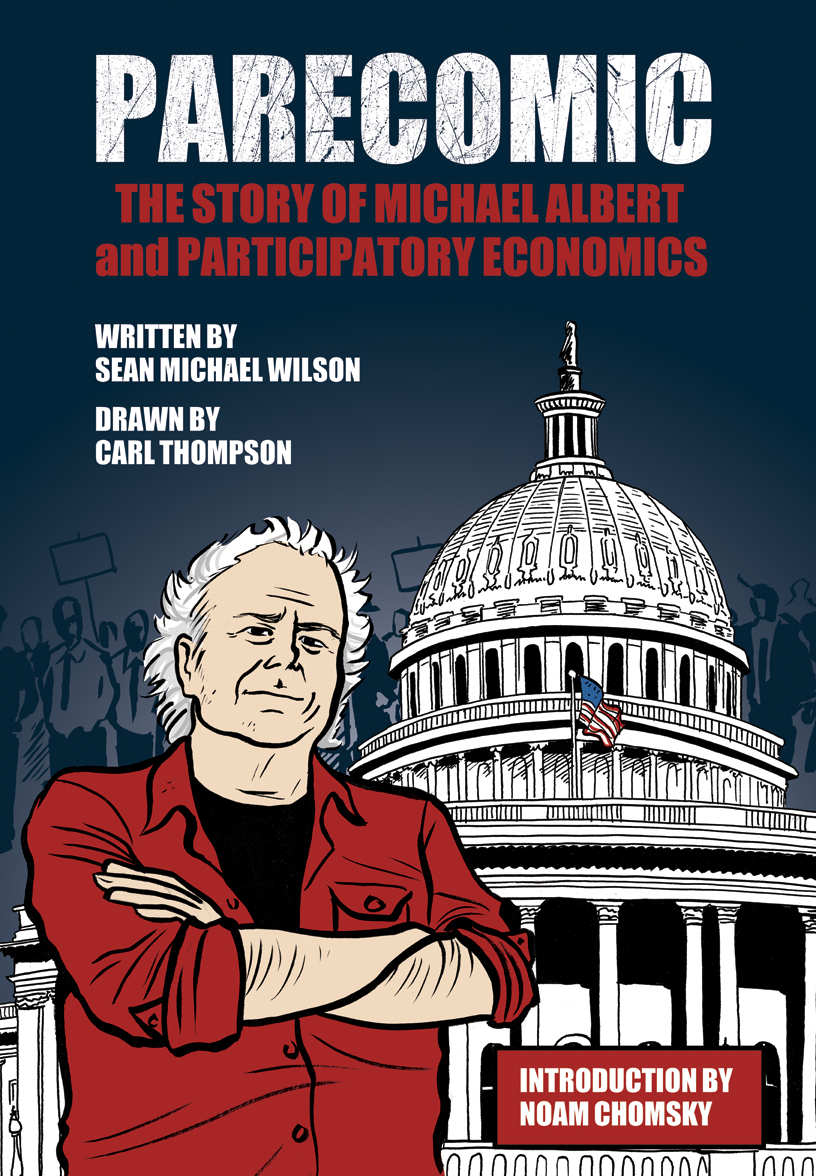
parecomicParecomic: The story of Michael Albert and Participatory Economics
Written by Sean Michael Wilson
Drawn by Carl Thompson
2013

Not liking the current economy very much, a book about an alternate way for an economy to run seemed like an excellent opportunity for me. Especially since it’s a graphic novel and thus likely to be at least slightly livelier than other books about the economy.

However, while it wasn’t a terrible book, it wasn’t a particularly good one either and I was really not impressed with participatory economics as it was described.

The first two-thirds of the book were more a biography/personal history of the civil rights era. I found this portion extremely interesting, even if it wasn’t saying much about participatory economics. The people and the times were interesting enough that it was okay that I didn’t find the main character (or any of the other characters) very sympathetic.

The later third of the book did discuss participatory economics, but did so very poorly. This is the closest I’ve ever come to feeling like I might understand why Ayn Rand was so down on liberals and socialists. Given that this book was written in Albert’s words, defending his ideals, presumably to the best of his ability, I have to admit that maybe Rand wasn’t entirely making up her annoying “liberal” characters as I’d assumed.

Albert wants to save the working class and the poor, but he sure doesn’t respect them. He argues that white-collar workers aren’t any better than blue-collar workers but assumes that it’s obvious that white-collar work is better and more empowering than blue-collar work. He assumes that everyone will like the same things and dislike the same things and generally have the same opinions if only they really understood. Thus, in his view, business meetings can reach consensus quickly and easily, and if you don’t agree with him, then you just don’t understand the situation.

It started out interesting, but ended up mostly irritating. On the other hand, it was well-illustrated, the first part was interesting, and the book as a whole wasn’t that long. So, faint praise, but still praise.

FinalCOmpsThat Lovely Horrible Stuff
By Eddie Campbell
2012

This was in the nonfiction new-release section at my library and it seemed to be a graphic novel about currency, which I thought would be interesting. Instead it was mostly some biographical ramblings of the author about his money troubles. It did have a section about the stone money of the island Yap, which was really interesting. I wish the whole book had been like that. Instead I mostly got annoyed at Campbell for being whiny. Like Parecomic, it was interesting and well-illustrated (and really quite short), but the main character was even more off-putting.

Stephen Hawking

I was reading a Cracked article the other day: 14 Photographs That Shatter Your Image of Famous People, and #13 was “A Young, Cool Stephen Hawking, Standing With His Bride.”

hawking_wedding

It actually looks quite a bit like the new Q from the most recent James Bond movie, Skyfall.

Q_fromJamesBond

It made me want to watch a Stephen Hawking biopic starring Ben Whishaw. (There’s already a biopic starring Benedict Cumberbatch that is apparently pretty good, but after watching Cumberbatch in both BBC’s Sherlock and Star Trek Into Darkness, I have trouble seeing him as young Stephen Hawking.)

Instead, I checked out a couple of biographies from my library:

Stephen HawkingStephen Hawking: Revolutionary Physicist
By Melissa McDaniel
1994

I got this book from the library because it was short and looked like a quick overview. Something like an Encyclopedia article: less detailed, less accurate, but somewhat more reliable than Wikipedia. I wasn’t even entirely sure if this book was supposed to be in the adult section rather than the young reader section. But, no, it was properly catalogued. It’s just that it’s kind of a book for people who don’t like reading.  Although it was frequently vague and/or confusing about the order of events, it was a useful overview in preparation for a more detailed biography.

Stephen Hawking 2Stephen Hawking: An Unfettered Mind
By Kitty Ferguson
2012

Alas, this book was a severe disappointment. I managed to force my way all the way through it, but I suggest avoiding it. Only in retrospect did I notice that of the five reviews on the back of the book, only one of them was for the book “Stephen Hawking”—the other four for person Stephen Hawking.

Ferguson has a serious case of hero worship for Hawking and it hamstrings this book. I imagine that one doesn’t write a biography of someone without feeling strongly for or against that person, but most biographers attempt to showcase their subjects in all their humanity. Ferguson, on the other hand, does more to obscure Hawking’s existence as a human being than she does to reveal it, presenting Hawking as a godly figure, without failing or flaw.

Ferguson’s own presence is also extremely present, as she highlights her connection to Stephen Hawking, talking about how her children went to the same school as the Hawking children did, how Hawking himself reviewed the manuscript for her first biography of him, and how she met with him at his office! I can see the stars in her eyes and little hearts floating around her head. In keeping with an overblown crush, Ferguson uses the passive voice in a pattern that I believe intentionally denies Hawking culpability in anything that Ferguson didn’t approve of and attributed to him actions and decisions that Ferguson did approve of. Hawking is presented as having perfect intuition for physics such that he requires no proof and his word should be accepted as gospel. Questionable events are either denied, skimmed over, or not mentioned at all. She presents Hawking as a messiah figure—awesome, majestic, unknowable and yet all-knowing—and Ferguson as his faithful disciple—a devoted lesser being who is brought greatness by proximity.

In addition, Ferguson attempts to explain a few actual physics issues that Hawking had worked on over the years, but learning new physics concepts requires a certain amount of trust in the teacher. After, 1, obscuring and contradicting biographical events, 2, describing students as working on incomprehensible and mysterious equations, and, 3, explaining that the Pythagorean Theorem changes when used in space-time*, Ferguson lost her credibility with me for any of her physics explanations.

By the end, this book was a pure slog to get through. I definitely do not recommend it to anyone.

In comparison, I was increasingly impressed by the earlier book which was short, to the point, and presented a factual and nuanced view of the actual person, Stephen Hawking.

* The Pythagorean Theorem is a relationship between the sides of a right triangle and the hypotenuse. It is most often summarized as A2 + B2 = C2. It would take a thorough explanation  from someone I trusted to know what they were talking about before I was willing to believe that when time is a dimension, the equation suddenly becomes A2 = B2 + C2.

Hedy’s Folly by Richard Rhodes

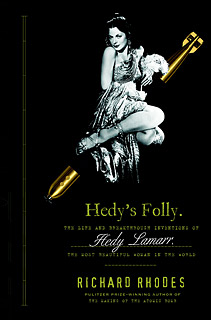
Hedys-Folly_211x320Hedy’s Folly: The life and breakthrough inventions of Hedy Lamarr the most beautiful woman in the world
by Richard Rhodes
2011

Hedy Lamarr is best known for being “the most beautiful woman in the world.” She was a film actress from 1930 through 1958, and once said, “Any girl can be glamorous. All you have to do is stand still and look stupid.”

Hedy was anything but stupid, although it’s amazing (and depressing) how many people discounted her intelligence. She broke into the film industry in Austria when she was 16, married at 19, escaped her controlling husband at 22, moved to Hollywood ahead of WWII, broke into the film industry in Hollywood to become a movie star, married (and divorced) five more times, raised three children, and died in January 2000. She also maintained a significant hobby of invention.

However, while I learned a great deal about Hedy Lamarr from reading this book, the title is somewhat misleading. It’s not so much the story of Hedy Lamarr as it is the story of one of her inventions: the frequency-hopping secret communication system.

Frequency-hopping is now known as spread-spectrum and is the technology that allows wireless communications to happen without interference or jamming. It’s one of the foundational technologies for cell phones, Bluetooth, military drones.  And it was developed by Hedy Lamarr and George Antheil, the composer of Ballet Mecanique, in Hollywood during WWII as a bit of civilian support of the war effort.

This book tells the story of how this technology came about, starting with background on these two famous artists. While it is an interesting perspective on the two characters, it is not a comprehensive biography of either, and it was a bit disingenuous of the author to title and illustrate the book as if it were a biography of Hedy Lamarr alone.

For what it is, though, the book is well written (with the only a few wrong notes, where the author inserts a few generic homilies), quite interesting, and not that long. I recommend it.

The Man Who Loved Only Numbers

the_man_who_loved_only_numbersThe Man Who Loved Only Numbers
by Paul Hoffman
1998

This is a wonderful book, but it also took me four tries over nearly a decade to get all the way through. It presents itself as a biography of the mathematician Paul Erdös (1913-1996). In reality, the book goes off on a lot of tangents, and there are a lot of natural breaks where it’s easy to set down. It talks about world history and about mathematics and is pretty obviously based on an oral history project. However many tangents it goes on, though, it does always return to Erdös.

Erdös, for those who don’t immediately recognize the name, is the zero point of Erdös numbers—where actors have degrees of Kevin Bacon, mathematicians have Erdös numbers, showing how close they are to having collaborated with Erdös.

Erdös is also one of the few mathematicians who made serious contributions to the field of mathematics after the age of 30, Mathematics generally being a young person’s field. Erdös remained a productive and innovative thinker until his death in his 80s. He was also a very peculiar man, thus a great focus for a biography.

He also seems like a good example of how there are people who are delightful to hear about and make the world a more wonderful place but I’m still glad I don’t have to deal with them personally. (Having read Surely You’re Joking, Mr. Feynman! several times and enjoyed it immensely, the physicist Richard Feynman is likely another of these individuals.) Among other things, Erdös spent most of his life couch surfing at his colleagues’ houses, demanding that they talk mathematics 18 hours a day. He made it work, though, and there was always someplace for him to stay.

Anyway, the problem with the book is that while it is excellent text about a fascinating character, it is also really dense, and not particularly well organized. In addition to Erdös himself, the book describes some of the more accessible and yet unusual mathematical proofs, the lives of various other mathematicians, and a good amount of political history–both that Erdös dealt with and that other mathematicians, both contemporary and historical, dealt with. The history and the mathematics are all related to Erdös’ life and experience, but it’s still a bit like reading multiple books, each of which requires a fair bit of concentration to properly appreciate. The book clearly shows its basis in oral history, and Hoffman doesn’t manage to give it any strong, overarching structure.

It is still well worth reading, but it does take effort.

The Rest of 2012

When I read a really good book I almost always write it up on the blog, generally because I’m so excited I want to make everyone I know read it. However, when I looked back over the list of books I read in 2012 (yes, I keep a list, otherwise I can never remember) I realized that I read some awfully good things that never made it here. So, to wrap up 2012, here are the five best books I read this year that I never got around to mentioning.

1) How To Be A Woman by Caitlin Moran. This is such a fabulous memoir. Moran uses her own life story to make a lot of points about feminism, beauty, generally living life as a woman in this society. But she’s funny, while also being radical! She’s also hilarious on Twitter.

2) The Family Fang by Kevin Wilson. I feel like this book sells itself as story about family, yet at the end of the book I felt sort of repulsed by the whole idea of families. But it’s a fascinating book.

3) Bring Up the Bodies by Hilary Mantel. This is on everyone’s best of the year lists, for good reason. This one moved a lot faster than Wolf Hall, Mantel’s first book about Thomas Cromwell, but you need to read them both to make sense of it. I admit that Tudor history is an interest of mine, but the beauty of these books is that the characters are so well-drawn that the historical details are just a backdrop for Thomas’s story.

4) Angelfall by Susan Ee. The first in another series of YA post-apocalyptic novels. There is no shortage of these books out there, but I liked this one a lot. Dark, but an interesting premise in which angels are the cause of the destruction. It also takes an unexpected position on religion, and I’m intrigued with how future books will play that out.

5) Broken Harbor by Tana French. The fourth in French’s of mystery novels set in modern-day Dublin is actually less a mystery and more the portrait of a family falling apart. My favorite of her books is still The Likeness, the second book, but they are all completely compelling and very, very well-written. There are connections between the books, but they are not a series, really, and they can all stand alone. Feel free to start with whichever one sounds most interesting.

The Paris Wife

by Paula McLain

Book Cover: The Paris WifeLet me preface by saying (with more than a hint of embarrassment) that I was an English major in college, yet have not read Ernest Hemingway. However, it served me well in the case of reading The Paris Wife. It was through the eyes of his first wife Hadley Richardson, in this historical nonfiction account, that I learned about Hemingway’s years in Paris as he established himself as a novelist.

The story read beautifully and the characters were well developed. During their time in Paris, the Hemingways befriended ‘characters’ that could practically write themselves—from well-known literary figures like Gertrude Stein and F. Scott Fitzgerald to avant-garde socialites to liberated women with big careers at companies like Vogue. Some of these characters were in fact the inspiration for Hemingway’s The Sun Also Rises. Yet Hadley’s perspective is nonetheless insightful. Although she ran with Hemingway’s various crowds, she seemed to be on the outside looking in. While the rest of the group played partners in crime, she observed their behaviors and shed light on their vivid energy and silly flaws.

What I found myself continually intrigued by was the extravagance of their lifestyle—considering the fact that Hemingway was a “struggling artist” who barely got them by with his correspondent side gigs. They had a cook, and then a nanny after their son was born. They traveled extensively in Europe and for long periods of time. They had elaborate cocktail parties in Spain during the Running of the Bulls (apparently financed by a richer member of the group).

I know for many Hemingway’s reputation precedes him. In The Paris Wife, he is depicted as a bold man with a big ego. But with Hadley as the storyteller, you also witness tender moments between the two of them. Unfortunately in the end though, you see how his growing pains as a literary star did damage among his close friends, circles of friends, and most sadly, his devoted wife and their son. As he followed his latest fancies without the worry of leaving a detrimental trail behind, I did have to remind myself that it was the 1920s, and therefore not so easy to fault Hadley for being such a devoted wife no matter what he was up to.

With this book now behind me, the fact that I have not read Hemingway makes it a simple choice of what to read next. Up first are A Moveable Feast and The Sun Also Rises, two books that reflect this time in his life. I am curious to experience his prose, but even more so, his perspective.

—Christine, contributing author

The Art of Learning by Josh Waitzkin

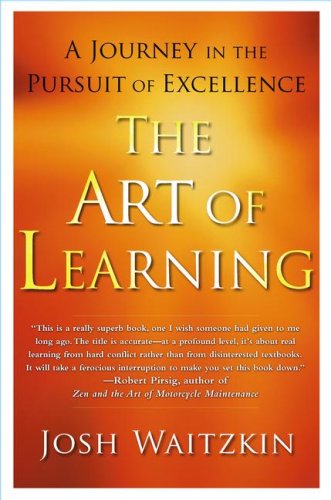
The Art of Learning: A Journey in the Pursuit of Excellence
by Josh Waitzkin
2007

I’m still working my way through some of the books on that list of 40 suggestions and at the moment I’m feeling a bit like Goldilocks, because I recently started three, dropped two and absolutely loved one.

I read the first eight pages of Never Eat Alone by Keith Ferrazzi and stopped because it made me think the author was an asshole. The introduction was essentially: here’s how I inserted myself into rich people’s lives and made good off of their connections while mocking anyone who took those connections for granted.

Then I read the first twelve pages of Zen Mind, Beginner’s Mind by Shunryu Suzuki and stopped because it made me think that I was an asshole. The text is very traditional zen discussion and I’m wondering how much is real and how much is playing to a stereotype, concentrating less on the actual concepts as I am on the meta relationship of author to publisher to readership.

Then I started The Art of Learning: A Journey in the Pursuit of Excellence by Josh Waitzkin and continued to the end because it was just right. No really. It really was just right and I actually plan on purchasing a copy so that I have it on hand to reread at times, focusing on learning the methods discussed in certain chapters.

First, about the author: Waitzkin was a chess prodigy and national champion as a child and he has since gone on to become a Tai Chi world champion as an adult. Plus he’s a good writer and appears to be a nice guy, too, which is actually kind of irritating because surely people that good at multiple things should have a few fatal flaws.

But anyway, the book is essentially an autobiography but it shows his life by means of his training and development from a highly theoretical perspective. He picks apart how he learned and and improved his various skills, looking at both successes and failures, evaluating the advice and assistance from academic studies and training centers, and discussing his role models, as well.

Keep in mind that I like strategy games, I like martial arts, and I like theoretical discussions, so this book fits my tastes perfectly. I am willing to acknowledge that other people may not like it as much, but I still strongly recommend it to basically everyone ever. It’s a fun read and it has some really important lessons about how to think about learning.

Is Everyone Hanging Out Without Me? (And Other Concerns)

By Mindy Kaling

Having finished The Checklist Manifesto on my beach vacation (taking a lot of grief from my friends for bringing such antithetic beach reading), I picked up Mindy Kaling’s memoire, Is Everyone Hanging Out Without Me?, at my friends’ house while waiting for my airplane back home, and it really would have been a much more suitable book for the beach. I really enjoy Mindy Kaling as Kelly Kapoor in “The Office,” and I’m a little embarrassed that while I realize logically that as a successful writer, director and producer, she must be much smarter and more insightful than Kelly, she does such a good job of inhabiting that character that I keep sort of forgetting that she’s not Kelly. At least I’m not alone at this, because Kaling includes a whole list of ways she is similar and ways she is dissimilar to Kelly as a service to her readers. In all of our defense, she does actually have quite a few similarities, including the tone of the book.

My friends had warned me that it isn’t quite on the level of Tina Fey’s Bossypants, and it isn’t, but I think I enjoyed it just as much, quite frankly. Bossypants is a much more traditional memoire, while Is Everyone Hanging Out Without Me? is more of a collection of comedic bits strung in chronological order of her life. I perhaps would have liked a little bit more about her actual life stories, like her childhood in what sounds like a very well-to-do and predominantly white neighborhood in Massachusetts, the lasting friendships she made in college, and her breakthrough in New York and then LA. But, I wouldn’t have wanted to sacrifice the stand-up-comedy tone of the book, either. I do also love “listicles,” which are getting a bit of a backlash on the Internet nowadays, and there are several chapters that are structured as lists.

So, basically, this would have been a great book to read on the beach but was also a good book to read during the Olympics’ endless volleyball games, being then easy to put down for the gymnastics or diving.

Graphic design addendum: I think this book just has the prettiest cover ever. Like, lots of covers are elegant, striking, distinguished, mysterious, or garish, but I can’t think of another one that is just so straight-up pretty.

—Anna

Refining My Theory of Memoirs

I’ve mentioned before that I much prefer memoirs that center around one concept or event, and then use that frame the story of the author’s life. Recently I’ve read two books that support my theory and one exception that might prove the rule.

I Never Promised You a Goodie Bag by Jennifer Gilbert is the story of how Gilbert, as a recent college grad, survived a brutal attack and then recovered and built a thriving party planning business (hence the title) and family. Gilbert has an inspiring story, and I could have read an entire book about her narrowly-avoided party-planning disasters, but the book reads very much like a one-thing-after-another narrative account of her life. I’m sure that to her it felt like it was all part of one story, since it’s her life, but I’m not sure it hung together as a narrative for the reader. Also, I only figured out by Googling her later that she was one of the real housewives of New York, something she never mentioned in the book at all. (Apparently, she was phased off the show because she wasn’t dramatic enough, which probably speaks well of her.) So, you know, it was fine.

Then I read Wild, by Cheryl Strayed, about a young woman who decided to deal with grief over the death of her mother and a divorce by hiking the Pacific Coast Trail. Strayed talks about her childhood and marriage and about all sorts of things, but her story is all centered around her hike, which gives the story a solid structure that supports her tangents and digressions. I really liked Wild, but it was not necessarily a happy, feel-good story. Strayed was seriously grieving and seriously unprepared for the trail, and there are parts that were so harrowing I had to essentially read through squinted eyes. But Strayed so clearly described how empowered she felt by the hike that I felt kind of empowered myself. (She also describes her blisters and black toenails in such detail that my feet started hurting.)

Finally, A Girl Walks Into a Bar by Rachel Dratch didn’t have any single, centering event, but I found it so charming that I didn’t mind.  The book is nominally about how Dratch stumbled into a relationship and baby in her early forties, when she had all but decided she would not have a family. In reality, big swatches of the book are about her start in comedy, and Saturday Night Live, and dating in New York, and the story just sort of ambles along. But Dratch is funny and sharp and sounds like she would just be an awesome person to hang out with, and the book is fun and quick. So I think the exception to my memoir rule is that if you are a professional comedian, then you can write a less-structured memoir. Otherwise, I suggest everyone read Wild and then write your own memoir around a very specific event.