more graphic novels

It is all too easy to buy a whole bunch of really cool graphic novels from either Small Press Expo or Toronto Comic Arts Festival, be absolutely delighted with them all, and then go home and get distracted from actually reading them, in part because there are so many and where do I even start? (It turns out collecting books and reading books can be two separate hobbies!) But I don’t want to forget about these in my ever-growing to-read pile, and so here are another three graphic novels that I acquired, read, and enjoyed.

She Walks With The Giant
by John V. Slavino
2022

This is a beautifully illustrated book with gorgeous vistas set in a post-apocalyptic world in a fantasy ancient Asia. The girl is an orphan in a ghost town who first sees the giant robot appear, and decides (much to the giant robot’s dismay) to follow along. The first part of the book is an exploration of the world as it is, while the second part is an exploration of the history that brought it to this point, where the giant came from, and how there’s no real escape from being part of that history.

Skip to the Fun Parts: A Guide to Cartoons and Complains about, the Creative Process
by Dana Jeri Maier
2023

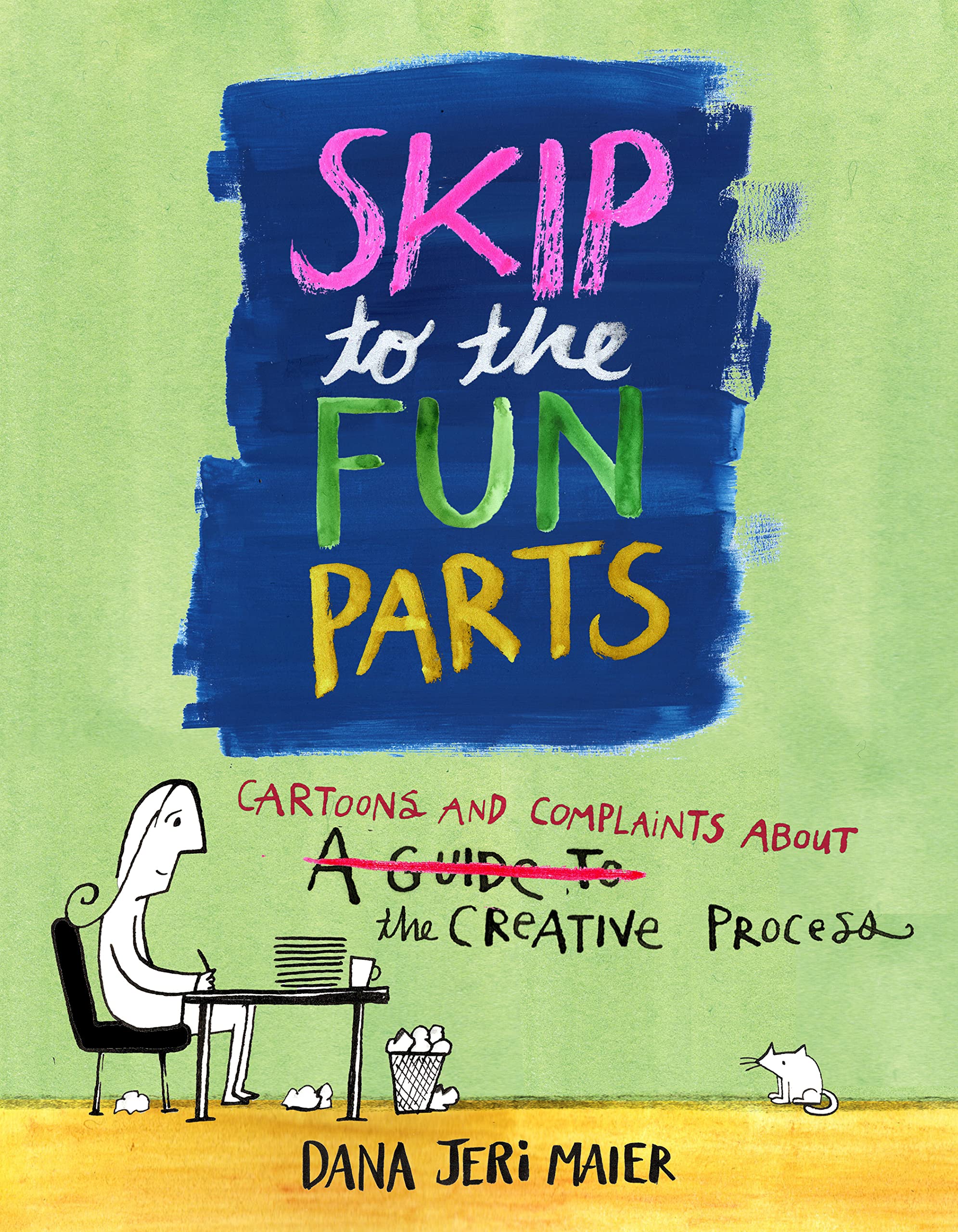
Admittedly I bought this with the expectation that this would be something of a guide to the creative process written by a published graphic novel writer/artist despite the clear strike-through of those exact words, and it’s decidedly not that, but I still found it remarkably reassuring and comforting, and also extremely funny and with a few good ideas thrown in. It felt comforting to see someone successful face some of the same issues I am with energy vs inspiration, and still persevering with good humor.

The Pineapples of Wrath
by Catherine Lamontagne-Drolet
2018

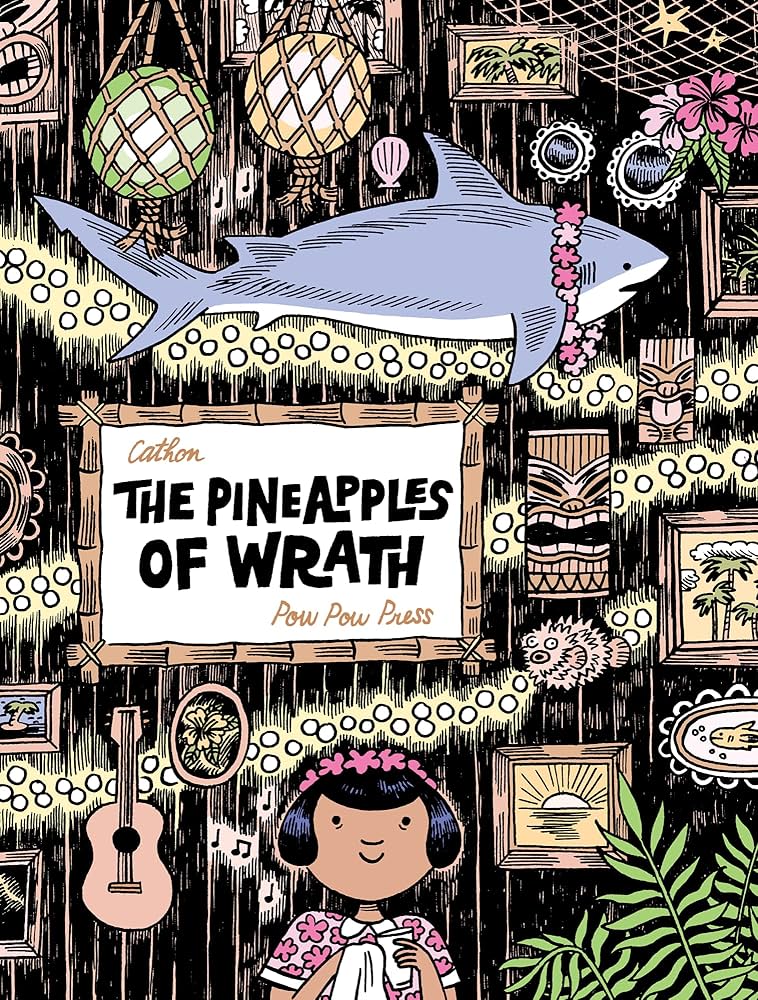
A friend who wasn’t particularly interested in graphic novels was curious to try one out and asked for a recommendation, so we asked her what genres she generally read, since graphic novels come in all genres. At which point she asked for a cozy mystery and Anna and I were both stumped. Graphic novels do come in all genres… but that was a rare one! However, we persevered and found a cozy mystery graphic novel: The Pineapples of Wrath, which is hilarious and adorable and has quite the body count as Marie-Plum, bartender and mystery-reader, determines that her elderly neighbor was murdered and if the police won’t investigate, then she will! The setting is a fictional little-Hawaii neighborhood in Québec, Canada, and it is just as ridiculously touristy as you can imagine and maybe a bit more.

Braiding Sweetgrass by Robin Wall Kimmerer

Braiding Sweetgrass: Indigenous Wisdom, Scientific Knowledge and the Teachings of Plants
by Robin Wall Kimmerer
2013
read by Robin Wall Kimmerer
2016

This is a gorgeous and fascinating book, and I’m glad that I was able to listen to a version read by the author. The book is a wide ranging series of stories and musings about her life, family history, biology, ecology, and reclaiming that which is too nearly lost. It starts with a very personal focus, about her life and self-reflection and moves onto some really fascinating discussions of plants and of Native American culture and history, and then continues onto a discussion of both the dangers of ecological destruction and the importance of not giving up on repairing such casualties.

Kimmerer was raised with a Native American’s perspective on nature which gave her a love of plants and a desire to study them, and then went on to get a PhD and then a professorship in biology with a very scientific perspective on nature. It was later that she realized how important it was to combine the two approaches to nature rather than to give up one for the other. The scientific perspective is one of studying plants as objects, with scientists as unbiased outsiders, while the Native American perspective is one of being part of the nature with humanity as the younger sibling needing to learn from the plants and animals who came before them.

One of the themes that really got to me was her description of how nature is a gift economy: plants give fruits and berries to the birds, and birds give transportation of seeds to the plants. And also how humans are part of this gift economy, not separate from it. Our role in nature is supposed to be taking what is given with gratitude and giving back with reciprocity. The dangers comes with refusing what is given, taking what is not given, not having gratitude, and not giving back.

Another metaphor that she used to great effect was delving into the story of the windigo — a Native American monster that is constantly hungry and can never be satiated — and how capitalist society is trying to turn everyone into this very monster: hungry for more and never satisfied.

The audiobook is approximately 17 hours long, so I’ve been listening to this on my work commute for more than a month, and Anna has been inundated with “In Braiding Sweetgrass…” statements, because every day there is some new and fascinating story or perspective. I’ve also had to deal with becoming a bit teary-eyed while driving a few times.

This is truly an amazing book, and I highly recommend it to basically anyone and everyone.

Power Born of Dreams by Mohammad Sabaaneh

Power Born of Dreams: My story is Palestine
written and illustrated by Mohammad Sabaaneh
2021

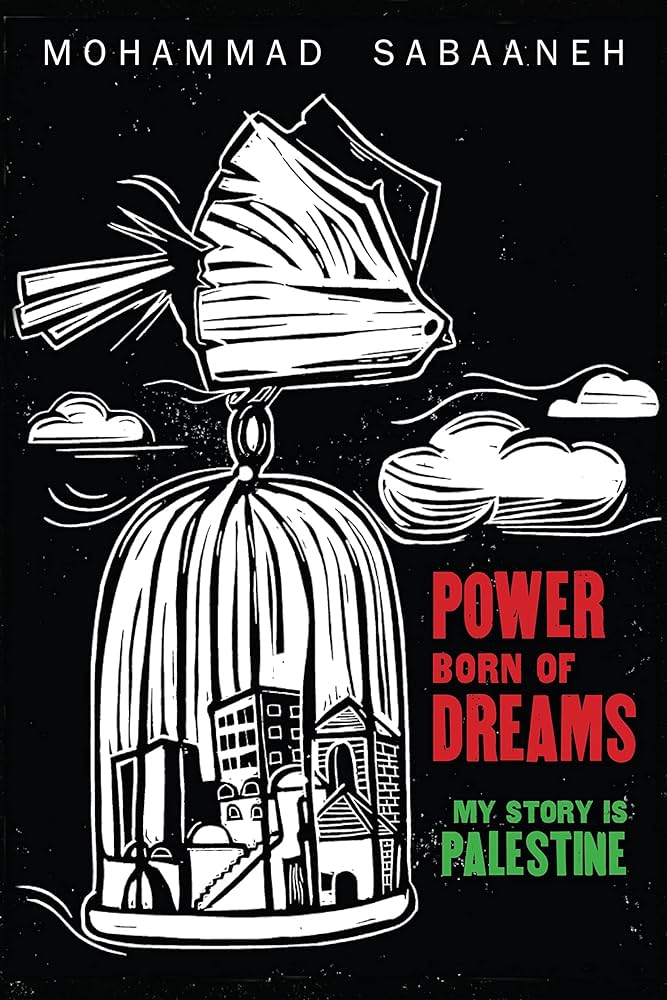
This reads more like prose poetry than a standard graphic novel, and it’s gorgeous and also devastating. Sabaaneh is an artist, journalist, and political cartoonist who lives in the West Bank but wrote this book while getting his masters degree in London and reflecting back on his time as a political prisoner in Israel and his life in general as a Palestinian. It’s about his life and the life of his community in tiny snippets and stories about oppression and holding onto hope because there’s no other recourse than to hope and dream for better.

I bought this book from the Street Noise Books publisher stall at the Small Press Expo before the most recent series of attacks from Hamas on Israel and from Israel on all of Palestine, but only read it after that was already in the news. The two sets of stories, from reading this book and hearing the news, gave each other context and break my heart. This book is not fictional, for all that it’s structured around a man hearing news from a bird who’s flying through his prison window, and the headlines in the news are not just statistics but real people living and dying and struggling to be free.

The main book is about Sabaaneh’s experience in prison and the small amount of news he was able to hear about what was happening with everyone else, but the afterwards are six single pages with basic introductions to significant historical events, locations, and laws effecting Palestine from 1967 to 2020.

The illustrations are all linocuts (images carved in linoleum and then printed), which are both beautiful and increasingly rare because they’re so time consuming to make. I’m pretty sure the only other book I have that’s similar are the wood cuts in Gods’ Man which was written in 1929.

This book is beautiful and heart-breaking but important, about a current political topic (which is rare for me) and I highly recommend it. Just be prepared to take the emotional hit.

Admissions

By Kendra James

I first heard about this book during Kendra James’ very funny guest stint on my favorite podcast “Yo, Is This Racist.” I highly recommend the episode, both because the hosts are always very funny and smart and because the stories James tells from the book got me hooked (granted after a few months). It is a memoir of her experience as the first Black legacy student at Taft, a fancy prep school in Connecticut, and the whole thing was a real eye-opener for me. In the early 2000s with nascent internet and social media, her high school experience was wildly different than mine, and it was often hard to parse whether that was due to the time period, the quality of the school, or race. Regardless, she captures this moment in her life with such detail that I really felt like I was getting a clear look into a life much different than mine.

On the one hand, I never really understood prep schools, feeling that at this point, for better or worse, most high schools sort of vaguely aim their students toward college instead of trade apprenticeships. However, James reveals the extraordinarily high level of guidance students at Taft got when applying for colleges, which really hammered home the extra privilege that makes these students much more likely to go to prestigious colleges and universities. (It also made me mad all over again about the college admissions bribery scandal, since they already had such a leg up!)

On the other hand, she was one of a handful of Black students in an overwhelmingly white school (in an overwhelmingly white state), and of course that came with a fairly constant barrage of aggressions, both micro and not so small. James is so funny overall in her writing that it came as a surprise how difficult some parts are to read. She does an equally skilled job at unpacking the oversized responsibility that is piled on all the students of color, who are also still so young and just coming into awareness of themselves and the world around them.

What struck me hardest from James’ memoir was how acutely James and other students of color could distinguish between individual racism, which was often more blatant, and systemic racism, which though more subtle, could hurt them in much wider ways. This really gets at what many white people, myself included, often don’t see: some rando shouting the n-word is disgusting, but a centuries-old institution requiring the Black, Latinx, and Asian students to continuously prove their worth to both their peers and much of the faculty is much more lastingly harmful. James and her fellow students of color recognized that immediately, and I felt bad that it took me so long into adulthood to begin to see the same thing.

I also have to admit that I recognized more of myself than I would have liked in her ignorant white classmates. My own high school was also very white, and while I did not actively hold racist beliefs, I just went with the cultural flow, and the flow in the Texas public school system was most definitely racist. Admissions gives a clear, fairly universal, real world example why not being racist isn’t enough, and why we need to aim to be anti-racist instead.

I only found out in the acknowledgements (for some reason, I’ve started reading them dedicatedly, and it feels somehow very middle aged of me) that James first began to write about her experiences on our beloved defunct website, The Toast!

Good Talk by Mira Jacob

Good Talk: A Memoir in Conversations
by Mira Jacob
2019

This is a very good book. It’s made up of illustrated conversations that the author had with various people in her life — her young son, her aging parents, her brother, her friends, her boyfriends and girlfriends, her husband, her extended family, her in-laws — skipping backward and forward through time. It starts out cute and funny but with heart and then keeps going, right for the heart. It never loses the cute, but it gets pretty serious.

The author is a dark-skinned child of Indian immigrants, born and raised in New Mexico, who moved to NYC to become a writer. She lives in NYC, married to a Jewish man, and with a son just old enough to watch the news as Trump runs for election. The conversations address and illustrate a number of issues — racism and colorism, expectations and dreams, personal identity and political division — from a very personal perspective. The central theme of the book is how can she be honest with her child, preparing him for the world and raising him to be a good person, while also protecting him from the pain of a world that’s not going to be as kind to him as he deserves. In many ways, it reminds me of Coates’ Between the World and Me.

One of the real strengths of this book, that comes from Jacob’s use of dialogue, is how it presents these complex interactions without attempting to simplify or explain them. It’s all friends and family and lived experiences. As she explains to her son on page 85: “We’re in the middle place where sometimes we get treated badly and sometimes we do it to other people. But I mean, that’s not the end of the world, right? Knowing we’ve got room for improvement?” To which her young son Z replies: “I’d rather just be the good guys.” (Me, too, kid. Me, too.)

As the memoir of a living women still very much in her prime, this book doesn’t really come to any conclusions other than the need to continue on, trying to find a way to make the world better than it currently is and trust that loved ones can be better too. It ends with a kind of grim determination to keep trying.

Adventure Cats by Laura J. Moss

Adventure Cats: Living Nine Lives to the Fullest
by Laura J. Moss
2017

This is a fun and inspiring book that I ran across at some point well after I’d already started taking my cat on walks with a halter and leash.* I thought to myself: this is a nonfiction book about adventure cats, my cat would definitely like to go on more adventures, so this might give me ideas.

And it did. Sort of. Maybe I’ll like outside adventures more if I have my cat with me. But as I’ve stated before, I find the concept of long walks a lot more interesting than the practice of it.

It turns out that I’m pretty much the exact opposite of the intended audience for this book. The intended audience is made up of adventurous people who are interested in seeing if they can get their cat involved in their lifestyle. My situation is that I am a standard couch-potato cat-owner who has stumbled across ownership of an adventure cat and now needs to figure out how to keep his life suitably enriched while also keeping him safe and me sane.

About half the book is made of short bios of various adventure cats and their people and what all is involved in their lifestyle. I adored these parts! So cute! There are cats who go hiking and camping and sailing and surfing and skiing and rock climbing and so much more. Awesome!

The other half of the book is focused on how-to instructions and lists of important information on how to safely go adventuring with a cat. It seems very useful and also highlighting that this is not my preferred method of relaxing or enjoying the world.

The directions on how to train a cat are also so slow and careful that it struck me as more of a deterrent than an inspiration to actually follow the method, but again: I’m not the audience of people who are adventurous and want a cat to match. I expect the written method is the correct way to train a cat, but my relationship with my cat is a lot more mutual training as I figure out how to accommodate his desires as much as I train him to accommodate mine.**

This book also ran into my standard pet peeve with pretty much all self-help books: they tend to talk to the reader with broad assertions (“you think”, “you feel”, “you respond”) that always make me feel particularly contrary (“you don’t know me!”), and I was getting that with this book as it simplified cat body language and responses in a way that was absolutely necessary for the scope of the book, but didn’t match my cat at all.***

A final warning: Every couple of pages this author uses a cutesy pun (being “purrpared”; anything being “pawsible”) and it’s way too cutesy for me.

Despite the various caveats, I do recommend this book. It is an inspiration to see about pushing the boundaries of what I do for my cat’s enrichment and maybe for my own enrichment too.

* As a kitten, my cat was extremely curious and completely fearless and had to be held back from stalking a flock of Canadian geese, and he doesn’t appear to have gained much sense of self-preservation since then.

** I didn’t have to lure my cat into liking the halter and leash: He wanted to go outside so I made wearing a halter and leash a condition of that, and it wasn’t so much leash training as it was compromise negotiation. If he came near the door, I would put the halter/leash on him, and he’d be allowed out. If he didn’t want the halter leash on him, then he shouldn’t come near the door as I was going out.

*** Yes, my cat got startled and poofed out with a full bottle-brush tail on a walk this weekend, but he also continued to explore and had absolutely no interest in returning to the safety of the house. Yes, at another point he froze absolutely still and then had to slowly approach and cautiously whack a fallen leaf like a dangerous enemy, but again, no interest in retreating to safety.

Leaving Isn’t the Hardest Thing

By Lauren Hough

I first read Lauren Hough in her eye-opening expose of life as a “cable guy,” which is also where I learned that some people refuse to let service workers in their home use their bathrooms, and am now very explicit about inviting them to, if needed. I immediately followed her on twitter, where she is very smart and funny, and very occasionally mentions that she grew up in a cult. I’d always thought she meant it hyperbolically, like her family was very conservatively religious, but then she announced her book of essays which would cover growing up in the Children of God cult. I thought oh shit, and then immediately preordered straight from the publisher.

And, whew, this book has such a strong narrative flow that I couldn’t put it down, but then also my head was so full of thoughts and feelings that at the same time I wanted to take a moment to process them all. Each essay connects so seamlessly with the next that I also kept forgetting it wasn’t a single narrative and was slightly puzzled (though not bothered) by the jumps back and forth in chronology. While the essays are all autobiographical, they are sorted by themes rather than chronologically. So, there is some really interesting recursion, where Hough revisits the same events in different essays, reflecting on them in different ways. It feels like Hough is sharing her own recovery with us, circling closer to the trauma that came out of her upbringing, coming at it from different directions to make ultimate sense of the whole. It feels raw and personal in a way that I’m not sure I’ve read before.

Hough relates all of this in a matter-of-fact voice that reminded me a bit of the noir style of writing, actually. Like, the world can be a terrible place where terrible things happen, but individuals just do the best they can in the circumstances given them. And that, while systems and organizations are inevitably corrupt, the connections you make with other people can be life savers. It’s an odd combination of grim and comforting at the same time, and I love it in noir and I love it here.

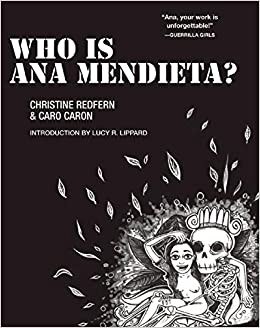
Who Is Ana Mendieta? by Redfern & Caron

Who Is Ana Mendieta?
by Christine Redfern & Caro Caron
introduction by Lucy R. Lippard
2011

This is a relatively short but extremely full and dense graphic novel. It’s a biography of an artist, but also a window into an artistic movement, and also a true crime tragedy, and also a demonstration of how systemic prejudice works to keep a whole demographic down. The particular art styles of both the book and the art movement that it describes are not ones that I particularly enjoy (a lot of shock value and intentionally disturbing imagery), and yet, I still highly recommend the book. It was a reminder to me of what second-wave feminism was trying to accomplish and the context it was working in.

Ana Mendieta was born in 1948 in Havana, Cuba, moved to the US in 1961, and died violently in 1985 (her husband was indicted for murder three times by a jury, and acquitted three times by a judge who then sealed the records.) During her life, Mendieta was a rising star in the art world and making waves. But the book also points out that she, like so many women before her, had to be their own firsts, breaking the glass ceiling, not because there hadn’t been women before her, but because the existence of those women was and is so regularly denied. This book itself is an effort to not have Ana Mendieta suffer the same fate, not just of death but of being quietly brushed aside, leaving art history to continue as a history of male artists.

So all of this to say: this book is educational, distasteful, enraging, and important.

Here For It: Or, How to Save Your Soul in America

By R. Eric Thomas

Here_For_ItWhew, this book! I’m a big fan of R. Eric Thomas’ weekly e-newsletter,* and figured this would be a similar collection of essays: a combination of very funny personal anecdotes and political/social commentary. And it was, but just…even better: deeper, more complex, shockingly poignant. I was in awe of how he balanced humor and gravity, and how artistically he threaded themes through his personal life into reflections of our country as a whole.

One sentence, I’ll be laughing out loud, and the next will stop me short:

“The fact that I sometimes enjoyed dating a boy was, to say the least, discomfirming information for a Christian, black-esque straight person who spent his free time carefully curating an Audra McDonald fan page on the internet. And it didn’t feel like there were two sides of me fighting for dominance; it felt like I was coming apart at some basic level, like I was becoming diffuse, like water becomes mist.”

… “like water becomes mist.” Whew!

Thomas has had hard times, as he struggled with what it meant to be black, gay, and deeply Christian in America, but he finds such reflective truths and ultimate optimism that it was an ideal read right now. In his introduction, Thomas talks about his childhood love for Sesame Street’s The Monster At the End of This Book. It’s a funny, light-hearted critique of a children’s book through the retrospective adult lens. By the end, he ties this all into how difficult life seems now, but how important it is to forge ahead (as a very skilled professional writer, he of course does this much more meaningfully than I can). The title of his book comes from his conclusion that he is “here for it,” it being his life, with all its ups and downs, and that is how you save your soul in America.

*I have to plug his analysis of Governor Cuomo’s covid-themed poster, which had me howling!

You Can’t Touch My Hair

By Phoebe Robinson

You_Can't_Touch_My_HairI decided to take a break from reading serious intellectual books about race and racism, and instead turn to a funny book about race and racism! And honestly, comedian Phoebe Robinson touches on many of the points from So You Want to Talk About Race and White Fragility through humor, pop culture, and personal anecdotes, so I really recommend this to anyone who wants to laugh while they learn some hard truths. Actually, I just recommend this to anyone, since Robinson is a very smart and funny writer on a whole range of topics:

  • Do you want to know which Hall & Oats lyrics summarize the entirety of human history?
  • Do you want detailed advice on how to correctly google yourself?
  • How to avoid being the Black Friend? (or conversely and more importantly, how to avoid tokenizing a friend as your Black Friend)

She kicks the book off right away with her titular hair: how her hair, society’s reactions to it, and the affect those reactions had on her evolved over her youth and young adulthood, culminating in a history of black hair in media which illustrates the decades it took for natural black hair to be even slightly accepted today.

For me, one of the most striking stories she tells is about a director she worked with, which quite literally runs down all the hallmarks of white fragility like a checklist: denial of racist words, reassurance of being a good person, burdensome guilt-ridden apology and request to ‘talk it out further,’ and the final cherry on top of turning to a different black person for absolution. It should seriously be used as the prime example in DiAngelo’s book!

My favorite part of the book, however, was toward the end where she writes a series of letters of ‘advice’ to her “all-time favorite person: my two-and-a-half-year-old biracial niece, Olivia.” As a professional comedian, of course she’s funny, but she really shines when she’s also sincere: “Seeing how you view the world makes me happy. Ah! A comedian expressing a genuine emotion and not following it with a joke. Full disclosure: That was really, really hard for me to do just then.”

In addition to wanting to make sure Olivia doesn’t miss such pop culture gems as DMX singing “Rudolph, the Red-Nosed Reindeer,” she tells her how great it is to be black, to be a woman, and even tags in John Hodgman for the difficult task of talking up being white without sounding racist! (You’re going to want to read the story of John taking his friend Wyatt—who I assume is Wyatt Cenac—to a gourmet mayonnaise shop in Brooklyn.)

And finally, in her advice on being sex-positive, she goes on a lengthy tangent about the problematic 2014 movie Kingsman: The Secret Service, which first of all, shocked me about that movie since I’d never seen it, but then made me want to read an entire book of her dissecting what does and does not work in movies and tv shows. This book is so chock full of pop culture references that I finally just had to appreciate the ones that I got and let the rest pass, or I would have been constantly jumping over to google.