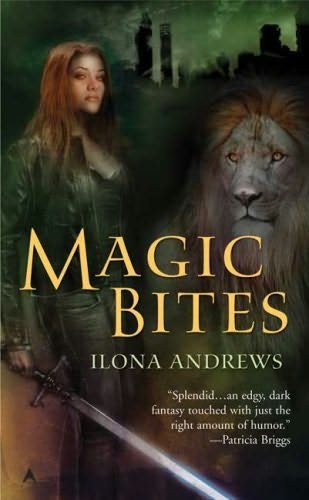
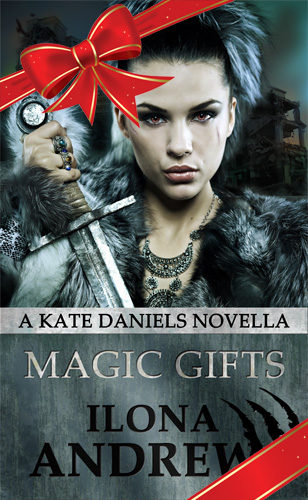
“Magic Gifts” by Ilona Andrews

“Magic Gifts”
by Ilona Andrews
2011

I like Vampire-Werewolf type books. And I have strong opinions regarding which ones are good and which ones… aren’t, but for now, I want to talk about something that one of my favorite authors did for Christmas:

She (actually “they” since Ilona Andrews is a husband-wife duo, but I’m going to go on and refer to her as her) gave her fans a novella. It’s free for download from her website, in pdf, kindle, or epub from her blog.*

The story has Kate Daniels (mercenary fighter and only recently acknowledged consort to Curran) and Curran (Beast Lord) dealing with vampires, attorneys, neo-vikings, and fae. All they wanted was to go on a nice date, but stuff keeps on happening. It’s awesome!

The events happen after the events of the fifth book in the Kate Daniels series and in the background of the sixth book (Gunmetal Magic, which focuses on Andrea Nash, Kate’s best friend and coworker).

As a heads-up, because this is a Christmas present, free to the fans, it was not given a professional lay out or a final professional proof reading, so expect a few typos and layout problems, but the story itself hangs together and the world building is where this author really shines and she shines here, too.

So thank you, Ilona Andrews, for a wonderful Christmas present, and I hope readers here enjoy it, too.

* This was posted late on Christmas Eve 2011, and will be available for two weeks. After that, it will be cleaned up and made available as a short story included at the end of Gunmetal Magic.

“Mastiff” by Tamora Pierce

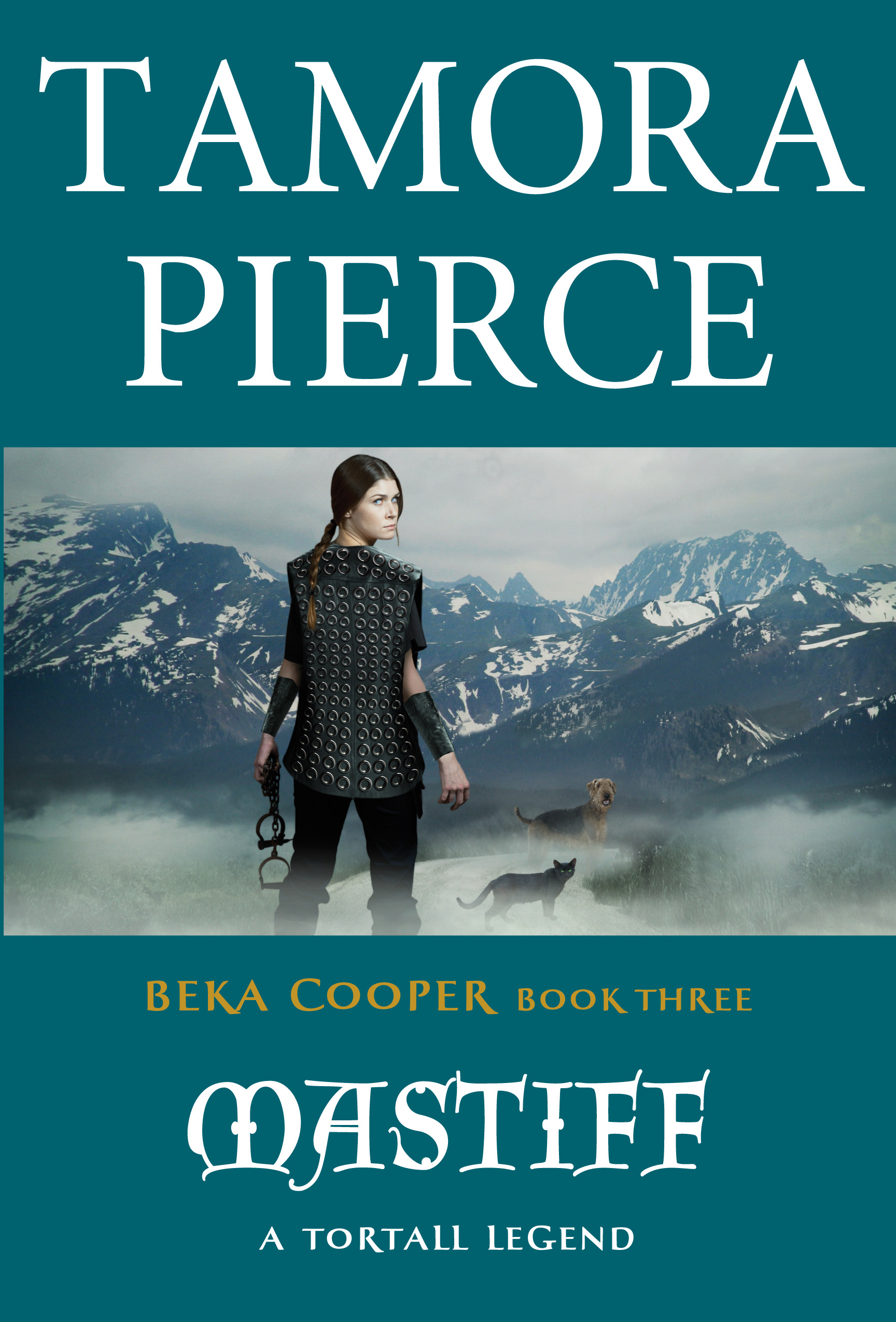
Mastiff coverMastiff
Tamora Pierce
(2011)

Despite the many other things I should have been doing, I bought and read Tamora Pierce’s latest book as soon as it came out. I loved it, of course.

Given that I loved it, of course, you can see that I might just be a tad biased in my review. I grew up with this universe. I love these books, and I love this author. Her first book (Alanna: The First Adventure) was published in 1983, and since then she’s written 26 other novels, generally broken into quartets, and set in one of two universes.

Both of the universes she writes are magical fantasy: Tortall has knights and wars and a pantheon of gods; Emelan has mages and priests and pirates. Fun!

Each quartet of books stands alone, although there are often brief appearances of the characters from previous quartets for the delight of those readers who have recognize them.  And while the characters develop through their quartets, the plots of each individual book also stand alone for the most part.

Mastiff, her most recent book, is set in Tortall and is the third book in a rare trilogy rather than a quartet. In Terrier, Becca Cooper was in training to be a city guard; in Bloodhound, she was finally an official city guard.

In Mastiff, Becca Cooper is one of the best of the city guards and thus given the hardest tasks. I think that’s why Mastiff struck me as slightly more mature than other of Pierce’s books. While she’s not formulaic, per se—each plot is different and each character is unique—she writes coming-of-age stories, generally of young girls. There are multiple stages of coming of age, and each quartet will follow a character through some of them.

Becca had her coming of age experiences in the first two books and had, in fact, come completely of age. In this, the character development was very much that of an adult in an adult’s world. Good and evil are not necessarily clearly delineated and sometimes even when they are, you wish they weren’t. The book starts with the funeral of Becca’s fiancé whom she had been intending to break up with and is then immediately sent on a mission to stop a traitor to the crown intent on civil war. There’s guilt and betrayal mixed in with adventure and mystery.

There’s also a sense of foreshadowing throughout this entire series. It’s set a hundred years prior to her first book, and for those of us who have read the Alanna series, we can see developing the social changes that Alanna will have to fight against.

I enjoyed the book immensely, I enjoyed the series immensely, and I enjoy this universe immensely. I definitely recommend them all. But if this is an entirely new universe to you, I recommend that you start with the first book in any of the quartets (or trilogy):
Alanna: The first adventure
Wild Mage
First Test
Terrier

“Jenny Pox” by J. L. Bryan

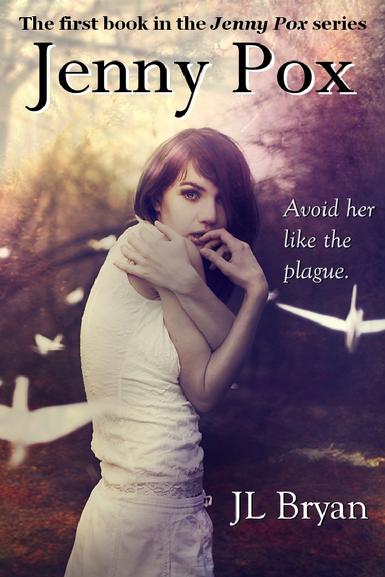
The cover of Jenny PoxJenny Pox
by J. L. Bryan
(2010)

I thought about not reviewing this book because I do not want to give it additional name recognition. But such is procrastination from my work: I not only read the book, I am now gong to tell you all about the experience.

The book’s premise is a high school drama with a few magical powers thrown in. It seemed like a fun quick read.

After reading it, my final conclusion is that if this is common for young adult fiction, I can see why so many people like Twilight. I didn’t like Twilight but it is orders of magnitude better – in writing style, in characterization, and in plot – than Jenny Pox.

Despite being relatively short, Jenny Pox reads like three books. Not complete books, no, but three sections that have very different writers with very different opinions on character and style and plot. It starts off quite well and is enjoyable for about the first third of the book and then doesn’t so much go down hill as fall off the edge of a cliff and hit bottom a long ways down.

And because I think it was awful and not worth reading, I have no compunction about give spoilers.

Continue reading

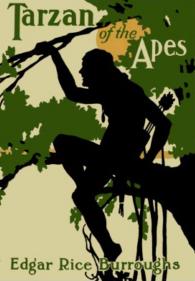
Tarzan of the Apes

Tarzan of the Apes cover imageTarzan of the Apes
written by Edgar Rice Burroughs
(1912)

Reading Tarzan of the Apes proved to be an experience.

I don’t know when I first heard the story of Tarzan. I assume that I acquired it from the aether of having grown up in a well-read household. It is a fun archetype: A child, orphaned and abandoned far from humanity, is raised in the wild by animals and grows up strong and clever.

The Jungle Book by Rudyard Kipling, written in 1894, has the same basic premise. There are a number of more recent books with the same premise, although they tend to add telepathic communication to the mix. I’d watched movies and cartoons of these classic stories, and read reworkings of the archetype many times before I ever got around to reading Tarzan of the Apes, as written by Edgar Rice Burroughs in 1912.

I don’t consider myself an easily offended reader, and I wasn’t even offended, precisely, by reading this book. Astounded, maybe. Appalled. Intrigued in the way of watching a train wreck. It is, I think, the single most prejudiced book I have ever read. If there’s a prejudice you can think of, it’s in there.

Sexism: check!
Racism: check!
Nationalism: check!
Classism: check!

Continue reading

“And Tango Makes Three”

And Tango Makes Three
Written by Justin Richardson and Peter Parnell
Illustrated by Henry Cole
(2005)

I am hardly the first and I won’t be the last person to read a book purely because it was banned. In fact, it’s a bit of a tradition for Banned Book Week: go out and read a banned book. I decided for a couple of reasons to go straight to the top of the banned books: here’s a book that’s the most contested, most banned book in the entire United States for four out of the last five years. (It was knocked down to second most banned book in 2009, but it rebounded back up to first place in 2010.)

This book has owned the American Library Association’s banned book list every year since its publication. Wow.

And then there’s the other reason why I picked this book. It is, in no particular order:  nonfiction, a picture book, intended for a kindergarten audience, and about penguins.

“Um…,” I hear you say. “Why exactly was it banned?”

Perhaps you ask tentatively because, well, the mind kind of boggles at the potential horrors that are being done to and with penguins.

They are… nesting and raising babies. This is the kind of thing that penguins do. In fact, most species do. They find themselves a mate, they make for themselves a nest, and they have babies, generally rather cute babies.

“Um…,” you say again. “So why…?”

Well, the book focuses on a specific penguin couple and their specific little baby penguin at New York City’s Central Park Zoo. The two adult penguins are both male. The egg they hatch was given to them by one of the zoo-keepers. (Noted in the author’s note at the back, the egg came from the nest of one of the other penguin couples who had a bad habit of abandoning the second of their two eggs.)

The story is about this couple of male penguins who put together a nest, and raise a baby penguin.

cover picture for And Tango Makes Three Shall I reiterate the fact that it has topped the banned book list for four out of the last five years?

So the fact that this book is so often banned is rather appalling for at least three different reasons:

Continue reading

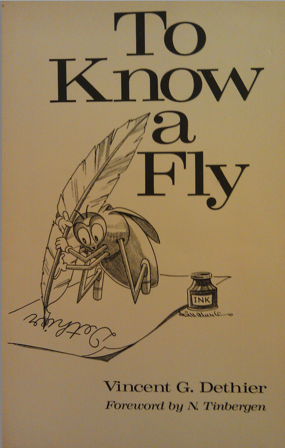
“To Know a Fly” by Vincent Dethier

To Know a Fly
written by Vincent G. Dethier
illustrated by Bill Clark and Vincent Dethier
Forward by N. Tinbergen
(1962)

This is a side-splittingly funny nonfiction book about the study of flies.

Take a moment to consider that, and now give me the benefit of the doubt for a few paragraphs to prove how this seemingly impossibility is not only possible but true.

Consider being in a laboratory setting. There are serious educated men (this being the 1960s, they were all men except for the cleaning lady), mysterious lab equipment, official white lab coats, a sterile environment, and, of course, the lab animals…who are all flies. Now consider those serious educated men attempting to coral those flies (not easy), keep that environment sterile (virtually impossible), and perform little experiments with them (a bit of a hit-or-miss proposition). This is the story told by Vincent Gaston Dethier, a leading American entomologist, i.e. a scientist who studies bugs. He writes in the same manner that I image he spoke at dinner parties, about the amusing and amazing things that had happened that day, intended for an audience made up of whoever his neighbors happened to be.

Continue reading