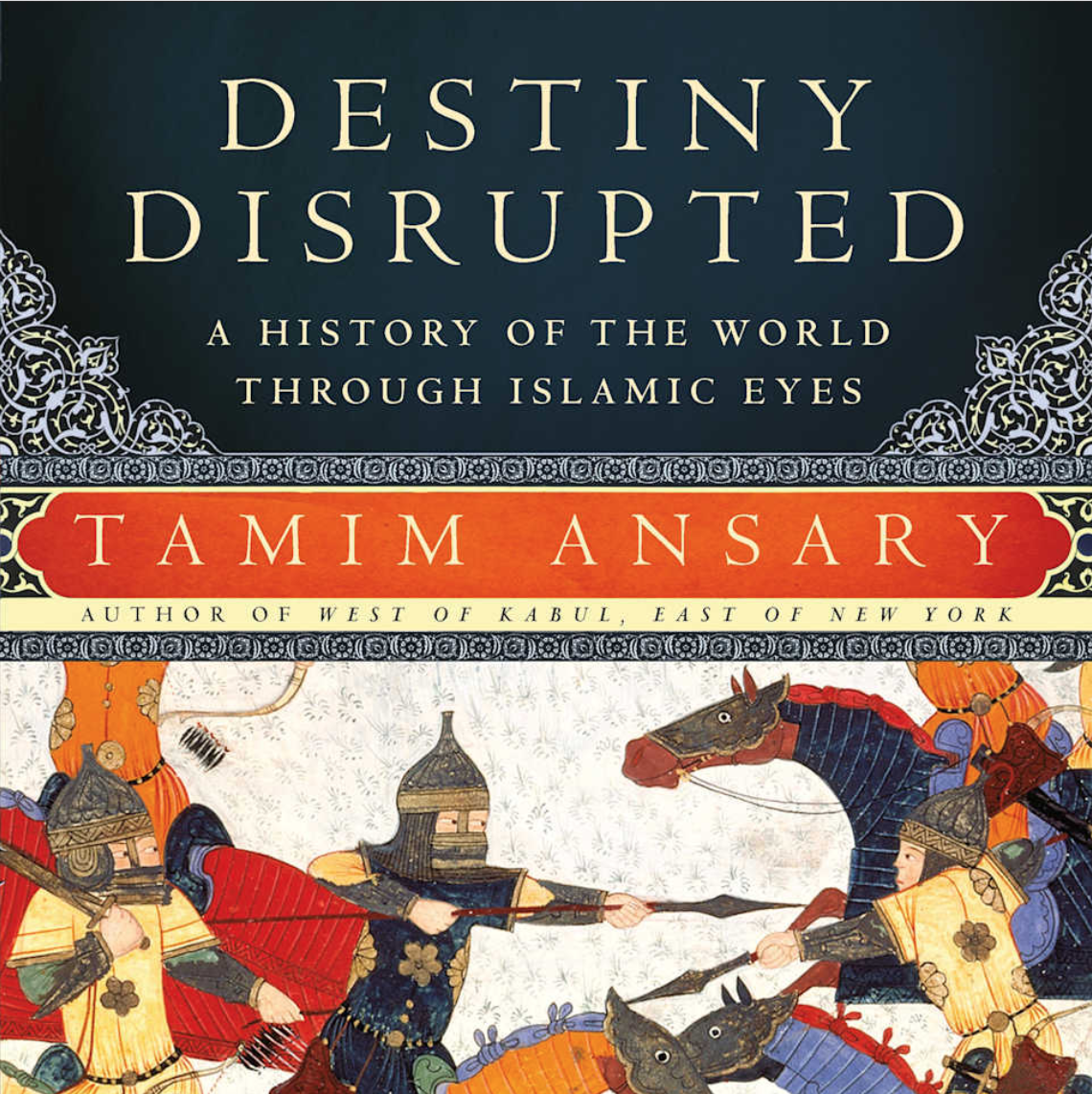
Destiny Disrupted: A History of the World Through Islamic Eyes
written by Tamim Ansary
read by Tamim Ansary
2009
This is an amazing book and I highly recommend it. I listened to the audiobook version which was read by the author, which I always appreciate. It is also unfortunately timely, what with the current war with Iran. I’ve been sitting on this review for a couple of weeks now because I’ve had trouble figuring out how to describe this book, beyond just saying that everyone should read it.
On the one hand, I want to talk about the things I learned — about the history of the Khalifate, the schism between Shia and Sunni, the Mongol holocaust, the various reform movements, and all of the fascinating stories that kept me variously enthralled and horrified, and surprised in how it all fit together. But if I start, I’ll just want to quote the entire book. Ansary has a conversational way of writing about history, both discussing broad themes and recounting specific events, peppered through with humor. With that in mind, this book is a delightful read.
On the other hand, I want to point out how these stories are the background by which whole populations see the world and make decisions based on the patterns in history that they know. Being in the US, protestant Christianity is pervasive and history is told with the US as the focal point, to the extent that it can be a struggle to image an alternative. This book provides an alternative, showing what history looks like when Islam is the pervasive religion and the geography Ansary defines as “the middle world” is the focal point. With that in mind, this is an important read.
This book is very much what it claims to be: it’s a world history book written for a western layperson, and also a demonstration of how subjective even factual history can be, based on which events are considered important or not. In the introduction, Ansary talks about how he was inspired to write this book as a result of having previously written a history textbook, specifically for a Texas school system in 2000, that had a set outline of what was important to discuss, with most of Arab history missing entirely. He was inspired to write a pointed response, since in this book, much of European history is insignificant and the US is barely considered a nation before the late 1800s.
Ansary makes a point that there are many world histories that can be truly told very differently depending on which culture is providing the perspective. World histories told through the East Asian, African, or Native American eyes would have just as little or even less overlap than world histories through Islamic and European eyes have. I kind of want to read those histories now too. But in the meantime, I’ll just have to read Ansary’s other books, because he really is an excellent writer.
While writing up this review, I also discovered that the book is available, in its entirety, on the Internet Archive! Go read it!
 Biblio-therapy