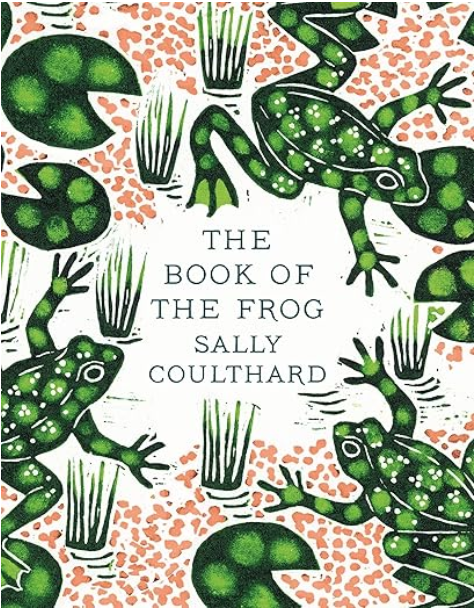
The Book of the Frog
by Sally Coulthard
2024
This is a beautiful little book and frogs are a lot more diverse than I had realized! Frogs have been around for somewhere in the order of 250 million years. Then 66 million years ago, dinosaurs went extinct after a meteor impact, and frogs survived:
“When all the dust had settled, and the world began to recover, the number of frog species ballooned rapidly. From the ruins of the Chicxulub impact, anurans emerged victorious and went on to colonize new and exciting ecological niches. With such an uncontested landscape to occupy, it’s perhaps no surprise that frogs and toads are now found in a wide and often bewildering range of different habitats. From Arctic pools to steamy treetops, underground burrows to urban back gardens, the resilient little anuran has made them all its home.”
The book is only 170 pages long, but covers a wide range of topics including evolution, reproduction, skin, sound, movement, food, and culture, with references and further resources at the end. The book gives generalized descriptions of frogs as a whole family while also highlighting some of the really interesting species that prove to be the exceptions. There’s apparently very few description of frogs as a family that doesn’t involve an exception for at least one species. My favorite might be the Brazillian Pumpkin Toadlet which jumps with no further control and careens through the air until it descends like any other not-particularly aerodynamic object, because it’s one of the handful of species of frogs that never learn how to land. Or it might be the Izecksohn’s Brazillian tree frog which, unlike most other frogs, is not carnivorous, likes to drink the nectar of the milk nut tree, and is the only known pollinating amphibian. There are so many awesome frog species!
The author alternates between describing frogs — both generally and specifically — with ideas for how the reader could help frogs — from creating ponds for breeding and protected places for hibernation to lobbying against poaching to participating in citizen science projects. While Coulthard celebrates how resilient the frog family is, she also address how a lot of species are going extinct and a lot more are under direct threat from a variety of sources including habitat loss, global warming, and four decades (so far) of their own fungal pandemic.
Over all, it’s a lovely little book, fun to read, and quite inspiring. I took pictures of the references and resources pages before returning the book to the library, but I might need to buy my own copy just to have.
 Biblio-therapy