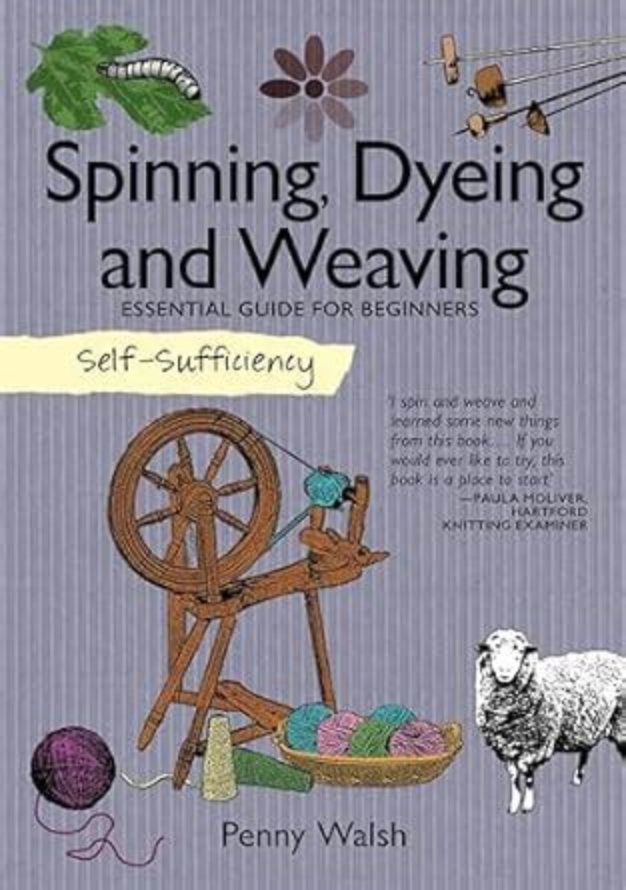
Spinning, Dyeing and Weaving: Essential Guide for Beginners, from the Self-Sufficiency series
by Penny Walsh
2009, 2016
I’ve recently been delving into the basic fibre arts. I’ve taken classes in how to spin wool on a drop spindle, how to dye yarn with natural dyes, and how to “skirt” a fleece that’s been freshly sheered off a sheep. One of these days I’m hoping to learn how to sheer a sheep myself. I already had the basics of weaving, knitting, and crocheting (albeit at the most basic level) and I’m enjoying figuring out the precursory stages. This book seemed like it would be right up my alley.
And it is, sort of. However it’s also absolutely bonkers. It veers wildly between being an extremely basic overview to being an extremely detailed instructional manual, and then back again. Harvesting vegetable fibres such as flax, hemp, or nettle is given a half page summary that mentions the necessity of starting and then interrupting the rotting process; meanwhile, there are 18 pages of recipes for dyes, including ingredients, amounts, temperatures and durations. However, I knew from early on that this book wasn’t going to be particularly reliable when it starts with discussing how easy maintaining a couple of sheep is to have your own steady source of fleeces. That seemed to be the theme of this book: mentioning some elaborate and time-consuming endeavor while narrating that it’s actually very simple.
Overall, I found it inspiring to keep working on the projects I’m working on. In some places, it reinforces some of the things I’ve learned from other sources and while in others it provides alternatives to some of the things I’d previously learned. But I didn’t learned anything new from this book, and not because there wasn’t anything new in it, but because nothing entirely new was explained well enough for me to learn it.
Oddly, the book also tries really hard to be easily readable to both British and American readers, and does so by providing translations between British and American terms as well as between metric and imperial measurements, but every time it does that, it just makes the text that little bit more confusing. For example, writing “2 square metre (21.5 sq ft.)” looks both weird and weirdly specific when talking about a garden plot for raising dye plants. It seemed representative of the variable levels of respect for the reader: we are assumed to be able to understand tapestry weaving from a two page spread including three diagrams and an illustrated loom, but also need clarification about “furniture (slip) covers”.
Overall, I’m not quite sure who the intended audience for this actually is, but it’s really not for a beginner. And while I enjoy learning all of these skills as a fun hobby, it’s not easy, it’s not quick, and it’s not a replacement for store bought: this is not a guide for self-sufficiency. However, reading this did get me off my couch and preparing a fleece for spinning that I’d been procrastinating about. So that’s a win!
 Biblio-therapy