I ran across a thread on Twitter listing out comics and manga by women, and there were a number I hadn’t heard of, so I promptly went on a hold spree on my library’s website.
The Good
Sleepless by Sarah Vaughn and Leila del Duca
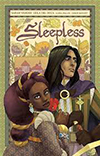
Ooh, this was a delight! The beautiful illustrations and realistic dialogue work together to draw the reader into this diverse Renaissance-type world of heraldry, politics, and magic. Lady Pyppenia or “Poppy” is the beloved though illegitimate daughter of the late king, trying to find her place in the court once her uncle takes the thrown. Her sworn knight, Cyrenic, is one of the ‘sleepless,’ guards who have magically sacrificed their need for sleep in order to offer around-the-clock protection, and the only one she can trust when assassins come for her.
The world building is expansive enough that it reminds me a bit of Game of Thrones, though much more family friendly, of course. The variety of fantasy cultures borrow elements from Europe through the Mediterranean and down into North Africa, represented with different fashions, manners, and magic, and all trying to navigate the various political alliances. At the same time, it is an intimate look at the relationship between a young woman in a precarious position of power and the man that serves her. The first volume ends on a cliffhanger, and the second picks up immediately, so get them together if you can.
Black Cloak by Kelly Thompson and Meredith McClaren

Another phenomenal story! I knew it was likely to be a good one for me from the various raves describing it as fantasy shot through with noir mystery/police procedural. There’s not much better way to my heart, and it is excellently done.
Set in a futuristic fantasy world, where elves, dragons, and humans all jostle for political power in the last standing city, Black Cloak balances the writing and illustrations beautifully in its “show, don’t tell” approach. When two bodies wash ashore from the mermaid lagoon, our protagonist, a ‘black cloak’ cop, must investigate. The world-building unfolds with the mystery as the bodies lead to secrets through all levels of the society.
The Bad
The Butcher of Paris by Stephanie Phillips and Dean Kotz
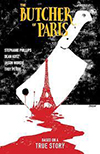
This four-part miniseries, collected into a trade paperback, unfortunately reminded me why I don’t read many big publisher comics any more. On the one hand, it captures a much overlooked historical event, one I’d never heard of before: a serial killer uses the chaos and violence of Nazi-occupied Paris as a cover, and is pursued by both the Paris police and the Nazi military. On the other hand, it necessarily has to flatten almost all the nuance to keep it short and visually striking.
The narrative alludes to the confusion over whether the serial killer is working for the Nazi regime or the French resistance, or if that sort of alliance even matters if it is just a cover for access to victims. I would have been really interested in a deeper look at that struggle, including what it means to be a serial killer in a society controlled by a genocidal regime with killing all around. However, the comic mostly abandons it for splashy movie-style action scenes and visual jump scares.
Daphne Byrne by Laura Marks and Kelley Jones

This comic just wasn’t for me, and I probably should have expected it—it’s horror, which doesn’t do much for me—but the cover was just so intriguing. Unfortunately as usual practice with comics, the cover art is often quite different from the inside art, and I found both the inside art and the narrative to be inconsistent. Daphne Byrne is a 14-year-old girl in the late 19th century who’s father has recently died and who’s mother has turned to a spiritualism scam for comfort (the art makes her look anywhere between 8 and 18 depending on the panel, with varying body shapes as well). She begins to get visual and auditory hallucinations, possibly demonic in nature, and struggles to resist the power it promises.
It’s not a bad premise; the problem is that, again, it is a short 6-issue miniseries that seems determined to check off just about every horror trope: corpses, satanism, sexual coercion, etc., etc. and it all just felt a little rote by the end. There were peeks at some interesting themes, such as the very mundane horror of a first period as a girl, but they quickly get swept aside for more fantastical elements.
The Weird
are you listening? by Tillie Walden

Whew, this one is intense! With comparatively sparse dialogue, this graphic novel is about grief, trauma, recovery, and losing and finding oneself (both literally and metaphorically). Two women, only vague acquaintances, take a road trip through rural Texas that gets deeply strange after one picks up a lost cat. The fantasy elements are truly fantastical, and the human elements are strickeningly recognizable. I also have a real soft spot for cranky women, and these two did not disappoint.
I don’t know how Walden does it, but the art perfectly captures the feeling of driving through the night, when the lights are all a little blurry and too bright, while sky seems huge and dark and roiling with movement. It’s long, so I’d expected to break it up over a few sittings, but was instead riveted until the end.
It’s Lonely at the Center of the Earth by Zoe Thorogood

This one is VERY meta — coming off her successful debut graphic novel (which I haven’t read) straight into the pandemic, Thorogood’s mental health becomes dire and she creates this ‘auto-bio-graphic-novel’ to help ground herself and find a road to recovery. She represents herself in a slew of different styles, breaks the fourth wall in a variety of ways, and explores different graphic mediums and layout approaches.
It’s really interesting and different… and a little bit annoying, honestly. It feels like a low blow to call this self-indulgent, especially when she’s been so upfront about the purpose of the book, and even lobs that criticism at herself. At the same time, there was plenty that I felt relatable (another criticism she gives herself), but also from a much earlier point in my life, so it felt a little tiresome to me now, which is just to say that this would probably be much more meaningful to people in their 20s than in their 40s.
***
As an aside: the various comics fit into these subheads surprisingly well, so I borrowed the theme from an extremely entertaining and effective Korean take on the classic ‘spaghetti western’ genre on Netflix, which I also recommend.
 Biblio-therapy
I love you checking these all out, because I then get the even more curated list, and both Sleepless and Black Cloak really were excellent!