
Miss Aldridge Regrets

By Louise Hare

I have very mixed feelings about this book. The central mystery is fiendishly clever, slowly revealed with each chapter and interspersed with short narratives from the unnamed murderer, which tease the identity and motive. Having witnessed the murder by poison of her boss in a London nightclub, Miss Lena Aldridge jumps on the offer of a role in a Broadway musical, accompanied by a first class ticket on an ocean liner to New York. She is reluctantly pushed into companionship with a wealthy family shortly before the patriarch dies by poison, and (minor spoiler) she seems perfectly positioned to take the fall for it.

For much of the book, I was on the edge of my seat, since it seemed impossible that Lena would be able to extricate herself from such a clever trap, especially since, as the murderer describes her on the first page, “She may have possessed both common sense and ambition, but from what I’d learned about her, she rarely used the two together.”

As the book went on, I wasn’t that confident that Lena possessed much common sense, actually. She is sympathetic but not particularly likeable. She sort of drifts through life, drinking far too much, thinking of herself when she should be thinking of others, and thinking of others when she should be most concerned with herself. She is caught completely off guard by the end reveal, and unfortunately so was I, since it was a solution that I’d already dismissed as being both too obvious and nonsensical.

Basically, the end fell so flat that it soured the rest of the book for me. Because I’d been previously so engrossed in the events, the finale was even more of a disappointment. There were also themes of racism, colorism, sexism, and classism woven throughout, but they became so heavy handed in the ending that they reminded me of, not even freshman 101 classes, but the dorm discussions in afterhours that we thought were so deep. Perhaps I’m just getting jaded as I get older.

The Secret Life of Albert Entwistle

By Matt Cain

The quoted praise for this book all included words like heartfelt, heartwarming, and heartbreaking, and they aren’t wrong—I laughed, cried, and aww’ed—but it all felt a little heavy handed. Not emotionally manipulative exactly, but not as effortlessly immersive as I’d hoped.

The novel follows Albert Entwistle, a postman nearing mandatory retirement, who is finding himself faced with how narrow his life has become. Intertwined with flashbacks to his youth, Albert’s early experiences with homophobia was so painful and traumatic for him that it turns into pretty severe social anxiety in general. The novel emphasizes how if you can’t be yourself in one way, it tends to bleed into closing off any sort of real relationships with people. That said, Albert’s early experiences are in no way uncommon or extraordinarily brutal, so no content warning needed for those. I get the impression that Matt Cain was more concerned with filling the lack in literature of stories with happy ending for older gay people, so understandably uninterested in delving deep into trauma, which I appreciated.

At times the book feels a little simplistic, in a sort of Forest Gump kind of way. Albert’s search for his secret high school boyfriend from 50 years ago follows a linear step-by-step trail that stretched my suspension of disbelief. On an individual level, though, Albert follows the same path that greater society has taken over the last five decades, his own self-acceptance mirroring the wider cultural progress. Cain is very purposefully walking the reader through an easily accessible guide to LGBTQ+ history.

In fact, he ends the book with some short interviews with gay men in their 60s from small Northern British towns like Albert’s, explicitly because he worried that the history was getting lost. So much has changed in such a relatively quick time, due to the very hard work of activists, that younger generations might not realize how much had to be fought for over the last few decades. Seeing Albert as a stand-in to personify a movement helped make sense of parts of his personality that seemed a little too flat or smoothed over.

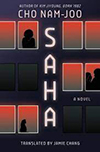
Saha

By Cho Nam-Joo

I’m not even sure what genre to give Saha: novel seems too bland, and while it is certainly dystopian, it is neither futuristic scifi or magical fantasy. It is nominally a mystery as the protagonist searches for her missing brother after his girlfriend is found dead, but there’s little hope of a pat solution for either Jin-kyung or the reader. It is also a searing indictment of capitalism and the corporatization of society.

The novel mostly takes place in Saha, a block of decaying apartments that are the only home permitted to those not granted citizenship in the corporate-owned Town. Though Jin-kyung and her brother kick off the novel, it jumps around between different characters and time-periods at breakneck speed. Many of the scenes reflect bits and pieces of real news stories in haunting detail: a ship full of refugees/deportees ‘disappearing’ into the sea and being forgotten as the news cycle changed; ‘free’ medical treatment but with insurance premiums so high they bankrupt people; the non-citizens only permitted to scrabble for the most difficult and dangerous jobs:

“A life of doing repetitive menial labor without any assurance of compensation was like walking down a path backward. Life was terrifying and tedious. Every time they paused to take stock of their lives, they found themselves unfailingly worse off than before; Saha residents thus grew more childish, petty, and simpleminded.”

I think I’ve mentioned before that I’m not particularly affected by horror novels, but Saha’s scenes were so gripping that I struggled to put the book down and then carried the tension of the book with me through several restless nights. It is not a comfortable book, but it is an excellent one.

About two-thirds through the book, I had an inkling of the thesis: the majority of the society of trapped into these strict castes, and the people are either uninterested or unable to combat the systemic structure. A few people try, though: one of which, without spoilers, is a do-gooder upper caste Citizen who tries to help the lowest caste of illegal Saha, but through her own inexperience and ignorance of their life, oversteps and makes things worse for herself and those around her. At the same time, scenes from the book that seemed to jump around time and place all start to circle around how the Saha slowly built up their society for themselves, based on mutual aid between what each needed and could offer.

It’s such a difficult theme to discuss and dissect, that outsiders often can’t help at all, no matter how well-intentioned, while those inside the oppressed group are prevented as much as possible from helping themselves—that this is how systemic oppression works, and it is very, very hard to deconstruct. It is perhaps more accessible to read about in an allegorical novel set in a fictional setting than to try to delve into the many real-world examples. On a more hopeful note, it does also portray that those who fight the oppression from within, even if they don’t manage to accomplish all that they’d hoped, can push progress forward in ways they wouldn’t have imagined.